
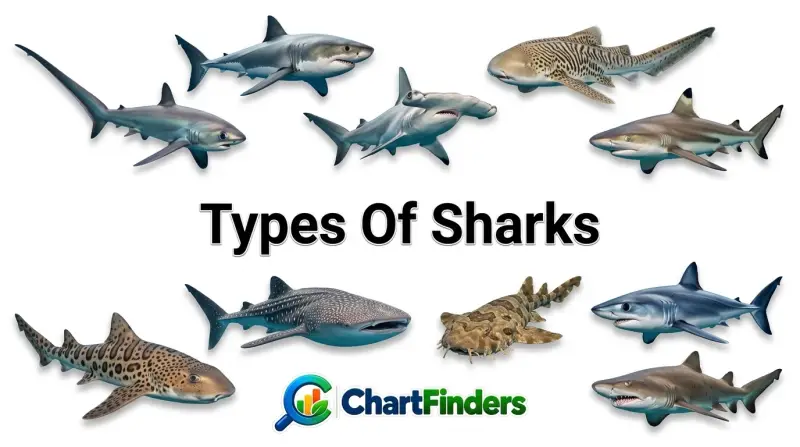
Sharks have inhabited Earth’s oceans for over 400 million years, surviving multiple mass extinction events and evolving into one of the most successful predatory lineages in marine history. Far from being uniform apex predators, sharks represent an astonishingly diverse evolutionary spectrum. They occupy nearly every marine niche, from shallow coral reefs and deep-sea trenches to open-ocean pelagic zones and even some river systems. Understanding the different types of sharks requires looking beyond popular media portrayals to examine their biological classifications, ecological adaptations, and the dynamic environmental factors shaping their distributions today.
The Diversity and Classification of Types Of Sharks
- Sharks are classified into eight orders within the class Chondrichthyes, characterized by their cartilaginous skeletons rather than bone and covered in placoid scales.
- The largest group is Carcharhiniformes (ground sharks), which includes iconic coastal and pelagic species like tiger sharks, bull sharks, and reef sharks.
- Lamniformes (mackerel sharks) include high-end thermoregulators like the white shark and shortfin mako, capable of maintaining body temperatures significantly above ambient water.
- Oceanic warming trends are shifting the traditional ranges of various shark species, pushing populations poleward and into deeper, cooler thermal bands.
- Conservation status varies widely; while species like the white shark (Carcharodon carcharias) receive strict international protection and are prohibited harvest items in commercial and recreational fisheries, others face intense pressure from overfishing, bycatch, and habitat loss.
To systematically study the various types of sharks, marine biologists rely on taxonomic hierarchy. Sharks belong to the class Chondrichthyes (cartilaginous fishes), distinguished from bony fishes (Osteichthyes) by skeletons made of flexible cartilage rather than calcified bone, and skin covered in placoid scales (dermal denticles) that feel like sandpaper. This anatomical foundation allows for incredible hydrodynamic efficiency, rapid growth, and specialized predatory adaptations across different families.
The Eight Orders of Sharks
All living shark species fall into eight distinct orders. Each order represents a major evolutionary divergence in body plan, feeding mechanism, reproductive strategy, and habitat preference.
- Carcharhiniformes (Ground Sharks): The largest order, containing over 270 species. They are characterized by a nictitating membrane (protective third eyelid), two dorsal fins without spines, an anal fin, and five gill slits. Examples include tiger sharks, bull sharks, reef sharks, and hammerheads.
- Lamniformes (Mackerel Sharks): Includes some of the fastest and largest predatory sharks. They lack a nictitating membrane and typically feature large gill slits and conical snouts. Famous members include the white shark, shortfin mako, thresher sharks, and the goblin shark.
- Orectolobiformes (Carpet Sharks): Bottom-dwelling sharks featuring barbels near their nostrils and often complex, camouflage-patterned skin resembling woven carpets. This order includes whale sharks, nurse sharks, wobbegongs, and zebra sharks.
- Squaliformes (Dogfish Sharks): Small to medium-sized cold-water and deep-sea sharks with two spine-bearing dorsal fins and no anal fin. Examples include the spiny dogfish, Greenland shark, and kitefin shark.
- Hexanchiformes (Cow and Frilled Sharks): Considered the most primitive living sharks, retaining anatomical features found in ancient fossil records, such as six or seven pairs of gill slits and a single dorsal fin. Examples include the sevengill shark and frilled shark.
- Squatiniformes (Angel Sharks): Highly flattened, ray-like bottom-dwellers with enlarged pectoral fins, adapted for ambushing prey from the seafloor sediment.
- Pristiophoriformes (Sawsharks): Distinguished by a long, flat snout lined with sharp lateral teeth and sensory barbels, used to stir up and slash at benthic prey. (Note: These are distinct from sawfishes, which are ray species belonging to the order Pristiformes).
- Heterodontiformes (Bullhead Sharks): Small, ancient-looking bottom sharks with high-foreheaded profiles, heavy spine-supported dorsal fins, and distinct molar-like rear teeth for crushing hard-shelled prey like crabs and sea urchins.
| Order Name | Common Representatives | Key Identifying Features | Primary Habitat | Reproductive Strategy |
|---|---|---|---|---|
| Carcharhiniformes | Tiger, Bull, Hammerhead, Blue Shark | Nictitating membrane present; anal fin present; no dorsal spines. | Coastal, pelagic, and reef systems | Viviparous, oviparous, or placental viviparous |
| Lamniformes | White Shark, Mako, Thresher, Basking | No nictitating membrane; large gill slits; specialized endothermy in many. | Open ocean (pelagic) and coastal waters | Ovoviviparous (often with intrauterine cannibalism/oophagy) |
| Orectolobiformes | Whale Shark, Nurse Shark, Wobbegong | Nasal barbels; mouth positioned ahead of the eyes in many species. | Tropical and temperate benthic zones | Oviparous or ovoviviparous |
| Squaliformes | Greenland Shark, Spiny Dogfish | Two dorsal fins with spines; no anal fin; five gill slits. | Deep sea and cold temperate waters | Ovoviviparous |
| Hexanchiformes | Sevengill Shark, Frilled Shark | Six or seven gill slits; single dorsal fin; primitive skeletal traits. | Deep water and continental shelves | Ovoviviparous (aplacental viviparity) |
| Squatiniformes | Pacific Angel Shark, Atlantic Angel Shark | Flattened ray-like bodies; mouth at the front of the head. | Sandy or muddy ocean floors | Ovoviviparous |
| Pristiophoriformes | Common Sawshark, Japanese Sawshark | Saw-like rostrum with lateral teeth and long barbels. | Continental shelves and upper slopes | Ovoviviparous |
| Heterodontiformes | Port Jackson Shark, Horn Shark | Pig-like snouts; crushing rear teeth; defensive spine on dorsal fins. | Rocky reefs and kelp forests | Oviparous (lays auger-shaped egg cases) |
Examining this taxonomic breakdown helps researchers and conservationists categorize ecological roles. For instance, pelagic hunters like mackerel sharks regulate open-water food webs, while benthic carpet sharks and dogfish maintain balance in coastal and deep-sea ecosystems.
Major Ecological Categories and Behavioral Adaptations
Beyond strict taxonomy, types of sharks are often grouped by their ecological niche and physiological adaptations. These categories highlight how different species exploit their environments for survival, hunting, and reproduction.
Pelagic vs. Benthic Sharks
The ocean environment imposes stark structural demands on its inhabitants. Pelagic sharks—such as the blue shark, oceanic whitetip, and shortfin mako—roam the open ocean. They possess sleek, streamlined bodies, high metabolic rates, and often continuous swimming habits required to maintain ram ventilation (forcing water across their gills). Because negative buoyancy would cause them to sink, many pelagic species rely on large, oil-rich livers containing squalene to provide partial hydrostatic lift.
Conversely, benthic sharks—like angel sharks, nurse sharks, and epaulette sharks—spend the majority of their lives resting on or near the ocean floor. Many benthic species utilize buccal pumping, actively drawing water into their pharynx and across their gills using muscular contractions, allowing them to remain stationary for extended periods without suffocating.
Filter Feeders: The Gentle Giants
While most sharks are carnivores hunting live prey, the largest fish in the sea are filter feeders. The whale shark (Rhincodon typus), basking shark (Cetorhinus maximus), and megamouth shark (Megachasma pelagios) subsist primarily on microscopic plankton, small crustaceans, and schooling fish.
- Whale Sharks: Utilize cross-flow filtration pads inside their gill slits to trap particles as small as a few millimeters while expelling water effortlessly.
- Basking Sharks: Swim slowly with massive mouths agape, straining water through specialized, comb-like gill rakers.
- Megamouth Sharks: Use luminous photophore-like tissue around their mouths to attract plankton in dark, deep-water environments.
Endothermy: Warm-Blooded Hunters
Most sharks are ectothermic (cold-blooded), matching the temperature of the surrounding water. However, members of the family Lamnidae—including the white shark, shortfin mako, and porbeagle—exhibit regional endothermy. Through a specialized vascular network called the rete mirabile (wonderful net), these sharks conserve metabolic heat generated by muscle contraction. This counter-current heat exchanger elevates the temperature of their swimming muscles, brain, stomach, and eyes, granting them superior burst speed, sharper vision, and efficient digestion in cold temperate waters.
Geographic Shifts and Contemporary Environmental Pressures
Oceanographic conditions have undergone significant shifts in recent years, directly influencing the distribution and behavior of various types of sharks. Rising ocean temperatures and shifting marine heatwaves are altering traditional migration corridors.
Historically, tropical and subtropical species like the bull shark and tiger shark stayed close to equatorial waters. However, warming sea surface temperatures have enabled certain populations to expand their ranges poleward into temperate zones. Similarly, pelagic predators are diving deeper into the water column or migrating further north to find optimal thermal bands.
Despite these shifting ranges, population dynamics remain heavily monitored. International frameworks, such as the strict protections enforced for white sharks (Carcharodon carcharias), which are classified as prohibited harvest species in many commercial and recreational jurisdictions requiring immediate release upon incidental capture, have allowed certain regional populations to stabilize. Yet, deep-sea species and coastal sharks face ongoing pressures from overfishing, bycatch, and habitat degradation in nursery grounds.
Identification and Differentiation of Common Shark Families
Distinguishing between different types of sharks in the field requires observing specific morphological markers. Misidentifying species can hinder conservation tracking and ecological assessments.
Recognizing Hammerheads (Family Sphyrnidae)
Hammerhead sharks are instantly recognizable due to their lateral head expansions, known as the cephalofoil. This structure provides distinct evolutionary advantages:
- Enhanced Sensory Perception: Spacing the ampullae of Lorenzini (electroreceptors) and nostrils wider apart improves the shark’s ability to detect weak electrical fields and chemical cues from prey hidden in sand.
- Binocular Vision: The positioning of the eyes on the outer edges of the cephalofoil grants a near 360-degree vertical field of vision.
- Hydrodynamic Lift: The broad, flat shape acts like a hydrofoil, increasing maneuverability, pitch control, and rapid turning speed.
Differentiating Requiem Sharks (Family Carcharhinidae)
Requiem sharks are the quintessential grey sharks of tropical and warm-temperate waters. The family includes the tiger shark, bull shark, blacktip shark, and oceanic whitetip. They are notoriously difficult to tell apart visually, often requiring analysis of vertebral counts, tooth morphology, and subtle fin markings. Key features include round eyes with nictitating membranes, slender bodies, and well-developed dorsal and caudal fins designed for endurance cruising.
Frequently Asked Questions
How many species of sharks exist today?
Currently, there are over 500 recognized species of sharks, and marine scientists continue to discover new species—particularly in deep-sea environments and remote reef systems. Every year, taxonomic revisions refine this number as genetic testing reveals hidden diversity.
What is the difference between a shark and a ray?
Both sharks and rays belong to the class Chondrichthyes and share a cartilaginous skeleton. However, sharks typically have lateral gill slits located on the sides of their bodies and free pectoral fins not fused to the head. Rays and skates feature ventral gill slits (on the underside of the body) and broad pectoral fins fused directly to the side of the head.
Are all sharks dangerous to humans?
No. The vast majority of shark species are harmless to humans. Out of more than 500 species, only a small fraction—such as the white, tiger, and bull shark—have been implicated in unprovoked bite incidents. Many species, including whale sharks, nurse sharks, and dogfish, pose no threat whatsoever.
How do sharks breathe underwater?
Sharks extract dissolved oxygen from water using gills. As water enters the mouth and passes over the internal gill slits, oxygen diffuses into the bloodstream. While some sharks must swim continuously to force water over their gills (ram ventilation), others can pump water actively using their cheek and pharyngeal muscles (buccal pumping) while resting on the seabed.
Why are sharks vital to marine ecosystems?
Sharks often act as apex or mesopredators, keeping marine food webs balanced. By culling sick, weak, or injured prey, they prevent overgrazing of critical habitats like coral reefs and seagrass meadows by herbivores, ultimately promoting biodiversity and ocean health.
Conclusion
The vast spectrum of types of sharks—from deep-dwelling dogfish and bottom-resting carpet sharks to high-speed mackerel sharks and gentle filter-feeding giants—demonstrates the remarkable adaptability of cartilaginous fishes. As environmental conditions continue to evolve, understanding their taxonomy, ecological roles, and behavioral adaptations remains vital for marine conservation and ecosystem management. Recognizing the distinct characteristics of each shark order ensures that these ancient predators are properly studied, protected, and appreciated within our global marine network.