
Marine turtles have roamed the world’s oceans for over 100 million years, surviving major evolutionary bottlenecks that claimed the dinosaurs. As ectothermic, air-breathing reptiles perfectly adapted to the marine environment, these creatures play vital roles in maintaining the health of coastal and oceanic ecosystems. From the seagrass grazing of green turtles to the deep-diving jellyfish predation of leatherbacks, each species occupies a specialized ecological niche.
However, understanding the differences among these marine reptiles requires looking past their broad reptilian traits. Conservationists, marine biologists, and coastal managers must accurately identify species, understand their life histories, and recognize their specific habitat requirements to implement effective protection measures. Human pressures, ranging from incidental fisheries capture to coastal development and climate change, impact each species differently, making precise taxonomic and ecological knowledge essential for modern marine conservation.
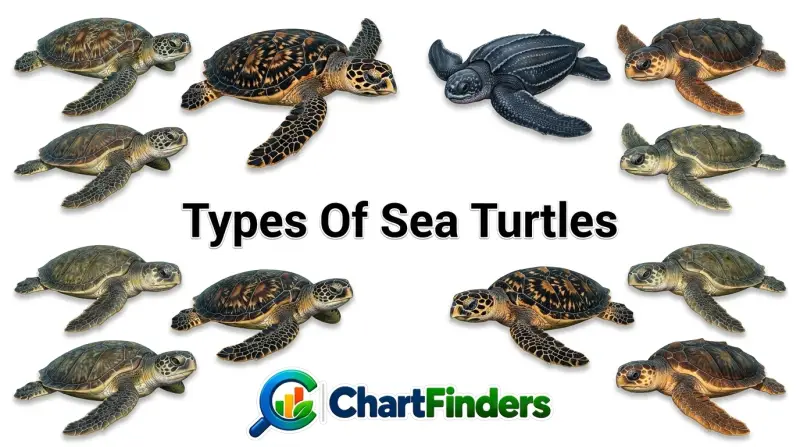
Types Of Sea Turtles
- There are seven distinct living species of sea turtles categorized into two primary families: Cheloniidae (hard-shelled turtles) and Dermochelyidae (the leathery-shelled leatherback).
- Dietary habits dictate physical morphology; species range from specialized sponge-eaters (hawksbills) and jellyfish-specialists (leatherbacks) to seagrass-grazing herbivores (greens).
- The Leatherback is the largest living sea turtle, capable of diving over 4,000 feet deep and tolerating near-freezing subpolar waters due to unique physiological adaptations.
- The Kemp’s Ridley is the rarest and smallest sea turtle, with a historic synchronized nesting behavior known as an arribada primarily concentrated in the Gulf of Mexico.
- Regional strongholds like Florida host five of the world’s seven species, serving as critical nesting and foraging grounds for loggerheads, greens, leatherbacks, hawksbills, and Kemp’s ridleys.
- Taxonomic identification relies heavily on scute patterns on the carapace, head scale arrangements, jaw shapes, and flipper claw counts.
To fully grasp the diversity of marine turtles, one must examine their biological classification, morphological variations, and specialized life histories. The following sections break down each species in detail, examining how their unique adaptations dictate their survival strategies across the globe’s temperate and tropical oceans.
| Common Name | Scientific Name | Family | Average Adult Weight | Primary Diet | Key Identifying Feature |
|---|---|---|---|---|---|
| Green Sea Turtle | Chelonia mydas | Cheloniidae | 300–350 lbs (136–159 kg) | Seagrasses, algae (herbivorous as adults) | Single pair of prefrontal scales between eyes; serrated lower jaw |
| Loggerhead | Caretta caretta | Cheloniidae | 250 lbs (113 kg) | Crustaceans, mollusks (conch, crabs) | Reddish-brown, heart-shaped shell; massive blocky head |
| Leatherback | Dermochelys coriacea | Dermochelyidae | 500–2,000 lbs (226–907 kg) | Jellyfish, tunicates | Leathery, rubbery skin with 7 distinct dorsal ridges; no hard shell |
| Hawksbill | Eretmochelys imbricata | Cheloniidae | 100–150 lbs (45–68 kg) | Sponges, anemones, squid | Narrow, hawk-like beak; overlapping carapace scutes with serrated edge |
| Olive Ridley | Lepidochelys olivacea | Cheloniidae | 75–100 lbs (34–45 kg) | Crabs, shrimp, sea urchins, fish | Olive-green, rounded shell; high number of lateral scutes (5+ pairs) |
| Kemp’s Ridley | Lepidochelys kempii | Cheloniidae | 75–100 lbs (34–45 kg) | Crabs (especially blue crabs) | Near-circular, grayish-green shell; two pairs of prefrontal scales |
| Flatback | Natator depressus | Cheloniidae | 150–200 lbs (68–91 kg) | Sea cucumbers, soft corals, mollusks | Depressed, flat olive-gray shell with upturned margins; endemic to Australia |
The table above outlines the foundational biological metrics that separate these species. While sharing a general reptilian blueprint—four flipper-like limbs, lungs for breathing air, and horny beak structures—their divergence across distinct evolutionary paths highlights the specialization required to exploit different marine resources.
Taxonomic Families: Cheloniidae vs. Dermochelyidae
All living sea turtles belong to the order Testudines and are split into two distinct families. Understanding this split is critical for accurate identification and evolutionary study.
Family Cheloniidae (Hard-Shelled Sea Turtles)
Six of the seven species belong to Cheloniidae. These turtles possess a bony carapace covered in keratinous plates called scutes. Their heads and limbs cannot be retracted fully into their shells, much like tortoises or freshwater turtles. Their front flippers generally feature one or two visible claws, and their dietary spectrum spans from herbivory to specialized durophagy (crushing hard-shelled prey).
Family Dermochelyidae (Leathery Sea Turtles)
Containing only a single living species—the leatherback—this family diverged from other sea turtles over 100 million years ago. Instead of a hard, scute-covered carapace, leatherbacks possess a flexible, mosaic-like matrix of thousands of tiny dermal bones embedded in a thick, rubbery skin layer. They have no visible claws on their flippers and possess long, paddle-like limbs designed for pelagic ocean crossing.
The Five Sea Turtle Species Found in U.S. and Florida Waters
While global diversity spans the tropics and subtropics, regions such as the southeastern United States—particularly Florida—serve as critical biological hot spots where five distinct species regularly forage, migrate, or nest.
1. Loggerhead Sea Turtle (Caretta caretta circumflexa / Caretta caretta)
Named for its disproportionately large, blocky head, the loggerhead is built for crushing heavy-shelled prey. Adults typically weigh around 250 pounds and measure about three feet in length. Their powerful jaws allow them to consume conchs, whelks, horseshoe crabs, and bivalves.
- Carapace Characteristics: Reddish-brown to yellowish-brown, slightly heart-shaped, with five pairs of lateral costal scutes.
- Distribution: Temperate and subtropical waters worldwide. They represent the most common nesting sea turtle species in the southeastern United States.
- Conservation Status: Globally listed as vulnerable, with distinct population segments ranging from threatened to endangered under the U.S. Endangered Species Act.
2. Green Sea Turtle (Chelonia mydas)
Despite its common name, the green sea turtle gets its designation from the greenish color of its body fat and cartilage, not its shell, which often displays rich shades of brown, olive, and mottled yellow. Juveniles are carnivorous, feeding on worms, small crustaceans, and jellyfish, but adults transition to a strict herbivorous diet consisting primarily of seagrasses and marine algae. This grazing habit makes them crucial gardeners of nearshore marine ecosystems.
- Carapace Characteristics: Smooth, oval-shaped carapace with four pairs of lateral scutes that do not overlap. A single pair of prefrontal scales exists between the eyes.
- Distribution: Tropical and subtropical coastal waters globally. Significant nesting occurs along Florida’s Atlantic coast and the Caribbean.
- Conservation Status: Listed globally under varying statuses; populations in U.S. waters are split between threatened and endangered.
3. Leatherback Sea Turtle (Dermochelys coriacea)
The leatherback is the undisputed giant of the reptile world, excluding crocodilians. Reaching lengths over six feet and weights up to 2,000 pounds, these pelagic nomads are built differently than every other sea turtle. Instead of a hard shell, seven prominent longitudinal ridges run down their rubbery, dark carapaces.
Their physiological adaptations are engineering marvels: a countercurrent heat exchange system in their flippers, high oil content, and the ability to adjust their metabolic rate allow them to dive deeper than 4,000 feet into the abyssal ocean and forage in near-freezing subpolar waters. Their diet consists almost exclusively of gelatinous zooplankton, such as jellyfish and siphonophores. To hold slippery prey, their esophagus is lined with backward-pointing spines called papillae.
4. Hawksbill Sea Turtle (Eretmochelys imbricata)
Easily recognized by its narrow, tapered head and sharp, bird-like beak, the hawksbill is uniquely specialized for extracting food from crevices in coral reefs. Their primary food source is marine sponges, which contain toxic glass spicules that most other animals cannot digest. By consuming these sponges, hawksbills help maintain the structural health and biodiversity of coral reef ecosystems.
- Carapace Characteristics: Thick, overlapping scutes (imbricated) that create a serrated rear margin. The shell displays a rich, tortoiseshell pattern of amber, brown, and yellow hues.
- Distribution: Tropical coral reefs of the Atlantic, Indian, and Pacific Oceans. In U.S. waters, they are frequently observed in the Florida Keys and Caribbean territories.
- Conservation Status: Critically endangered globally due to historic overexploitation for the tortoiseshell trade and ongoing habitat degradation.
5. Kemp’s Ridley Sea Turtle (Lepidochelys kempii)
The Kemp’s ridley is the world’s rarest and smallest sea turtle. Adults reach lengths of only two feet and weigh between 75 and 100 pounds. Sporting a nearly circular, grayish-green carapace, this species is heavily concentrated in the Gulf of Mexico and the northwestern Atlantic.
Kemp’s ridleys are specialized crab-eaters, using their powerful jaws to crush blue crabs and other benthic crustaceans. They are famous for their unique daytime synchronized nesting behavior known as an arribada (Spanish for “arrival”), where thousands of females come ashore simultaneously on specific beaches in Tamaulipas, Mexico, to lay eggs. Conservation efforts have pulled this species back from the brink of extinction following catastrophic population crashes in the mid-20th century.
Global Species: Olive Ridley and Flatback Sea Turtles
While the previous five species inhabit U.S. waters, two additional species complete the global roster of marine turtles.
6. Olive Ridley Sea Turtle (Lepidochelys olivacea)
The olive ridley is structurally similar to the Kemp’s ridley but is the most abundant sea turtle in the world. Named for its olive-green, heart-shaped shell, this species is pelagic and carnivorous, feeding on crabs, shrimp, rock lobsters, tunicates, and fish.
Like their Kemp’s cousins, olive ridleys are renowned for massive arribadas on tropical shores in Central America (particularly Costa Rica), India, and Odisha. These synchronized mass nesting events serve as a predator-saturation strategy, overwhelming local predators with millions of hatchlings emerging over a few compressed days.
7. Flatback Sea Turtle (Natator depressus)
Endemic exclusively to the continental shelf waters of Australia, the flatback sea turtle is named for its distinctive depressed, flattened carapace with upturned margins. Growing up to 200 pounds, flatbacks feed on soft-bodied benthic invertebrates, including sea cucumbers, soft corals, squid, and mollusks.
Unlike most other sea turtles, flatback females lay a relatively small clutch of very large eggs, which hatch into exceptionally large, robust hatchlings. Their restricted geographic range and specific dependence on Australian northern coastal habitats make them unique among marine turtles.
Life History Stages and Development
Sea turtles undergo complex life cycles characterized by radical shifts in habitat, diet, and vulnerability across different developmental stages.
1. Embryonic Development and Hatching
Nesting occurs on sandy tropical and temperate beaches. Females crawl ashore at night, excavate a flask-shaped egg chamber with their rear flippers, and deposit a clutch of 50 to 150 soft-shelled, ping-pong-ball-like eggs. The incubation period lasts approximately 50 to 70 days, driven primarily by ambient nest temperature. Temperature-dependent sex determination (TSD) governs hatchling gender: warmer sand temperatures produce predominantly female hatchlings, while cooler sand produces males.
2. The “Lost Years” and Pelagic Phase
Once hatchlings emerge, they face a frantic dash across the beach to the surf, navigating by light horizons. Upon reaching the water, they enter a frenzied swimming state that propels them miles offshore into pelagic convergence zones, sargassum mats, or ocean current gyres. This phase, often called the “lost years,” spans several years where juvenile turtles drift in the open ocean, feeding on plankton and hiding in floating seaweed until they reach a critical size threshold.
3. Coastal Foraging and Subadult Stage
As juveniles grow larger and less vulnerable to pelagic predators (such as pelagic fish and seabirds), they recruit back to shallow coastal foraging grounds, coral reefs, bays, and estuaries. Here, their diets shift toward their adult specializations (seagrasses, sponges, or hard-shelled crabs), and they spend decades growing toward sexual maturity.
4. Adult Migrations and Reproduction
Adult sea turtles are phenomenal navigators, utilizing Earth’s geomagnetic field and chemical cues to migrate hundreds or thousands of miles between foraging grounds and natal nesting beaches. Breeding occurs in offshore waters near nesting beaches. Females store sperm and can lay multiple clutches of eggs across a single nesting season before migrating back to distant foraging grounds, entering a multi-year resting phase to rebuild fat reserves.
Morphological Adaptations for Marine Survival
Surviving in a marine environment requires extreme evolutionary specialization. Sea turtles possess multiple physiological systems designed to handle the challenges of open-ocean life.
Salt Glands
Because sea turtles ingest significant amounts of saltwater while feeding and swimming, they must eliminate excess sodium chloride without access to fresh water. Specialized lachrymal (tear) glands located near their eyes secrete concentrated salt solutions. This process often makes nesting females appear as though they are weeping on the beach, though it is purely a physiological regulatory mechanism.
Respiratory Adaptations
As air-breathing reptiles, sea turtles must surface to breathe atmospheric oxygen. However, their lungs are exceptionally efficient, and they can collapse and reinflate their respiratory tracts to withstand high pressures during deep dives. Their muscles contain high concentrations of myoglobin, allowing them to store large amounts of oxygen internally and dramatically slow their heart rates during prolonged dives or periods of brumation (winter torpor).
Limbs and Locomotion
Unlike freshwater turtles and tortoises with distinct clawed digits capable of walking on land, sea turtles have limbs modified into hydrodynamic flippers. Front flippers serve as primary oars, generating powerful forward thrust through an underwater flight motion, while hind flippers act as rudders for steering and stabilization.
Common Identification Mistakes and Exceptions
Distinguishing among sea turtle species can be challenging, particularly when dealing with juveniles, subadults, or damaged specimens. Field biologists rely on standardized diagnostic keys to avoid common misidentifications.
- Green Turtle vs. Loggerhead Juveniles: Small green turtles and loggerheads can look similar at a glance. Biologists check the prefrontal scale count on the top of the head between the eyes (greens have one pair; loggerheads have two pairs) and examine costal scute counts on the shell.
- Kemp’s Ridley vs. Olive Ridley: These two species are nearly identical in body shape and color during early stages. The primary diagnostic separator involves costal scute counts and pore arrangements on the marginal bridge scutes, though geographic location provides a strong initial indicator (Kemp’s in the Atlantic/Gulf; olive ridleys primarily in the Pacific/Indian oceans, though occasional range overlaps occur).
- Assuming All Turtles Have Hard Shells: Novices frequently mistake leatherbacks for large logs or mammalian marine life due to their lack of a traditional bony, scute-covered shell. Recognizing the distinct longitudinal ridges and leathery skin prevents this classification error.
Frequently Asked Questions
How many species of sea turtles exist in the world?
There are seven recognized living species of sea turtles globally. They are grouped into two families: Cheloniidae (hard-shelled turtles, including Green, Loggerhead, Hawksbill, Olive Ridley, Kemp’s Ridley, and Flatback) and Dermochelyidae (the Leatherback).
What is the largest species of sea turtle?
The Leatherback sea turtle (Dermochelys coriacea) is by far the largest species. Adults can reach lengths exceeding six feet and weigh anywhere from 500 to over 2,000 pounds. They are easily distinguished from all other sea turtles by their rubbery, leathery skin and prominent dorsal ridges rather than a hard shell.
Which sea turtle is the rarest?
The Kemp’s Ridley (Lepidochelys kempii) is the rarest and most endangered sea turtle species in the world. Its population plummeted to near-extinction in the mid-20th century, though intensive international conservation efforts and nesting beach protections in Mexico and the U.S. have driven a gradual recovery.
How do you tell the difference between a green sea turtle and a loggerhead?
The easiest way to differentiate them is by examining head shape and scale patterns. Loggerheads have massive, blocky heads designed for crushing heavy-shelled prey and possess two pairs of prefrontal scales between their eyes. Green turtles have smaller, rounded heads with a single pair of prefrontal scales and a serrated lower jaw adapted for grazing seagrasses.
Do sea turtles live in fresh water?
No. Sea turtles are obligate marine reptiles adapted exclusively to saline and brackish environments. While some species occasionally enter low-salinity estuaries, mangrove creeks, or river mouths to forage or seek shelter, they cannot survive long-term in freshwater habitats because their physiological systems require marine conditions and saltwater salt-gland excretion.
How long can sea turtles stay underwater?
While resting or sleeping, sea turtles can remain submerged for several hours (often 4 to 7 hours depending on water temperature and metabolic rate). However, when swimming actively or foraging, their oxygen consumption increases, requiring them to surface every few minutes to breathe atmospheric air.
Conclusion
The seven species of sea turtles represent an evolutionary triumph of marine adaptation, each occupying a specialized ecological role that shapes coastal and oceanic habitats worldwide. From the reef-grazing green turtle and sponge-eating hawksbill to the deep-diving leatherback and the crab-crushing ridleys, these reptiles are biological indicators of ocean health. Recognizing the distinct morphological characteristics, life histories, and habitat requirements of each species is the first critical step toward effective conservation, ensuring that these ancient marine navigators continue to thrive across global oceans.