
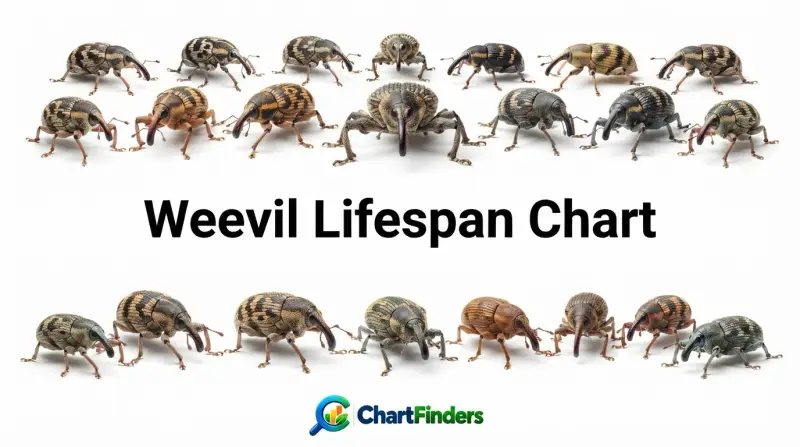
Quick Answer: Most adult weevils live for two to three months, though their total life cycle—from egg to larva, pupa, and adult—averages about three months under optimal conditions. However, lifespan varies drastically by species, environmental conditions, and ecological niches. Certain agricultural pests and tropical species survive for several months, while unique eusocial colonial weevils can live for up to 10 years, rivaling the lifespan of a colony queen.
Understanding the lifespan of a weevil is essential for agricultural management, pantry pest prevention, and ecological study. As one of the largest families of beetles on Earth—encompassing over 80,000 species within the Curculionidae family—weevils display remarkable diversity in behavior, habitat, and longevity. From household pantry invaders like the granary and rice weevils to destructive agricultural pests like the alfalfa and citrus root weevils, and rare eusocial species in Australia, the timeline from egg deposition to adult senescence varies immensely.
This comprehensive guide examines the weevil lifespan chart, breaking down each developmental stage, comparing species longevity, and analyzing the environmental and physiological factors that accelerate or delay their life cycles. Whether you are managing crop yields, mitigating stored-product infestations, or exploring entomological science, this detailed overview provides the authoritative insights you need.
Understanding the Weevil Lifespan Chart and Developmental Stages
- The standard adult weevil lifespan ranges from 2 to 3 months across many common stored-product and field species, governed by temperature and food availability.
- The complete weevil life cycle consists of four distinct metamorphic stages: egg, larva, pupa, and adult.
- Environmental variables such as temperature, humidity, and host moisture directly dictate the speed of development and overall longevity.
- Certain specialized species, including eusocial Australian weevils and some palm-boring pests, break the standard mold by living up to 10 years.
- Dormancy, estivation, and diapause allow specific field pests, like the alfalfa weevil and citrus root weevils, to survive adverse seasonal conditions as resting larvae or sheltering adults.
To accurately map how long a weevil lives, researchers and agricultural specialists divide the organism’s existence into four precise morphological stages: the egg, the legless grub (larva), the transformational pupa, and the fully hardened adult. While the adult phase is what most people observe, total biological longevity encompasses the entire metamorphic cycle.
The duration of each stage is heavily dependent on ambient temperature and moisture. In warmer climates or heated indoor pantries, metabolic rates increase, compressing the timeline. Conversely, cooler temperatures slow metabolism down, extending both larval development and adult survival thresholds.
The Four Stages of the Weevil Life Cycle
- Egg Stage: Female weevils chew a small cavity into a seed kernel, plant stem, or root tissue, depositing a single microscopic egg before sealing the opening with a gelatinous secretion. This stage typically lasts between 3 to 14 days depending on ambient warmth.
- Larval Stage: Hatching internally, the soft, legless, C-shaped grub feeds continuously within its host medium. This stage represents the primary feeding phase and lasts anywhere from 2 to 8 weeks depending on the nutritional quality of the food source and external temperature.
- Pupal Stage: Transforming within a secure cocoon or inside the hollowed-out grain kernel, the larva undergoes complete metamorphosis. The pupal stage generally spans 1 to 3 weeks while internal structures reorganize into the characteristic snout-bearing adult form.
- Adult Stage: Emerging as a fully formed beetle, the adult weevil spends its initial days hardening its exoskeleton before seeking mates and feeding. Common pantry and agricultural adults survive for 2 to 3 months, though extreme ecological exceptions exist.
| Weevil Species Group | Primary Habitat / Host | Egg-to-Adult Cycle Duration | Average Adult Lifespan | Maximum Recorded Longevity |
|---|---|---|---|---|
| Granary Weevil (Sitophilus granarius) | Stored grains, wheat, corn | 4 to 6 weeks | 3 to 4 months | 7 to 8 months (cool conditions) |
| Rice Weevil (Sitophilus oryzae) | Stored rice, pasta, cereals | 4 to 5 weeks | 4 to 5 months | 6 months |
| Alfalfa Weevil (Medicago sativa pests) | Alfalfa and forage crops | 3 to 6 weeks | 2 to 3 months (plus summer dormancy) | 4 to 5 months (active + diapause) |
| Citrus Root Weevil Complex (Diaprepes spp.) | Citrus trees and alternate hosts | 6 to 8 weeks (larval phase extended) | 3 to 4 months | Up to 6 months |
| Red Palm Weevil (Rhynchophorus ferrugineus) | Palm trunks and plantation trees | 2 to 4 months | 2 to 3 months | Up to 10 years (in colony environments) |
| Australian Eusocial Weevils | Woody galls and native flora | Extended seasonal cycle | Multiple years | Up to 10 years (non-reproductive helpers) |
The comparative data above highlights the vast evolutionary divergence within Curculionidae. While stored-product pests optimize for rapid reproduction over a short window, specialized wood-boring and social species have evolved physiological adaptations that dramatically extend their survival horizons.
Comparative Analysis of Major Weevil Species Lifespans
Examining individual species reveals why a generalized lifespan chart must be contextualized by ecology. Different environmental pressures shape how long individual weevils persist in nature and agricultural ecosystems.
Stored-Product Pests: Granary and Rice Weevils
Pantry invaders operate on a rapid biological clock. Because stored grains provide an enclosed, nutrient-dense environment with protection from external predators, species like the granary weevil (Sitophilus granarius) and rice weevil (Sitophilus oryzae) maximize output. An adult female can lay upwards of 300 to 400 eggs over her lifetime. The entire generation cycle can repeat multiple times per year indoors, with adults living roughly 90 to 120 days under normal room temperatures.
Agricultural Field Pests: Alfalfa and Citrus Root Weevils
Field-dwelling pests face harsher, fluctuating climates. The alfalfa weevil completes its destructive larval feeding in early spring, after which mature larvae pupate on the ground. Emerging adults feed briefly before entering a protective summer dormancy (estivation) or diapause to survive high summer temperatures, resuming activity later. Similarly, citrus root weevils, such as the Diaprepes complex monitored in agricultural management programs, spend the majority of their lifespan underground as damaging root-feeding larvae before emerging as short-lived surface adults.
Long-Lived Exceptions: Palm and Eusocial Species
At the extreme end of the longevity spectrum are species adapted to stable, protected niches within large colonies or woody structures. The red palm weevil, a devastating pest of tropical and subtropical palm plantations, can persist for extended periods when shielded inside massive host trunks. , unique Australian eusocial weevils exhibit colony structures where non-reproductive helper females assist in excavating and defending woody habitats. These specialized helpers can live for up to 10 years, rivaling the lifespan of the colony queen—an extraordinary trait previously thought exclusive to social insects like ants and termites.
Environmental Factors Governing Weevil Longevity
Weevils are ectothermic organisms, meaning their internal body temperature and metabolic rate are dictated by the surrounding environment. Consequently, external conditions serve as the primary accelerator or brake on their life cycle.
Temperature Dynamics
Temperature thresholds strictly dictate development speed. At optimal temperatures between 25°C and 28°C (77°F to 82°F), stored-product weevils complete their life cycle at maximum velocity. If temperatures drop below 15°C (59°F), metabolic processes slow down significantly, halting egg production and extending adult survival while freezing development in immature stages. Conversely, extreme heat exceeding 35°C (95°F) induces physiological stress, shortening adult lifespans and reducing fertility.
Humidity and Moisture Availability
Moisture content within the host medium is equally vital. Granary pests require a grain moisture content of at least 9% to 12% to successfully complete larval development. In bone-dry environments, eggs and early-instar larvae desiccate and perish, drastically reducing the effective population lifespan.
Practical Application: Monitoring and Management Implications
Knowing the exact timeline of a weevil’s lifespan directly influences pest control and agricultural scouting strategies. Understanding generational turnover helps professionals determine when intervention is most effective.
- Pantry Eradication: Because pantry weevils complete their life cycle in 4 to 6 weeks under warm indoor conditions, discarding infested dry goods and sealing new groceries in airtight glass or heavy plastic containers for at least 6 weeks breaks the breeding cycle entirely.
- Agricultural Scouting: In alfalfa and citrus management, scouting schedules must align with developmental stages. Monitoring ends when mature larvae drop to the ground to pupate, as emerging summer adults enter dormancy and are less immediately destructive to active foliage.
- Quarantine Protocols: International trade regulations regarding timber and agricultural imports account for the prolonged larval and adult stages of wood-boring and palm pests, mandating rigorous fumigation and inspection protocols to prevent invasive spread.
Common Mistakes and Misconceptions Regarding Weevil Lifespans
When analyzing weevil longevity, several common misconceptions often lead to ineffective management or inaccurate biological assumptions.
- Assuming All Weevils Live Only a Few Weeks: While pantry pests have brief 3-month lifespans, assuming all 80,000+ species share this trait ignores long-lived wood-boring and eusocial species that survive for years.
- Confusing Larval Duration with Adult Lifespan: Many observers mistake the total life cycle duration (egg to adult death) with active adult longevity. Adults typically occupy only the final third of the total timeline.
- Overlooking Diapause: Failing to account for summer dormancy or winter diapause can lead growers to believe a pest population has died out naturally when it is merely resting in a protective dormant state.
- Treating Infested Grain Without Breaking the Cycle: Killing visible adult weevils in a pantry without throwing out infested flour or rice leaves hidden eggs and larvae intact inside the kernels, ensuring a new generation will emerge within weeks.
Frequently Asked Questions
How long do weevils live as pantry pests?
Common stored-product species, such as the granary weevil and rice weevil, live as adults for approximately two to three months. Their total life cycle from egg to adult death generally spans about three to four months under standard indoor conditions.
Can weevils survive winter temperatures?
Yes. Many field species survive winter by entering diapause—a state of suspended metabolic activity—either as sheltering adults beneath plant debris or as mature larvae resting safely in soil cocoons until spring warmth returns.
What is the longest-living weevil species?
Certain specialized species, such as specific palm-boring pests and newly documented eusocial Australian weevils, can live for up to 10 years, particularly when operating within protected colony structures or woody plant galls.
Do adult weevils eat food during their lifespan?
Yes. Adult weevils require sustenance to survive and reproduce. Pantry species bore into seeds and grains to feed on carbohydrates, while agricultural species feed on foliage, stems, or roots depending on their host specialization.
How quickly do weevils reproduce during their life cycle?
A single female weevil can lay between 150 and 400 eggs over her lifetime, depositing them individually inside host kernels or plant tissues. Under warm conditions, this rapid reproduction allows populations to multiply exponentially within a single season.
Conclusion
The weevil lifespan chart reveals a fascinating spectrum of biological strategy, ranging from the rapid, high-volume reproduction of short-lived pantry pests to the remarkable, multi-year longevity of specialized wood-boring and social species. While the typical adult weevil survives for two to three months within a three-month total life cycle, environmental variables like temperature, humidity, and dormancy dictate precise outcomes. By understanding these developmental timelines, homeowners, agronomists, and researchers can effectively anticipate, monitor, and manage weevil populations across diverse ecosystems.