
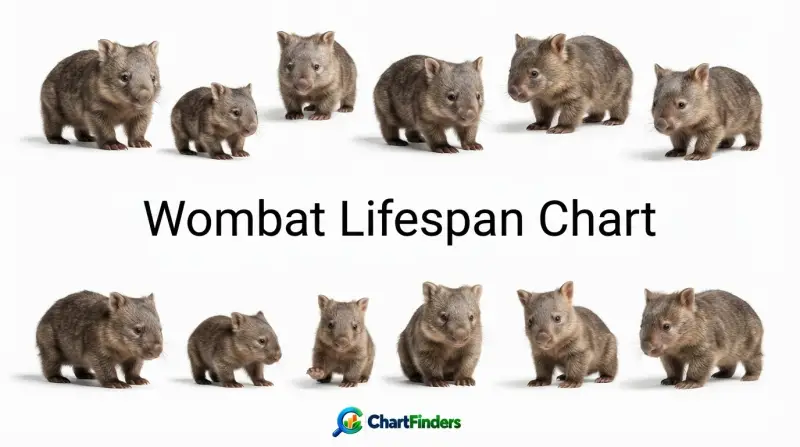
The lifespan of a wombat varies significantly depending on whether the animal lives in the wild or in human care. In the wild, wombats typically live between 5 and 15 years, constrained by environmental pressures such as vehicular strikes, disease (like sarcoptic mange), drought, and predation. In contrast, under professional zoological care, wombats commonly achieve a lifespan of 20 to 26 years, with exceptionally well-managed individuals reaching up to 30 years.
Understanding the life expectancy of these robust, burrowing marsupials requires examining the interplay between biological resilience, environmental challenges, and husbandry practices. As iconic symbols of the Australian bush, wombats occupy a unique ecological niche, yet their longevity is frequently misunderstood by the public. While their armored hindquarters and formidable claws provide excellent defense against natural predators, modern anthropogenic threats drastically curtail their natural potential in the wild.
This comprehensive guide examines the definitive Wombat Lifespan Chart and the underlying physiological, ecological, and environmental variables that dictate how long these remarkable creatures survive. Whether you are a wildlife researcher, a student of zoology, or simply an enthusiast captivated by these stocky marsupials, this reference manual explores every stage of wombat ontogeny—from vulnerable pouch life to the fragile challenges of geriatric care.
Understanding the Wombat Lifespan Chart
A structured examination of wombat longevity reveals a stark divergence between wild survivorship curves and captive longevity. Because wild wombats face constant ecological pressures—including nutritional stress during droughts, vehicular trauma, and devastating parasitic infections—their average age of mortality is considerably lower than their physiological maximum. Conversely, managed facilities provide protected environments where veterinary intervention and consistent nutrition allow wombats to approach their true biological limits.
- Wild vs. Captive Disparity: Wild wombats average 5 to 15 years of life, whereas captive individuals in zoos and sanctuaries regularly reach 20 to 26 years.
- Maximum Recorded Age: Exceptional individuals under optimal human care have documented lifespans stretching up to 30 years.
- Species Variations: The three extant species—Common Wombat, Southern Hairy-nosed Wombat, and Northern Hairy-nosed Wombat—exhibit slightly different survival dynamics, heavily influenced by habitat security.
- Critical Mortality Windows: The highest mortality rates occur during the dependent pouch phase, the immediate post-weaning dispersal period, and advanced geriatric senescence.
- Primary Environmental Bottlenecks: Sarcoptic mange, motor vehicle collisions, and habitat fragmentation remain the leading causes of premature death in wild populations.
To contextualize these age ranges across different living conditions and developmental milestones, the comparative matrix below outlines the primary parameters governing wombat longevity.
| Life Parameter / Condition | Wild Environment | Captive / Sanctuary Environment | Primary Influencing Factors |
|---|---|---|---|
| Average Lifespan | 5 – 12 years | 18 – 24 years | Predation, vehicle strikes, veterinary access, diet quality |
| Maximum Recorded Lifespan | 12 – 15 years (rare) | 26 – 30 years | Genetic predisposition, absence of chronic disease, husbandry standards |
| Infant/Juvenile Mortality | High (up to 40-50% in first two years) | Low (<10% with managed breeding) | Pouch security, maternal nutrition, parasite control |
| Leading Cause of Mortality | Mange, vehicular trauma, starvation | Age-related organ failure, dental disease | Human encroachment vs. managed geriatric medicine |
| Reproductive Senescence | Typically active until natural death | Managed or decreased in advanced age | Endocrine stability, physical wear on dentition |
The data within this table underscores a fundamental reality of wildlife biology: environmental stressors act as severe truncation factors on potential longevity. While the genetic blueprint of a wombat supports a multi-decade existence, ecological hazards dramatically compress the realized lifespan of free-ranging populations.
Comparative Analysis of Extant Wombat Species Lifespans
Taxonomically, the family Vombatidae comprises three distinct extant species: the Common Wombat (Vombatus ursinus), the Southern Hairy-nosed Wombat (Lasiorhinus latifrons), and the critically endangered Northern Hairy-nosed Wombat (Lasiorhinus krefftii). Each species operates within unique ecological parameters that subtly influence population-level longevity.
The Common Wombat inhabits the cooler, more densely vegetated, and higher-rainfall regions of southeastern Australia and Tasmania. Because their habitat receives more consistent rainfall, they face slightly lower risks of absolute starvation during seasonal dry spells compared to their arid-zone cousins. However, their geographic overlap with dense human populations exposes them to extreme rates of vehicular mortality and agricultural culling.
In contrast, the Southern Hairy-nosed Wombat inhabits the semi-arid scrublands and grasslands of southern Australia. They must cope with extreme ambient temperatures and unpredictable rainfall, relying heavily on complex, subterranean warren systems to buffer environmental extremes. In optimal conditions, protected populations show remarkable longevity, though severe droughts can trigger sudden mortality spikes across all age classes.
The Northern Hairy-nosed Wombat represents an extreme conservation scenario. Confined almost entirely to a single protected sanctuary in Queensland, intensive management, supplementary feeding, and round-the-clock monitoring have elevated their survival metrics significantly. While historical wild data for this species was sparse due to extreme rarity, managed conservation specimens regularly exceed the historical wild averages of their relatives.
The Wombat Life Cycle: From Pouch to Geriatric Seniority
Tracing the physiological arc of a wombat provides essential context for interpreting lifespan charts. Like all marsupials, wombats invest heavily in protracted developmental stages, transitioning from an altricial neonate to a fully independent, long-lived herbivore.
Neonatal and Pouch Development (Months 0–12)
Wombat reproduction begins with a gestation period of approximately 30 days, resulting in the birth of a single, highly underdeveloped young (joey) weighing less than a gram and measuring under three centimeters in length. Guided by instinct, the blind, hairless neonate crawls upward through the mother’s fur to enter the pouch.
Crucially, the wombat’s pouch opens backward—an evolutionary adaptation that prevents dirt from packing into the pouch while the mother excavates extensive underground burrows. Inside the pouch, the joey attaches to a single teat and remains securely locked in place for approximately 6 to 8 months. During this phase, mortality is closely linked to maternal health; if a mother succumbs to drought or disease, the pouch young cannot survive independently.
Weaning and Emergence (Months 12–18)
Around 9 to 10 months of age, the joey begins permanently poking its head out of the pouch and sampling grasses, though milk remains its primary nutritional source. Complete emergence typically occurs between 12 and 15 months. Even after vacating the pouch, the juvenile remains closely associated with its mother for another year, sharing her burrow and learning crucial foraging and predator-avoidance behaviors.
This post-emergence transitional period represents the first major ecological bottleneck. Young sub-adults must establish their own burrows or find vacant refuges. Competition for prime real estate exposes them to territorial aggression from older resident wombats and elevates their vulnerability to predation by introduced carnivores such as red foxes and wild dogs.
Adulthood and Prime Years (Years 2–15)
By age two to three, wombats reach full physical maturity, characterized by thick, coarse pelage, powerful muscular development, and fully erupted, continually growing hypsodont teeth adapted to grinding tough, fibrous grasses, roots, and bark.
During their prime years (roughly ages 3 to 12), healthy wombats maintain stable territories marked by scent glands and vocalizations. Prime adults possess few natural predators; a fully grown adult wombat weighing between 20 and 35 kilograms can easily crush a predator against the roof of its burrow using its heavily ossified cartilaginous rump plate. Consequently, prime-age mortality in a protected environment is remarkably low.
Senescence and Geriatric Aging (Years 15–30+)
As wombats enter advanced age, physiological decline mirrors that of other large mammals. Dental wear is a primary limiting factor in geriatric wombat longevity. Because their teeth grow continuously throughout life, years of grinding abrasive, silica-rich native grasses eventually leads to malocclusion, periodontal disease, or structural tooth failure.
Geriatric wombats in the wild struggle to process fibrous vegetation efficiently, leading to progressive emaciation and increased susceptibility to secondary infections and harsh weather. In captive environments, specialized diets—including chopped grasses, specialized herbivore pellets, and softened vegetation—can mitigate dental limitations, allowing animals to live well into their mid-to-late twenties.
Environmental and Ecological Factors Dictating Lifespan
The vast gap between a wild wombat’s 10-year average and a captive wombat’s 25-year maximum highlights the severity of external environmental pressures. Several primary drivers determine whether a wild wombat reaches its biological potential.
Disease Dynamics: The Scarcoptic Mange Crisis
Without question, one of the single greatest biological threats to wild wombat populations is sarcoptic mange, caused by the burrowing mite Sarcoptes scabiei. Introduced via European settlement and domestic animals, this parasite burrows into the wombat’s skin, causing intense irritation, severe hyperkeratosis (crusting), blindness, and eventual systemic exhaustion and death.
Left untreated, sarcoptic mange carries a near-100% mortality rate in wild populations, devastating entire colonies and dramatically reducing the upper age limit of regional populations. Modern conservation interventions utilizing systemic antiparasitic treatments delivered via burrow flaps have proven effective, yet managing sprawling wild populations remains an ongoing logistical challenge.
Anthropogenic Pressures: Vehicles and Habitat Loss
For wombats residing near rural infrastructure, human-wildlife conflict is a constant hazard. Wombats are crepuscular and nocturnal foragers, frequently moving across roadways during dusk and night hours. Because of their immense muscular density and low-slung profiles, colliding with a wombat often results in severe vehicular damage and immediate mortality for the animal.
, agricultural fencing, land clearing, and urban sprawl fragment wombat habitat. Fragmentation isolates populations, leading to inbreeding depression and restricting access to diverse food sources during seasonal droughts.
Climatic Extremes and Drought
Wombats are exceptionally well-adapted to temperature regulation through burrow usage, where ambient temperatures remain stable year-round. However, prolonged droughts severely impact their nutritional base. As grasses wither and root systems dry out, wombats must expend significantly more energy foraging over wider areas.
During severe drought cycles, body condition scores plummet across wild cohorts. Lactating females may abandon pouch young to ensure their own survival, causing multi-year reproductive drop-offs that alter the age structure of the population for decades.
Comparative Longevity: Wombats vs. Other Australian Marsupials
To fully appreciate the wombat lifespan chart, it is instructive to compare their longevity metrics against other prominent Australian marsupials. Wombats are among the longest-lived marsupials in the world, surpassed only by certain larger macropods under ideal conditions.
| Species | Scientific Name | Average Wild Lifespan | Maximum Captive Lifespan | Key Ecological Survival Strategy |
|---|---|---|---|---|
| Common Wombat | Vombatus ursinus | 5 – 12 years | 20 – 26 years | Subterranean burrows, robust physical armor |
| Red Kangaroo | Osphranter rufus | 8 – 10 years | 20 – 25 years | High mobility, nomadic grazing, rapid reproduction |
| Koala | Phascolarctos cinereus | 10 – 12 years | 15 – 18 years | Arboreal lifestyle, specialized eucalyptus diet |
| Tasmanian Devil | Sarcophilus harrisii | 5 – 6 years | 8 – 10 years | Scavenging efficiency, high litter turnover |
| Sugar Glider | Petaurus breviceps | 3 – 9 years | 12 – 15 years | Gliding locomotion, tree-hollow nesting |
As illustrated in the comparison table, the wombat’s combination of fossorial (burrowing) security and robust anatomy grants it a baseline longevity that exceeds many other marsupials of comparable body weight, matching or exceeding even large macropods when protected from anthropogenic threats.
Best Practices for Wildlife Care and Age Assessment
For wildlife rehabilitators, veterinarians, and field biologists, accurately assessing the age of a rescued or wild wombat is critical for determining appropriate medical treatment, nutritional support, and rehabilitation protocols. Because exact birth dates are rarely known in rescue scenarios, professionals rely on anatomical and morphological markers.
Morphological Indicators of Wombat Age
- Body Mass and Weight Thresholds: Neonates weigh under 100g; pouch young scale progressively up to 1.5–3kg upon emergence; sub-adults range from 10 to 18kg; fully mature adults typically stabilize between 20 and 35kg depending on the species and sex.
- Dental Eruption and Wear: Examining the incisors and cheek teeth provides reliable insight. Juvenile teeth are white and sharply chisel-shaped, whereas mature and geriatric teeth show progressive yellow-to-orange staining from soil iron and distinct occlusal wear patterns.
- Fur Condition and Coloration: Pouch young are naked or possess fine, downy fuzz. Sub-adults exhibit soft, dense coats, while mature adults develop coarse, bristly guard hairs often scarred from territorial sparring.
- Epi-pubic Bone and Sexual Maturity: Development of secondary sexual characteristics, testicular descent in males, and pouch elasticity in females indicate transition into breeding age (typically reached between 2 and 3 years).
Rehabilitation and Captive Management Considerations
When orphaned joeys enter wildlife care, replicating the natural maternal bond is essential for long-term psychological and physiological health. Hand-rearing requires specialized milk formulas that closely mimic marsupial milk composition—typically lower in lactose and higher in lipids and proteins compared to bovine milk.
, captive environments must be carefully engineered to prevent behavioral pathologies. Providing deep sand substrates for instinctive digging, adequate climbing and scratching enrichment, and species-appropriate social grouping prevents stereotypic behaviors and promotes optimal physical conditioning, directly supporting the animal’s progression toward its maximum potential lifespan.
Common Misconceptions Regarding Wombat Longevity
Several persistent myths surround the biology and life expectancy of wombats. Dispelling these misconceptions is crucial for accurate wildlife reporting and effective conservation advocacy.
Myth 1: Wombats are slow-moving and therefore short-lived due to easy predation.
While wombats appear lumbering and deliberate during casual foraging, they are deceptively fast when startled, capable of reaching burst speeds of up to 40 kilometers per hour over short distances. Combined with their subterranean retreats and defensive rump plates, adult predation is exceptionally rare.
Myth 2: Captive wombats have the exact same lifespan expectations as wild specimens.
As established by the wombat lifespan chart data, the absence of vehicular hazards, infectious mange outbreaks, and starvation pressures in professionally managed zoos and accredited sanctuaries nearly doubles the realized life expectancy of captive individuals.
Myth 3: Wombat teeth stop growing once adult size is reached.
Unlike many placental mammals, wombat incisors and cheek teeth are open-rooted and grow continuously throughout their entire lives. This adaptation is necessary to compensate for the extreme abrasive wear caused by a diet rich in siliceous grasses and dirt.
Frequently Asked Questions
How long do wombats live in the wild?
In the wild, wombats typically live between 5 and 12 years. While their biological machinery can support a much longer life, environmental pressures such as vehicular strikes, sarcoptic mange, drought-induced starvation, and territorial conflict drastically truncate their lifespan.
What is the maximum recorded age of a captive wombat?
Under optimal zoological care and professional veterinary supervision, exceptional individual wombats have reached up to 26 to 30 years of age, representing the upper biological limit of the vombatid family.
Do male and female wombats have different lifespans?
In controlled environments, there is no significant sexual dimorphism in longevity between males and females. In the wild, however, adult males sometimes experience slightly higher mortality rates during prime breeding years due to aggressive territorial combat and roaming behavior that increases road exposure.
What are the primary causes of death for wild wombats?
The leading causes of mortality for wild wombats include sarcoptic mange (a parasitic mite infection), motor vehicle collisions due to roadside foraging, severe dehydration and starvation during prolonged droughts, and canine predation on vulnerable juveniles.
How can you determine the age of an adult wombat?
Wildlife professionals estimate wombat age by assessing body weight, dental wear patterns on the continuously growing molars and incisors, bone density via radiographs, and overall physical condition, including coat coarseness and scar accumulation from territorial interactions.
Conclusion
The wombat lifespan chart demonstrates a profound divergence between survival in the unpredictable Australian wilderness and longevity under dedicated human stewardship. While wild wombats battle relentless environmental challenges that cap their existence at roughly a decade, protected individuals reveal a resilient physiology capable of thriving for nearly three decades. By understanding the life stages, environmental bottlenecks, and biological vulnerabilities of wombats, conservationists and wildlife managers can better protect these iconic marsupials, ensuring that robust populations continue to shape the Australian landscape for generations to come.