
The genus Philodendron is one of the most diverse and adaptable groups in the aroid family (Araceae), encompassing hundreds of accepted species alongside countless cultivated sports and patented hybrids. Because phenotypic variation can be extreme across different life stages—where a juvenile plant looks entirely different from its mature, sun-drenched adult counterpart—identifying a specific philodendron can quickly become overwhelming for both novice and experienced growers alike. Without a systematic reference guide, features like green heart-shaped leaves or vining stems easily blur together, leading to mislabeled collections and improper care routines.
This master guide provides a definitive framework for recognizing and classifying diverse philodendrons. By breaking down the plant kingdom’s most complex tropical genus into clear diagnostic categories, this resource equips you with the visual markers, structural clues, and botanical terminology necessary to decode your collection with confidence. From understanding growth habits and juvenile-to-adult leaf transitions to evaluating specific variegation patterns, every section is designed to turn casual observation into expert botanical identification.
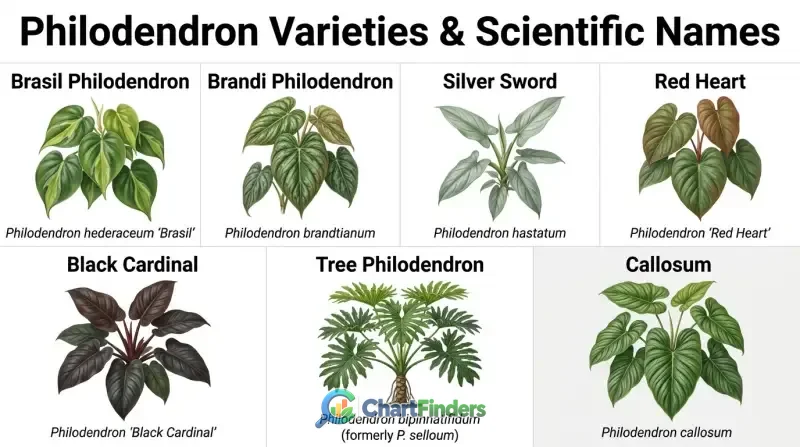
Philodendron Identification Chart
- Growth Habit Division: Philodendrons split primarily into two structural camps: vining/climbing epiphytes and self-heading (non-climbing) rosettes.
- Leaf Metamorphosis: Juvenile leaves often bear little resemblance to adult foliage; mature size, fenestrations, and lobe development are critical ID tools.
- Stem and Petiole Markers: Features like winged petioles, cataphyll persistence, and internode spacing help separate look-alike species within the same section.
- Variegation Types: Genetic variegation (like golden stripes in ‘Brasil’) differs fundamentally from silver marbling (as seen in P. brandtianum) and stress-induced pigments.
- Taxonomic Complexity: Many commercial names are trade designations or patents rather than valid botanical species, requiring close morphological inspection.
To navigate the vast diversity of the genus, a systematic identification chart must focus on repeatable, physically verifiable plant parts. Below is a comprehensive comparative matrix categorizing prominent philodendron varieties by their growth habits, signature leaf shapes, distinctive colors, and specific identifying traits.
| Common Name | Botanical Name | Growth Habit | Leaf Shape & Texture | Signature Coloration & Markings | Key Identification Clue |
|---|---|---|---|---|---|
| Brasil Philodendron | Philodendron hederaceum ‘Brasil’ | Vining / Epiphytic climber | Cordate (heart-shaped), soft, glossy | Green centers splashed with golden-yellow and lime-green | Patented cultivar with distinct multi-tone bright variegation stripes |
| Brandi Philodendron | Philodendron brandtianum | Vining / Trailing climber | Ovate-cordate, smooth, slightly leathery | Rich olive-green background heavily marbled with metallic silver | Intense silver flecking along primary and lateral veins |
| Silver Sword | Philodendron hastatum | Climbing epiphyte | Hastate (arrowhead or sword-shaped), stiff | Glaucous grey-green to metallic silvery-blue | Elongated, triangular basal lobes pointing outward like a spear |
| Red Heart | Philodendron ‘Red Heart’ | Vining / Semi-climbing | Cordate to heart-shaped | Deep green adaxial surface with striking reddish-maroon undersides | Vibrant red pigmentation on the lower leaf lamina and petioles |
| Black Cardinal | Philodendron ‘Black Cardinal’ | Self-heading (Upright rosette) | Broad, oval, unfolding bronze-burgundy | Emerges dark burgundy/chocolate, maturing to near-black deep green | Non-climbing, clumping habit with thick, upright central stems |
| Tree Philodendron | Philodendron bipinnatifidum (formerly P. selloum) | Arborescent (Tree-like trunk) | Deeply pinnatifid (deeply lobed and split margins) | Solid, glossy, vibrant medium-to-dark green | Massive woody stem base and deeply cut, finger-like frond edges |
| Callosum | Philodendron callosum | Epiphytic climber / Creeper | Leathery, oblong-lanceolate | Deep matte green with prominent, pale midribs | Thick, rubbery texture and narrow, elongated blade shape |
This comparative framework highlights how structural differences separate visually similar plants. Reviewing the table above reveals that leaf morphology alone cannot confirm an ID; growth habit—whether a plant sprawls along a moss pole or forms a tight, self-supporting crown—is the mandatory starting point for any accurate identification workflow.
Core Morphological Markers for Philodendron Classification
Accurate philodendron identification demands a working knowledge of botanical terminology. Botanists classify aroids using precise anatomical structures that remain stable across different growing environments. Understanding these markers prevents misidentifications caused by temporary stress or abnormal lighting conditions.
Growth Habits: Climbers versus Self-Headers
The single most important division in any philodendron identification chart is the plant’s growth architecture:
- Vining and Epiphytic Climbers: These species feature long internodes and produce aerial roots at the nodes to latch onto tree trunks and vertical supports. Examples include Philodendron hederaceum and Philodendron brandtianum. Over time, as they climb toward high-intensity light, their leaves often undergo dramatic transformations, increasing significantly in size.
- Self-Heading (Upright) Rosettes: These plants feature tightly compressed stems where internodes are extremely short. They grow upward in a rigid, vase-like crown without requiring structural support. Varieties like Philodendron ‘Black Cardinal’ and Philodendron bipinnatifidum fall into this category, maintaining an arborescent or clumping silhouette throughout their life cycle.
Leaf Anatomy and Blade Geometry
Leaf shape is the primary visual cue for most hobbyists, but precise geometric terms clarify distinctions that casual descriptions miss:
- Cordate: Heart-shaped with a notched base where the petiole attaches, typical of the Philodendron hederaceum complex.
- Hastate / Sagittate: Arrowhead or spear-like shapes featuring distinct basal lobes. Sagittate leaves point downward, whereas hastate leaves (such as Philodendron hastatum) flare outward.
- Pinnatifid / Fenestrated: Leaves split deeply into lobes or develop natural holes (fenestrations) as seen in mature P. bipinnatifidum and P. monstera look-alikes. These cuts reduce wind resistance in tropical canopies and allow lower leaves to receive filtered sunlight.
Cataphylls and Petioles
Often overlooked, the structures supporting the leaf provide vital diagnostic evidence. A cataphyll is a modified, scale-like leaf that protects new emerging foliage. In some species, these structures remain green and persistent, drying up slowly into papery fibers, while in others they shed immediately. Petiole shape—whether cylindrical, flattened, D-shaped in cross-section, or equipped with lateral wings—acts as a permanent fingerprint for separating closely related species.
Analyzing Popular Varieties and Their Defining Traits
To put this identification framework into practice, we can examine several prominent philodendron groups and analyze the micro-features that separate true species and patented cultivars from common impostors.
The Hederaceum Complex (Heartleaf Types)
The Philodendron hederaceum complex is the most widely cultivated group of trailing aroids. Within this group, genetic mutations and selective breeding have produced distinct foliage variations:
- Philodendron hederaceum (Standard Green): Pure green, glossy, heart-shaped leaves with flexible vining stems. Juveniles and adults look relatively similar, though adult leaves on mature climbing vines thicken and elongate slightly.
- Philodendron hederaceum ‘Brasil’: Distinguished by streaks of golden-yellow, chartreuse, and deep green running through the lamina. The variegation pattern is stable and light-dependent; low light causes the yellow sectors to revert toward muted green.
- Philodendron ‘Red Heart’: Exhibits a classic cordate silhouette paired with a striking, high-contrast dark red underside. This pigmentation is genetic and persistent, distinguishing it from general nutrient deficiencies or lower-leaf senescence that causes normal green leaves to flush red before dropping.
Silver and Metallic Foliage Species
Silver-leafed philodendrons are prized for their reflective epidermal cells, which create a shimmering, metallic aesthetic. Two notable examples include:
- Philodendron brandtianum (‘Brandi’): Features olive-green leaves densely stippled and marbled with silvery-white patches. The pattern tends to concentrate heavily around the primary lateral veins. Its stems are slender, trailing, and reddish-brown when young.
- Philodendron hastatum (‘Silver Sword’): Exhibits solid, pale silvery-blue leaves with a stiff, leathery texture. Unlike marbled species, the entire leaf blade takes on a uniform glaucous coating, and the leaves lengthen dramatically into distinct spear shapes as the plant matures and climbs.
Large-Format and Self-Heading Specimens
For growers evaluating massive tropical specimens, structural scale and stem morphology are :
- Philodendron bipinnatifidum: Frequently confused with species of Monstera or Thaumatophyllum (into which some former philodendrons were reclassified), this plant forms a thick, woody trunk over decades. Its leaves are deeply divided into slender, pinnate segments, giving it a fern-like or ruffled architectural profile.
- Philodendron ‘Black Cardinal’: A self-heading hybrid lacking vining tendencies. Its leaves emerge with a glossy, dark wine-red color, transitioning to a very dark, near-black forest green upon hardening. The petioles are thick, succulent, and closely packed along a central axis.
Step-by-Step Identification Workflow for Growers
When faced with an unidentified philodendron, working through a structured diagnostic sequence prevents premature guessing. Follow this five-step evaluation process to narrow down your plant’s identity accurately.
- Assess the Stem Architecture: Look closely at the base and nodes. Is the plant producing long, trailing, vine-like stems with clear rooting nodes? Or is it a rigid, upright rosette with compressed stems? If it climbs, it belongs to the subgenus Philodendron or Pteromischum. If it is self-heading, it likely belongs to subgenus Meconostigma or represents an upright hybrid.
- Examine Leaf Geometry and Sinus Structure: Inspect the point where the petiole connects to the leaf blade. Are the basal lobes rounded (cordate), sharp and triangular (sagittate), or split into fingers (pinnatifid)? Measure the length-to-width ratio of mature leaves.
- Check Surface Texture and Variegation: Touch the leaf. Is it thin and papery, thick and rubbery, or stiffly leathery? Look closely at color patterns. Is there true genetic variegation (stripes, sectors), metallic silver marbling (reflective epidermal layers), or solid uniform coloration with colored undersides?
- Inspect New Growth and Petioles: Observe newly emerging leaves. Do they emerge from protective cataphylls? Are the petioles round, winged, or edged with rough little bumps? Check the color of emerging stems and leaf sheaths, as many hybrids retain bright red or pink pigments in their newest growth.
- Compare Against Botanical Database Standards: Cross-reference your accumulated traits against verified botanical keys or registered cultivar descriptions. Keep in mind that juvenile plants grown indoors often display smaller, less complex leaves than adult specimens grown in optimal tropical conditions.
Common Identification Pitfalls and Misleading Clues
Even experienced horticulturists can be misled by environmental adaptations and morphological convergence within the aroid family. Avoiding these common identification mistakes ensures greater accuracy.
The Juvenile-to-Adult Trap: Many people attempt to identify a cutting based solely on juvenile leaves. A young climbing philodendron often produces small, simple heart-shaped leaves that bear zero resemblance to the massive, fenestrated, or heavily lobed leaves the same plant produces once it climbs several meters up a support structure. Always verify whether a specimen is in its juvenile or adult phase before making a final determination.
Environmental Stress Mimicry: Nutrient deficiencies, extreme temperature fluctuations, and lighting stress can alter leaf color and texture. For example, nitrogen deficiency can cause older leaves to yellow and develop reddish tints, easily mistaken for natural coloration like that of the Red Heart philodendron. Similarly, insufficient light can cause variegated cultivars like ‘Brasil’ to lose their yellow stripes and revert to solid green.
Cross-Generalization with Look-Alikes: The aroid family features high levels of convergent evolution. Epipremnum, Scindapsus, and Monstera species frequently share habitats and physical traits with Philodendrons. For instance, Epipremnum pinnatum and certain philodendrons both feature fenestrated leaves. Checking root types, sap characteristics, and floral spadix structures remains the definitive scientific method for confirming genus boundaries when vegetative traits overlap.
Frequently Asked Questions
The easiest way to distinguish them is by examining how new leaves emerge and the structure of their petioles. Philodendron new leaves emerge from a protective sheath called a cataphyll, and their petioles generally wrap smoothly around the stem. Pothos (Epipremnum aureum) leaves emerge rolled up inside the petiole base of the preceding leaf, leaving a distinct, circular scar around the stem node once they unfurl.
No. While many popular species are vining epiphytes that climb trees in their native rainforest habitats, an entire group of philodendrons is classified as “self-heading” or upright. These varieties grow in non-climbing rosettes with tightly stacked stems, forming bushy, tree-like, or clumping structures that do not require stakes or moss poles.
Reversion in variegated cultivars like Philodendron hederaceum ‘Brasil’ is almost always caused by insufficient light. Variegated tissue lacks chlorophyll, meaning the plant requires higher light intensity to sustain those sectors. If placed in a dim corner, the plant produces more green cells to maximize photosynthesis, causing the brighter yellow or silver markings to fade or disappear.
Juvenile leaves are typically smaller, simpler in shape, and lack the deep lobes, splits, or massive dimensions seen in adult foliage. As a climbing philodendron scales a vertical surface and gains access to brighter light and increased moisture, its hormonal signals trigger the production of larger, highly fenestrated or deeply lobed adult leaves—a process known as heteroblasty.
Not always. Many popular plants sold in garden centers are patented cultivars, commercial selections, or hybrid crosses (such as Philodendron ‘Black Cardinal’). These carry trade designations rather than formal binomial botanical names. While they share distinct phenotypic stability, they are horticultural creations rather than naturally occurring wild species.
Conclusion
Mastering philodendron identification is an engaging blend of art and botanical science. By looking beyond superficial similarities and examining core structural markers—such as growth habit, leaf geometry, petiole anatomy, and juvenile-to-adult transitions—you can successfully decode even the most challenging tropical specimens. Whether you are cataloging a rare climbing epiphyte or verifying a patented vining cultivar, a structured identification approach transforms uncertainty into clarity, ensuring your collection is accurately understood and properly cared for.