
Plumbing repair projects often grind to a sudden halt at the exact moment a homeowner or maintenance professional pulls a leaking shower handle. Behind the escutcheon plate lies a complex assembly of brass stems, ceramic disks, O-rings, and precision-molded polymer sleeves. Among the most recognizable plumbing brands in North America, Price Pfister (now officially known as Pfister) has manufactured dozens of proprietary shower valve configurations over the past several decades. Because manufacturers frequently update internal cartridge engineering while maintaining identical exterior trim styles, visual identification from the outside is virtually impossible. Successfully diagnosing a drip, eliminating dangerous temperature fluctuations, or stopping a behind-the-wall leak requires a systematic approach to cartridge anatomy and part cross-referencing.
This master guide provides field-experienced insights, technical classifications, diagnostic pathways, and comparative data to help you accurately identify and replace your Price Pfister shower cartridge. Whether you are dealing with a classic two-handle compression setup or a modern pressure-balancing single-handle mixing valve, understanding the precise geometric, mechanical, and functional markers of your hardware will save you time, eliminate return trips to the plumbing supply house, and ensure a secure, watertight repair.
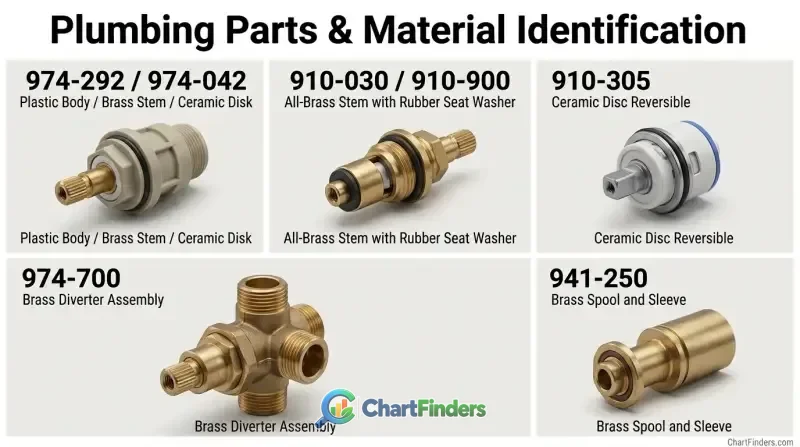
Price Pfister Shower Cartridge Identification Chart
- Never buy blindly: Exterior trim styles do not reveal internal cartridge models; you must pull the old cartridge to verify physical dimensions, ports, and splines.
- Match the broach: The number of teeth on the stem (spline count) and the overall stem length are the two most critical physical identifiers for handle compatibility.
- Valve body compatibility: Single-handle pressure-balance valves (such as the 0X6 or Jlab series) use entirely distinct cartridges compared to two-handle systems.
- Ceramic vs. Washer: Modern Price Pfister cartridges largely rely on ceramic disc technology or durable polymer spools, replacing older brass-and-rubber compression stems.
- Cost expectations: OEM and aftermarket replacement cartridges generally retail between $20 and $40, while professional replacement averages $100 to $300 total.
- Safety first: Always turn off the main water supply to the home (or integrated service stops) and relieve line pressure before removing retaining clips or bonnets.
The core of any successful shower repair relies on structured identification. The following comprehensive reference details the most common Price Pfister shower and tub/shower cartridges, outlining their valve applications, physical identification traits, stem configurations, and operational characteristics.
| Part Number / Series | Valve Application | Construction Type | Key Identification Markers | Rotation / Operation |
|---|---|---|---|---|
| 974-292 / 974-042 | Single-Handle Pressure Balance (0X6, Jlab) | Plastic Body / Brass Stem / Ceramic Disk | Cylindrical gray or black plastic body, dual-port side seals, brass stem with square retaining ear. | Counter-clockwise to open; up-and-down mixing. |
| 910-030 / 910-900 | Two-Handle Tub & Shower (Hot/Cold) | All-Brass Stem with Rubber Seat Washer | Long brass stem, threaded barrel, broached tip, flat rubber washer at the base. | Multi-turn clockwise/counter-clockwise. |
| 910-305 | Roman Tub & Select Diverter Applications | Ceramic Disc Reversible | Ceramic internal plates, distinct collar, often field-reversible. | Quarter-turn or half-turn operation. |
| 974-700 | Roman Tub Diverter Stem (0X6-440R) | Brass Diverter Assembly | Specialized upper diverter stem with integrated threading and O-ring seals. | Vertical pull or twist diversion. |
| 941-250 | Older Single-Handle pull-out/push-in | Brass Spool and Sleeve | Heavy brass body, lateral balancing piston, complex sleeve arrangement. | Pull out for volume, twist for temperature. |
When analyzing this table, notice how the intended application dictates the physical makeup of the cartridge. Two-handle setups rely on long, threaded brass stems designed for multi-turn compression, whereas single-handle pressure-balance valves utilize compact, enclosed plastic-and-ceramic assemblies designed to slide directly into a recessed brass valve body.
To further contextualize the financial and market landscape of these components, consider the following distribution of typical replacement costs and labor factors associated with Price Pfister shower repairs in current market conditions:
| Repair Scope | Parts Cost (OEM/Aftermarket) | Estimated Labor Time | Total Professional Cost Range |
|---|---|---|---|
| Two-Handle Stem Replacement (Pair) | $25 – $45 | 30 – 45 Minutes | $100 – $200 |
| Single-Handle Pressure Balance Cartridge | $20 – $40 | 45 – 60 Minutes | $150 – $300 |
| Roman Tub Valve Cartridge / Diverter | $35 – $110 | 60 – 90 Minutes | $200 – $400 |
| Complete Valve Body Replacement (Wall Opening) | $80 – $150 | 2 – 4 Hours | $450 – $900+ |
Anatomy of a Price Pfister Shower Valve
To correctly identify a cartridge, you must understand how it interacts with the surrounding brass valve body hidden inside the wall. Price Pfister designs vary significantly depending on whether the fixture controls water flow via two independent handles (hot and cold) or a single handle that mixes temperature and volume simultaneously.
Single-Handle Pressure-Balance Valves
Modern Price Pfister single-handle showers predominantly utilize pressure-balancing technology. These systems protect users from scalding or thermal shock when someone flushes a toilet or runs a washing machine elsewhere in the building. The heart of this system is a floating spool or ceramic sliding plate enclosed within a cylindrical cartridge housing (most notably the 974 series).
As the single handle moves, it shifts the internal mechanism to balance incoming hot and cold water pressures. Over time, mineral buildup (limescale), O-ring degradation, or thermal fatigue causes the internal seals to fail, resulting in handle stiffness, dripping spouts, or complete temperature lockouts.
Two-Handle Compression and Ceramic Stems
Traditional two-handle Price Pfister shower setups separate hot and cold water control into two distinct valves. These cartridges—frequently referenced under the 910 series—rely on a threaded brass barrel. Turning the handle drives the stem forward or backward, pressing a flat rubber washer against a brass seat inside the valve body to stop the flow of water.
More recent iterations of two-handle fixtures utilize ceramic disc technology. Instead of crushing a rubber washer against a brass seat, two polished ceramic plates slide across one another to block or permit water flow. Ceramic cartridges offer smoother operation and significantly longer lifespans, though they are vulnerable to failure if sediment or pipe debris becomes trapped between the discs.
Step-by-Step Cartridge Removal and Measurement Protocol
Relying solely on visual memory or exterior trim appearance is the leading cause of incorrect cartridge purchases. Follow this systematic extraction and measurement protocol to ensure absolute accuracy before visiting a plumbing supply house or ordering online.
1. Preparation and Water Shutoff
Locate the primary water shutoff valve for your home or the specific bathroom shutoffs if installed. Turn them completely off. Open the shower handle to drain any residual water standing in the vertical pipe runs. Plug the tub drain with a washcloth or stopper to prevent tiny screws, retaining clips, or O-rings from falling down the drain.
2. Removing Exterior Trim
Remove the decorative handle by loosening the set screw underneath using a hex wrench (allen key) or by unscrewing the decorative cap and removing the central Phillips screw. Slide off the handle sleeve, escutcheon plate, and any protective plastic sleeves or collars. This exposes the retaining nut, bonnet, or retaining clip holding the cartridge inside the valve body.
3. Extracting the Cartridge
For single-handle pressure-balance valves (like the 974 series), remove the wire retaining clip (horseshoe clip) by pulling it straight up or out with pliers. Grasp the stem firmly with channel-lock pliers and pull straight out. If the cartridge is calcified in place, use a specialized cartridge puller tool to avoid twisting and snapping the brass stem inside the valve body.
For two-handle stems, use a deep-well socket wrench or adjustable wrench to unscrew the entire brass stem assembly counter-clockwise from the wall.
4. Taking Critical Measurements
With the cartridge removed and cleaned of heavy debris, measure the following physical attributes:
- Overall Length: Measure from the very tip of the stem to the back edge of the cartridge body.
- Broach (Spline) Count: Count the individual teeth on the brass or plastic stem tip where the handle attaches. Pfister stems typically feature specific tooth counts (e.g., 12-point, 16-point, or specialized square broaches).
- Body Diameter and Length: Measure the outer diameter of the main plastic or brass barrel.
- Port Configuration: Note the location and quantity of O-rings, side inlet ports, and mounting ears.
Common Price Pfister Cartridge Families
Distinguishing between the various product lines manufactured by Price Pfister requires careful attention to specific engineering markers. Below is an in-depth breakdown of the primary families encountered in residential and commercial field service.
The 974 Series (Single-Handle Pressure Balance)
The 974-292 and its variants represent the gold standard of modern Price Pfister single-handle showers. Characterized by a cylindrical black or gray plastic outer housing, a prominent brass stem, and two lateral O-ring ports on the sides, this cartridge controls both volume and temperature in a single axis. It slides into the 0X6 valve body. A common mistake is failing to lubricate the new cartridge’s O-rings with plumbers silicone grease prior to insertion, which can pinch the seals and cause immediate leaks.
The 910 Series (Two-Handle Traditional)
Spanning decades of production, the 910 series covers hot and cold stems for two-handle tub and shower faucets. Stems in this family feature long threaded bodies. It is critical to distinguish between hot and cold versions within this series; many 910 stems are direction-specific (opening clockwise vs. counter-clockwise) to ensure symmetrical handle rotation.
Diverter Stems (974-700 and Roman Tub Variants)
In installations featuring a tub spout diverter or a Roman tub with an integrated handshower hose, a dedicated diverter cartridge routes water between the primary spout and the secondary outlet. The 974-700 diverter stem, for instance, manages water routing within the 0X6-440R valve assembly. These units experience high mechanical stress and frequently wear out, leading to water leaking simultaneously from the showerhead and tub spout during operation.
Troubleshooting Symptoms and Failure Modes
The specific manner in which a shower valve fails often points directly to the underlying mechanical cause. Recognizing these symptoms helps confirm your cartridge diagnosis.
- Constant Dripping from Spout or Showerhead: Usually caused by degraded internal seals, worn rubber washers (in older 910 series), or scratched ceramic discs. Mineral deposits preventing a tight closure are also frequent culprits.
- Handle Stiff or Binding: Limescale accumulation between moving plastic and brass surfaces, or dried-out factory silicone grease. Disassembling and cleaning the cartridge or replacing it restores smooth lever operation.
- Fluctuating Water Temperature: In pressure-balance valves (974 series), a stuck or fouled internal balancing spool fails to react to pressure drops in the hot or cold supply lines, causing sudden bursts of scalding water or freezing cold.
- Cross-Mixing (Always Warm Water): If the shower never runs truly cold, the internal cartridge mixing mechanism is compromised, allowing hot water to bypass into the cold supply line, or vice-versa.
Frequently Asked Questions
OEM Price Pfister (Pfister) cartridges usually feature the brand name stamped onto the brass stem or molded into the plastic housing, alongside a part number. Aftermarket equivalents sold at big-box hardware stores may look identical in shape and broach count but often utilize slightly different polymer compounds or O-ring tolerances. While high-quality aftermarket cartridges function well, OEM parts guarantee exact dimensional compatibility.
For older two-handle brass stems (910 series), replacing individual rubber washers, springs, and O-rings is cost-effective and straightforward. However, for modern single-handle pressure-balance cartridges (974 series), internal components are sealed within a welded or ultrasonically bonded plastic housing. These modern cartridges are non-rebuildable and must be replaced as a complete assembly.
This failure occurs when the retaining teeth or splines inside the handle have stripped away, or when the cartridge stem itself has sheared off inside the valve body. Remove the handle to inspect whether the metal or plastic teeth on the handle are worn smooth. If the handle is intact, the cartridge stem is broken and requires immediate extraction and replacement.
Many modern Price Pfister valve bodies (such as the 0X6 series) feature integrated screwdriver service stops hidden behind the escutcheon plate. If your valve is equipped with these functional isolation stops, you can shut off the water directly at the valve without turning off the home’s main supply. If service stops are absent or seized, you must shut off the main water supply.
Mineral scale can cement brass and plastic cartridges firmly into the surrounding brass valve housing. Never use excessive force or hammer on the brass stem, as this can crack the internal valve body inside the wall. Instead, purchase a universal shower cartridge puller tool designed to clamp onto the stem and jack the cartridge straight out safely.
Conclusion
Accurately identifying and replacing a Price Pfister shower cartridge transforms a frustrating plumbing emergency into a manageable maintenance project. By bypassing superficial exterior trim and focusing on the core mechanical markers—stem length, spline broach count, body diameter, and valve series—you can bypass guesswork entirely. Always prioritize safety by shutting off the water supply, take precise measurements after pulling the old unit, and rely on quality OEM or compatible replacement parts. With the correct cartridge in hand and properly lubricated seals in place, your shower will return to smooth, leak-free operation for years to come.