
To the untrained observer, North America’s diverse family of sparrows often blurs into a bewildering sea of brown feathers. Phrases like “LBBs”—Little Brown Birds—long captured the frustration field naturalists experience when trying to put a precise name on a secretive bird scurrying through leaf litter. Yet, once you train your eye to look beyond the general wash of rufous, tan, and gray, an astonishingly world of distinctive facial patterns, specialized bill structures, and unique behavioral traits emerges.
Mastering sparrow identification is not about memorizing hundreds of species at once; it is about developing a systematic field methodology. Whether you are observing a migratory songbird in a coastal marsh, a resident field dweller in a regenerating thicket, or an urban visitor at a backyard feeder, utilizing a reliable identification chart transforms guesswork into confident birding. This comprehensive guide breaks down the critical anatomical features, regional distribution patterns, population trends, comparative metrics, exceptions, and common identification pitfalls needed to identify the most commonly encountered sparrow species with absolute precision.
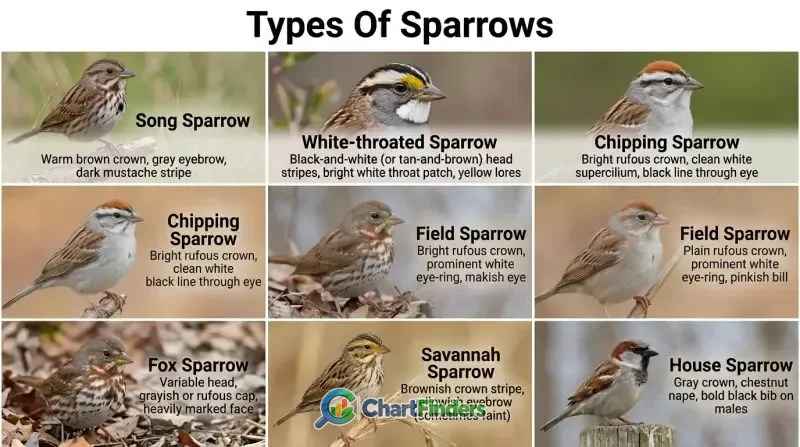
Sparrow Identification Chart
- Focus on Facial Patterns: Crown stripes, eyebrow (supercilium) color, and malar borders are far more reliable identification markers than overall body plumage.
- Examine Breast Markings: Note whether the chest is cleanly unstreaked, heavily streaked, or features a distinct central breast spot (as seen in Song Sparrows).
- Check Bill Morphology: Conical, stout bills indicate seed-eating specialists, but subtle variations in upper and lower mandible color separate similar species like Field and Chipping Sparrows.
- Habitat Context Matters: Pairing visual cues with micro-habitat preferences—such as dense marshes versus dry brushy fields—drastically narrows down identification possibilities.
- Leverage Community Science Data: Long-term monitoring projects like the Christmas Bird Count help track regional population shifts and conservation vulnerabilities among North American sparrows.
- Acknowledge Seasonal Variations: First-year juvenile sparrows often lack the bold head patterns of adults, requiring careful observation of wing bars, back streaking, and structural silhouette.
Effective sparrow identification requires a standardized approach to anatomy and field marks. The following master comparison table outlines the defining physical traits, habitat preferences, and behavioral tendencies of the most widespread sparrow species in North America.
| Species | Size & Shape | Key Head & Face Marks | Breast & Underparts | Primary Habitat |
|---|---|---|---|---|
| Song Sparrow | Medium, long rounded tail | Warm brown crown, gray eyebrow, dark mustache stripe | Heavy dark streaks converging into a central breast spot | Brushy areas near water, gardens, marshes |
| White-throated Sparrow | Large, robust, long-tailed | Black-and-white (or tan-and-brown) head stripes, bright white throat patch, yellow lores | Plain grayish breast and belly without streaking | Woodland edges, thickets, winter feeders |
| Chipping Sparrow | Small, slender, notched tail | Bright rufous crown, clean white supercilium, black line through eye | Unstreaked pale gray breast and underparts | Open woods, lawns, parks, pine forests |
| Field Sparrow | Small, delicate | Plain rufous crown, prominent white eye-ring, pinkish bill | Unstreaked buffy-gray breast, pale throat | Overgrown fields, pastures, brushy clearings |
| Fox Sparrow | Very large, robust | Variable head, grayish or rufous cap, heavily marked face | Dense arrow-shaped spots and streaks on a white background | Forest floor, dense understory, thickets |
| Savannah Sparrow | Small, short-forked tail | Brownish crown stripe, yellowish eyebrow (sometimes faint) | Fine, sharp dark streaks on a whitish breast | Open grasslands, agricultural fields, salt marshes |
| House Sparrow | Stocky, heavy-billed (Introduced) | Gray crown, chestnut nape, bold black bib on males | Plain dirty-gray underparts without streaks | Urban centers, farms, human structures |
When analyzing this data, notice how variations in facial striping and breast patterns prevent overlapping identifications between similar-sized birds. For instance, while both the Chipping Sparrow and Field Sparrow are small and feature rufous caps, the Chipping Sparrow displays a stark black eye-line and dark bill, whereas the Field Sparrow shows a distinctive white eye-ring and a glowing pinkish bill.
Understanding Sparrow Anatomy for Field Identification
To make the most of any sparrow identification chart, you must familiarize yourself with avian topography. Field guides frequently reference specific facial tracts and feather groups that separate closely related taxa.
The Cranial Region and Crown
The top of the head—the crown—is a primary diagnostic zone. Species like the White-crowned Sparrow feature bold, black-and-white lateral crown stripes flanking a central white stripe. Conversely, the Swamp Sparrow exhibits a rich rufous crown bordered by dark lateral streaks. Inspecting whether a crown is uniform, split by a pale median line, or bordered by contrasting stripes instantly narrows your candidate list.
Facial Stripes and Eyebrows
The area above the eye (the supercilium or eyebrow stripe) and the area below it tell a compelling story. Pay close attention to the lores (the space between the bill and the eye); a splash of bright yellow in this region is the hallmark of a White-throated Sparrow or a Savannah Sparrow. The malar stripe (often called the mustache stripe) running down from the base of the bill helps delineate species like the Song Sparrow from the Savannah Sparrow.
Underparts and Breast Architecture
Sparrow underparts generally fall into three categories: heavily streaked, cleanly unstreaked, or marked with a central spot. The Song Sparrow famously exhibits heavy streaking that coalesces into a dark central breast spot. In contrast, the Field Sparrow and Chipping Sparrow present completely unstreaked, smooth grayish or buffy breasts, separating them instantly from brush-dwelling streaked look-alikes.
Detailed Profiles of Common North American Sparrows
A static chart provides the foundation, but real-world identification requires deep-dive familiarity with individual species behaviors, micro-habitats, and regional variations.
Song Sparrow (Melospiza melodia)
The Song Sparrow is arguably North America’s most variable and adaptable native sparrow, distributed widely from Alaskan scrub to Mexican deserts. Despite its regional variations—ranging from pale desert forms to massive, dark Pacific coastal races—the structural signature remains consistent: a long, rounded tail that it frequently pumps up and down while flying, a robust bill, and heavily streaked underparts centered around a distinct chest blob.
Song Sparrows prefer tangled brush, hedgerows, and wetland edges. Their song—a series of energetic, musical notes starting with clear introductory chips and ending in trills—is a staple of spring soundscapes. Conservation data from organizations like the National Audubon Society shows that while overall populations remain robust, local wetland-dwelling subspecies face ongoing vulnerabilities due to coastal habitat loss.
White-throated Sparrow (Zonotrichia albicollis)
Instantly recognizable by its crisp white throat patch contrasting against a dark breast, the White-throated Sparrow is a beloved winter visitor across eastern and central North America. This species exhibits two distinct plumage morphs: the tan-striped morph and the white-striped morph. Both share the diagnostic white throat and yellow lores, but the white-striped form features bold black-and-white head stripes that give it a striking, aristocratic appearance.
Breeding in the northern boreal forests, White-throated Sparrows migrate south in autumn, foraging actively in flocks on forest floors and beneath backyard feeders. Their clear, sweet whistling song (“Old Sam Peabody, Peabody, Peabody” or “Oh sweet Canada, Canada, Canada”) is an auditory landmark in northern breeding grounds.
Chipping Sparrow (Spizella passerina)
The Chipping Sparrow is a dapper, delicate bird of open woodlands, suburban lawns, and parks. During the breeding season, its bright rufous cap, crisp white eyebrow, and stark black line running straight through the eye make it unmistakable. In non-breeding plumage, the crown becomes duller and streaked with brown, but the dark line through the eye and the pale bill generally remain reliable clues.
Unlike many secretive sparrows that hug the ground, Chipping Sparrows spend considerable time foraging in short grass or perching openly in trees. Their song is a dry, monotonous trill that sounds remarkably like a sewing machine or an insect.
Field Sparrow (Spizella pusilla)
Often confused with the Chipping Sparrow, the Field Sparrow is defined by its pinkish bill, prominent white eye-ring, and unstreaked buffy-gray breast. It lacks the stark black eye-line of the Chipping Sparrow, presenting instead a softer, more washed-out facial expression framed by a rufous cap and pale ear cavity.
True to its name, the Field Sparrow is a bird of early successional habitats—abandoned agricultural fields, overgrown pastures, and powerline cuts featuring scattered shrubs and small trees. Historical data indicates that Field Sparrow populations expanded during the post-Industrial Revolution clearing of North American forests, though modern clean-farming practices and reforestation have driven moderate long-term regional declines.
Fox Sparrow (Passerella iliaca)
The Fox Sparrow is the giant among common North American sparrows. Heavily built and richly colored, it commands attention as it aggressively scratches through leaf litter like a towhee. Depending on the subspecies group (Red, Slate-colored, or Sooty), its plumage varies from bright rufous-brown to dark charcoal-gray, but its defining feature is the dense pattern of heavy, arrow-shaped spots and streaks across a white breast.
Comparative Analysis of Sparrow Populations and Trends
Long-term community science initiatives, such as the Christmas Bird Count (CBC) coordinated by the National Audubon Society, provide invaluable datasets regarding how North American sparrow populations fluctuate over decades. The graph and table below illustrate the relative abundance index trends for three prominent species over a standardized multi-decade monitoring window.
| Species Group | 1970s Baseline | 1990s Midpoint | 2010s Recent Survey | Current Status (2026 Context) |
|---|---|---|---|---|
| Song Sparrow | 100 | 96 | 92 | Stable / Regionally Vulnerable in Marshes |
| Field Sparrow | 100 | 82 | 68 | Moderate Long-Term Decline |
| White-throated Sparrow | 100 | 98 | 95 | Widespread and Generally Stable |
Note: Index values are normalized to a baseline of 100 in the 1970s based on standardized community science indices. While widespread species maintain resilient core populations, habitat fragmentation continues to pressure localized populations, particularly grassland and early-successional specialists.
Taxonomic Distinctions: New World vs. Old World Sparrows
A frequent source of confusion among field birders involves distinguishing true native North American sparrows from introduced species. Understanding family-level differences clarifies evolutionary relationships:
- New World Sparrows (Family Passerellidae): This diverse family includes native taxa such as Song Sparrows, Fox Sparrows, and White-throated Sparrows. They are characterized by conical bills adapted for crushing seeds and insects, often exhibiting complex, melodious songs and secretive ground-dwelling habits.
- Old World Sparrows (Family Passeridae): Represented primarily by the House Sparrow (Passer domesticus) and Eurasian Tree Sparrow (Passer montanus), these species originated in Eurasia and Africa. They are true weavers, closely tied to human habitations, agricultural buildings, and urban concrete landscapes. They possess stockier builds, aggressive social behaviors at feeders, and lack the subtle crown-and-eyebrow patterning typical of native sparrows.
Step-by-Step Field Identification Methodology
When you encounter an unfamiliar sparrow in the field, attempting to identify it by flipping through a field guide page-by-page is inefficient. Instead, execute this structured four-step observational sequence:
- Observe Overall Shape and Posture: Is the bird sleek and long-tailed like a Song Sparrow, bulky and thick-necked like a Fox Sparrow, or dainty and short-tailed like a Chipping Sparrow? Silhouette eliminates whole groups of birds immediately.
- Scan the Head and Face: Focus your binoculars entirely on the head. Note the crown color (rufous, gray, or striped), the presence or absence of an eye-ring or supercilium, and any distinctive coloration in the lores.
- Inspect the Bill: Is the bill pale pink (Field Sparrow), dual-toned dark and pale (Tree Sparrow), or heavy and conical (House Sparrow)? Bill structure reflects diet and provides immediate taxonomic separation.
- Examine Breast and Flanks: Look downward from the chin. Is the breast clean gray, uniformly streaked, or marked with a prominent central blotch or necklace? Check the flanks for rufous or streaked washing.
Common Identification Pitfalls and How to Avoid Them
Even experienced birders occasionally misidentify sparrows because certain biological realities complicate field work. Being aware of these pitfalls prevents common identification errors.
The Juvenile Plumage Trap
Juvenile sparrows of many species look remarkably alike. In late summer, young Song Sparrows, Savannah Sparrows, and Swamp Sparrows frequently display heavily streaked breasts without the adult head patterns fully developed. When examining a juvenile, rely heavily on structural cues—such as tail length, bill shape, and overall habitat—rather than trying to match adult facial field marks.
Over-Reliance on General Plumage Color
Lighting conditions dramatically alter the perception of brown feathers. Early morning or late evening golden-hour light can make a standard brown-capped sparrow look intensely rufous, leading to misidentifications with Field or Chipping Sparrows. Always cross-reference color with structural markers like eye-rings, malar stripes, and tail proportions.
Overlooking Subspecific Variation
Several widespread sparrows, particularly the Song Sparrow and Fox Sparrow, exhibit radical clinal variation across North America. A Song Sparrow in Alaska looks vastly different from one in southern California. Consult regional checklists and understand that geographic location acts as a powerful secondary filter in confirming tricky subspecies.
Frequently Asked Questions
The White-throated Sparrow and the Chipping Sparrow are generally considered the easiest for beginners. The White-throated Sparrow’s crisp white throat patch and bold head stripes are unmistakable, while the Chipping Sparrow’s bright rufous crown and tidy white eyebrow make it simple to recognize in open suburban settings.
The Song Sparrow is larger, features a long rounded tail that it pumps in flight, and displays heavy breast streaking that converges into a central spot. The Savannah Sparrow is smaller, has a shorter, notched tail, features fine sharp breast streaks, and often displays a subtle yellowish wash above the eye (the supercilium).
No. Native North American sparrows belong to the family Passerellidae (New World sparrows). The House Sparrow (Passer domesticus) belongs to the family Passeridae (Old World sparrows or weavers) and was introduced to North America from Europe in the 19th century.
Many sparrows display duller, less contrasting plumage during their non-breeding winter cycles, or they may be first-year juveniles whose definitive adult head patterns have not yet fully developed through pre-basic molts.
Edge habitats offer the highest diversity. Look for transitional zones where dense shrubby thickets, overgrown fields, or brush piles meet open grasslands, woodland borders, or shallow wetland edges.
Conclusion
Mastering sparrow identification is a rewarding journey that elevates your general fieldcraft and sharpens your attention to ecological detail. By moving past the initial impression of a generic brown bird and systematically evaluating crown patterns, facial stripes, breast architecture, and bill morphology, you can decode the identity of even the most secretive species. Utilize the structural principles and comparison metrics outlined in this guide, respect the micro-habitats that support them, and let careful observation turn the challenge of “LBBs” into one of birding’s greatest pleasures.