
Accurately identifying the exact species of rodent invading a home, agricultural facility, or research enclosure is the single most critical step in resolving an infestation or meeting regulatory compliance. Misidentifying a Norway rat as a roof rat can result in entirely ineffective trapping programs, wasted financial resources, and prolonged property damage. Because different rodent species occupy distinct ecological niches, possess unique behavioral quirks, and present varying public health risks, field technicians, public health inspectors, and property owners rely heavily on a structured Rodent Identification Chart. This comprehensive guide details the precise morphological, behavioral, and biological markers needed to identify common rodent species with absolute confidence, ensuring appropriate, targeted interventions.
(Reference: Rodent – Wikipedia)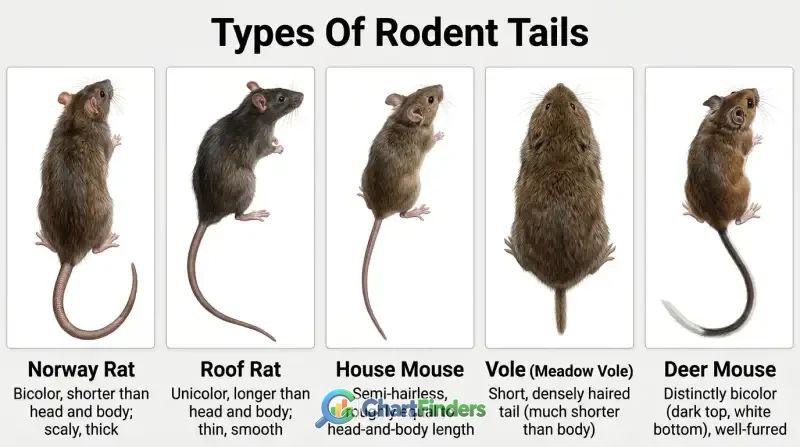
Rodent Identification Chart
- Norway Rats vs. Roof Rats: Norway rats are heavy-bodied burrowers with tails shorter than their heads and bodies combined; roof rats are sleek, agile climbers with tails longer than their combined head-and-body length.
- House Mice Distinctions: Significantly smaller than rats, house mice feature large, prominent ears, pointed snouts, and fine, hairless tails proportional to their small frames.
- Sign Tracking Matters: Dropping shape, gnaw marks, smudges, and runway locations provide definitive secondary evidence when visual sightings are rare.
- Behavioral Biology: Understanding neophobia (fear of new objects) versus exploratory behavior dictates how quickly different species interact with traps and baits.
- Regulatory Standards: Professional identification guidelines must align with established institutional frameworks, such as FELASA protocols for laboratory animals or vector control mandates for public health.
To successfully navigate pest control or field biology, one must look beyond generic descriptions of “mice and rats.” Commensal rodents—those species that live in close association with humans—exhibit specific anatomical adaptations designed for swimming, climbing, burrowing, or squeezing through microscopic gaps. The following comprehensive reference details the key physiological and environmental metrics used across the pest management industry.
Explore our detailed breakdown on Sparrow Identification Chart (Complete Data Matrix).| Species | Scientific Name | Adult Weight | Total Length (incl. tail) | Tail Characteristics | Ear & Snout Morphology | Primary Habitat & Nesting | Dropping Morphology |
|---|---|---|---|---|---|---|---|
| Norway Rat | Rattus norvegicus | 300 – 500 g | 12 – 18 inches | Bicolor, shorter than head and body; scaly, thick | Small, thick ears covered in short hair; blunt, thick snout | Burrower; ground-level, basements, sewers, crawlspaces | Large (3/4 inch), capsule-shaped with blunt ends |
| Roof Rat | Rattus rattus | 150 – 250 g | 13 – 17 inches | Unicolor, longer than head and body; thin, smooth | Large, naked, prominent ears; pointed, sharp snout | Climber; attics, trees, upper structural voids, vines | Spindle-shaped (1/2 inch) with pointed ends |
| House Mouse | Mus musculus | 12 – 30 g | 5 – 8 inches | Semi-hairless, roughly equal to head-and-body length | Large, prominent ears relative to head; pointed snout | Nests in wall voids, stored goods, boxes, ground level | Small (1/8 inch), rod-shaped with pointed ends |
| Vole (Meadow Vole) | Microtus pennsylvanicus | 20 – 50 g | 4 – 7 inches | Short, densely haired tail (much shorter than body) | Small, furry ears embedded in fur; blunt, rounded snout | Surface runways, grass thatch, shallow underground burrows | Small, rounded or blunt ends, greenish-brown to dark |
| Deer Mouse | Peromyscus maniculatus | 15 – 35 g | 5 – 8 inches | Distinctly bicolor (dark top, white bottom), well-furred | Large, prominent eyes and ears; delicate, pointed snout | Rural structures, outbuildings, tree cavities, hollow logs | Small, dark, often found clustered in hidden caches |
When analyzing the table above, note that while weight and length ranges provide solid baselines, environmental factors such as food availability and population density can cause individual specimens to fall outside standard parameters. Therefore, morphological proportions—such as tail-to-body ratios and ear prominence—serve as the most reliable diagnostic indicators.
Visualizing Rodent Biometrics and Proportions
To further clarify the physical disparities between the three primary commensal species, visual comparisons of weight ranges and tail proportions highlight distinct biological separation:
| Species Metric | Norway Rat (Rattus norvegicus) | Roof Rat (Rattus rattus) | House Mouse (Mus musculus) |
|---|---|---|---|
| Average Body Mass | 400 grams | 200 grams | 20 grams |
| Tail vs. Body Ratio | Tail is ~80% of body length | Tail is ~120% of body length | Tail equals body length |
| Climber vs. Burrower | Excels at burrowing; poor vertical climber | Exceptional acrobat and vertical climber | Nimble climber; squeezes through 1/4-inch gaps |
| Default Litters/Year | 4 to 6 litters | 4 to 6 litters | 7 to 10 litters |
Detailed Morphological Breakdown of Primary Commensal Rodents
Proper identification requires examining specific anatomical features in isolation. Commensal rodents share similar mammalian traits, but evolutionary pressures have shaped their skeletal and sensory structures quite differently based on whether they spend their lives burrowing in damp earth or balancing on high-voltage wires.
Norway Rat (Brown Rat / Sewer Rat)
The Norway rat is the largest of the common commensal rodents. Sturdily built, it can easily intimidate smaller rodent species and is responsible for massive amounts of structural and agricultural damage globally.
- Head and Body: Heavy, thick-set body. The fur is coarse, typically brown mixed with black hairs on the back, shading to gray or yellowish-white on the belly.
- Head Shape: Blunt, heavy muzzle with small, tightly set ears that do not easily fold over the eyes when pulled forward.
- Tail Construction: Scaly and bicolored (darker on top, lighter underneath), noticeably shorter than the combined length of the head and body.
- Behavioral Signatures: Highly neophobic regarding new objects in its territory. Prefers ground-level burrows dug along foundations, riverbanks, and under concrete slabs.
Roof Rat (Black Rat / Ship Rat)
Slender and exceptionally agile, the roof rat is uniquely adapted to arboreal life and elevated structural spaces. It earned the name “ship rat” due to its historical tendency to travel via maritime vessels.
- Head and Body: Sleek, slender body structure. The coat can range from jet black to gray-brown, with a belly that is often white, gray, or grayish-white.
- Head Shape: Sharp, pointed snout with large, thin, translucent ears that, when folded forward, easily reach the eyes. Large, prominent eyes give it exceptional low-light visual acuity.
- Tail Construction: Unicolorous, smooth, and finely scaled. The tail is significantly longer than the head and body combined, serving as an essential balancing organ.
- Behavioral Signatures: Excellent climber. Nests in attics, false ceilings, trees, and dense ivy. Less suspicious of new environmental changes than the Norway rat.
House Mouse
Despite sharing human habitats for millennia, the house mouse remains a distinct biological entity capable of thriving in micro-environments that cannot support larger rat populations.
- Head and Body: Small and delicate. Dusty gray or light brown fur with a lighter belly. The skeleton is remarkably compressible, allowing adults to pass through openings as small as a dime (1/4 inch).
- Head Shape: Small, pointed head featuring very large, prominent ears and dark, beady eyes.
- Tail Construction: Semi-hairless, long relative to its tiny body, and uniform in color.
- Behavioral Signatures: Highly curious. Explores new objects immediately. Range is extremely limited, often remaining within a 10-to-30-foot radius of its nest if food and water are abundant.
Secondary Identification Clues: Signatures Left Behind
Because rodents are predominantly nocturnal and cryptic, inspectors rarely see live specimens during initial site assessments. Accurate identification relies heavily on forensic clues left in the environment.
Excrement (Droppings) Analysis
Droppings are the most common diagnostic sign of a rodent infestation. Their dimensions, shape, and distribution immediately point toward a specific species:
Norway Rat Droppings
Large (approx. 3/4 inch long), capsule-shaped with blunt ends. They are dark brown and scattered randomly along active runways.
Roof Rat Droppings
Medium-sized (approx. 1/2 inch long), spindle-shaped with sharply pointed ends. Often found concentrated in elevated nesting areas or near rafters.
House Mouse Droppings
Small (approx. 1/8 inch long), rod-shaped with pointed or blunt ends. Found in large quantities scattered indiscriminately near feeding sites, inside drawers, and along baseboards.
Gnawing Habits and Structural Damage
Rodent incisors grow continuously—at a rate of several inches per year—forcing them to gnaw constantly to keep their teeth worn down to a functional length.
- Rat Gnawing: Leaves coarse, deep gouges roughly 1/8 inch wide or greater. Capable of chewing through soft metals (lead, aluminum), plastics, cinder blocks, and unreinforced wood.
- Mouse Gnawing: Leaves small, clean-cut, parallel scratch marks and fine wood shavings. Rarely damages hard metals, but easily destroys drywall, insulation, and electrical wiring.
Smudge Marks and Runways
Rodents have poor eyesight and rely on tactile hairs (vibrissae) and a strong sense of smell, hugging walls and baseboards as they travel. Over time, the oils and dirt from their fur leave dark, greasy smear marks (rub marks) along walls, beams, and entry holes.
Field Methodology and Diagnostic Decision Framework
When conducting a physical inspection, pest professionals utilize a systematic elimination framework. Follow this step-by-step diagnostic workflow to pinpoint the exact rodent species on-site:
- Observe the Spatial Elevation of Activity: Are signs, droppings, and damage concentrated at ground level, in crawlspaces, and around burrows (pointing toward Norway rats), or are they found in upper rafters, attics, and trees (pointing toward roof rats)? If activity is localized to scattered pantries, cabinets, and low wall voids with minimal structural damage, suspect house mice.
- Measure Fecal Dimensions and Shape: Collect a fresh fecal sample. If length exceeds 1/2 inch with blunt ends, it is a rat. Distinguish further: blunt capsules indicate Norway rats; spindle shapes with tapered points indicate roof rats. Droppings under 1/4 inch indicate house mice or small wild voles.
- Inspect Tail-to-Body Proportions: If a dead specimen or captured individual is available, compare the tail length to the head-and-body length. A tail shorter than the body indicates a Norway rat; a tail noticeably longer than the body indicates a roof rat; a tail roughly equal to body length points to a house mouse.
- Evaluate Environmental Entry Points: Look for exterior burrows in the soil (Norway rat) versus high-level entry points such as compromised roof shingles, unsealed soffits, or overhanging tree branches (roof rat).
Common Identification Mistakes and Diagnostic Pitfalls
Even experienced field workers can misidentify rodents if they rely on superficial characteristics or fail to account for ecological anomalies. Avoiding these common mistakes ensures precise pest management programs.
Confusing Juvenile Norway Rats with Adult House Mice
A frequent error is mistaking a young Norway rat for an adult house mouse. While both are small, a juvenile Norway rat has disproportionately large feet and a thick, blunt head relative to its immature body. A house mouse, even when young, maintains delicate features, large prominent ears, and a slender, tapered snout.
Overlooking Wild Rodent Intrusions (Voles and Deer Mice)
Structures situated near rural boundaries, fields, or heavily wooded lots often experience intrusions from wild rodent species that behave differently than true commensal pests.
- Meadow Voles: Frequently mistaken for mice, voles have short, densely haired tails, rounded bodies, and blunt faces. They rarely infest interior wall voids, instead building surface runways in lawns and occasionally girdling the bark of landscape trees under snow cover.
- Deer Mice: Distinguished by sharply bicolored tails (dark top, stark white bottom) and pure white underbellies. They are primary vectors for Hantavirus and often enter cabins, sheds, and rural homes during autumn.
Misinterpreting Drop Locations as Species Proof
Rats are excellent travelers and can climb into attics or drop down into basements from unexpected heights. Relying on dropping location alone without evaluating physical morphology, gnaw patterns, and local habitat can lead to treating an attic for Norway rats when the actual culprit is an agile roof rat population.
Frequently Asked Questions
Size and shape are the definitive indicators. Mouse droppings are tiny—about the size of a grain of rice (1/8 inch)—with pointed ends. Rat droppings are substantially larger. Norway rat droppings are capsule-shaped (3/4 inch) with blunt ends, whereas roof rat droppings are spindle-shaped with pointed ends.
No. While house mice occasionally dig shallow, protected earth cavities under heavy cover, they do not construct the extensive, deep burrow systems characteristic of Norway rats. House mice prefer to nest inside structural voids, behind insulation, inside furniture, and within stored goods.
Tail proportions directly reflect evolutionary locomotion habits. Roof rats are arboreal climbers that use their tails as balancing poles, resulting in a tail longer than their head and body combined. Norway rats are ground-dwelling burrowers; their tails act less as balancers and remain shorter than their combined head and body length.
It is rare for both species to establish large populations in the exact same micro-habitat due to direct competition and aggression by the larger Norway rat. However, in large commercial complexes, warehouses, or multi-story structures, Norway rats may occupy the lower levels and sewers while roof rats inhabit upper structural zones and attics.
Different rodent species carry different pathogen profiles and ectoparasites. For example, deer mice are notorious reservoirs for Sin Nombre virus (causing Hantavirus Pulmonary Syndrome), while roof rats are historically linked to plague-carrying fleas due to their proximity to maritime trade and human sleeping quarters. Correct identification ensures targeted vector control and appropriate personal protective equipment (PPE) deployment.
Conclusion
Mastering rodent identification requires moving past generalized assumptions and utilizing a rigorous, multi-faceted diagnostic approach. By evaluating morphological proportions, analyzing structural damage, examining fecal morphology, and understanding the distinct behavioral biology of Norway rats, roof rats, and house mice, professionals and property owners alike can implement precise, effective management strategies. Accurate identification eliminates trial-and-error pest control, safeguards public health, and protects structural integrity against costly vertebrate damage.