
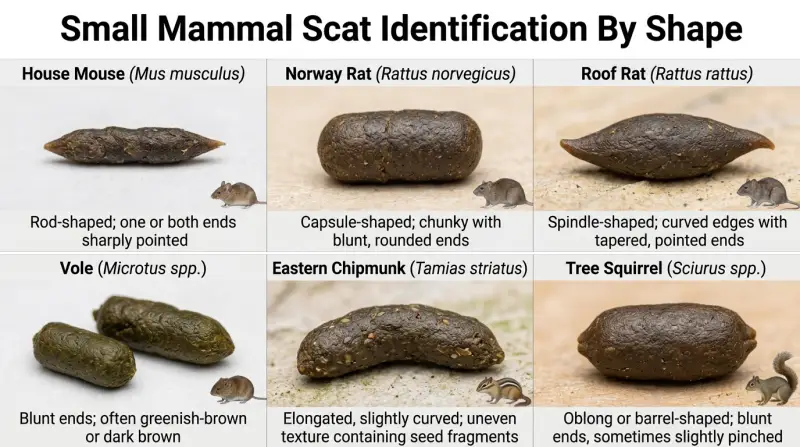
Rodent Scat Identification Chart
- Rodent droppings are structurally categorized by length, diameter, end shape (pointed vs. blunt), and surface texture.
- House mice produce small, rice-grain-sized pellets (1/8 to 1/4 inch) with sharply pointed ends.
- Norway rats leave large, capsule-shaped droppings (up to 3/4 inch) featuring blunt ends, typically concentrated in specific latrine sites.
- Roof rat scat is distinguished by an elongated, spindle or curved shape with pointed tips, measuring around 1/2 inch.
- Dietary composition directly alters scat appearance; seed-heavy diets produce firmer, lighter-colored droppings, while insect- or garbage-based diets create dark, irregular deposits.
- Freshness is determined by moisture content and pliability; fresh deposits are dark and pliable, whereas older deposits turn chalky gray and crumble upon touch.
- Standard safety procedures—including respiratory protection and damp clean-up methods—must be utilized to prevent aerosolization of dangerous pathogens when inspecting droppings.
The following master reference framework consolidates the primary physical metrics and behavioral indicators required to differentiate various rodent droppings encountered in field and structural environments. Use this chart as an initial diagnostic screen before performing granular inspections.
| Species | Average Length | Diameter | Shape & Ends | Color (Fresh vs. Old) | Typical Spatial Distribution |
|---|---|---|---|---|---|
| House Mouse (Mus musculus) | 1/8 to 1/4 inch (3–6 mm) | Approx. 1/16 inch | Rod-shaped; one or both ends sharply pointed | Dark brown to black; turns gray and chalky | Scattered randomly along runways, feeding sites, and nesting areas |
| Norway Rat (Rattus norvegicus) | 3/4 inch (approx. 19 mm) | 1/4 inch | Capsule-shaped; chunky with blunt, rounded ends | Dark brown; turns light gray with age | Concentrated in localized latrine areas, burrows, and basement corners |
| Roof Rat (Rattus rattus) | 1/2 inch (approx. 12–15 mm) | 1/8 to 3/16 inch | Spindle-shaped; curved edges with tapered, pointed ends | Dark brown to black; turns gray-brown | Scattered in elevated spaces, attics, rafters, and upper structural framing |
| Vole (Microtus spp.) | 1/4 to 3/8 inch | 1/8 inch | Blunt ends; often greenish-brown or dark brown | Greenish-brown to dark; fades to tan when dry | Found along surface runways in grass, mulch beds, and shallow soil depressions |
| Eastern Chipmunk (Tamias striatus) | 1/3 to 1/2 inch | 1/8 inch | Elongated, slightly curved; uneven texture containing seed fragments | Brown to dark brown | Near burrow entrances, stone walls, and garden perimeters |
| Tree Squirrel (Sciurus spp.) | 3/8 to 5/8 inch | 1/4 inch | Oblong or barrel-shaped; blunt ends, sometimes slightly pinched | Dark brown, olive-brown, or reddish | Found beneath trees, on deck railings, and in attic entry points |
Reading this table requires evaluating multiple morphological dimensions simultaneously. Never rely on size alone, as sub-adult rats can produce droppings that overlap in length with large mice, necessitating close inspection of end-cap geometry and deposition patterns.
Anatomical Foundations of Rodent Scat
Rodent digestive tracts are optimized for high-efficiency fiber and grain processing, though physiological differences across species dictate the final morphology of their waste. As food passes through the stomach and intestines, nutrients are extracted, and moisture is reclaimed in the hindgut. The resulting fecal bolus is compressed into a cylindrical pellet as it passes through the anal sphincter.
The distinct shape of rodent scat is largely a byproduct of intestinal contraction patterns and the animal’s physical size. Smaller rodents like the house mouse possess narrower colons that shape waste into delicate, tapered rods. Conversely, larger rodents like the Norway rat possess wider colons, producing thicker, more robust cylinders with blunt terminals where the fecal stream broke off.
Morphological Signatures of Common Rodent Species
Differentiating between specific pest species is essential for targeted eradication and management. Each species exhibits distinct deposition habits and physical dimensions that reflect its biological niche and foraging behavior.
House Mouse Droppings
House mouse (Mus musculus) droppings are among the most frequently encountered indoor contaminants. They measure between 1/8 and 1/4 inch in length—roughly the size of a grain of long-grain rice. The ends are typically pointed, and the surface texture is slightly rough due to undigested paper, insulation, or fibrous plant matter. A single mouse can produce between 50 and 80 droppings per 24-hour period. Because mice explore haphazardly rather than along strict, linear paths, their scat is typically found scattered randomly across pantry shelves, inside drawers, and along baseboards rather than concentrated in neat piles.
Norway Rat Droppings
Often referred to as sewer rats, brown rats, or wharf rats, Norway rats (Rattus norvegicus) produce the largest common structural rodent droppings. Measuring up to 3/4 inch long and nearly 1/4 inch in diameter, these pellets resemble large dark capsules or coffee beans. Both ends are characteristically blunt and rounded. Norway rats establish communal latrine sites; discovering a cluster of dozens of uniformly sized, fresh droppings in a dark corner, crawlspace, or near a burrow entrance strongly indicates a Norway rat infestation.
Roof Rat Droppings
Roof rats (Rattus rattus), also known as black rats or fruit rats, leave droppings that are intermediate in size between mice and Norway rats—typically around 1/2 inch long. Unlike the blunt ends of Norway rat scat, roof rat droppings feature tapered, pointed ends, and the pellet body often exhibits a slight curve or spindle shape. Because roof rats are agile climbers, their scat is frequently discovered in elevated locations, including attic insulation, false ceilings, rafters, and upper-story wall voids.
Vole and Field Mouse Scat
Voles (Microtus species) and field mice generate droppings that are commonly mistaken for indoor pests when found near structural foundations or mulched garden beds. Vole scat measures about 1/4 to 3/8 inch long with blunt ends. Because voles consume high quantities of green vegetation, grass blades, and roots, their fresh droppings often display a greenish-brown tint that dries to a dull, fibrous tan. These are found exclusively outdoors along surface runways through grass or beneath heavy thatch.
Environmental Degradation and Scat Aging
The physical condition of rodent scat provides direct chronological data regarding active versus historical infestation status. Understanding how droppings degrade over time prevents unnecessary chemical treatments in vacant spaces and highlights active harborage zones.
- Fresh Phase (0 to 24 Hours): Droppings are dark brown to glossy black, pliable when pressed with a gloved finger, and retain a distinct, musky odor. Moisture content is high, and the surface may exhibit a slight sheen.
- Intermediate Phase (1 to 7 Days): The outer layer loses moisture and begins to turn dull. The pellet stiffens significantly, and the musky odor fades. Color shifts from deep black to a muted dark brown.
- Old Phase (1 Week to Months/Years): Droppings become completely dry, brittle, and chalky gray. When compressed, they easily crumble into fine dust. The interior matrix may contain bleached plant fibers or hair shafts.
When conducting an audit, pest control professionals use the “touch test” (performed strictly with gloved hands or tools) or visual sheen analysis to determine whether droppings found in an attic or basement represent an ongoing infestation or remnants from a previous season.
Dietary Impacts on Scat Characteristics
While baseline size and shape remain relatively constant within a species, diet introduces significant variability in color, texture, and consistency. Rodents are opportunistic omnivores or herbivores depending on the species.
When rats or mice gain access to pantry staples such as flour, grains, or pet kibble, their droppings become lighter in color, uniform in texture, and firmly packed. Conversely, if rodents are feeding on municipal waste, meat scraps, or high-moisture fruits and vegetables, the resulting scat becomes darker, softer, and more irregularly shaped. Insect-heavy diets—frequently consumed by mice foraging in crawlspaces—leave chitinous fragments embedded in the fecal matter, which glistens under inspection lighting.
Safety Protocols and Health Hazards
Inspecting and cleaning rodent droppings carries inherent biological risks. Dried rodent excreta can break down into fine particulate dust that, when disturbed, becomes airborne and poses severe respiratory hazards.
| Pathogen / Disease | Primary Carrier Species | Transmission Mechanism | Clinical Symptoms |
|---|---|---|---|
| Hantavirus Pulmonary Syndrome (HPS) | Deer Mouse (Peromyscus maniculatus) | Inhalation of aerosolized virus from dried urine, saliva, or droppings | Fever, muscle aches, fatigue, followed rapidly by respiratory failure |
| Leptospirosis | Norway Rats, Mice, Voles | Contact of broken skin or mucous membranes with contaminated water or soil | High fever, headache, chills, muscle aches, vomiting, jaundice |
| Salmonellosis | House Mice, Rats | Ingestion of food or water contaminated with rodent feces | Diarrhea, abdominal cramps, fever starting 6 hours to 6 days after exposure |
| Lymphocytic Choriomeningitis (LCMV) | House Mouse | Inhalation of infectious aerosols or contact with broken skin | Aseptic meningitis, fever, malaise, lack of appetite, muscle ache |
To safely manage areas contaminated by rodent activity, adhere to strict remediation protocols:
- Never Sweep or Vacuum Dry Scat: Sweeping or using standard vacuums aerosolizes dried viral particles and bacteria, dramatically increasing inhalation risks.
- Apply Disinfectant First: Saturate the droppings and surrounding contaminated surfaces with a 10% household bleach solution (1 part bleach to 9 parts water) or an EPA-registered hospital-grade disinfectant. Allow it to sit for at least 10 to 15 minutes.
- Collect and Seal: Pick up the soaked droppings using paper towels or a disposable scraper. Place the waste into double-sealed plastic bags before disposal in outdoor bins.
- Personal Protective Equipment (PPE): Always wear nitrile gloves and an N95 or P100 respirator mask when disturbing suspected rodent latrine sites in enclosed structures like attics or crawlspaces.
Differentiating Rodent Scat from Look-Alikes
A common pitfall in wildlife tracking is misidentifying non-rodent droppings as pest activity. Several common animals produce scat that mimics rat or mouse droppings.
Bat Guano vs. Mouse Scat
Bat guano is frequently found on porches, window sills, or beneath attic soffits where bats roost. While similar in size to mouse droppings, bat guano consists entirely of insect exoskeletons. When crushed between fingers, bat guano crumbles into a glittering, powdery dust composed of shiny insect wings and shell fragments. Mouse droppings, by contrast, contain fibrous plant material and hair, crushing into a dull, earthy meal.
Lizard and Gecko Droppings
Reptile droppings are often cylindrical and dark, but they feature a distinct white or yellowish uric acid cap at one end. Rodents never excrete uric acid caps; their waste is uniformly colored throughout.
Small Predator Scat (Shrews and Weasels)
Shrews and small mustelids produce dark, twisted droppings that often contain visible hair and bone fragments. Shrew scat is typically smaller than mouse scat and has a distinct, pungent, musky odor.
Frequently Asked Questions
Fresh droppings are dark brown or black, moist, slightly pliable, and may have a subtle sheen. As they age past 24 to 48 hours, they lose moisture, become dull and stiff, and eventually turn chalky gray. Old droppings crumble easily into dust when compressed, whereas fresh droppings offer slight resistance before squishing or breaking cleanly.
Yes. Dried mouse droppings can carry pathogens such as Hantavirus and Salmonella. Direct contact with broken skin or inhaling dust from disturbed droppings can lead to severe illness. Always wet down droppings with a disinfectant solution, wear gloves and an N95 respirator, and avoid dry sweeping or vacuuming.
Size and shape are the primary differentiators. Mouse droppings are 1/8 to 1/4 inch long with sharp, pointed ends. Rat droppings are substantially larger; Norway rat droppings reach up to 3/4 inch with blunt, rounded ends, while roof rat droppings measure around 1/2 inch with tapered, pointed ends and often a curved shape.
Certain rodent species—most notably the Norway rat—establish communal latrine sites where multiple individuals consistently deposit waste. Finding a large cluster of uniform droppings in a dark corner or near a structural wall typically indicates a primary latrine associated with a rat nest or heavy traffic zone.
Yes. A diet rich in seeds and grains produces firm, light-brown droppings with a uniform texture. A diet consisting of garbage, meat scraps, or high-moisture pet food results in darker, softer, and more irregularly shaped droppings that may emit a stronger odor.
Proper rodent scat identification bridges the gap between guessing and effective pest management. By systematically evaluating structural dimensions, end-cap geometry, deposition patterns, and environmental degradation, property owners and field specialists can accurately determine species identity, gauge infestation severity, and implement targeted remediation strategies while maintaining rigorous safety standards.