
Walking along a tidal shoreline and discovering an intact, intricately patterned seashell is one of the enduring joys of coastal exploration. Yet, that initial moment of discovery is almost invariably followed by a familiar question: “What is this one called?” Because marine mollusks inhabit nearly every aquatic ecosystem on Earth, from intertidal rock pools to abyssal plains, the diversity of shells washed ashore is staggering. From the heavy, robust conchs of subtropical waters to the delicate, translucent bivalves of temperate mudflats, seashells offer a physical archive of marine biodiversity.
However, identifying these calcareous structures can quickly become overwhelming for the amateur beachcomber and even seasoned naturalists. Nature does not adhere to rigid, uniform templates; juvenile specimens look drastically different from adults, environmental stressors alter coloration, and wave action constantly wears down diagnostic spines and surface sculpture. To navigate this diversity without frustration, observers rely on systematic identification frameworks. Modern technological tools, including AI-powered smartphone applications and regional field guides, have revolutionized how people approach beachcombing, yet the core principles of morphological taxonomy remain the definitive standard for accurate identification.
This master guide provides an authoritative, field-tested breakdown of seashell morphology, taxonomy, and identification strategies. Whether you are cataloging finds from Central and South Florida, searching for rare specimens, or simply trying to understand the basic architecture of mollusks, this resource equips you with the foundational knowledge required to read the physical language of shells.
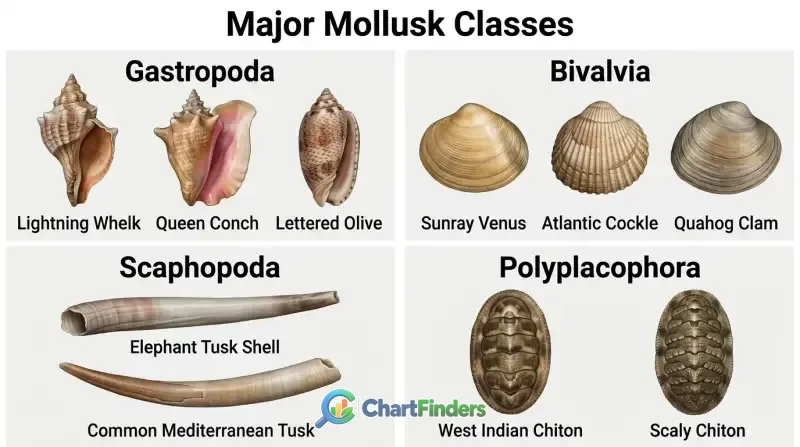
Shell Identification Chart Fundamentals and Morphology
- Seashell identification is rooted in structural morphology, dividing primarily into classes such as Gastropoda (snails), Bivalvia (clams), and Scaphopoda (tusk shells).
- Key diagnostic features include the aperture (opening), spire, columella, umbo, and hinge teeth.
- Gastropods typically exhibit spiral coiling, which can be dextral (right-handed) or sinistral (left-handed) depending on the species.
- Bivalves require examining valve symmetry, adductor muscle scars, and the hinge plate to determine species-level identity.
- Environmental factors, wear patterns, and growth stages often cause phenotypic variation, making reliance on color alone unreliable.
- Modern field identification combines classical morphological charts with digital tools like AI image analysis and regional checklists.
- Safety is ; beachcombers must verify that a shell is unoccupied before collection to protect live marine animals and avoid venomous organisms.
To use any identification chart effectively, you must first master the anatomical terminology of mollusks. A seashell is not merely a decorative object; it is an external exoskeleton secreted by the mantle of a soft-bodied animal. Understanding how this structure grows provides immediate clues to its taxonomic family.
Classifying the Major Molluscan Groups
The phylum Mollusca contains several classes represented on beaches worldwide, but three dominate shell collections:
- Gastropoda (Gastropods): Single-piece (univalve) shells that are typically coiled in a spiral. Examples include conchs, whelks, olives, and volutes.
- Bivalvia (Bivalves): Shells composed of two separate valves connected by an elastic ligament and a hinge mechanism. Examples include clams, cockles, mussels, and oysters.
- Scaphopoda (Scaphopods): Tubular, tapering shells open at both ends, commonly known as tusk shells or tooth shells.
Anatomical Landmarks of Gastropods
When examining a univalve or snail shell, identification charts direct your attention to specific architectural zones:
- Apex: The oldest, topmost tip of the shell where embryonic growth began.
- Spire: All the whorls of the shell visible above the body whorl, excluding the aperture. Spire height (high-spired vs. flat/depressed) is a primary taxonomic divider.
- Body Whorl: The largest, final whorl of the shell that terminates at the opening.
- Aperture: The main opening through which the animal extends its head and foot. The shape, interior coloration, and presence of teeth or notches inside the aperture are critical diagnostic traits.
- Outer Lip and Inner Lip: The boundaries of the aperture. The inner lip often sits against the columella—the central pillar around which the whorls are wound.
- Siphonal Canal: A groove or tubular extension at the anterior end of the aperture through which the living animal extends its siphonal current.
Anatomical Landmarks of Bivalves
Bivalve identification requires a different set of visual references because the shell consists of two lateral halves:
- Umbo (Beak): The swollen, prominent point near the hinge where growth of the valve originated. The umbo typically points toward the anterior (front) end of the shell.
- Hinge Line and Teeth: The interlocking projections and sockets along the dorsal margin that align the two valves when the shell closes.
- Pallial Line and Sinus: Interior markings left by the mantle attachment. A deep indentation (pallial sinus) indicates the animal has retractable siphons (burrowing habits), while a smooth, unbroken line indicates a surface-dwelling habit.
- Sculpture: Radial ribs (running from umbo to margin) versus concentric rings (running parallel to the growth margin).
| Molluscan Class | Primary Symmetry | Key Diagnostic Features | Common Regional Examples | Identification Difficulty |
|---|---|---|---|---|
| Gastropoda | Asymmetrical spiral univalve | Spire height, aperture shape, columella folds, siphonal canal | Lightning Whelk, Queen Conch, Lettered Olive | Moderate (requires looking at aperture and interior) |
| Bivalvia | Bilateral symmetry (two valves) | Umbo position, hinge teeth, pallial sinus, radial/concentric ribs | Sunray Venus, Atlantic Cockle, Quahog Clam | Moderate to High (internal scars often needed) |
| Scaphopoda | Bilaterally symmetrical tubular cone | Length, curvature, apical opening diameter | Elephant Tusk Shell, Common Mediterranean Tusk | Low (limited morphological variation) |
| Polyplacophora | Series of eight overlapping dorsal plates | Plate sculpture (valves), girdle texture and spicules | West Indian Chiton, Scaly Chiton | High (requires plate counting and girdle analysis) |
The table above outlines the core structural differences that separate major shell groups. When starting an identification session, determining whether a specimen possesses a single coiled whorl, two matching valves, or tubular symmetry immediately eliminates 90% of potential taxonomic confusion.
Comparative Analysis of Common Shell Families
To refine identification beyond basic classes, beachcombers must examine family-level characteristics. Certain families exhibit highly specialized adaptations that make them instantly recognizable once the diagnostic clues are understood.
The Whelk and Conch Families (Melongenidae and Strombidae)
Large predatory and grazing gastropods often dominate shorelines, yet amateurs frequently confuse heavy conchs with large whelks. Strombidae (True Conchs) possess a specialized notch on the outer lip of the aperture known as the “strombid notch,” through which the animal extends its eye stalk. They also typically feature a flared outer lip in adulthood. In contrast, Melongenidae (Whelks) lack this notch and often display pronounced shoulder knobs or spines, along with a prominent siphonal canal.
A classic regional example is the Busycon contrarium (Lightning Whelk). Unlike the vast majority of gastropods which exhibit dextral (right-handed) coiling, the Lightning Whelk is almost exclusively sinistral (left-handed)—meaning the aperture opens on the left side when the apex points upward. Recognizing left-handed coiling instantly narrows down identification in North American Atlantic waters.
The Olive Family (Olividae)
Olive shells are prized for their high-gloss finish, cylindrical shape, and seamless appearance. The animal secretes a mantle that covers the shell, preventing encrusting organisms from settling and maintaining its polished luster. To identify species within Olividae, experts examine the sutures (the lines where whorls meet) and the distinctive channeling near the base of the aperture, along with color bands that range from stark white to deep violet-brown.
The Bivalve Spectrum: Venus Clams and Cockles
Among bivalves, the family Veneridae (Venus clams) represents one of the most successful and morphologically diverse groups. They are sturdy, heavy shells with robust hinge teeth and rounded to triangular outlines. They are easily distinguished from Cardiidae (true cockles), which feature striking, symmetrical radial ribs that create a distinct “corrugated” profile and a heavily toothed margin where the two valves lock together.
Modern Identification Tools: AI Apps vs. Traditional Charts
The methodology of shell identification has undergone a profound technological shift. For generations, beachcombers relied entirely on printed field guides, taxonomic keys, and comparative museum collections. Today, digital integration has transformed the workflow.
Contemporary identification ecosystems now incorporate AI-powered mobile applications available on platforms like Google Play. These applications leverage machine learning models trained on millions of marine biology datasets to analyze digital photographs of shells instantly. When a user uploads a photo, the algorithm evaluates color gradients, surface texture, aperture geometry, and outline contours to suggest species matches with confidence scores.
Strengths and Limitations of AI Shell Identifiers
- Speed: AI apps provide immediate baseline possibilities within seconds, making them exceptionally useful for novices in the field.
- Educational Integration: Many digital guides pair identification results with marine biology facts, habitat ranges, and conservation status.
- Visual Dependency Flaws: AI models struggle when a shell is severely worn, bleached by the sun, encrusted with barnacles, or viewed from an ambiguous angle that obscures the aperture.
- Geographic Blind Spots: Generic algorithms may suggest a species native to the Indo-Pacific when the user is beachcombing in the Mediterranean or the Gulf of Mexico, highlighting the necessity of geographic context.
Therefore, the most reliable identification workflow combines the speed of AI screening with the rigorous verification of traditional regional identification charts and anatomical keys.
Step-by-Step Shell Identification Framework
When you pick up an unidentified shell, following a structured physical examination prevents misidentifications and builds taxonomic fluency. Apply this step-by-step decision framework in the field:
- Verify Occupancy and Safety: Before touching or collecting any shell, ensure it is vacant. Live mollusks, hermit crabs, and venomous marine life (such as cone snails or blue-ringed octopuses in certain regions) frequently inhabit shells. Never collect a live animal.
- Determine the Symmetry Class: Look at the overarching architecture. Is it a single univalve spiral (Gastropod), a pair of matching hinged plates (Bivalve), a tubular cone (Scaphopod), or segmented plates (Chiton)?
- Assess Orientation and Coiling (Gastropods): Hold the shell with the apex pointing upward and the aperture facing toward you. Does the opening sit on the right (dextral) or the left (sinistral)? Measure the relative height of the spire compared to the body whorl.
- Examine the Aperture and Lip: Look inside the opening. Are there teeth, folds on the columella, or a thickened outer lip? Is there a long siphonal canal or a short notch? These features separate predatory carnivorous snails from herbivores.
- Analyze Surface Sculpture and Color: Feel the exterior. Are the ridges running spirally, radially, or concentrically? Note the base color and pattern markings (e.g., zigzags, blotches, bands). Remember that sun-bleached shells lose color, so rely on sculpture and shape over pigmentation.
- Cross-Reference with Regional Charts: Consult a localized field guide or digital chart specific to the geographic body of water where the shell was found. Marine species have strict biogeographic ranges; finding a tropical reef cowry on a temperate New England beach usually indicates discarded ballast or a traveler’s souvenir rather than a native population.
Common Mistakes and Identification Pitfalls
Even experienced beachcombers occasionally stumble into classic identification traps. Recognizing these pitfalls ensures higher accuracy:
- Over-Relying on Coloration: Environmental diet, water temperature, and sun exposure cause extreme color variation within a single species. A brightly banded calico scallop can sometimes appear entirely pale white or deep purple. Always prioritize structural morphology over color.
- Confusing Juvenile and Adult Forms: Many gastropods undergo dramatic morphological changes when reaching maturity. For instance, juvenile conchs lack the heavily flared, thickened outer lip that defines adults, leading collectors to misclassify them as standard whelks.
- Ignoring Wear and Torsion: Wave action aggressively tumbles shells, wearing down fragile spines, smoothing out delicate ribs, and eroding the apex. A heavily eroded lightning whelk can lose its characteristic shoulder knobs, resembling a generic smooth spindle shell.
- Ignoring Geographic Native Ranges: Assuming any shell can wash up anywhere ignores oceanographic currents and biogeography. Always filter your identification candidates by the specific marine province or coastline you are visiting.
Frequently Asked Questions
Look closely inside the aperture. If you see dark fleshy tissue, an operculum (the horny “trapdoor” sealing the opening), or movement within, leave the shell immediately. Additionally, if the shell feels unusually heavy for its size, it may be occupied by a dense hermit crab rather than housing its original owner.
Coiling direction is genetically determined during early embryonic development through chiral cleavage patterns. While the overwhelming majority of gastropod species are dextral (right-handed), certain families or genetic mutations within populations produce sinistral (left-handed) specimens, which serves as a powerful diagnostic identifier.
To remove organic residue and unpleasant odors, soak non-porous shells in a 1:1 mixture of warm water and household white vinegar for no more than 30 to 60 minutes, followed by thorough rinsing in fresh water. Avoid acid soaking on delicate nacreous shells (like abalone or certain bivalves), as acid will dissolve the lustrous outer layers.
AI apps serve as exceptional preliminary screening tools that narrow down potential species in seconds. However, because lighting, wear, and rare color morphs can confuse algorithms, they should be used alongside traditional regional charts and anatomical checklists for definitive identification.
When a mollusk dies, organic pigments within the periostracum (the outer protein layer) and shell matrix degrade when exposed to sunlight, wave action, and bacterial breakdown. Prolonged UV exposure strips away color patterns, leaving behind the underlying calcium carbonate structure in stark white.
Conclusion
Mastering shell identification bridges the gap between casual beachcombing and genuine ecological appreciation. By looking past surface colors and examining foundational architectural traits—such as aperture geometry, spire height, hinge structures, and coiling symmetry—you transform an anonymous calcium carbonate fragment into a distinct biological story. Whether you utilize traditional taxonomic charts, regional field guides, or instant AI screening tools, systematic observation remains the key to unlocking the hidden biodiversity of our world’s coastlines.