
Managing land molluscs in agricultural fields, commercial nurseries, and home gardens begins with proper identification. Gardeners, agronomists, and researchers frequently lump all slimy, soft-bodied gastropods into a single category of general pests. However, treatment strategies, economic thresholds, and seasonal activity patterns vary drastically across species. While some gastropods feed aggressively on emerging crops and ornamental foliage, others are primarily detritivorous, feeding on decaying organic matter, or predatory, hunting other ground-dwelling invertebrates.
Field identification can be challenging due to high intraspecific color variation, juvenile developmental changes, and the ability of many species to contract or alter their body shape when disturbed. Relying solely on color or size is a common pitfall that leads to misdiagnosis and ineffective control methods. This comprehensive reference guide provides the morphological criteria, diagnostic charts, and contextual insights necessary to correctly identify key land mollusc species.
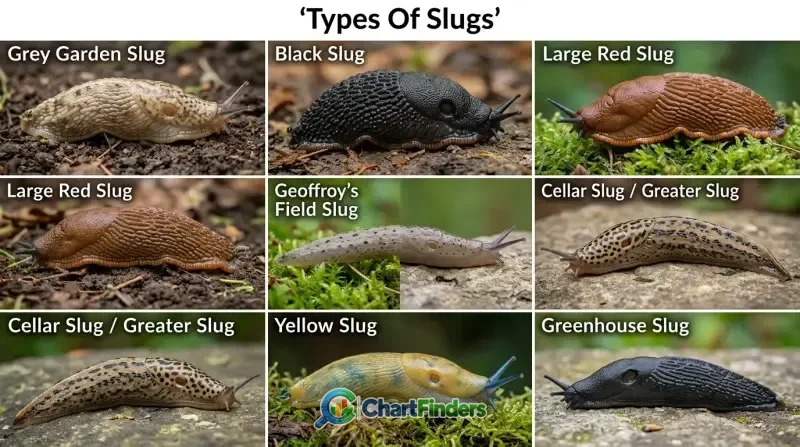
Slug Identification Chart
- Pneumostome Position: The location of the breathing pore relative to the mantle’s midpoint is a primary taxonomic separator.
- Keel Development: A ridge running down the dorsal tail region separates keeled slugs (Limacidae) from round-backed families.
- Mucus Characteristics: Sticky, clear, or brightly colored (yellow/orange) mucus serves as an essential defensive and identification trait.
- Behavioral Timing: Most pest species are nocturnal or active during high-humidity periods, retreating beneath soil clods or debris at dawn.
- Juvenile Challenges: Immature specimens often lack adult pigmentation, requiring structural examination (keels, mantle texture) for accurate ID.
To successfully navigate pest management and ecological surveys, field observers must understand the structural morphology of gastropods. The following reference table contrasts the defining physical characteristics, typical habitats, and economic pest status of the most widespread land mollusc groups encountered in temperate agricultural and horticultural environments.
| Common Name | Scientific Name | Size Range | Key Diagnostic Features | Mucus Type | Primary Pest Status |
|---|---|---|---|---|---|
| Grey Garden Slug | Deroceras reticulatum | 30–50 mm | Mottled cream/grey-brown; off-center pneumostome in rear half of mantle; wrinkled skin texture. | Milky white when disturbed | Major agricultural & horticultural pest |
| Black Slug | Arion ater | 100–150 mm | Large, bulky body; rounded back with no keel; coarse tubercles; color ranges from jet black to orange/brown. | Sticky, bright yellow or orange slime | Moderate garden pest; feeds on foliage and decaying matter |
| Large Red Slug | Arion rufus | 120–180 mm | Very large; foot fringe often a contrasting color; heavily wrinkled mantle; difficult to distinguish from A. ater without dissection. | Vivid orange/yellow slime | Significant pest in gardens and soft fruit production |
| Geoffroy’s Field Slug | Deroceras invadens | 30–45 mm | Slender; pale grey or brownish with darker spots; nearly identical externally to D. reticulatum; internal examination often required. | Thin, watery, turning milky when irritated | Widespread urban and agricultural pest |
| Cellar Slug / Greater Slug | Limax maximus | 100–200 mm | Large, slender; leopard-like spots and stripes; prominent keel on posterior tail; forward-facing pneumostome. | Clear and watery (not sticky) | Minor pest; primarily feeds on fungi, decaying matter, and occasionally other slugs |
| Yellow Slug | Limax flavus | 75–100 mm | Yellowish body with blue-green mottling; blue tentacles; smooth mantle with fine pattern. | Yellowish, watery mucus | Found around damp cellars, greenhouses, and organic debris; minor plant pest |
| Greenhouse Slug | Milax gagates | 40–65 mm | Dark grey to black; distinct, sharp dorsal keel running from mantle to tail tip; pear-shaped mantle grooves. | Sticky, clear or whitish slime | Pest of root crops, tubers, and greenhouse container plants |
The table above outlines the foundational baseline for field identification. However, because external appearances can shift based on diet, hydration levels, and age, examining specific anatomical features in detail is necessary for definitive classification.
Anatomical Markers Used in Slug Identification
Gastropod taxonomy relies heavily on soft-body morphology. Unlike shelled molluscs where shell whorls dictate identity, soft-bodied land slugs require the observation of specific external landmarks.
The Mantle and Pneumostome
The mantle is the fleshy, hood-like structure located just behind the head. On the right side of this mantle lies the pneumostome (the breathing pore). The position of this pore is a primary taxonomic differentiator:
- Forward or Center: If the pneumostome is located anteriorly or near the exact midpoint of the right mantle edge, the specimen typically belongs to the family Limacidae (e.g., Limax maximus).
- Posterior Half: If the breathing pore is situated clearly in the rear half of the right mantle edge, it belongs to the family Agriolimacidae (e.g., Deroceras species).
Dorsal Keels and Body Textures
The contour of the back provides an instant clue to family classification:
- Keeled Slugs (Milacidae and Limacidae): These species possess a distinct, raised ridge (the keel) running along the midline of the back from the rear edge of the mantle to the tip of the tail. In Milax species, this keel is sharp and runs the entire length; in Limax, it is restricted to the posterior tail section.
- Round-Backed Slugs (Arionidae): Members of this family lack a dorsal keel entirely. Their backs are rounded, highly convex, and covered in pebble-like or worm-like tubercles (wrinkles).
Mucus Composition and Coloration
When handled or irritated, slugs secrete mucus as a defense mechanism and locomotory lubricant. The physical properties of this mucus are highly diagnostic:
- Clear and Watery: Characteristic of Limax species; leaves little residue on fingers.
- Milky White: Typical of Deroceras species when disturbed.
- Vivid Yellow or Orange: A definitive indicator of the Arion genus (such as Arion ater or Arion rufus). This bright secretion serves as an aposematic warning to predators.
Major Slug Families and Species Profiles
Understanding the behavioral habits, preferred environments, and life cycles of individual species enables targeted monitoring and timing of cultural or chemical controls.
Family Agriolimacidae: The Agate Slugs (Genus Deroceras)
The genus Deroceras includes some of the most destructive agricultural pests worldwide, particularly in broadacre field crops, canola, cereals, and cool-season vegetables.
The Grey Garden Slug (Deroceras reticulatum): This species is arguably the most economically damaging pest across temperate agricultural zones. It is highly adaptable, tolerating varied soil types and temperature fluctuations. Adults measure up to 50 mm in length and display a pale cream, fawn, or greyish-brown background overlaid with a darker, mottled network pattern that is often concentrated on the sides. When irritated, it produces a characteristic sticky, milky-white slime. It lays clusters of transparent eggs under soil clods, stones, or crop residue throughout autumn, winter, and spring.
Geoffroy’s Field Slug (Deroceras invadens): Externally almost indistinguishable from D. reticulatum, this species has spread globally through international plant trade. It thrives in urban gardens, nurseries, and damp agricultural margins. Positive identification often requires internal dissection of the genitalia, making careful field logging and habitat association vital.
Family Arionidae: The Round-Backed Slugs (Genus Arion)
Characterized by their robust bodies, lack of a dorsal keel, and granular skin texture, Arion species are prominent in woodland edges, perennial gardens, and damp pastures.
The Black Slug (Arion ater) and Large Red Slug (Arion rufus): These two closely related species are often grouped as the Arion ater complex due to hybridization and overlapping physical traits. Despite their common names, color is notoriously unreliable: both species can be jet black, dark brown, bright reddish-orange, or pale yellow. They can grow up to 150–180 mm long. Their primary defense is curling into a tight, sticky sphere and rocking from side to side while exuding copious amounts of bright yellow or orange mucus. They feed heavily on herbaceous plants, fungi, and decaying matter.
Family Limacidae: The Cellar and Garden Slugs (Genera Limax and Lehmannia)
Limacid slugs are generally larger, sleeker creatures with long bodies, keels restricted to the tail, and watery mucus.
The Cellar Slug / Great Grey Slug (Limax maximus): Reaching lengths up to 200 mm, this impressive species features striking dark spots and longitudinal stripes along its pale grey or yellowish body. It is commonly found in damp cellars, outbuildings, woodpiles, and shaded garden borders. While it occasionally feeds on garden plants, its diet consists primarily of fungi, algae, rotting vegetation, and occasionally other smaller slug species, rendering its pest status secondary compared to Deroceras.
Family Milacidae: The Keeled Slugs (Genus Milax)
The Greenhouse Slug (Milax gagates): Easily recognized by its prominent, sharp dorsal keel running all the way from the mantle to the tail tip, this dark grey to jet-black slug is specialized for a subterranean lifestyle. It spends the majority of its life underground, feeding on potato tubers, root crops, bulbs, and the taproots of ornamentals. Its presence is frequently overlooked until harvest when deep, smooth cavities are discovered in underground crops.
Seasonal Activity and Monitoring Dynamics
Slug populations fluctuate dramatically in response to temperature and moisture. Field monitoring data from agricultural monitoring projects illustrate distinct seasonal cycles:
- Spring Emergence: Overwintered eggs hatch as temperatures rise and spring rains provide abundant surface moisture. Juvenile and adult populations peak during mid-to-late spring, causing maximum damage to emerging seedlings and shoot growth.
- Summer Estivation: As temperatures increase and soil moisture drops in late spring and early summer, overall slug activity declines sharply. Many species burrow deep into soil crevices, under large stones, or beneath dense crop canopies to estivate (enter a state of dormancy), posing minimal risk to crops during the peak of summer.
- Autumn Resurgence: With the return of cooler temperatures and autumn precipitation, adults resume surface activity, feeding aggressively and laying eggs that will overwinter.
Common Identification Pitfalls and Look-Alikes
Accurate field identification requires avoiding several frequent mistakes:
- Relying Solely on Coloration: Color morphs within species like Arion ater range from pure white and bright orange to deep black. Using color alone results in misidentifications. Always check mantle markings, slime color, and body shape.
- Confusing Slugs with Other Soil Organisms: Certain soil-dwelling larvae, flatworms (such as the New Zealand flatworm or Australian flatworm), and large caterpillars are occasionally mistaken for slugs. True slugs lack jointed legs, possess sensory tentacles, and produce characteristic mucus trails.
- Overlooking Juveniles: Immature slugs of large species (like Limax maximus or Arion rufus) are frequently misidentified as distinct miniature species. Juvenile identification requires careful observation of structural proportions and microscopic or tactile examination of key features.
Frequently Asked Questions
Most agricultural pests belong to the genera Deroceras (small, mottled, milky mucus) or Arion (large, round-backed, yellow mucus), which feed heavily on living plant tissue. Conversely, large limacid slugs (like Limax maximus) with clear mucus and leopard spotting often feed on fungi, detritus, and occasionally other slugs, making their overall garden impact much more benign.
Mucus characteristics are chemically consistent diagnostic markers. For example, Arion species universally produce a vivid, sticky yellow or orange slime used to deter predators, whereas Deroceras species produce a milky white secretion when physically irritated, and Limax species secrete thin, clear, watery slime.
Slugs do not typically vanish entirely, but their surface activity drops significantly as temperatures rise and soils dry out. During late spring and summer, populations retreat deep into soil cracks, root zones, and organic mulch layers to estivate, emerging again when autumn rains arrive.
A dorsal keel is a raised, longitudinal ridge running along the middle of a slug’s back behind the mantle. Slugs in the families Milacidae (keeled slugs) and Limacidae (cellar/garden slugs) possess keels—either running the entire length of the body to the tail tip or restricted to the posterior tail section—whereas round-backed slugs in the family Arionidae lack a keel completely.
Juveniles can be difficult to identify visually because distinct banding and color morphs often develop later in life. To identify them, focus on permanent structural traits: check the relative position of the pneumostome on the mantle, determine whether a dorsal keel is present, and observe the texture of the skin (whether smooth, wrinkled, or covered in prominent tubercles).
Conclusion
Proper slug identification moves pest management beyond generalized, wasteful treatments toward targeted, sustainable control. By examining stable morphological markers—such as pneumostome placement, mantle texture, dorsal keels, and mucus secretion color—observers can reliably differentiate destructive agricultural pests from benign or beneficial soil dwellers. Integrating this morphological knowledge with an understanding of seasonal activity patterns ensures effective timing of monitoring efforts and protection for crops and gardens throughout the growing season.