
Encountering a hidden clutch of eggs beneath a rotting log, buried in a garden mulch bed, or tucked into a damp basement corner often triggers immediate curiosity and concern. Unlike birds, which deposit hard, calcium-rich eggs in elevated nests, most native snakes produce soft-shelled, leathery or parchment-like ova designed to absorb ambient moisture from their surrounding substrate. Because female snakes invest significant metabolic energy into selecting secluded, thermally stable incubation sites, discovering these clutches offers a rare glimpse into local herpetofauna dynamics. However, distinguishing between the eggs of harmless beneficial rodent controllers and those of venomous pit vipers remains a critical priority for property owners, wildlife rehabilitators, and field researchers alike.
The challenge of snake egg identification lies in their morphological plasticity. Unlike avian eggs, which maintain fixed dimensions and rigid crystalline shells, reptile eggs undergo physiological changes throughout their incubation period. As they draw water and mineral ions from the nest medium, they swell, change weight, and shift contour. , interspecies variability is often eclipsed by intraspecific differences driven by maternal age, diet, and environmental humidity. This comprehensive master guide examines the structural biology, morphological markers, deposition behaviors, and comparative characteristics required to interpret hidden reptilian clutches safely and accurately.
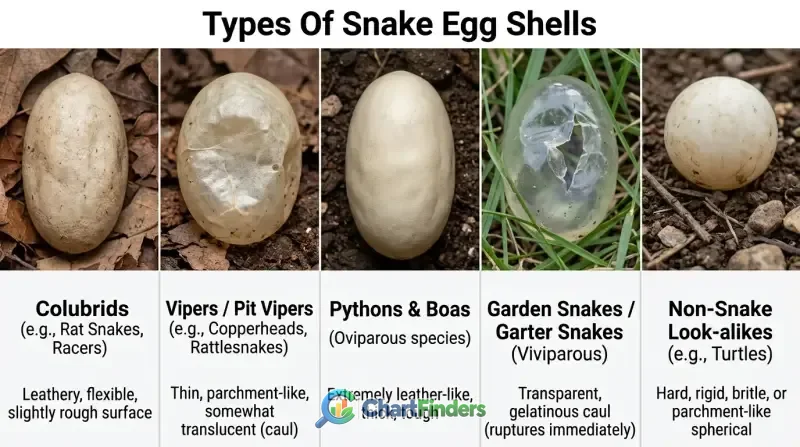
Snake Egg Identification Chart
- Snake eggs possess pliable, leathery, or parchment-like shells that yield to gentle pressure, distinguishing them instantly from brittle avian or hard-shelled turtle eggs.
- Clutches are frequently adhered or stuck together in cohesive masses; attempting to forcibly separate them can tear the delicate outer membrane and kill the developing embryo.
- Reptile eggs lack chalazae—the rope-like protein cords that anchor bird yolks—meaning any accidental rotation during handling can cause the internal yolk to crush the embryo.
- Unlike bird eggs, which are laid at final size, snake eggs absorb environmental moisture and expand significantly in both length and width as incubation progresses.
- Visual identification down to the exact species level is notoriously difficult from morphology alone, often requiring geographic context, clutch size, and habitat analysis.
- Incubation environments require specific temperature and humidity thresholds; desiccation or supersaturation will quickly arrest embryogenesis.
To assist in field evaluation, the following identification matrix categorizes common North American and general reptilian reproductive characteristics. Use this reference alongside local geographic distributions and habitat parameters.
| Species Group / Type | Average Dimensions (Inches) | Shell Texture & Flexibility | Clutch Adhesion | Typical Deposition Site |
|---|---|---|---|---|
| Colubrids (e.g., Rat Snakes, Racers) | 1.0 – 2.5 inches long | Leathery, flexible, slightly rough surface | Often fused into large, sticky clusters | Rotting logs, mulch piles, loose soil, abandoned burrows |
| Vipers / Pit Vipers (e.g., Copperheads, Rattlesnakes) | 1.2 – 1.8 inches long (Viviparous – born live) | Thin, parchment-like, somewhat translucent (caul) | Loosely clustered or semi-adherent | Under flat rocks, inside hollow logs, rock crevices |
| Pythons & Boas (Oviparous species) | 2.0 – 5.0+ inches long | Extremely leather-like, thick, tough | Strongly bound; guarded by coiled female | Deep subterranean chambers, termite mounds, tree hollows |
| Garden Snakes / Garter Snakes (Viviparous) | N/A (Born live with thin membranes) | Transparent, gelatinous caul (ruptures immediately) | Not applicable (live birth) | Grassy tussocks, under debris (born encased, emerge instantly) |
| Non-Snake Look-alikes (e.g., Turtles) | 0.8 – 1.5 inches diameter | Hard, rigid, brittle, or parchment-like spherical | Usually separate, completely un-adhered | Excavated flask-shaped nests in open, sunny soil |
When analyzing this data, remember that measuring a clutch in the wild must be done with extreme care. Touching or altering the alignment of the eggs can disrupt their delicate gas exchange membranes or cause fatal internal trauma.
Anatomy and Biological Structure of Snake Eggs
Understanding the unique internal architecture of a snake egg clarifies why standard egg-handling techniques fail when applied to reptiles. While bird eggs are engineered for high-energy avian brooding—requiring a rigid calcium carbonate shell to support the incubating parent’s weight—snake eggs belong to an evolutionary strategy centered on moisture retention and subterranean burial.
The Shell Membrane and Moisture Exchange
The exterior of a snake egg consists of a multi-layered protein matrix impregnated with calcium salts, though in concentrations far lower than those found in avian shells. This composition results in a texture reminiscent of heavy-duty parchment paper or soft leather. The shell is semi-permeable, featuring microscopic pores that facilitate the bidirectional diffusion of respiratory gases ($O_2$ and $CO_2$) and water vapor.
Unlike bird eggs, which contain a fixed internal water budget established at the moment of laying, snake eggs depend entirely on the surrounding substrate for hydration. If the nest medium dries out, the eggs lose turgor pressure, shrivel, and the embryos dehydrate. Conversely, if the soil becomes waterlogged, the microscopic pores flood, cutting off oxygen exchange and suffocating the developing neonates.
Absence of Chalazae and the Danger of Rotation
A fundamental biological distinction between avian and reptilian reproductive biology involves internal stabilization structures. Bird eggs possess specialized proteinaceous ropes called chalazae that anchor the yolk in the center of the albumen, keeping the germinal disc elevated regardless of how the egg rolls in a nest.
Reptile eggs completely lack chalazae. The yolk floats freely within the internal fluid matrix. If a human or a predator picks up a snake egg and rotates, tilts, or inverts it, the heavy yolk rolls against the delicate inner membranes. This mechanical shift can crush the developing embryo or rupture the yolk sac, terminating gestation instantly. For this reason, field researchers emphasize that any collected eggs must remain in their exact original orientation.
Visual and Tactile Identification Criteria
Because direct observation of the mother snake is rare, identification must rely entirely on morphological features of the clutch. Field investigators evaluate specimens using four primary parameters: shape, texture, clustering behavior, and deposition context.
Shape and Dimensional Dynamics
Avian eggs are typically oval or asymmetric (pyriform), designed to roll in circles rather than fall off cliffs. Snake eggs, however, are almost universally oblong, cylindrical, or elliptical. Their length-to-width ratio is noticeably elongated.
Crucially, dimensions change over time. A freshly laid colubrid egg might measure 1.2 inches upon deposition, but by absorbing water from a damp log over a 60-day incubation window, it can swell to nearly 2 inches in length. Therefore, relying solely on ruler measurements without accounting for incubation stage leads to misidentification.
Texture and Elasticity
Tactile examination—performed only when absolutely necessary and with clean, bare hands or sterile gloves—reveals a yielding, pliable surface. Pressing gently on a snake egg yields a springy resistance, akin to a deflated rubber ball or a thick leather pouch. Hard, rigid shells that crack under pressure indicate turtle, gecko, or bird origin, not snake origin.
Clutch Adhesion and Deposition Patterns
When a female snake oviposits, the eggs are coated in a viscous fluid that hardens slightly upon air exposure, gluing adjacent eggs together into a unified, consolidated mass. If you encounter a cluster of eggs stuck tightly to one another like grapes in a bunch, it is almost certainly a colubrid snake clutch (such as a rat snake or milk snake).
By contrast, many turtle species lay spherical eggs that remain completely separate and independent within the soil. Pit viper eggs are occasionally found touching, but their parchment-like membranes are less rigidly fused than those of rat snakes.
Oviparous vs. Viviparous Species: A Critical Distinction
A common pitfall in snake egg identification is assuming that all snakes lay eggs. In reality, squamate reproduction is divided into two primary strategies: oviparous (egg-laying) and viviparous (live-bearing).
| Reproductive Mode | Embryonic Nourishment | Maternal Investment | Representative Taxa |
|---|---|---|---|
| Oviparous (Egg-Laying) | Yolk nutrient store inside shelled egg | Site selection, occasional brooding/guarding, no postpartum care | Rat snakes, racers, king snakes, pythons, cobras |
| Viviparous (Live-Bearing) | Placental transfer or yolk sac retained internally | Internal gestation, behavioral thermoregulation during pregnancy | Vipers, rattlesnakes, garter snakes, water snakes, boas |
Many people search for “rattlesnake eggs” or “copperhead eggs” in woodpiles, unaware that North American pit vipers are viviparous. They give birth to fully formed live young encased in a thin, translucent embryonic membrane (the caul) which the neonates rupture and discard within minutes of birth. Finding a clutch of leathery, independent eggs underground almost never points to a rattlesnake; it points to a harmless egg-laying colubrid.
Step-by-Step Field Identification Process
When an unknown clutch is discovered, field naturalists follow a structured investigative framework to identify the origin without damaging the reproductive viability of the nest.
- Assess the Surroundings: Note the immediate microhabitat. Is the clutch buried in loose garden soil, tucked inside a decaying hardwood stump, hidden under a flat slate stone, or exposed in an open lawn? Subterranean and rotting wood environments strongly favor egg-laying colubrid species.
- Examine Shell Rigidity: Without applying heavy pressure, test the surface give. Pliable, leathery, or wrinkled surfaces confirm reptilian origin. Brittle, chalky, or hard-calcite surfaces point to avian or chelonian (turtle) sources.
- Check Clustering and Adhesion: Observe whether the eggs are fused together in a sticky mass. Fused clusters strongly suggest rat snakes or other large colubrids. Separated, loose eggs require closer inspection for shell texture.
- Analyze Shape and Color: Pure white, elongated oblong shapes point toward snakes or lizards. Yellowish, tinted, or perfectly spherical shapes often indicate turtles.
- Consult Local Range Maps: Cross-reference the discovery location with regional herpetological databases to eliminate species whose geographic ranges do not overlap with the site.
Common Mistakes and Identification Pitfalls
Misidentifying reptile clutches is remarkably common due to striking convergent evolution among egg-laying organisms. Recognizing these frequent errors prevents unnecessary panic or ecological disruption.
- Confusing Snake Eggs with Turtle Eggs: Turtle eggs are almost universally spherical and have either rigid, brittle shells or tough, parchment-like skins that do not stick together in fused clusters. Finding round eggs in an open, sun-baked patch of dry soil almost always indicates a turtle, not a snake.
- Assuming All Venomous Snakes Lay Eggs: Because venomous elapids (like cobras) and pythons lay eggs, the public frequently assumes local venomous snakes (like rattlesnakes and copperheads) do the same. As established, American pit vipers are live-bearers. Finding a nest of eggs eliminates venomous pit vipers from consideration.
- Rotating Discovered Eggs: A well-intentioned homeowner discovering eggs in a garden bed often picks them up, turns them over to inspect them, or relocates them into a bucket. Because snake eggs lack chalazae, this rotation frequently drowns the embryo in the yolk, resulting in total clutch failure.
- Pest insect cocoons, such as those of certain large beetles or hornet nests constructed underground, are occasionally mistaken for reptile eggs. Closer inspection reveals papery or silken fibrous walls rather than leather-like protein membranes.
Frequently Asked Questions
The eggs themselves are not venomous or toxic, and a developing embryo poses zero physical threat. However, handling wild reptile eggs can transfer skin oils or bacteria onto the semi-permeable shell, potentially clogging respiratory pores. , disturbing a nest may provoke a defensive maternal snake (such as a rat snake or python) lingering nearby to protect her clutch.
If the location does not interfere with daily activities, the best course of action is to leave them undisturbed. Beneficial snakes are exceptional rodent controllers. If the eggs must be moved—such as during major landscaping work—relocate them as a cohesive unit into a nearby damp, shady spot (like a brush pile or compost heap) without separating them and without altering their exact vertical orientation.
Incubation periods vary widely depending on ambient temperature and species, but most common North American snakes hatch within 50 to 70 days. The process typically occurs from mid-summer through early autumn (July to September), when solar warmth peaks.
Healthy, viable snake eggs are plump, turgid, and pearly white or cream-colored. As they develop, some species show pinkish or yellowish internal vascular networks when backlit carefully with a small flashlight (candling). Dead or unfertilized eggs quickly turn yellow, brown, or gray, collapse inward, develop mold, or emit a foul odor.
Most common colubrid snakes deposit their eggs in hidden sites and abandon them immediately, offering no parental care. However, certain species—most notably pythons, king cobras, and occasionally large rat snakes—coil their bodies around the clutch, using muscular contractions (shivering thermogenesis) to generate heat and protect the eggs from predators until hatching.
Conclusion
Interpreting reptilian clutches requires patience, an understanding of reproductive biology, and careful observation of physical traits. By recognizing that snake eggs are leathery, oblong, moisture-absorbent, and frequently adhered together—while remembering that many dangerous pit vipers give live birth—observers can accurately contextualize these hidden biological packages. Whether left undisturbed to hatch beneficial rodent predators or carefully relocated away from construction zones, respecting the structural fragility of these remarkable eggs ensures the continued balance of local ecosystems.