
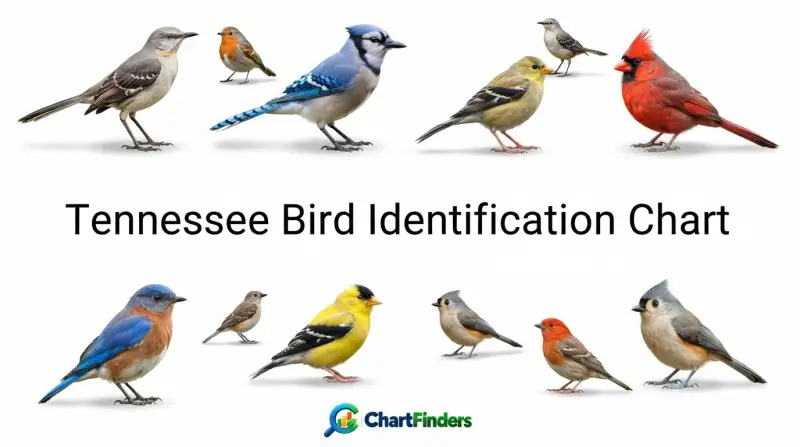
Tennessee occupies a unique biogeographical crossroads in North America, bridging the southern extensions of the Appalachian Mountains, the rolling topography of the Interior Low Plateau, the fertile basin of Middle Tennessee, and the flat agricultural bottomlands of the west. This diverse topography produces varied microclimates and habitats, supporting a rich avian community that fluctuates throughout the year. Whether you are observing the massive winter Sandhill Crane migration in East Tennessee, tracking forest-dwelling warblers in the Great Smoky Mountains, or documenting backyard feeder visitors in Nashville and Memphis, structured identification frameworks are essential for accurate field work.
Navigating this avian diversity can be challenging due to seasonal plumage shifts, sexual dimorphism, and subtle morphological variations among related taxa. Recent conservation milestones, such as the Tennessee Wildlife Resources Agency’s ongoing efforts to reintroduce extirpated species like the Red-cockaded Woodpecker, highlight how dynamic and carefully monitored the state’s bird populations truly are. This guide provides an exhaustive framework for identifying Tennessee birds, exploring regional distribution, feeding habits, taxonomic groups, and analytical identification charts to elevate your field skills.
Tennessee Bird Identification Chart
- Tennessee hosts over 400 documented bird species across diverse ecosystems, ranging from high-elevation spruce-fir forests to lowland wetlands.
- Effective bird identification relies on a combination of size and shape (gestalt), color patterns, bill structure, behavioral traits, and distinct vocalizations.
- Backyard bird feeding guides for Tennessee typically focus on 45 core residential and migratory feeder species, including cardinals, titmice, goldfinches, and various woodpeckers.
- Regional birding hotspots such as the Great Smoky Mountains, Reelfoot Lake, and the Hiwassee Wildlife Refuge support specialized avian communities year-round.
- Conservation initiatives, including the reintroduction of the Red-cockaded Woodpecker by the Tennessee Wildlife Resources Agency, emphasize the importance of preserving mature pine savannas.
To master Tennessee bird identification, observers must move beyond casual color matching and adopt a systematic approach based on taxonomy, morphology, and ecology. The state’s avifauna is divided into permanent residents, summer breeding migrants, winter visitors, and transient species moving along major flyways like the Mississippi Flyway.
The following master reference chart summarizes key taxonomic families, primary identification markers, typical habitats, and seasonal status across Tennessee’s geographical zones.
| Taxonomic Family | Key Representative Species | Diagnostic Identification Markers | Primary Tennessee Habitat | Seasonal Status |
|---|---|---|---|---|
| Cardinals & Allies (Cardinalidae) | Northern Cardinal, Blue Grosbeak, Indigo Bunting | Cone-shaped seed-cracking bills; strong sexual dimorphism in males/females. | Woodland edges, brushy fields, suburban feeders | Permanent Resident / Summer Breeder |
| Woodpeckers (Picidae) | Downy, Hairy, Pileated, Red-headed, Red-cockaded | Stiff tail feathers for vertical trunk bracing; chisel-like bills; undulating flight. | Mature deciduous and pine forests, dead snags | Permanent Resident |
| Mimic Thrushes (Mimidae) | Northern Mockingbird, Gray Catbird, Brown Thrasher | Long tails, curved bills, complex repeating vocalizations and mimicry. | Thickets, suburban yards, brushy forest edges | Permanent Resident / Summer Breeder |
| New World Sparrows (Passerellidae) | Song Sparrow, White-throated Sparrow, Dark-eyed Junco | Streaked brown/gray plumage; conical seed-eating bills; ground-foraging behavior. | Weedy fields, brush piles, forest floors | Winter Visitors / Permanent Residents |
| Wood Warblers (Parulidae) | Yellow-rumped Warbler, Chestnut-sided Warbler, Ovenbird | Small, active insectivores; often brightly colored males in spring breeding plumage. | Canopy and understory of deciduous forests | Migrants / Summer Breeders |
| Hawks & Eagles (Accipitridae) | Red-tailed Hawk, Cooper’s Hawk, Bald Eagle | Broad wings, hooked raptorial bills, sharp talons; soaring or perching posture. | Open agricultural fields, river corridors, forests | Permanent Residents / Winter Visitors |
When analyzing this identification chart, notice how bill morphology directly correlates with dietary niches. Conical bills indicate granivores (seed-eaters), slender pointed bills suggest insectivores, and hooked raptors represent carnivores. Integrating these functional traits with geographic context narrows down potential candidates immediately.
Geographic Distribution and Avian Habitats in Tennessee
Tennessee’s topography spans roughly 500 miles from east to west, creating three distinct grand divisions—East, Middle, and West Tennessee—each supporting unique bird populations shaped by elevation, geology, and hydrology.
East Tennessee: The Appalachian Highlands
Dominated by the Blue Ridge and Ridge-and-Valley provinces, East Tennessee features high-elevation spruce-fir forests and rugged mountain ridges. This zone shares avian characteristics with northern Canada, harboring breeding populations of Black-throated Blue Warblers, Canada Warblers, and Red-breasted Nuthatches. Mountain streams attract Louisiana Waterthrushes, while rocky crags and high ridges provide foraging territory for Peregrine Falcons and Common Ravens.
Middle Tennessee: The Highland Rim and Central Basin
Characterized by rolling hills, limestone glades, and extensive agricultural valleys, Middle Tennessee is a stronghold for open-country and woodland-edge species. The region’s numerous reservoirs and river systems—such as Old Hickory Lake and Percy Priest Lake—serve as crucial stopover points for waterfowl, herons, and gulls. Suburban feeders throughout Nashville and surrounding counties brim with Tufted Titmice, Carolina Chickadees, and American Goldfinches.
West Tennessee: The Mississippi Alluvial Plain
The westernmost sector features flat topography, cypress swamps, bottomland hardwood forests, and major aquatic landmarks like Reelfoot Lake. This ecosystem supports high concentrations of wading birds, including Great Blue Herons, Great Egrets, and Wood Ducks. The Mississippi River corridor acts as a primary superhighway for migratory waterfowl and neotropical songbirds navigating the Mississippi Flyway.
Backyard Feeder Identification: The Core Tennessee Species
For many enthusiasts, bird identification begins right outside the kitchen window. Tennessee backyard feeding stations regularly attract a predictable suite of species. Understanding the subtle differences between similar feeder visitors prevents common misidentifications.
Distinguishing Downy vs. Hairy Woodpeckers
One of the most frequent identification dilemmas in Tennessee backyards involves telling the small Downy Woodpecker apart from its larger counterpart, the Hairy Woodpecker. Both exhibit identical black-and-white dorsal patterns with white backs and red nape patches on males. However, key proportional differences separate the two:
- Size: The Downy Woodpecker measures roughly 6.5 inches (sparrow-sized), whereas the Hairy Woodpecker measures around 9.5 inches (robin-sized).
- Bill Length: The Downy features a stubby, delicate bill that is noticeably shorter than the width of its head. The Hairy possesses a robust, chisel-like bill that equals or exceeds the length of its head.
- Outer Tail Feathers: Downy outer tail feathers are typically barred with black spots; Hairy outer tail feathers are clean, pristine white.
Differentiating Titmouse, Chickadee, and Nuthatch
Small, active feeder visitors can blur together for novice observers. The Carolina Chickadee features a distinct black cap and bib with soft gray flanks and a short, dark bill. The Tufted Titmouse is slightly larger, silver-gray above with a prominent crest (topknot), rusty flanks, and a prominent black patch above its bill. Meanwhile, the White-breasted Nuthatch can be instantly recognized by its unique behavior of moving head-first down tree trunks, paired with a stark white face, bluish-gray back, and nasal, yarring call.
Raptors and Waterbirds of Tennessee
Beyond backyard feeders and songbird woodlots, Tennessee’s wetlands, rivers, and open fields support apex predators and specialized aquatic species.
Raptor Identification in the Field
Hawk identification relies heavily on silhouette, wing-to-tail proportions, and flight style. Buteos—such as the Red-tailed Hawk and Red-shouldered Hawk—feature broad wings and rounded tails, frequently soaring in wide circles over open fields or highway medians. Accipiters, including the Cooper’s Hawk and Sharp-shinned Hawk, possess short, rounded wings and long tails designed for high-speed, agile navigation through dense woodlands. Falcons, like the American Kestrel, display long, pointed wings and rapid, shallow wingbeats.
The Sandhill Crane Phenomenon and Wetland Species
Each winter, tens of thousands of Sandhill Cranes descend upon East Tennessee, particularly around the Hiwassee Wildlife Refuge near Dayton, Tennessee. Standing over four feet tall with a wingspan exceeding six feet, these majestic grey waders fly with necks fully extended, emitting resonant, trumpeting calls. They share wetland habitats with Great Blue Herons (which fly with their necks curved back in an ‘S’ shape), Double-crested Cormorants, and seasonal waterfowl.
Step-by-Step Field Identification Method
When encountering an unfamiliar bird in Tennessee, resist the urge to immediately flip through field guide pages. Instead, apply a systematic, step-by-step evaluation process to narrow your options logically.
- Evaluate Gestalt (Overall Size and Shape): Is the bird stout like a sparrow, sleek like a swallow, or long-legged like a heron? Compare its bulk to familiar reference birds like a House Sparrow, American Robin, or Crow.
- Examine the Bill Structure: What is the shape of the feeding apparatus? Conical bills indicate seed-cracking; thin, pointed bills suggest insect gleaning; hooked bills denote predatory habits; flat, broad bills point toward dabbling or filter-feeding.
- Note Plumage Patterns and Coloration: Look for distinct field marks—wing bars, eye rings, eyebrow stripes (supercilia), crown color, breast streaking, or tail patches. Note whether sexual dimorphism is present.
- Observe Behavior and Locomotion: How does the bird move? Does it creep vertically up tree trunks, hop on the ground scratching leaf litter, forage upside down on branch tips, or soar effortlessly on thermal currents?
- Listen to Vocalizations: Songs and calls are often the most reliable diagnostic tools. Note rhythm, pitch, quality (buzzing, whistling, fluting), and repetition patterns.
Common Identification Mistakes and Look-Alikes
Even experienced birders occasionally misidentify species due to tricky seasonal plumage shifts, juvenile variations, or deceptive lighting conditions. Being aware of common pitfalls prevents field errors.
- Fall Warbler Confusion: Breeding male warblers are brightly colored and easily named, but fall and winter warblers often drop their vibrant hues, donning dull olive-green and grayish tones. For example, the Yellow-rumped Warbler retains its diagnostic bright yellow rump patch year-round, serving as a vital anchor for identification when other field marks fade.
- House Finch vs. Purple Finch: While House Finches are common year-round Tennessee feeder visitors, Purple Finches arrive as winter visitors. Male Purple Finches exhibit a deeper, raspberry-red coloration that extends down their backs and flanks, whereas House Finches display a brighter red restricted mostly to the head, breast, and rump, accompanied by heavily streaked brown flanks.
- Juvenile Herons: Immature Little Blue Herons hatch out entirely white, leading many observers to misidentify them as Snowy Egrets or Cattle Egrets. Checking bill color (two-toned grayish-blue with a dark tip in juvenile Little Blue Herons versus bright yellow in Cattle Egrets and black with yellow feet in Snowy Egrets) prevents misclassification.
Frequently Asked Questions
How many bird species can be found in Tennessee?
Over 400 species of birds have been documented within Tennessee’s borders. This high number is driven by the state’s diverse geography, ranging from the high-elevation Appalachian spruce-fir forests to the Mississippi River basin, as well as its position along major migratory flyways.
What is the most common backyard bird in Tennessee?
The Northern Cardinal holds the title of Tennessee’s state bird and remains one of the most widespread and recognizable backyard visitors year-round. Other extremely common backyard species include the Carolina Chickadee, Tufted Titmouse, American Goldfinch, House Finch, and Mourning Dove.
When is the best time of year for birdwatching in Tennessee?
While birding is rewarding year-round, peak diversity occurs during the spring (April to May) and autumn (September to October) neotropical migrations, when hundreds of transient species pass through the state. Additionally, winter brings remarkable concentrations of waterfowl, raptors, and Sandhill Cranes to Tennessee’s refuges and lakes.
Where are the best birding locations in East Tennessee?
East Tennessee boasts world-class birding locations, including the Great Smoky Mountains National Park (ideal for high-elevation warblers and thrushes), Seven Islands State Bird Park along the French Broad River, and the Hiwassee Wildlife Refuge, renowned for its massive wintering populations of Sandhill Cranes and Bald Eagles.
How can I attract more diverse birds to my Tennessee backyard feeder?
To maximize backyard diversity, offer a variety of food sources in clean feeders. Black-oil sunflower seeds attract the widest range of finches, titmice, and cardinals; surefire suet blocks draw woodpeckers, nuthatches, and wrens; and nyjer (thistle) seed specifically targets American Goldfinches. Supplementing feeders with a fresh, moving water source (such as a birdbath with a dripper) is often the single most effective way to attract species that do not typically visit seed trays.
Conclusion
Mastering Tennessee bird identification requires a blend of geographic awareness, taxonomic knowledge, and careful field observation. From the rugged peaks of the Blue Ridge to the rich bottomlands of the Mississippi River, Tennessee’s varied landscapes support a vibrant avian community that shifts with the seasons. By utilizing systematic identification charts, paying close attention to bill morphology, behavior, and vocalizations, and supporting local conservation initiatives, birders can deepen their understanding and appreciation of Tennessee’s remarkable natural heritage.