
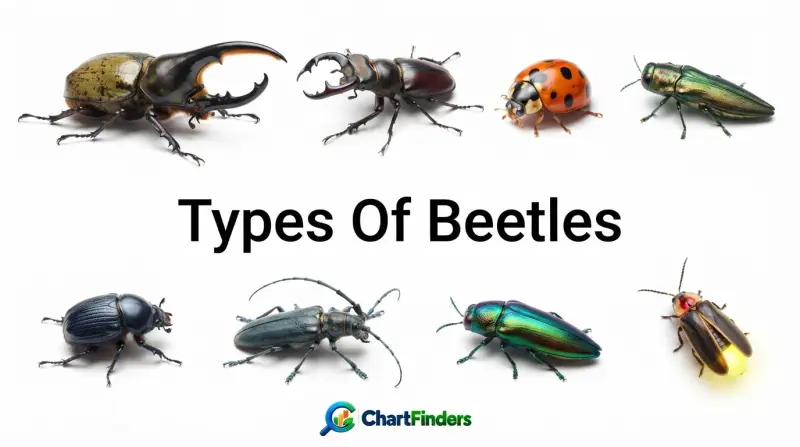
The Order Coleoptera represents a magnificent pinnacle of evolutionary success, accounting for roughly forty percent of all known insect species. From damp forest floors where saproxylic species break down decaying timber to agricultural fields plagued by herbivorous pests, beetles occupy almost every conceivable terrestrial and aquatic niche. Understanding the vast diversity of beetles requires a close examination of their morphological variations, ecological roles, and taxonomic classifications. Whether examining newly discovered specimens near academic research facilities or tracking seasonal emergences driven by climatic shifts, entomologists continue to uncover the immense complexity hidden within this single insect order.
Taxonomic Diversity and Biological Classification: Understanding the Types Of Beetles
- Coleoptera is the largest insect order, defined by hardened forewings (elytra) meeting in a straight line down the dorsal midline.
- Metamorphosis is complete (holometabolous), progressing through egg, larva, pupa, and adult instars.
- Major families include Carabidae (ground beetles), Curculionidae (weevils), Staphylinidae (rove beetles), and Chrysomelidae (leaf beetles).
- Ecological roles vary immensely, spanning predaceous, herbivorous, saprophytic, and mycophagous feeding guilds.
- Morphological adaptations such as lamellate antennae, elongated rostra, and reduced elytra serve as primary diagnostic identification features.
To systematically categorize the staggering variety of beetles, taxonomists divide the order Coleoptera into four primary suborders: Adephaga, Archostemata, Myxophaga, and Polyphaga. By far the largest of these is Polyphaga, containing the vast majority of commonly encountered beetle families. Morphologically, beetles are immediately distinguished from other insect orders by their unique wing modification. The forewings are heavily sclerotized into protective shells known as elytra, which shield the underlying flight wings and dorsal abdominal segments during burrowing, resting, or navigating dense vegetation. When in flight, the elytra lift outward, remaining stationary to provide aerodynamic stability while the membranous hindwings execute propulsion.
The anatomical structures of beetles offer vital clues for identification and classification. Mouthparts are uniformly adapted for chewing (mandibulate), though the specific geometry of the mandibles reflects dietary specialization—ranging from the massive, scissor-like cutting blades of predaceous tiger beetles to the delicate, grinding structures of pollen-feeding flower chafers. Antennae exhibit immense morphological divergence across families, appearing filiform (thread-like), clavate (clubbed), serrate (saw-toothed), pectinate (comb-like), or lamellate (plated), serving as primary sensory organs for chemical and tactile detection.
Suborder Polyphaga: The Dominant Superfamily Assemblages
Accounting for more than ninety percent of all beetle species, Polyphaga displays incredible ecological plasticity. Within this suborder, several superfamilies and families command significant attention from both professional entomologists and citizen scientists alike.
Carabidae (Ground Beetles)
Ground beetles are predominantly nocturnal, fast-running predators that patrol the soil surface, leaf litter, and under-bark microhabitats. Anatomically, Carabidae feature thread-like antennae, prominent mandibles, and specialized trochanters on the hind legs that facilitate rapid locomotion. Many species possess chemical defense mechanisms, spraying irritating quinones from abdominal glands when threatened. The subfamily Cicindelinae (tiger beetles), often treated as a separate family, showcases extreme visual predatory behavior with bulging compound eyes and rapid interception speeds.
Curculionidae (Weevils)
Recognizable by their distinct elongated snouts—or rostra—at the tip of which reside the mandibles, weevils represent one of the largest families of organisms on Earth. This rostrum is utilized for boring into plant tissues to deposit eggs or feed on internal structures. The antennae are typically elbowed (geniculate) with a terminal club. Many agricultural pests, such as the boll weevil and various grain borers, belong to this diverse family, alongside beneficial species utilized for biological weed control.
Staphylinidae (Rove Beetles)
Rove beetles are easily identified by their shortened, truncated elytra that leave a large portion of the flexible abdominal segments exposed. Despite their deceptively earwig-like appearance, rove beetles are true beetles capable of strong flight using wings meticulously folded beneath their brief elytra. Staphylinidae are exceptionally diverse, inhabiting soil, dung, decaying fungi, and ant nests as predators, scavengers, or commensals.
Chrysomelidae (Leaf Beetles)
Leaf beetles are phytophagous insects that feed exclusively on plant foliage, stems, and roots across all life stages. Adults often display bright, metallic warning coloration (aposematism) or specialized friction devices that produce sound when disturbed. Prominent examples include the Colorado potato beetle and flea beetles, both of which possess hypertrophied hind femora adapted for jumping away from danger.
Cerambycidae (Longhorned Beetles)
Characterized by exceptionally long antennae that frequently exceed the total length of the insect’s body, longhorned beetles are major components of forest ecosystems. Their larvae are wood-boring xylophages that excavate extensive galleries beneath the bark and into the heartwood of stressed or dead trees. This tunneling action accelerates nutrient cycling in woodland environments, though certain invasive species can cause severe economic damage to timber and orchard industries.
Comparative Analysis of Major Beetle Families
To differentiate the vast array of beetle morphologies and ecological niches, researchers rely on systematic diagnostic criteria. The table below outlines the key distinguishing features, primary dietary habits, and representative genera across major beetle families.
| Family Name | Common Name | Key Diagnostic Features | Primary Dietary Guild | Representative Genera / Examples |
|---|---|---|---|---|
| Carabidae | Ground Beetles | Thread-like antennae, cursorial legs, prominent mandibles, fluid-filled defensive glands. | Predaceous (insects, slugs, larvae) | Calosoma, Carabus, Cicindela |
| Curculionidae | Weevils | Elongated rostrum (snout), elbowed geniculate antennae, compact body armor. | Herbivorous (phytophagous, seed/stem borers) | Anthonomus, Curculio, Sitophilus |
| Staphylinidae | Rove Beetles | Shortened elytra exposing multiple abdominal segments, flexible abdomen. | Predaceous / Saprophagous | Ocypus, Paederus, Staphylinus |
| Chrysomelidae | Leaf Beetles | Cryptic or metallic coloration, often hidden or reduced tarsi, oval body form. | Herbivorous (foliage and root feeders) | Leptinotarsa, Diabrotica, Chrysolina |
| Cerambycidae | Longhorned Beetles | Extremely long antennae, notched compound eyes, robust cylindrical body. | Xylophagous (wood-boring larval stage) | Anoplophora, Monochamus, Cerambyx |
| Scarabaeidae | Scarab Beetles | Lamellate antennae with plate-like tips that fan open, stout fossorial front legs. | Saprophagous, phytophagous, coprophagous | Scarabaeus, Popillia, Melolontha |
The comparative data above highlights how structural modifications correlate directly with ecological survival strategies. For instance, the fossorial (digging) legs of Scarabaeidae facilitate dung burial and soil tunneling, whereas the elongated rostrum of Curculionidae provides precise oviposition access past hard pericarp layers in seeds and nuts.
Ecological Roles and Specialized Beetle Groups
Beetles drive essential ecological functions across planetary habitats. Without their active participation in nutrient cycling, decomposition, and pollination, terrestrial ecosystems would rapidly collapse under accumulated organic waste.
Saproxylic and Saprophagous Specialists
Saproxylic beetles—those dependent on dead or dying wood during some portion of their life cycle—are critical architects of forest health. Larvae of families such as Buprestidae (jewel beetles) and Cerambycidae break down dense lignin and cellulose matrices, turning fallen timber into friable soil amendments. Similarly, dung beetles within the family Scarabaeidae bury mammal feces underground, aerating pasture soils, recycling vital nitrogen, and suppressing parasitic fly populations.
Aquatic and Semi-Aquatic Coleoptera
While primarily terrestrial, beetles have successfully colonized freshwater habitats multiple times. Families such as Dytiscidae (predaceous diving beetles) and Hydrophilidae (water scavenger beetles) exhibit specialized adaptations for aquatic life. Dytiscids possess flattened, fringe-haired hind legs that function as oars, and they carry an air bubble trapped beneath their elytra when submerging. Their larvae, often called water tigers, inject digestive enzymes into prey using hollow mandibles.
Blister Beetles and Chemical Defenses: The Family Meloidae
Certain beetle groups have evolved potent biochemical defenses that interact strongly with surrounding wildlife and human handlers. Members of the family Meloidae, commonly known as blister beetles, synthesize a defensive blistering agent called cantharidin. When disturbed, reflex bleeding occurs at their leg joints, exuding hemolymph laced with cantharidin that causes severe dermal blistering upon contact with skin. Historical and ecological documentation shows that oil beetles (subfamily Meloidae: Meloe) exhibit complex triungulin larval development, parasitizing ground-nesting bee colonies.
Identification Methodology and Practical Field Examination
Accurate identification of beetle species requires a methodical approach combining macroscopic field observations with microscopic laboratory examination. Because the order Coleoptera contains hundreds of thousands of species, generalized assumptions often lead to misclassification.
- Examine the Elytra: Determine whether the forewings meet in a straight dorsal suture, are shortened (leaving abdominal segments exposed), or possess distinct texture striations, punctures, or metallic sheens.
- Inspect Antennae Segmentation: Count and characterize the antennal joints. Check for elbowed structures (weevils), lamellate plates (scarabs), or extreme elongation (longhorns).
- Analyze Tarsal Formula: Examine the number of tarsal segments (joints on the feet) on the pro-, meso-, and meta-legs. Tarsal formulas (e.g., 5-5-5 or 4-4-4) are primary diagnostic characters used in taxonomic keys.
- Assess Mouthpart Orientation: Note whether the head projects forward horizontally (prognathous) or bends downward vertically (hypognathous), and check for the presence of a rostrum.
- Consult Regional Identification Keys: Utilize peer-reviewed monographs, modern digital identification platforms, and specialized taxonomic literature for the target geographic region.
Common Mistakes and Identification Pitfalls in Coleoptera
When studying or identifying beetles, researchers and enthusiasts frequently encounter deceptive morphological similarities and misinterpretations that compromise accurate classification.
- Confusing Rove Beetles with Earwigs: Because Staphylinidae feature short elytra and an exposed, flexible abdomen, they are frequently mistaken for Dermaptera (earwigs). True rove beetles lack the characteristic pincer-like cerci at the tip of the abdomen found in earwigs.
- Overlooking Larval Instars: Attempting to identify beetle larvae using adult morphological keys is impossible. Larvae (grubs, wireworms, and borers) require specialized larval keys focusing on urogomphi, spiracle patterns, and head capsule structures.
- Assuming Uniform Diet Within Families: While many families share broad feeding preferences, dietary guilds can vary significantly at the genus or species level, particularly within large polyphagan families like Chrysomelidae.
- Inadequate Specimen Preparation: Pinning beetles through the right elytron often destroys critical taxonomic characters located on the scutellum or mesonotum. Proper mounting points or side-pinning techniques must be employed for delicate specimens.
Frequently Asked Questions About Beetles
What defines an insect as a beetle?
An insect is classified as a beetle if it belongs to the order Coleoptera, meaning it possesses heavily hardened forewings called elytra that protect membranous hindwings, chewing mouthparts, and undergoes complete metamorphosis.
Are all beetles harmful to plants and agriculture?
No. While species like the Colorado potato beetle or certain weevils are notable agricultural pests, a massive proportion of beetles are beneficial predators, pollinators, scavengers, or decomposers that regulate insect populations and enrich soil health.
How do beetles breathe underwater?
Aquatic beetles cannot breathe water directly; instead, they carry an air supply with them when diving. They trap a bubble of air beneath their elytra or against specialized hairs (plastron) on their abdomen, allowing oxygen to diffuse directly into their spiracles.
Why are longhorned beetles considered forest pests?
Longhorned beetle larvae (Cerambycidae) bore deep tunnels into the wood of trees. While native species primarily target dead or stressed timber to recycle nutrients, invasive species can decimate healthy forest stands and commercial lumber stock.
How can one differentiate between a male and female stag beetle?
Sexual dimorphism is pronounced in many beetle families, particularly Lucanidae (stag beetles). Males typically possess vastly hypertrophied, antler-like mandibles used for sparring with rival males, whereas females possess shorter, much stronger mandibles adapted for crushing wood and digging nesting sites.
Conclusion
The study of Coleoptera reveals an astonishing breadth of evolutionary adaptation, ecological importance, and morphological specialization. From microscopic soil-dwellers to massive canopy-dwelling longhorns, beetles represent a foundational pillar of global biodiversity. Continued taxonomic research, detailed anatomical breakdown, and careful field documentation remain essential for understanding how these remarkable organisms navigate and sustain natural ecosystems.