
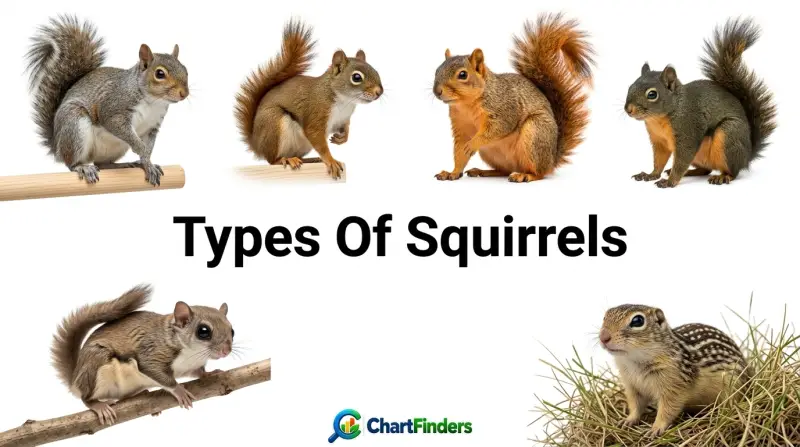
Few wildlife groups are as universally recognized or ecologically adaptable as the squirrel. From high-alpine meadows to dense suburban yards and city parks, these members of the family Sciuridae occupy nearly every terrestrial habitat on Earth outside of Australia, polar regions, and extreme deserts. Their evolutionary success stems from exceptional agility, specialized dentition, and a behavioral repertoire that includes complex caching strategies and social systems.
Understanding the diversity of squirrels requires looking beyond the familiar gray silhouette perched on a backyard bird feeder. The family Sciuridae is extraordinarily varied, encompassing creatures as tiny as the five-inch African pygmy squirrel and as massive as the three-foot Indian giant squirrel. Whether examining the gliding mechanics of nocturnal flying squirrels, the subterranean engineering of prairie dogs, or the arboreal acrobatics of forest-dwelling tree squirrels, each group has evolved distinct morphological and behavioral adaptations tailored to its ecological niche.
This master guide explores the primary classifications, distinct anatomical and behavioral traits, and geographical distribution of the world’s most notable squirrel species. By breaking down the differences between tree, ground, and flying squirrels, this article provides a complete framework for identifying, understanding, and appreciating these resilient rodents.
Types Of Squirrels: Classification, Characteristics, and Ecological Roles
- Sciuridae is divided into three primary functional groups: tree squirrels, ground squirrels, and flying squirrels.
- All squirrels possess open-rooted, continuously growing incisors that require constant gnawing to wear down.
- Tree squirrels are strictly diurnal, rely heavily on scatter-hoarding food, and possess exceptional spatial memory.
- Ground squirrels include social burrowers like prairie dogs and marmots, many of which hibernate or aestivate during extreme seasons.
- Flying squirrels do not actually fly; instead, they glide using a furry membrane called a patagium and are almost exclusively nocturnal.
- North America alone hosts over 65 distinct species spanning diverse regional climates and habitats.
- Squirrels play a critical keystone role in forest regeneration through uneaten buried seeds and fungal spore dispersal.
To systematically study or identify types of squirrels, scientists and field naturalists categorize the family Sciuridae into three broad ecological guilds. This tripartite division—tree squirrels, ground squirrels, and flying squirrels—reflects distinct evolutionary adaptations in skeletal structure, nesting habits, and locomotor strategies.
| Ecological Type | Primary Locomotion | Nesting / Sheltering Habit | Active Period | Notable North American Examples |
|---|---|---|---|---|
| Tree Squirrels | Arboreal leaping, running along branches | Dreys (leaf nests) or tree cavities | Diurnal (daytime) | Eastern Gray Squirrel, Eastern Fox Squirrel, American Red Squirrel |
| Ground Squirrels | Terrestrial running, digging, bipedal standing | Subterranean burrows and tunnel systems | Diurnal / Crepuscular | Rock Squirrel, Golden-mantled Ground Squirrel, Black-tailed Prairie Dog |
| Flying Squirrels | Gliding between trees using patagium | Tree cavities, abandoned woodpecker holes | Nocturnal (nighttime) | Northern Flying Squirrel, Southern Flying Squirrel |
The table above illustrates the primary dividing lines within the family Sciuridae. While all squirrels share basic rodent characteristics—such as large eyes, prominent whiskers, and bushy tails—their daily lives are shaped entirely by whether they spend their time navigating high canopies, burrowing beneath the soil, or launching themselves into the night air.
Tree Squirrels (Sciurinae)
Tree squirrels are the most visible members of the family to urban and suburban residents. Built for a three-dimensional arboreal environment, they possess powerful hind legs, sharp claws designed for gripping bark, and long, bushy tails that serve as dynamic balancing poles and rudders during high-speed leaps.
Unlike many other mammals, tree squirrels do not truly hibernate. Instead, they remain active year-round, weathering winter conditions by relying on thick winter coats and stored food reserves. Their caching strategies are divided into two primary methods: scatter-hoarding, where thousands of individual food items are buried in shallow caches across a territory, and midden-hoarding, where massive piles of conifer cones and seeds are stored in a single central location.
Eastern Gray Squirrel (Sciurus carolinensis)
The eastern gray squirrel is arguably the most recognizable tree squirrel in North America and has been successfully introduced to parts of Europe and western states. Typically measuring 17 to 20 inches in total length—with a fluffy tail comprising nearly half that length—this species is characterized by its salt-and-pepper gray coat, white-rimmed tail hairs, and white belly. Exceptionally adaptable, eastern gray squirrels thrive in deciduous forests as well as highly urbanized city parks where human food sources are abundant.
Eastern Fox Squirrel (Sciurus niger)
As the largest tree squirrel native to North America, the eastern fox squirrel can reach lengths of up to 29 inches and weigh over two pounds. Its common name derives from its rich, rusty-orange or brownish-yellow belly fur, which resembles the coloration of a red fox. Fox squirrels prefer open-canopy oak and pine woodlands interspersed with agricultural fields, where they spend a significant amount of time foraging directly on the ground compared to their gray cousins.
American Red Squirrel (Tamiasciurus hudsonicus)
Smaller, more high-strung, and fiercely territorial than gray or fox squirrels, the American red squirrel is a conifer forest specialist. Measuring roughly 10 to 15 inches long, it features reddish-brown upperparts, a white underbelly, and distinct black eye-rings. Red squirrels are famous for their loud, scolding vocalizations and their habit of constructing large central food caches called middens, where they store spruce and pine cones for winter consumption.
Abert’s Squirrel (Sciurus aberti)
Also known as the tassel-eared squirrel, Abert’s squirrel is an unmistakable inhabitant of the ponderosa pine forests of the American Southwest, including Arizona and New Mexico. It is distinguished by prominent tufts of long fur on its ears—which grow up to an inch during winter—and a striking gray coat with a reddish-brown dorsal patch. Abert’s squirrels have a unique obligate relationship with ponderosa pines, feeding almost exclusively on the inner bark, twigs, and staminate cones of these specific trees.
Ground Squirrels (Xerinae)
Ground squirrels encompass a massive and diverse group of rodents that have adapted to life on and beneath the ground. Unlike tree squirrels, which possess slender skeletal frames optimized for leaping, ground squirrels typically feature more robust bodies, shorter legs, and powerful forelimbs equipped with heavy claws for excavation.
The ground squirrel subfamily includes not only true ground squirrels (genus Spermophilus and related genera) but also chipmunks, marmots, woodchucks, and prairie dogs. Because open ground exposes them to avian and mammalian predators, ground squirrels rely heavily on complex alarm-calling vocalizations and subterranean burrow systems that provide safety, thermal regulation, and safe rearing sites for offspring.
Rock Squirrel (Otospermophilus variegatus)
The rock squirrel is the largest ground squirrel in North America, found throughout the rocky canyons, cliffs, and arid scrublands of the Southwest. Measuring up to 20 inches long, it has a mottled grayish-brown coat speckled with white and black. Unlike burrowers that dig exclusively in deep soil, rock squirrels take advantage of natural rock crevices, boulder fields, and stone walls for shelter.
Golden-mantled Ground Squirrel (Callospermophilus lateralis)
Inhabiting high-altitude subalpine and alpine forests across western North America, the golden-mantled ground squirrel is frequently mistaken for a chipmunk due to its distinct black-and-white lateral stripes running along its flanks. However, it can be easily distinguished from true chipmunks by the lack of facial stripes; instead, it features a rich golden-orange head and shoulders “mantle.”
Spotted Ground Squirrel (Xerospermophilus spilosoma)
Adapted to arid grasslands, sand dunes, and desert scrub, the spotted ground squirrel is a smaller, slender species characterized by a cinnamon-brown or grayish coat covered in distinct white spots. These squirrels are adept diggers, constructing extensive burrow systems where they escape the intense desert heat through midday aestivation.
Prairie Dogs and Marmots
While often recognized by their distinct common names, prairie dogs (genus Cynomys) and marmots (such as the eastern woodchuck, Marmota monax, and the yellow-bellied marmot, Marmota flaviventris) are specialized branches of the ground squirrel family. Prairie dogs are renowned for living in massive, highly social subterranean colonies known as “towns,” featuring sophisticated communication systems that convey specific predator details. Marmots, conversely, are heavy-bodied, solitary or family-group herbivores that undergo deep winter hibernation.
Flying Squirrels (Pteromyini)
Despite their name, flying squirrels do not possess powered flight like bats or birds. Instead, they are master gliders. Their secret lies in the patagium—a specialized, furry fold of skin that stretches between their front and rear wrists. When a flying squirrel leaps from a high branch, it extends its limbs to tauten this membrane, transforming its body into an aerodynamic airfoil.
Flying squirrels are strictly nocturnal, emerging only after dark to forage for nuts, seeds, fungi, lichen, and insects. Their large, dark eyes are packed with light-gathering photoreceptor cells, providing exceptional night vision. Because they rely heavily on mature timber for nesting cavities, they serve as important indicators of healthy, undisturbed forest ecosystems.
Northern Flying Squirrel (Glaucomys sabrinus)
The northern flying squirrel is slightly larger than its southern counterpart, measuring 10 to 12 inches in total length. It inhabits boreal and mixed coniferous-deciduous forests across Canada and the northern United States, extending southward along high-elevation mountain ranges. Its belly fur features dark gray bases with white tips, and it plays a critical ecological role in dispersing spores of subterranean fungi, such as truffles, which trees require for nutrient absorption.
Southern Flying Squirrel (Glaucomys volans)
Found throughout the deciduous and mixed forests of the eastern half of North America, the southern flying squirrel is petite, measuring roughly 8 to 10 inches long. Its underbelly fur is pure white to the base. Southern flying squirrels are highly social during the winter months, frequently gathering in communal nesting cavities by the dozen to huddle together and conserve body heat during freezing weather.
Anatomy, Senses, and Survival Mechanisms
The evolutionary persistence of squirrels across diverse global habitats is driven by highly specialized anatomical features. From dental structure to sensory perception, every aspect of a squirrel’s biology is fine-tuned for foraging efficiency and predator evasion.
The Mechanics of Rodent Dentition
Like all rodents, squirrels possess two pairs of continuously growing incisors—one upper and one lower pair. The front surface of each tooth is coated in hard orange enamel, while the rear consists of softer dentin. As the squirrel gnaws on hard nutshells, wood, or bones, the softer dentin wears down faster than the enamel, maintaining a self-sharpening, chisel-like edge.
Because these teeth never stop growing—averaging six inches of growth per year in some species—constant gnawing is a biological imperative rather than a behavioral choice. Without hard objects to wear their teeth down, a squirrel’s incisors would elongate to the point where the animal could no longer close its mouth or feed.
Sensory Adaptations and Spatial Memory
Tree squirrels rely heavily on exceptional vision and stereoscopic depth perception to navigate complex arboreal pathways. Their eyes are positioned high on the sides of their skull, granting them a wide field of view to spot avian predators overhead while calculating leaps between swaying branches.
For scatter-hoarding species, cognitive mapping and spatial memory are vital for survival. Research indicates that gray and fox squirrels remember the exact coordinates of thousands of buried nuts, utilizing landmarks and geometric memory rather than relying solely on olfaction. Interestingly, squirrels will occasionally perform “deception caching”—digging empty holes and covering them up—to trick observing competitor squirrels or blue jays.
Ecological Impact and Human-Wildlife Interactions
Squirrels are far more than passive inhabitants of forests and parks; they function as crucial ecological engineers. Their caching habits directly shape plant community structures, while their presence supports higher trophic levels.
Seed Dispersal and Forest Regeneration
While scatter-hoarding squirrels successfully recover a high percentage of their buried food caches, thousands of nuts are inevitably forgotten or lost to predation. Oak, hickory, walnut, and pine species rely heavily on this phenomenon. Because squirrels frequently bury nuts beneath the soil surface in optimal germination microhabitats—farther from parent trees where competition and disease pressure are lower—they act as primary agents of reforestation.
Suburban Adaptation and Management Challenges
In suburban and urban environments, squirrels frequently interface with human infrastructure. Their propensity for gnawing can lead to property damage when they chew through electrical wiring, wooden siding, or plastic utility lines to access attic spaces for nesting. Effective wildlife management in these contexts focuses on exclusion—sealing roof vents, trimming tree branches away from eaves, and securing garden produce—rather than chemical control.
Frequently Asked Questions
Do all squirrels hibernate during the winter?
No. Most tree squirrels (such as gray, fox, and red squirrels) remain active throughout the entire winter, relying on stored fat reserves, thick winter coats, and cached food. However, many ground-dwelling species—including ground squirrels, woodchucks, and marmots—undergo true hibernation, lowering their body temperatures and metabolic rates to survive months of freezing temperatures and food scarcity.
How can you tell the difference between a chipmunk and a ground squirrel?
While both belong to the family Sciuridae and share ground-dwelling habits, chipmunks are easily distinguished by the prominent black-and-white stripes running directly across their faces. Most ground squirrels lack distinct facial stripes, often featuring mottled coats, spots, or stripes restricted entirely to their body flanks and back.
Can flying squirrels actually fly?
Flying squirrels cannot achieve powered, flapping flight like bats or birds. Instead, they glide. By launching themselves from high tree branches and stretching out their arms and legs, they tauten a specialized furry membrane called a patagium. This creates an aerodynamic surface that allows them to glide downward across distances exceeding 150 feet with precise steering control.
Why do squirrels twitch their tails?
Tail twitching and flicking serve as a complex communication tool within squirrel societies. It is most commonly used as an alarm signal to warn conspecifics of potential predators, such as hawks, domestic cats, or snakes. It can also function as a territorial warning or an expression of agitation toward rivals.
Are squirrels considered rodents?
Yes. Squirrels belong to the order Rodentia, specifically the family Sciuridae. Like all rodents, they are characterized by a single pair of upper and lower incisors that grow continuously throughout their lives and require constant gnawing to maintain proper length.
The remarkable diversity of the family Sciuridae highlights an evolutionary masterclass in ecological adaptation. From the high-flying gliders of nocturnal forests to the industrious tree-dwellers of suburban parks and the social burrowers of arid grasslands, squirrels demonstrate an unmatched ability to thrive across changing environments. Understanding the distinct traits of tree, ground, and flying squirrels provides valuable insight into the interconnected mechanics of wild ecosystems.