
Quick Answer: Jasper is a microcrystalline, opaque variety of quartz with a Mohs hardness of 6.5 to 7. A proper jasper identification chart relies on examining its fine-grained structure, waxy to dull luster, conchoidal fracture, and characteristic multi-colored or patterned matrix—such as banding, brecciation, or orbicular inclusions—while distinguishing it from dyed chalcedony or synthetic imitations through specific gravity and hardness testing.
Gemstone identification often bridges the gap between geological science and lapidary appreciation. Among the vast families of minerals, few categories spark as much fascination, or as much confusion, as jasper. Often blanket-termed as any opaque, patterned chalcedony, true jasper possesses specific mineralogical parameters that separate it from other quartz varieties, agates, and modern synthetic market substitutes. Whether you are sorting through rough field stones, evaluating cabochons for jewelry, or curating a systematic mineral collection, relying on a systematic identification framework is essential.
Explore our detailed breakdown on Seashell Identification Chart (Complete Data Matrix).This guide serves as an authoritative master resource for identifying jasper. We will explore its precise physical and optical properties, break down its primary varietal classifications using an information-dense identification matrix, examine diagnostic testing protocols, and address common market treatments. By understanding the microcrystalline structure and geological formation pathways of jasper, you can move beyond superficial color assessments to achieve definitive, professional-grade identification.
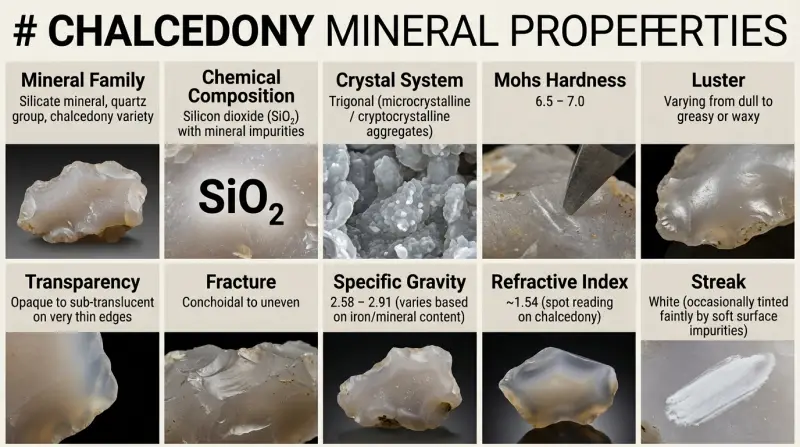
Jasper Identification Chart
- Jasper is an opaque, microcrystalline variety of quartz (chalcedony) containing up to 20% foreign materials, which account for its rich colors and complex patterns.
- Its Mohs hardness of 6.5 to 7 makes it durable enough to scratch glass and resist a steel file, a critical initial diagnostic threshold.
- Unlike translucent agate, jasper is fundamentally opaque, even in thin sections, due to high concentrations of iron oxides, clay, or other mineral inclusions.
- Common identification pitfalls include confusing dyed quartz or glass imitations with natural matrix patterns like brecciated or picture jasper.
- Advanced verification requires evaluating specific gravity (typically 2.58 to 2.91 depending on inclusion density) and refractive index (around 1.54).
- Differentiating jasper from similar stones requires a multi-step testing approach combining visual pattern analysis, streak tests, and scratch testing.
To properly navigate the world of jasper, one must understand how mineralogical data translates into practical field and laboratory identification. The following comprehensive matrix outlines the core scientific properties that define true jasper and separate it from look-alike minerals.
| Property | Scientific Specification / Characteristic | Diagnostic Significance |
|---|---|---|
| Mineral Family | Silicate mineral, quartz group, chalcedony variety | Confirms microcrystalline silica foundation. |
| Chemical Composition | Silicon dioxide ($text{SiO}_2$) with mineral impurities | Impurities (iron, clay, organic matter) dictate color and pattern. |
| Crystal System | Trigonal (microcrystalline / cryptocrystalline aggregates) | Grains are too small to see with the naked eye without high magnification. |
| Mohs Hardness | 6.5 – 7.0 | Will easily scratch window glass; cannot be scratched by a steel knife. |
| Luster | Varying from dull to greasy or waxy | Distinguishes it from vitreous quartz crystals and resinous plastics. |
| Transparency | Opaque to sub-translucent on very thin edges | Primary differentiator between jasper (opaque) and agate (translucent). |
| Fracture | Conchoidal to uneven | Produces smooth, curved shell-like break patterns when fractured. |
| Specific Gravity | 2.58 – 2.91 (varies based on iron/mineral content) | Heavier than standard glass imitations; useful for density comparison. |
| Refractive Index | ~1.54 (spot reading on chalcedony) | Standard gemological refractometer reading for quartz varieties. |
| Streak | White (occasionally tinted faintly by soft surface impurities) | Distinguishes jasper from heavier metallic ores like hematite. |
This reference matrix forms the baseline for all subsequent identification steps. When evaluating an unknown specimen, verifying these baseline physical constants eliminates dozens of unrelated mineral families before you even begin analyzing patterns or commercial trade names.
Understanding the Mineralogical Definition of Jasper
In classical mineralogy, jasper is classified as an aggregate of microcrystalline quartz and/or cryptocrystalline quartz and organic-bearing silica. The word itself derives via Old French and Latin from the Afroasiatic roots meaning “spotted or speckled stone.” Unlike macrocrystalline quartz varieties such as amethyst or rock crystal—where individual hexagonal prisms are easily distinguished—jasper’s crystals are sub-microscopic fibers packed tightly together.
What truly separates jasper from other chalcedony varieties is its impurity budget. While pure chalcedony can be semi-transparent and uniform, jasper is typically 10% to 20% foreign material. These impurities are not defects; they are the very soul of the stone. Iron oxides produce reds, browns, and yellows; hydroxides create greens and blacks; and trapped organic compounds or clay minerals contribute earthy grays, blues, and purples. Because these inclusions are distributed unevenly during the silica gel precipitation process, jasper develops its signature opaque, patterned appearance.
Visual Characteristics and Optical Signatures
Visual identification requires training the eye to recognize structural opacity and pattern formation. When light hits a piece of quartz, its path reveals much about its internal structure:
- Opacity vs. Translucency: If you backlight a standard cabochon with a strong LED penlight, true agate will allow light to pass through its body, revealing banding or cloudiness. True jasper will block light almost entirely, perhaps glowing faintly only on the absolute thinnest edge of a bevel.
- Luster Variations: Freshly fractured jasper has a dull to greasy luster. When polished by a lapidary, it takes on a smooth, waxy polish. If a stone displays a glassy, highly vitreous luster akin to high-end lead crystal, suspect synthetic glass or treated quartz.
- Matrix Integration: The patterns within jasper—whether they look like miniature landscapes in “picture jasper” or shattered tectonic puzzle pieces in “brecciated jasper”—are fully integrated into the stone matrix. They are never surface-level coatings, dyes, or printed films.
Major Varieties and Classifications of Jasper
Because jasper forms in diverse geological environments worldwide, it manifests in a staggering array of patterns and color combinations. Gemologists and collectors organize these variations based on structural formation, inclusion types, and geographic provenance.
Structural and Pattern-Based Types
The naming convention of jasper often relies on how the silica gel settled, fractured, or interacted with surrounding minerals during diagenesis (the process by which sediments turn into rock).
- Picture Jasper: Characterized by fine dendritic or flow-patterned inclusions of iron oxides that create natural imagery resembling landscapes, horizons, or abstract paintings when cut parallel to the bedding planes.
- Brecciated Jasper: Formed when tectonic forces shatter existing rock underground, and silica-rich fluids subsequently cement the angular fragments back together with contrasting veins of quartz or hematite.
- Orbicular (or Poppy) Jasper: Features distinct, concentric circular or radial patterns (orbs) formed by spherulitic crystal growth within the silica gel as it cooled and hardened.
- Ribbon or Banded Jasper: Displays parallel sedimentary bands of contrasting colors, reflecting cyclical changes in the depositional environment where the silica accumulated.
Color-Dominant Types
While patterns define many jaspers, others are categorized primarily by their dominant chromatic profile, driven by specific trace elemental concentrations.
| Variety Name | Primary Color / Pattern | Key Chromophore / Geological Cause |
|---|---|---|
| Red Jasper | Brick red to deep brownish-red | High concentration of anhydrous iron(III) oxide (hematite inclusions). |
| Yellow Jasper | Mustard, golden, or brownish-yellow | Hydrated iron oxide inclusions (limonite or goethite). |
| Green Jasper (Plasma) | Dark green, often with white or red spots | Inclusions of celadonite, chlorite, or green iron silicates. |
| Basanite / Touchstone | Velvety black, fine-grained | Dense carbonaceous matter or microscopic iron sulfides. |
| Mookaite | Pastel pink, mustard yellow, cream, and red | Originating in Western Australia; formed from weathered radiolarian claystone. |
Understanding these classifications ensures you do not mistake a banded agate for a ribbon jasper, or a synthetic dyed dolomite for a natural orbicular variety. Each type carries distinct physical markers tied to its unique geochemical birthplace.
Comparative Analysis: Jasper vs. Similar Silicate Minerals
To establish rigorous identification criteria, it is essential to compare jasper directly against mineralogical look-alikes that share its chemical foundation ($text{SiO}_2$) or physical appearance.
| Mineral / Stone | Transparency | Hardness (Mohs) | Diagnostic Distinctions |
|---|---|---|---|
| Jasper | Opaque | 6.5 – 7.0 | Opaque even on thin edges; high impurity load (10-20%); earthy/waxy luster. |
| Agate | Transparent to Translucent | 6.5 – 7.0 | Passes light readily; displays translucent concentric or fortification banding. |
| Chert / Flint | Opaque to Sub-translucent | 6.5 – 7.0 | Dull, uniform earthy appearance; lacks the decorative multi-colored matrix of jasper. |
| Common Opal | Translucent to Opaque | 5.5 – 6.5 | Lower hardness; amorphous silica structure containing water (hydrophilic); lower specific gravity (~2.15). |
| Dyed Dolomite / Magnesite | Opaque | 3.5 – 4.5 | Significantly softer (can be scratched easily with a copper coin); reacts (effervesces) with hydrochloric acid. |
Step-by-Step Jasper Identification Methodology
When presented with an unknown stone, a professional gemologist follows a strict elimination sequence. Never rely on visual inspection alone; tactile and physical testing provide the empirical proof needed for absolute verification.
Step 1: Initial Visual and Tactile Inspection
Examine the specimen under natural daylight or a balanced 5000K LED task light using a 10x jeweler’s loupe.
- Check for opacity: Is light penetrating the stone, or is it blocked?
- Look for surface texture: Is it waxy, dull, or glassy?
- Inspect pattern depth: Do the patterns look trapped inside the stone matrix, or do they appear painted on the surface?
Step 2: Hardness Testing (Scratch Test)
Perform a non-destructive scratch test on an inconspicuous back or bottom edge of the stone.
- Try to scratch a common glass plate (Mohs ~5.5). True jasper (Mohs 6.5–7) will easily leave a sharp scratch on the glass.
- Attempt to scratch the stone using a hardened steel file or masonry nail (Mohs ~6.5). If the steel easily carves a groove into the stone, it is not jasper; it is likely a softer carbonate like calcite, serpentine, or soapstone.
Step 3: Specific Gravity (Density) Estimation
If you have access to a precise digital carat/gram scale, you can perform a hydrostatic specific gravity test.
- Weigh the dry stone in air ($W_{text{air}}$).
- Suspend the stone in a beaker of distilled water using a thin wire and record the submerged weight ($W_{text{water}}$).
- Calculate Specific Gravity: $text{SG} = frac{W_{text{air}}}{W_{text{air}} – W_{text{water}}}$.
- Natural jasper should yield an SG value between 2.58 and 2.91. Values significantly lower suggest porous plastics or resins; values significantly higher suggest metallic ores.
Step 4: Magnification and Micro-Structure Analysis
Under 30x to 40x magnification, look for fluid flow lines, micro-fractures filled with secondary quartz, and the absence of gas bubbles. Synthetic glass imitations almost always reveal microscopic spherical air bubbles trapped during manufacturing. Natural jasper will show chaotic, crystalline growth structures and mineral inclusion clusters.
Common Market Treatments, Imitations, and Synthetic Dyes
Because high-grade, vividly patterned jasper can command strong collector prices, the commercial gem market frequently sees treated materials and outright imitations. Knowing how to spot these alterations protects you from purchasing mislabeled stones.
Dyed Chalcedony and “German Jasper”
Historically and presently, colorless or pale grey chalcedony or quartz is often soaked in organic dyes or metallic salt solutions (such as iron or chromium compounds) and then heated to artificially create vibrant reds, greens, or blues.
- How to identify: Examine drill holes or micro-fractures under magnification. Dyes tend to pool and concentrate heavily in cracks, fissures, and porous zones, creating an unnatural, web-like color concentration that does not match natural mineral deposition patterns.
Glass and Plastic Imitations
Mass-produced costume jewelry frequently uses molded colored glass or polymer resins styled to mimic orbicular or picture jaspers.
- How to identify: Glass and plastics fail the thermal conductivity test (they feel warm to the touch initially, whereas natural quartz feels cold). Under a loupe, glass reveals swirling flow lines with entrained round air bubbles, and plastics can be easily gouged with a sharp steel needle or tested positive with a hot point test (emitting a faint chemical odor).
Composite Stones (Doublets)
Less common with jasper than with opal, but occasionally encountered, composite stones use a thin slice of attractive patterned jasper glued over a common base material (like backing glass or low-grade matrix) to save weight and material cost.
- How to identify: View the stone from the side profile using a loupe. Look for an unnatural horizontal glue seam or a sharp transition in material texture and luster between the top dome and the bottom base.
Frequently Asked Questions
The primary distinguishing factor is transparency. Agate is a variety of chalcedony that is transparent to translucent, often displaying sharp, concentric, glass-like bands when backlit. Jasper is opaque due to higher concentrations of impurities (such as iron or clay), meaning light will not pass through it. Both share the same chemical composition ($text{SiO}_2$) and Mohs hardness (6.5–7).
Yes. Because true jasper has a Mohs hardness rating between 6.5 and 7, it is harder than standard soda-lime window glass (which sits at approximately 5.5). Dragging a sharp edge or corner of a jasper specimen across a glass plate will leave a permanent scratch. If your stone cannot scratch glass, it is too soft to be true jasper.
The vast spectrum of jasper colors is driven by foreign mineral impurities trapped during the stone’s formation. Anhydrous iron oxides create rich reds and browns; hydrated iron oxides (limonite/goethite) produce yellows and mustards; chlorite and celadonite generate greens; and trapped organic carbon or pyrites yield deep blacks and grays.
Dyed jasper—often sold under trade names or marketed simply as enhanced stones—is not entirely “fake” if the base material is genuine natural quartz/chalcedony that has been color-treated. However, ethical gemological standards require sellers to disclose any treatments, enhancements, or dyeing. Unsuspecting buyers paying natural-grade prices for heavily dye-impregnated material are being misled.
Yes, preliminary field identification is entirely possible using simple household and field tools. By combining a visual opacity check, a 10x jeweler’s loupe examination for matrix integration, a glass scratch test (Mohs hardness), and a specific gravity heft test, you can accurately identify over 90% of jasper specimens without needing advanced lab instrumentation like an FTIR spectrometer or refractometer.
Conclusion
Mastering the art and science of jasper identification requires a balanced approach that respects both geological data and physical testing. By looking past commercial trade names and evaluating foundational properties—such as opacity, microcrystalline structure, conchoidal fracture, and a Mohs hardness of 6.5 to 7—you can strip away marketing ambiguity. Whether you are evaluating rough field finds or finished cabochons, applying the structured identification chart and testing protocols outlined in this guide ensures absolute confidence in verifying genuine jasper.