
Identifying waterfowl in the field can be one of the most rewarding yet challenging pursuits in North America. Whether you are scanning a misty marsh at dawn during hunting season, participating in a Christmas Bird Count, or simply observing migrating flocks from a blind, birds often appear as distant silhouettes or fleeting flashes of color. Without a systematic approach, distinguishing between similar species like female Mallards and Gadwalls, or telling a Green-winged Teal apart from a Blue-winged Teal, can feel overwhelming. A well-designed identification chart serves as an indispensable tool, organizing complex biological data into clear, easily digestible visual markers.
(Reference: identification guide” by the late Frank S. Todd.)This comprehensive guide explores the essential elements of North American duck identification, examining the anatomy, behavioral cues, and visual patterns that separate dabbling ducks from diving ducks and sea ducks. By breaking down species categories, regional distribution, and critical diagnostic features, this resource equips you with the knowledge needed to interpret field charts accurately and make confident identifications in any wetland environment.
Explore our detailed breakdown on Types Of Deer Identification Chart.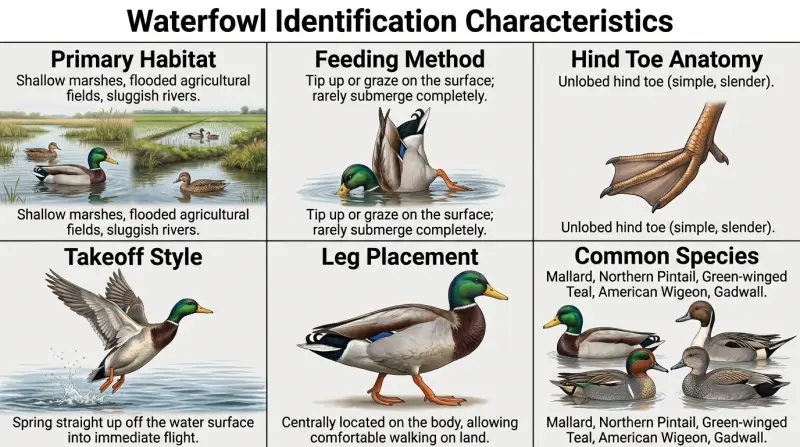
North American Duck Identification Chart
- Waterfowl are broadly divided into behavioral guilds: dabbling ducks (surface feeders), diving ducks (submergence feeders), and sea ducks (marine specialists), each requiring distinct physical adaptations.
- Key diagnostic features include bill shape and color, head plumage, overall silhouette, flight behavior, and the iridescent wing patch known as the speculum.
- Dabbling ducks launch directly upward into the air when taking off from water, whereas diving ducks and sea ducks must patter along the surface to gain momentum.
- Field guides and waterproof charts are essential for durable, real-time reference in wet environments and changing weather conditions.
- Seasonal plumage changes—specifically eclipse plumage in drakes—frequently complicate identification during late summer and early autumn.
To use an identification chart effectively, you must first understand how to categorize what you are seeing. North American ducks fall primarily into distinct tribes characterized by their feeding habits, anatomical structure, and ecological niches. The following table contrasts the primary biological and behavioral differences between the major waterfowl groups encountered by observers and hunters across the continent.
| Diagnostic Trait | Dabbling Ducks (Anatinae) | Diving Ducks (Aythyinae) | Sea Ducks (Mergini) |
|---|---|---|---|
| Primary Habitat | Shallow marshes, flooded agricultural fields, sluggish rivers. | Deep lakes, large rivers, wide bays, open freshwater. | Marine coastal waters, rocky shorelines, deep open ocean. |
| Feeding Method | Tip up or graze on the surface; rarely submerge completely. | Dive completely underwater to forage for seeds, tubers, and invertebrates. | Dive deep in marine zones for mollusks, crustaceans, and fish. |
| Hind Toe Anatomy | Unlobed hind toe (simple, slender). | Lobed hind toe (features a flap of skin for propulsion). | Lobed hind toe; heavily modified for deep marine diving. |
| Takeoff Style | Spring straight up off the water surface into immediate flight. | Run or patter across the water surface for several yards to gain lift. | Run across water surface with heavy wingbeats to gain momentum. |
| Leg Placement | Centrally located on the body, allowing comfortable walking on land. | Set further back on the body, making walking awkward and clumsy. | Extremely far back, highly efficient for swimming, helpless on land. |
| Common Species | Mallard, Northern Pintail, Green-winged Teal, American Wigeon, Gadwall. | Canvasback, Redhead, Lesser Scaup, Ring-necked Duck. | Common Goldeneye, Bufflehead, Common Merganser, Eiders, Scoters. |
Understanding Dabbling Ducks (Puddle Ducks)
Dabbling ducks represent the most familiar group of waterfowl across North America. They thrive in shallow marshes, flooded agricultural fields, sluggish rivers, and shallow lakes. Because they feed by tipping tail-up rather than diving, their physical build is optimized for shallow water and occasional terrestrial foraging.
When examining a dabbling duck on a field chart, pay close attention to the speculum—a brightly colored, often iridescent patch of feathers on the secondary flight feathers of the wing. The color of the speculum (e.g., violet-blue in Mallards, bright green in Green-winged Teal, or white and black in Gadwalls) is one of the most reliable taxonomic markers visible when birds are in flight or stretching their wings.
Diving Ducks and Sea Ducks
Diving ducks and sea ducks inhabit deeper lakes, large rivers, bays, and coastal marine waters. Their bodies are heavier and more torpedo-shaped, reducing buoyancy and allowing them to submerge efficiently to depths of several feet—or even dozens of feet in the case of sea ducks like scoters and eiders.
Identifying diving ducks requires looking at silhouette proportions. Species like the Canvasback feature a sloping, wedge-shaped head profile that transitions smoothly into a long black bill, whereas the Redhead features a rounded, high-foreheaded head with a bluish-gray bill tipped in black. Leg placement is another critical field mark; because their legs are positioned far back to act as rudders underwater, diving ducks appear ungainly and awkward when forced to walk on shore.
Sea ducks, forming the tribe Mergini, possess specialized adaptations for marine environments. This group includes goldeneyes, buffleheads, mergansers, eiders, and scoters. Mergansers feature slender, serrated bills designed for gripping slippery fish, while goldeneyes and buffleheads are compact cavity-nesters with striking head patterns.
| Species Name | Category | Key Diagnostic Visual Marker | Typical Habitat |
|---|---|---|---|
| Mallard | Dabbling Duck | Iridescent green head, yellow bill, white neck ring, curled tail feathers (drake). | Freshwater marshes, urban ponds, rivers, agricultural fields. |
| Green-winged Teal | Dabbling Duck | Tiny size, vertical white shoulder stripe, iridescent green eye patch (drake). | Shallow marshes, flooded mudflats, shallow ponds. |
| Northern Pintail | Dabbling Duck | Elongated needle-like tail, white neck stripe, brown head (drake). | Open wetlands, agricultural fields, prairie potholes. |
| Canvasback | Diving Duck | Sloping wedge-shaped head, red eye, pale whitish-gray body (drake). | Deep lakes, large marshes, sheltered bays. |
| Bufflehead | Sea Duck / Diver | Tiny size, massive white head patch behind black eye (drake), plump build. | Wooded lakes, sheltered coastal bays, rivers. |
Anatomical Markers and Field Identification Clues
Mastering duck identification requires looking past overall color and focusing on micro-markers. Waterproof charts and field guides emphasize several specific anatomical zones:
- Bill Morphology: The shape, width, and coloration of the bill tell a story about diet. Broad, flat bills (like those of Mallards and Northern Shovelers) are equipped with comb-like lamellae for straining organic matter from water or mud, whereas slender, serrated bills (like those of Mergansers) are adapted for catching live fish.
- Head Shape and Crests: Many species possess structural head features that persist regardless of lighting or plumage phase. For example, the Wood Duck features a sleek, slicked-back crest, while the Hooded Merganser can fan out a dramatic, semi-circular white crest.
- Tail Length and Posture: The Northern Pintail is instantly recognizable even at a distance due to the drake’s elongated, needle-like central tail feathers. Conversely, ruddy ducks often swim with their stiff, fan-shaped tails cocked vertically upright against their backs.
- Voice and Behavioral Postures: Female Mallards are famous for their loud, descending quack, whereas drakes produce a softer, reedy muzzled sound. Head-pumping displays, wing-flapping, and territorial posturing provide secondary confirmation when visual markers are obscured by fog or distance.
Seasonal Plumage Variations: Breeding vs. Eclipse
One of the greatest challenges in waterfowl identification is managing seasonal plumage shifts. Male ducks (drakes) exhibit their brightest, most striking breeding plumage (alternate plumage) from late autumn through early spring. This is the look most commonly featured on identification charts.
However, following the breeding season in early summer, drakes undergo a rapid, synchronized molt where they lose all their flight feathers simultaneously, leaving them flightless for weeks. During this period, they assume an “eclipse plumage,” wherein drakes mimic the cryptic, mottled brown coloration of hens to avoid mammalian and avian predators.
Recognizing eclipse plumage requires looking closely at permanent structural clues rather than relying solely on bright head colors. Even in eclipse plumage, a drake Mallard will maintain a yellowish-green bill and a heavier body build than a female, and a drake Pintail will show the beginnings of structural elongation in its tail feathers. Experienced birders cross-reference bill coloration and eye color, which change much less dramatically than body feathers across seasons.
Common Mistakes and Identification Pitfalls
Even seasoned observers occasionally misidentify waterfowl due to common visual illusions, lighting conditions, and hybridizations. Being aware of these pitfalls prevents frequent errors in the field.
Mistaking Female Dabblers for Each Other
While male ducks (drakes) are often unmistakable with their vibrant colors, female dabbling ducks (hens) across multiple species share a cryptic, mottled brown plumage designed for camouflage on the nest. A female Mallard, Gadwall, American Wigeon, and Northern Pintail can look deceptively similar when viewed swimming amongst emergent vegetation.
To avoid this mistake, focus on secondary field marks:
- Female Mallard: Distinguished by a bright orange-and-black bill, a white-bordered violet-blue speculum, and a robust body.
- Gadwall Hen: Often confused with female Mallards, but features a smaller, slenderer bill that is dark orange-edged on the sides, a distinct white belly (visible in flight), and a white speculum.
- American Wigeon Hen: Features a remarkably short, stubby blue-gray bill with a black tip, a rounded head, and grayish-brown flanks.
Lighting and Distance Distortions
Early morning and late evening light—prime times for waterfowl activity—often cast warm or cool shadows that distort color perception. A dark-bodied diving duck like a Scaup or Ring-necked Duck can easily appear completely black at a distance of 100 yards, masking the subtle gloss of purple or green on the head. Always rely on silhouette, flocking behavior, and relative size before locking in an identification based solely on perceived coloration under poor lighting.
Hybridization Among Waterfowl
Mallards and Northern Pintails frequently hybridize with closely related species (and domestic strains), producing intermediate offspring that display mosaic characteristics of both parents. A hybrid duck might possess a greenish cast to its head like a Mallard but exhibit the slender neck and elongated tail structure of a Pintail. When encountering an anomalous individual that does not match standard plates on an identification chart, consider natural hybridization before declaring a rare vagrant sighting.
Frequently Asked Questions
Keep your chart clipped to your daypack, blind bag, or lanyard where it remains easily accessible in wet conditions. When you spot a duck, resist the urge to identify the entire bird at once. Instead, scan systematically: note whether it is dabbling or diving, examine the bill shape and color, check head ornamentation, and look for speculum colors if the bird takes flight. Cross-reference these isolated traits with the chart panels.
Examine how the bird rides the water line. Dabbling ducks (like Mallards and Teal) tend to float higher and more buoyantly, often with their tails held slightly above or level with the water surface. Diving ducks (like Scaup and Canvasbacks) sit lower, heavier, and more horizontal in the water because their dense body structure and rear-set legs reduce surface buoyancy.
Sexual dimorphism in waterfowl is an evolutionary adaptation driven by mating systems and predator avoidance. Drakes wear bright, highly visible plumage during the winter breeding season to attract females and establish pair bonds. Conversely, hens require cryptic, mottled brown plumage to remain completely camouflaged while incubating eggs on the ground in vulnerable open-nesting environments.
Eclipse plumage is a temporary, dull phase of feathers that male ducks assume after the breeding season during their flightless molt. Because drakes temporarily mimic the brown, mottled appearance of hens, they lose their distinct species-specific head patterns, making them difficult to distinguish on a standard chart that features birds in peak breeding condition.
Yes and no. While sea ducks (such as scoters, eiders, mergansers, and long-tailed ducks) share the ability to dive deeply for food, they belong to distinct taxonomic subfamilies and are typically grouped separately from inland diving ducks like Canvasbacks and Scaup. Sea ducks generally inhabit harsh marine coastal environments and possess specialized physiological adaptations for salt-water survival.
Conclusion
Mastering North American duck identification is a skill built upon patience, observation, and familiarity with core biological markers. While species diversity across marshes, lakes, and coastal bays is vast, breaking down each sighting by behavior, silhouette, bill morphology, and wing patterns simplifies the process. By utilizing a durable, waterproof identification chart as a reliable field companion and keeping potential pitfalls like eclipse plumage and hybridization in mind, you can approach any waterfowl encounter with confidence and accuracy.