
North Carolina’s diverse climate—stretching from the Appalachian Mountains across the Piedmont and down to the Atlantic coastal plain—creates ideal habitats for an extensive variety of arachnids. For homeowners and outdoor enthusiasts alike, encountering an eight-legged visitor is a routine occurrence. However, the anxiety associated with these encounters often stems from a lack of reliable identification tools. When a spider crosses a kitchen floor or spins a web across a porch light, the immediate reaction is frequently driven by fear rather than fact.
(Reference: Spiders in and Around Homes | NC State Extension Publications)Most spiders found indoors in North Carolina are beneficial predators hunting insects, not looking for a fight. Yet, the presence of medically significant species requires caution, proper sanitation, and targeted management strategies. Navigating this landscape successfully means moving past generalizations and looking at specific anatomical markers, behavioral traits, and geographical distributions. This master guide provides a comprehensive North Carolina spider identification framework to help you separate harmless pest controllers from genuine risks.
Explore our detailed breakdown on Trout Identification Chart: Complete Reference Chart.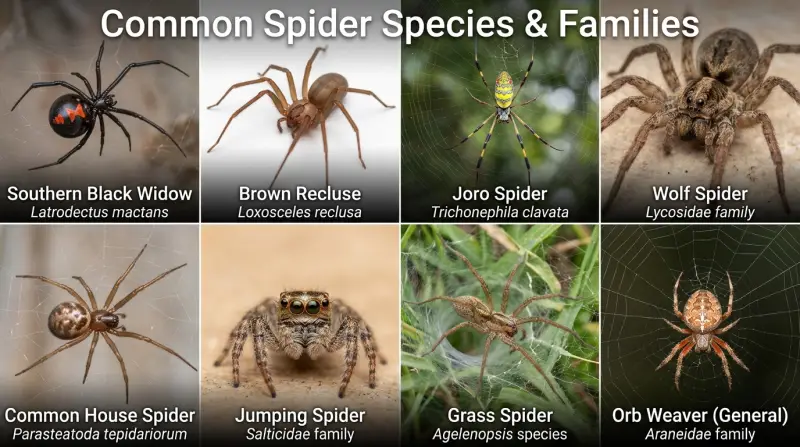
North Carolina Spider Identification Chart
- Only two spiders in North Carolina are medically significant: the Southern Black Widow and the Brown Recluse.
- The vast majority of indoor sightings are harmless hunting or web-building spiders that help control true household pests.
- Invasive species, such as the large, colorful Joro spider, are spreading across Western North Carolina but pose no threat to humans or pets.
- Physical characteristics such as eye arrangements, abdominal markings, and leg morphology are far more reliable for identification than size or color alone.
- Unfamiliar spiders should always be photographed rather than handled if they do not cleanly match standard identification profiles.
- Proactive exclusion, moisture reduction, and clutter removal remain the most effective long-term defense strategies against indoor spider populations.
To accurately identify spiders encountered in North Carolina, homeowners must look beyond simple size and color, as variations occur within species due to age, gender, and regional factors. The following comprehensive identification chart details the most frequently encountered spiders across the state, their defining physical features, habitat preferences, and medical significance.
| Common Name | Scientific Name | Key Identification Markers | Web / Habitat Type | Medical Significance |
|---|---|---|---|---|
| Southern Black Widow | Latrodectus mactans | Shiny black body; striking red hourglass marking on the underside of the abdomen. Females are large (~1.5 inches including legs); males are smaller and lighter. | Irregular, messy, three-dimensional webs built near ground level in dark, protected spaces (woodpiles, crawlspaces, under eaves). | High (Medically Significant). Neurotoxic venom causes severe muscle cramps, pain, and systemic symptoms requiring medical evaluation. |
| Brown Recluse | Loxosceles reclusa | Uniform yellowish-brown to dark brown color; violin-shaped marking on the cephalothorax pointing backward; eyes arranged in three pairs (six total). | No structured web; erratic threads used as daytime retreat in dark, undisturbed areas (boxes, closets, behind furniture). | High (Medically Significant). Necrotic venom destroys local tissue, leading to slow-healing wounds and potential systemic complications. |
| Joro Spider | Trichonephila clavata | Large body with vibrant yellow and blue-black stripes on the abdomen; red markings underneath. Females can measure up to 3 inches across. | Large, permanent wheel-shaped (orb) webs spun high between trees, utility poles, or structures outdoors. | None. Timid species with venom tailored to insects; poses no threat to humans or pets. |
| Wolf Spider | Lycosidae family | Robust, hairy, gray-to-brown body with distinct stripes; large prominent eyes arranged in three rows (four small on bottom, two large in middle, two medium on top). | No web; active ground hunter that roams lawns, gardens, and occasionally enters homes at floor level. | Low. Non-aggressive. Bite is painful and can cause local swelling, but venom is not medically dangerous. |
| Common House Spider | Parasteatoda tepidariorum | Mottled brown to grayish body with chevron or patterned markings on the abdomen; bulbous, rounded shape. | Tangled, cobweb-style structures in upper corners of rooms, basements, attics, and garages. | None. Docile and harmless; excellent natural controller of flies and mosquitoes. |
| Jumping Spider | Salticidae family | Compact, stocky body with metallic or colorful markings; square-ish head front featuring two massive, forward-facing central eyes. | No permanent web; active daytime stalker that leaps on prey. Uses silk safety dragline. | None. Highly curious, docile, and rarely bites unless trapped directly against skin. |
| Grass Spider | Agelenopsis species | Brownish body with distinct dark longitudinal stripes running down the cephalothorax; prominent spinnerets extending from the rear abdomen. | Flat, sheet-like webs with a funnel retreat in grass, shrubs, and low foundation corners. | None. Extremely fast runners; entirely harmless to humans. |
| Orb Weaver (General) | Araneidae family | Extremely variable; often large, brightly colored, round abdomens with spiny projections or geometric patterns. | Classic, symmetrical wheel-shaped orb webs built in gardens, between trees, and around outdoor lighting. | None. Docile garden dwellers that consume massive quantities of flying agricultural and structural pests. |
When analyzing this chart, note that geography plays a major role in distribution. While Black Widows thrive statewide, the Brown Recluse is primarily established in specific western and central pockets of North Carolina, making casual indoor encounters with the recluse much rarer in coastal counties than popular anxiety suggests.
Anatomical and Behavioral Identification Fundamentals
Mastering spider identification requires looking beyond superficial color variations and examining structural anatomy. Spiders are arachnids, distinct from insects by their two main body segments—the cephalothorax (head and thorax fused) and the abdomen—along with eight walking legs and zero antennae or wings.
Eye Arrangements and Ocelli Count
One of the most scientifically reliable ways to identify spider families is through the number and arrangement of their eyes (ocelli). While most spiders possess eight simple eyes, their spatial configuration varies dramatically:
- Wolf Spiders (Lycosidae): Look for three distinct rows of eyes—four small ones in the bottom row, two very large eyes in the middle row looking forward, and two medium-sized eyes on top.
- Brown Recluse (Loxosceles reclusa): Unlike most spiders that have eight eyes, recluses possess only six eyes arranged in distinct pairs (dyads) forming a semicircle across the front of the head.
- Jumping Spiders (Salticidae): Feature a flat face with two enormous central eyes flanked by smaller secondary eyes, providing stereoscopic, high-definition vision.
Web Architecture and Silk Placement
The type of web a spider constructs often reveals its hunting strategy and family lineage. Web builders rely on structural engineering to catch prey, whereas hunters utilize speed, camouflage, or active stalking.
- Orb Webs: Symmetrical, wheel-shaped masterpieces spun by orb weavers and Joro spiders. Designed to intercept flying insects in open air.
- Sheet and Funnel Webs: Flat, non-sticky sheets constructed close to the ground or in vegetation by grass spiders and funnel weavers, terminating in a silken tube where the spider hides.
- Irregular Cobwebs: Tangled, three-dimensional webs built in dark corners, basements, and structural voids by cobweb spiders, including the Black Widow.
Medically Significant Spiders in North Carolina
Out of the countless spider species inhabiting North Carolina, only two possess venom potent enough to cause medically significant systemic or necrotic reactions in humans. Understanding their biology, preferred habitats, and bite characteristics is critical for proper safety management.
The Southern Black Widow (Latrodectus mactans)
The Southern Black Widow is easily recognized by its jet-black, shiny exoskeleton and the iconic crimson-red hourglass shape on the ventral side of the abdomen. In some specimens, this mark may be split or resemble a pair of red spots.
Black widows prefer undisturbed, dark environments near ground level. Outdoors, they hide in woodpiles, stone walls, hollow stumps, and under deck ledges. Indoors, they occasionally slip into neglected crawlspaces, basements, and garages. Female black widows are sedentary, rarely leaving their webs unless disturbed. Their neurotoxic venom targets the nervous system. A bite often feels like a pinprick initially, followed by dull local pain, muscle rigidity, abdominal cramping, sweating, and nausea. While rarely fatal to healthy adults thanks to modern antivenom and supportive care, bites require immediate professional medical evaluation, particularly for children and elderly individuals.
The Brown Recluse (Loxosceles reclusa)
The Brown Recluse is frequently misidentified. Homeowners across North Carolina often suspect a brown recluse upon seeing any brown spider, but the species has a restricted natural range within the state, being more common in specific western and Piedmont zones while largely absent from coastal regions.
Key markers include a uniform, unpatterned brown body (ranging from tan to dark brown) and a distinct darker violin-shaped marking on the cephalothorax, with the neck of the violin pointing backward toward the abdomen. They lack spines on their legs, appearing smooth and delicate.
Recluses earn their name from their secretive nature. They hide behind heavy furniture, inside cardboard boxes stored in attics, within seldom-worn shoes, and inside closets. Bites typically occur when a spider is pressed directly against human skin—such as when sliding a foot into an uninspected boot. The venom is dermonecrotic, destroying local cellular tissue. A bite may initially go unnoticed, but within hours, it can develop into a painful, blistering lesion with a central dark area that may ulcerate. Professional medical treatment is vital to manage tissue breakdown and prevent secondary infection.
Common Harmless Look-Alikes and Beneficial Indoor Species
Because the public is hyper-aware of venomous spiders, many harmless, beneficial species are mistakenly persecuted. Recognizing these common residents prevents unnecessary panic and preserves natural pest control inside the home.
Wolf Spiders
Often mistaken for tarantulas or brown recluses due to their large size and hairy legs, wolf spiders are active nocturnal hunters that do not build webs. Instead, they patrol baseboards, entryways, and gardens. Female wolf spiders exhibit unique maternal behavior, carrying their egg sacs attached to their spinnerets and later carrying hundreds of spiderlings on their backs. They are completely non-aggressive and will only bite if firmly pinned or handled.
The Invasive Joro Spider (Trichonephila clavata)
First detected in North Carolina in 2021, the Joro spider has rapidly established populations across the western counties. Featuring striking yellow and blue-black stripes on a large body, they weave massive, golden-hued orb webs. Despite their intimidating appearance—females can span up to three inches—they are entirely harmless to humans and pets, feeding exclusively on nuisance insects like stink bugs, mosquitoes, and flies.
Cellar Spiders (Daddy Longlegs)
Often confused with harvestmen (which are arachnids but not true spiders), cellar spiders have extremely long, delicate legs and small, oval bodies. They hang upside down in erratic webs in damp corners, cellars, and bathroom ceilings. Despite an old urban legend regarding venom potency, cellar spiders have harmless mouthparts incapable of piercing human skin.
Practical Inspection and Prevention Strategies
Managing spider populations indoors does not rely on indiscriminate chemical spraying, which is often ineffective against wandering hunters. Instead, an integrated pest management (IPM) approach focuses on habitat modification, structural exclusion, and reducing prey insects.
| Prevention Step | Actionable Implementation | Targeted Result |
|---|---|---|
| Seal Entry Points | Install fine-mesh screens on crawlspace vents, repair damaged window screens, and apply silicone caulk around exterior utility penetrations, doors, and window frames. | Prevents wandering outdoor species (wolf spiders, grass spiders) from crossing the structural threshold. |
| Manage Moisture | Repair leaky plumbing, use dehumidifiers in damp basements and crawlspaces, and ensure proper exterior drainage away from foundation walls. | Eliminates the high humidity required by cellar spiders and reduces the insects that spiders feed upon. |
| Reduce Clutter and Vegetation | Keep firewood piles elevated and stored at least 20 feet away from the house. Trim back shrubs, tall grass, and tree branches touching exterior walls. | Removes prime harborage sites for Black Widows and prevents direct bridging pathways into living spaces. |
| Inspect Stored Items | Store seasonal clothing, shoes, and decorations in sealed, latching plastic storage bins rather than open cardboard boxes in attics or garages. | Denies Brown Recluses and other web-building spiders dark, undisturbed nesting zones. |
| Vacuum Regularly | Thoroughly vacuum baseboards, dark corners, under furniture, and ceiling perimeters weekly to remove egg sacs, webs, and hidden spiders. | Physically removes pests and disrupts breeding cycles without relying on chemical insecticides. |
Common Identification Mistakes and Misconceptions
Misidentifying spiders leads to improper treatment choices, unnecessary chemical exposure, and elevated anxiety. Avoiding common pitfalls ensures accurate assessment during an encounter.
- Assuming Size Equals Danger: Many people assume that large spiders—such as grass spiders or wolf spiders—are venomous, while small spiders are harmless. In reality, North Carolina’s most dangerous spider (the Black Widow) is moderate in size, and the Brown Recluse is relatively small.
- Relying Solely on Color: Spiders vary significantly in shade and patterning based on maturity, sex, and environment. Color alone should never be the primary diagnostic trait.
- Misdiagnosing Bites: Many skin lesions, staph infections (MRSA), tick bites, and allergic reactions are misattributed to “spider bites.” True spider bites typically feature two distinct puncture marks and localized symptoms that develop rapidly, whereas systemic necrotic wounds from verified brown recluses are clinically distinct and comparatively rare in North Carolina.
- Handling Unidentified Specimens: If a spider does not clearly match standard identification criteria, attempting to handle or squash it bare-handed is a primary mistake. Instead, capture it safely in a glass container or photograph it closely for professional confirmation before deciding on next steps.
Frequently Asked Questions
No. While isolated specimens can be transported into eastern regions via moving boxes or freight, established breeding populations of the Brown Recluse are primarily confined to specific western and central counties of North Carolina. Sightings on the coast are overwhelmingly misidentified wolf spiders, crevice weavers, or nursery web spiders.
Wash the bite area thoroughly with soap and water, apply a cool compress to reduce swelling, and elevate the limb. If you suspect a Black Widow or Brown Recluse bite—or if you develop severe muscle cramping, spreading redness, fever, or an open skin lesion—seek medical attention immediately. Try to safely capture or photograph the spider if possible to assist medical personnel with identification.
No chemical barrier treatment completely eradicates spiders permanently, because spiders walk on the tips of their legs and groom less frequently than insects, limiting their ingestion of residual surface insecticides. Effective spider control relies heavily on sweeping away webs, reducing moisture, sealing entry gaps, and eliminating their primary food source—other insects.
No. Despite their large, colorful appearance, Joro spiders are timid, non-aggressive, and possess venom that is strictly specialized for subduing small insects. They pose zero threat to humans, cats, dogs, or other domestic animals.
Female Southern Black Widows are easily identified by their shiny black bodies and bright red hourglass markings. Male black widows are significantly smaller, lighter in color (often featuring tan, gray, or white banding with spots), and are completely harmless, lacking the anatomical capacity to deliver a medically significant bite to humans.
Conclusion
Encountering spiders in North Carolina is an inevitable part of living in a geographically diverse state with a rich ecosystem. While the presence of venomous species like the Black Widow and the localized Brown Recluse demands vigilance, fear should be replaced by informed observation. By utilizing accurate identification markers—such as eye arrangements, web structures, and specific physical traits—homeowners can confidently distinguish dangerous arachnids from harmless, beneficial pest controllers. Combined with proactive exclusion, clutter reduction, and routine sanitation, proper identification ensures a safe, balanced coexistence with North Carolina’s diverse wildlife.