
Accurately identifying wild and stocked trout is one of the most rewarding yet challenging skills an angler, field biologist, or conservationist can develop. Because trout readily hybridize and exhibit remarkable color variations depending on water chemistry, diet, spawning status, and habitat turbidity, relying on a single visual cue—such as a splash of red on the throat or a scattering of dark spots—often leads to misidentification. Compounding the complexity is the wide geographic distribution of both native and introduced salmonid species, which frequently overlap in mountain streams, tailwaters, and high-alpine lakes.
Mastering trout identification requires moving past superficial appearances to examine diagnostic anatomical features: the specific arrangement of spots, the presence or absence of teeth on the back of the roof of the mouth, fin margins, body proportions, and scale counts. Whether you are complying with strict regional harvest regulations, practicing selective catch-and-release, or simply cataloging a day on the water, understanding these structural and chromatic distinctions ensures proper stewardship of these magnificent cold-water fisheries.
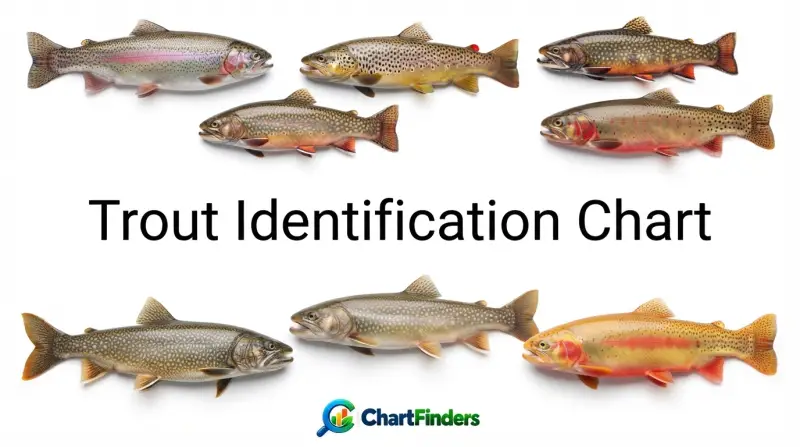
Trout Identification Chart
- Look Beyond Color: Body coloration changes dramatically based on water clarity, diet, and spawning condition; rely primarily on spot patterns, fin borders, and anatomical structures.
- The Cutthroat Distinction: True cutthroat trout are instantly identifiable by the distinct red-to-orange slash marks beneath the lower jaw (mandible).
- Char vs. True Trout: Species like Brook trout, Bull trout, and Lake trout are technically char (genus Salvelinus) and feature light-colored spots on a darker background, whereas true trout (genus Oncorhynchus and Salmo) feature dark spots on a lighter background.
- Mouth Anatomy Matters: Examining the vomer (roof of the mouth), basibranchial teeth, and the extension of the upper jaw past the back edge of the eye provides definitive taxonomic separation.
- Tail Shape Clues: Forked, square, or slightly emarginate caudal fins help segregate fast-water stream dwellers from deep-lake predators.
- Regulatory Compliance: Correct identification is vital for adhering to bag limits, size restrictions, and specialized catch-and-release rules designed to protect native stocks.
To provide a clear, rapid reference for field use, the following comprehensive identification matrix outlines the primary diagnostic criteria for the most commonly encountered trout and char species in North American and European watersheds.
| Species | Scientific Name | Primary Identification Clues | Spot Pattern & Markings | Fin Characteristics | Caudal (Tail) Fin |
|---|---|---|---|---|---|
| Rainbow Trout | Oncorhynchus mykiss | Pink-to-red lateral band along sides; silver or olive body; small black spots densely covering back, dorsal fin, and tail. | Uniform small black spots; spots on tail are typically arranged in neat rows radiating outward. | Dorsal and tail fins heavily spotted; pelvic/anal fins sometimes tipped in white. | Slightly forked with a broad base. |
| Brown Trout | Salmo trutta | Golden-brown to olive-yellow body; square tail; large jaw extending well past the rear margin of the eye in mature adults. | Large black and reddish-brown spots surrounded by pale halos (haloed spots); few to no spots on tail. | Adipose fin often tinged with orange or red; dorsal and pectoral fins lack heavy black spotting. | Square or truncate, rarely forked. |
| Brook Trout | Salvelinus fontinalis | Technically a char; dark green to black back with worm-like vermiculations; lower fins feature striking white and black leading edges. | Light yellow, cream, or red spots with blue halos scattered across dark background flanks. | Lower fins (pectoral, pelvic, anal) have distinct white borders backed by a dark band. | Square to slightly emarginate (not deeply forked). |
| Cutthroat Trout | Oncorhynchus clarkii | Distinct red, orange, or pink slash marks in the throat grooves under mandible; teeth often present on the base of the tongue (basibranchial teeth). | Spots concentrated heavily toward the rear half of the body; spots frequently cross below the lateral line. | Dorsal, adipose, and caudal fins heavily spotted. | Slightly forked. |
| Lake Trout | Salvelinus namaycush | Large char with a deeply forked tail; pale gray, green, or brown body covered in light worm-like vermiculations. | Light gray, white, or yellowish spots on a dark background; absence of any red or pink spots. | Fins lack bright white or black borders; plain or lightly spotted. | Deeply forked (crescent-shaped). |
| Bull Trout | Salvelinus confluentus | Large, flat head; elongated body; deep olive to gray back with pale yellow, orange, or pinkish spots. No black spots anywhere. | Round pale yellow or orange spots on flanks; complete absence of dark spots or worm-like markings on dorsal fin. | Lower fins lack bright white leading edges seen in brook trout. | Slightly forked to truncate. |
| Golden Trout | Oncorhynchus aguabonita | Brilliant golden-yellow belly and lower flanks; deep red lateral stripe; heavy, large black spots concentrated near the tail. | Large black spots concentrated on the posterior half of the body and caudal fin. | White tips on pelvic and anal fins, similar to cutthroat trout traits in high-alpine hybrids. | Slightly forked. |
When analyzing this matrix, notice that nature rarely draws sharp lines without exceptions. Environmental adaptations, localized stocking programs, and hybridization frequently create intermediate forms that test the keenest observer. The sections below dissect each major species and group to provide deep morphological context.
Understanding Taxonomic Divisions: True Trout vs. Char
Before examining individual species, it is essential to understand the biological divide between true trout and char. While both belong to the family Salmonidae, they occupy distinct taxonomic genera that exhibit fundamental anatomical differences.
True trout belong to the genera Salmo (native to Europe and western Asia, including the Brown Trout) and Oncorhynchus (native to the Pacific basin, including Rainbow and Cutthroat trout). Char belong to the genus Salvelinus and include Brook trout, Lake trout, Bull trout, and Dolly Varden.
Diagnostic Differences in Mouth Structure and Scales
- Vomerine Teeth: In true trout, teeth are present along the entire length of the vomer (the flat bone on the roof of the mouth). In char, teeth are restricted to the head of the vomer, forming a small patch that does not extend down the shaft.
- Spot Pigmentation: True trout feature dark spots (black, brown, or deep green) on a lighter body background. Char feature light spots (cream, yellow, pink, or red) on a darker body background.
- Scale Size: Char generally possess much smaller, finer scales embedded deeply in the skin, giving them a smoother, velvety texture compared to true trout.
Detailed Species Breakdown and Identification Clues
Rainbow Trout (Oncorhynchus mykiss)
The Rainbow Trout is arguably the most widely distributed and recognized salmonid in the world. Native to cold-water tributaries of the Pacific Ocean in North America and Asia, they have been successfully introduced to every continent except Antarctica.
Key Identification Features: The hallmark trait is a broad, pink-to-red iridescent band running along the lateral line from the gill plate to the tail, though this band may be faint in sea-run forms (steelhead) or strictly freshwater resident populations inhabiting dark waters. The body is silver, olive-green, or blue-gray above, fading to a white belly. Small, black spots pepper the entire body, extending densely across the dorsal fin, adipose fin, and the caudal fin. Unlike cutthroat trout, rainbows lack basibranchial teeth at the base of the tongue and do not possess red throat slashes.
Brown Trout (Salmo trutta)
Introduced to North America from Europe in the late 19th century (specifically via the famous dash from Germany’s Lake Lochleven), the Brown Trout is renowned for its wariness, nocturnal feeding habits, and ability to tolerate warmer water temperatures than native brook trout.
Key Identification Features: Brown trout vary wildly in appearance depending on whether they inhabit swift freestone rivers, deep tailwaters, or stillwater lakes. Generally, they feature a golden-brown, yellowish-olive, or brassy flank. Their most reliable diagnostic feature is the presence of large, dark black and reddish-brown spots encircled by distinct pale halos (halos of cream or light blue). The caudal fin is notably square or truncate and typically devoid of spots, though a few sparse black spots may appear near the upper margin. In mature adults, the maxilla (upper jaw) extends well past the rear margin of the eye, giving the head a distinctly heavy, bulldog-like profile.
Brook Trout (Salvelinus fontinalis)
Native to eastern North America, the Brook Trout is actually a char, a distinction that explains its unique coloration and ecological requirements. They thrive in pristine, ice-cold headwater streams, spring creeks, and high-altitude tarns.
Key Identification Features: Brook trout are among the most visually striking freshwater fish. The back is olive-green to dark brown, marked with worm-like vermiculations (marbling) rather than distinct round spots. The flanks feature red or crimson spots surrounded by pale blue halos. The most definitive identifying feature, however, is the coloration of the lower fins (pectoral, pelvic, and anal): each features a stark, brilliant white leading edge followed by a jet-black band and a reddish-orange body. The belly of a spawning male brook trout burns a brilliant, fiery orange-red.
Cutthroat Trout (Oncorhynchus clarkii)
Named for the striking red, orange, or pink slash marks located in the mandibular grooves under the lower jaw, the Cutthroat Trout comprises numerous distinct subspecies (such as the Yellowstone, Westslope, Lahontan, and Rio Grande cutthroats) adapted to the cold, high-elevation waters of western North America.
Key Identification Features: Aside from the iconic throat slashes, cutthroat trout are distinguished by spot distribution. Their black spots are typically sparse near the head and become heavily concentrated on the posterior (rear) half of the body, particularly extending across the caudal peduncle and tail fin. Many subspecies also possess small teeth on the basibranchial plate at the base of the tongue—a structural feature absent in rainbow trout. Where rainbow and cutthroat ranges overlap, natural hybridization occurs (“cutbows”), blending the red throat slash with the uniform spot pattern of the rainbow.
Lake Trout (Salvelinus namaycush)
The Lake Trout is the largest of the char species, inhabiting deep, cold, oligotrophic lakes across northern North America, Canada, and alpine regions of the northern United States.
Key Identification Features: As a deep-water apex predator, the lake trout features an elongated, torpedo-shaped body, a large head, and a deeply forked caudal fin (crescent-shaped), which separates it immediately from brook and brown trout. Its body color ranges from pale gray to dark green or black, overlaid with light gray, white, or yellowish vermiculations and spots. It lacks any red, pink, or orange spots on its body, and its fins do not possess the striking white borders characteristic of brook trout.
Bull Trout (Salvelinus confluentus)
Often confused with Brook Trout and Lake Trout, the Bull Trout is a native char of northwestern North America that requires exceptionally cold, clean, and complex interconnected river systems to survive. They are currently listed under conservation acts across much of their native range.
Key Identification Features: Bull trout possess a noticeably large, flat, broad head with an elongated snout, earning them the historical moniker “dolly Varden” (though true Dolly Varden are a separate, smaller sister species). The body is olive-green to gray, marked with pale yellow, orange, or pinkish spots along the flanks. Crucially, bull trout have no black spots or vermiculations on their dorsal fin, distinguishing them from brook trout and lake trout.
Golden Trout (Oncorhynchus aguabonita)
Native to the high-altitude volcanic waters of California’s southern Sierra Nevada mountains (specifically Golden Trout Creek and the Kern River drainage), the Golden Trout is celebrated as one of the most beautiful freshwater fish on earth.
Key Identification Features: Golden trout exhibit a brilliant, iridescent golden-yellow belly and lower flanks, bisected by a vibrant red lateral band. Parr marks (dark vertical oval bars along the sides) often persist into adulthood. Large, bold black spots are concentrated almost exclusively on the posterior half of the body and the tail fin. Their lower fins often feature white leading edges, hinting at evolutionary ties to cutthroat or rainbow lineages introduced or native to the region.
Advanced Identification: Hybridization and Morphological Variations
Field identification becomes genuinely complex when encountering hybridized trout or morphs adapted to unique environmental pressures. Understanding these variations prevents misclassification.
Rainbow x Cutthroat Hybrids (“Cutbows”)
In watersheds where native cutthroat trout and introduced rainbow trout overlap, natural hybridization frequently occurs. Cutbows present an identification puzzle because they blend traits from both parent species:
- They may display a faint or prominent red throat slash characteristic of cutthroats.
- Their spot pattern is often intermediate: spots extend forward past the dorsal fin (like a rainbow) but remain denser toward the tail (like a cutthroat).
- Basibranchial teeth may be present, but often reduced in number or size.
Stream-Resident vs. Lacustrine (Lake) Morphs
A single species can look drastically different depending on its habitat. A brown trout or rainbow trout residing in a tiny, nutrient-poor headwater stream will remain small (“creek-sized”), highly colored, and heavily spotted with dark parr marks persisting into adulthood. Conversely, the exact same genetic strain living in a rich lake or tailwater will grow large, silvery, and develop sparse spotting with muted coloration.
Practical Field Identification Checklist
When you land a trout and need to make a rapid, accurate identification before release or harvest, follow this step-by-step visual and tactile assessment framework:
- Examine the Tail (Caudal Fin): Is it square (Brown), deeply forked (Lake), slightly forked (Rainbow, Cutthroat), or squarish/emarginate (Brook)?
- Check the Spotting Pattern: Are there dark spots on a light background (True Trout) or light spots on a dark background (Char)?
- Inspect the Throat: Are there bright red/orange slash marks under the lower jaw (Cutthroat)?
- Look at the Fins: Do the lower fins have sharp white leading edges backed by black (Brook)? Are there dense black spots across the dorsal and tail fins (Rainbow)?
- Check the Mouth and Jaw: Does the upper jaw extend past the rear margin of the eye (Mature Brown)?
Common Identification Mistakes and Pitfalls
Even experienced anglers fall victim to common visual traps when identifying trout in the field. Avoiding these mistakes ensures accurate logging and regulatory compliance.
- Confusing Brook Trout and Bull Trout: Both are char with light spots on dark bodies. However, brook trout feature worm-like vermiculations on their back and dorsal fin, whereas bull trout have plain dorsal fins without vermiculations or black spots.
- Assuming Stocked Rainbows Represent Native Cutthroats: Stocked rainbow trout occasionally display a reddish tint under the throat due to diet or bruising, leading anglers to misidentify them as cutthroat trout. Always check for true mandibular slash marks and basibranchial teeth.
- Ignoring Juvenile Markings: Young trout of nearly all species exhibit dark vertical bars on their sides known as parr marks. An inexperienced angler might mistake a juvenile brown or rainbow trout for an entirely different species if they rely solely on flank patterns rather than fin and head morphology.
Frequently Asked Questions
What is the easiest way to tell a Brown Trout from a Rainbow Trout?
The easiest method is to examine the tail and spotting. Rainbow trout have small black spots covering their entire body, including the dorsal and tail fins. Brown trout feature large, haloed spots (dark spots surrounded by pale rings) and a square, unspotted tail. Additionally, a brown trout’s upper jaw extends well past the back of the eye, whereas a rainbow’s jaw is shorter.
Are Brook Trout true trout?
No. While commonly called trout, brook trout are actually members of the char genus (Salvelinus). They differ from true trout in their internal mouth anatomy (vomerine teeth structure), scale size, and distinctive light spots on a dark background accompanied by white-tipped lower fins.
What does a red slash under the jaw mean?
A distinct red, orange, or pink linear mark in the throat groove beneath the lower mandible is the definitive diagnostic marker of a Cutthroat Trout or a cutthroat hybrid. This trait separates cutthroats from rainbow and brown trout.
Why do some trout lack spots on their heads?
Spot distribution varies widely by species and environment. Cutthroat trout and golden trout naturally concentrate their spots toward the posterior (rear) half of their bodies, leaving the head and anterior flanks relatively clean and unspotted.
Can trout change their colors?
Yes. Trout possess specialized skin cells called chromatophores that allow them to alter their coloration and camouflage themselves against their immediate environment. A trout pulled from a dark, woody pool will appear much darker than one caught over bright, sandy gravel flats in the same river system.
Mastering trout identification enriches every moment spent on the water. By looking past shifting environmental colors and focusing on structural markers—spot distribution, fin margins, mouth anatomy, and caudal shapes—you can decode the rich biodiversity of our cold-water ecosystems with absolute confidence.