
The arachnofauna of North America is remarkably diverse, comprising thousands of described species across dozens of families. For the average observer, homeowner, or field researcher, encountering an eight-legged visitor often triggers immediate questions: Is this specimen dangerous? Is it a native inhabitant or an established exotic? How does one reliably differentiate a venomous recluse from a harmless hunting spider? Answering these questions requires moving beyond crude rules of thumb—such as the erroneous belief that all brightly colored spiders are dangerous—and adopting the systematic, morphological approach utilized by academic entomologists and arachnologists.
(Reference: Brown Recluse Spider Identification and Safety Guide – Arachnids Charts – Detailed Spider Information Chart for Home Safety Awareness – Mowbi Wholesale)Morphological identification relies on examining anatomical structures under magnification: the number and spacing of eyes on the ocular quadrangle, the presence or absence of a violin-shaped dorsal pattern on the cephalothorax, spinneret configuration, and leg-segmentation ratios. , the ecological landscape of North America is shifting. The intentional and accidental introduction of foreign lineages, most notably the Asian Jorō spider (Trichonephila clavata), has expanded the diagnostic scope required for accurate field identification. This comprehensive master guide provides an exhaustive framework for parsing North American arachnids, emphasizing anatomical breakdown, venom characterization, and systematic field diagnostics.
Explore our detailed breakdown on Crane Birds Identification Chart.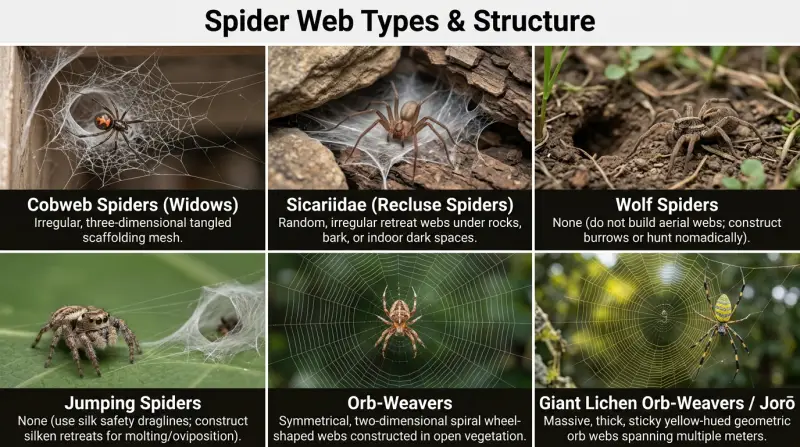
North American Spider Identification Chart
- Medical Significance is Rare: Out of thousands of North American spider species, only two genera—Latrodectus (widows) and Loxosceles (recluses)—possess venom capable of causing severe systemic or necrotic pathology in humans.
- Ocular Arrangement is Diagnostic: Most spider families can be identified to the family level simply by counting and observing the geometric arrangement of their eyes on the anterior cephalothorax.
- The Violin Mark is Specific to Recluses: The brown recluse (Loxosceles reclusa) and its congeners feature a distinct dark violin-shaped marking on the dorsal carapace, accompanied by an absence of abdominal patterns and spines on the legs.
- Invasive Species are Expanding: The Jorō spider (Trichonephila clavata), native to East Asia, has successfully established self-sustaining populations in the southeastern United States since its initial 2014 detection, recognized by its large size and golden webs.
- Hobo and Wolf Spiders Are Frequently Misidentified: Non-venomous native wolf spiders (Family Lycosidae) and European grass funnel-weavers (Tegenaria agrestis) are frequently mistaken for dangerous recluses due to brown coloration and aggressive postures.
- Anatomical Dissection Over Color: Coloration and size are notoriously plastic traits within arachnid populations; true identification relies strictly on sclerotized structures, trichobothria patterns, and claw morphology.
To effectively utilize a North American spider identification chart, one must understand that arachnid taxonomy is built upon hierarchical physical characteristics. The table below outlines the primary diagnostic families encountered in North America, highlighting their key anatomical markers, web structures, geographic distributions, and medical relevance.
| Family / Common Name | Scientific Name | Key Anatomical Identifiers | Web Architecture | Geographic Range | Medical Significance |
|---|---|---|---|---|---|
| Cobweb Spiders (Widows) | Latrodectus spp. | Globular abdomen, comb-setae on hind tarsi, glossy black cuticle, often with red/orange ventral hourglass. | Irregular, three-dimensional tangled scaffolding mesh. | Cosmopolitan across North America; regional species variations (e.g., L. mactans, L. hesperus). | High (Neurotoxic): Latrodectism causes intense muscular pain, cramping, and autonomic instability. |
| Sicariidae (Recluse Spiders) | Loxosceles spp. | Six eyes in three dyads, uniform brown coloration, dorsal violin marking, no abdominal spines or patterns. | Random, irregular retreat webs under rocks, bark, or indoor dark spaces. | South-central, midwestern, and southeastern United States; limited western pockets (e.g., L. deserta). | High (Necrotic): Loxoscelism causes localized dermonecrotic lesions and systemic loxoscelism in rare cases. |
| Wolf Spiders | Family Lycosidae | Large eyes with distinct large posterior median pair; robust, hairy legs; active ground hunters. | None (do not build aerial webs; construct burrows or hunt nomadically). | Ubiquitous throughout North America in fields, forests, and residential lawns. | Low: Mechanical bite causes localized pain and swelling; venom is not medically significant. |
| Jumping Spiders | Family Salticidae | Rectangular cephalothorax, large forward-facing anterior median eyes, acute stereoscopic vision. | None (use silk safety draglines; construct silken retreats for molting/oviposition). | Widespread across all North American terrestrial ecosystems. | Low: Docile unless cornered; bite results in minor, transient localized irritation. |
| Orb-Weavers | Family Araneidae | Variable morphology; often large, brightly colored abdomens; robust spiny legs adapted for web construction. | Symmetrical, two-dimensional spiral wheel-shaped webs constructed in open vegetation. | Found continent-wide in gardens, forests, and structural eaves. | None: Completely harmless to humans; venom targeted strictly at insect prey. |
| Giant Lichen Orb-Weavers / Jorō | Trichonephila clavata | Elongated cylindrical abdomen with yellow and blue-grey transverse bands; large body size (females up to 25-30mm). | Massive, thick, sticky yellow-hued geometric orb webs spanning multiple meters. | Southeastern United States (rapidly expanding northward and westward since 2014). | None: Extremely docile, non-aggressive, and possesses venom of negligible toxicity to humans. |
Reading the data above requires understanding that biological classification is not merely a list of traits, but a weighted matrix. When examining an unknown specimen, an entomologist evaluates macro-morphology first—such as whether the animal builds a geometric orb web or hunts freely on the substrate—before narrowing down to micro-morphological traits like eye configuration.
Anatomical Breakdown and Diagnostic Morphology
Accurate identification of North American spiders requires a firm grasp of external arachnid anatomy. Unlike insects, which possess three distinct tagmata (head, thorax, and abdomen), spiders possess two fused tagmata: the cephalothorax (prosoma) and the abdomen (opisthosoma), joined by a narrow pedicel.
The Cephalothorax and Ocular Patterns
The dorsal shield of the cephalothorax, known as the carapace, houses the central nervous system, musculature, and the ocular apparatus. The arrangement of the eyes is one of the most reliable diagnostic tools in arachnology. Most true spiders possess eight simple eyes (ocelli), though subterranean or cave-dwelling species may have six, four, or zero eyes.
- Family Lycosidae (Wolf Spiders): Eyes are arranged in three distinct rows (4-2-2). The bottom row consists of four small eyes, the middle row features two exceptionally large anterior median eyes, and the top row contains two medium-sized posterior lateral eyes.
- Family Salticidae (Jumping Spiders): Characterized by a distinctive flat or rounded, high-walled cephalothorax featuring an enormous pair of anterior median eyes that provide acute, color-perceiving stereoscopic vision, flanked by three smaller pairs.
- Family Sicariidae (Recluse Spiders): Uniquely possesses exactly six eyes arranged in three pairs (dyads)—one median pair and two lateral pairs—leaving a noticeable gap between the dyads.
Abdominal Markings and Spinneret Configuration
The opisthosoma (abdomen) houses the digestive tract, heart, respiratory book lungs, and silk-producing spinnerets. While abdominal color patterns (such as stripes, spots, or cardiac marks) are helpful, they are notoriously variable within single species due to genetic polymorphism and nutritional status.
Instead, researchers look to the spinnerets located at the posterior ventral tip of the abdomen. The number, length, and segmentation of these silk-spinning appendages differentiate primitive mygalomorphs (such as tarantulas and trapdoor spiders, which possess four robust, finger-like spinnerets) from advanced araneomorph spiders (which typically possess six spinnerets, often featuring a modified cribellum or colulus).
Medically Significant Spiders of North America
A primary driver for spider identification inquiries is the legitimate concern over medically significant bites. Within the North American continent, medical entomology recognizes two primary genera capable of inflicting systemic or necrotic envenomation: Latrodectus and Loxosceles.
Genus Latrodectus (Widow Spiders)
Widow spiders are characterized by a glossy, globose abdomen, slender legs, and a dense, messy web structure often built near ground level, woodpiles, or dark structural cavities. Several distinct species inhabit North America:
- Southern Black Widow (Latrodectus mactans): Found primarily in the southern and eastern United States, recognized by the classic bright red hourglass marking on the ventral abdomen.
- Western Black Widow (Latrodectus hesperus): Common across the western half of the continent, featuring similar coloration though the hourglass may sometimes be broken into two separate red spots.
- Northern Black Widow (Latrodectus variolus): Ranges from southern Canada down through the eastern U.S., marked by red spots and broken white/yellow lateral lines on the dorsal abdomen.
- Brown Widow (Latrodectus geometricus): An introduced cosmopolitan species found in southern states, featuring mottled brown-and-tan coloration with an orange-yellow ventral hourglass and spiky tan egg sacs.
The venom of Latrodectus species contains alpha-latrotoxin, a potent neurotoxin that triggers massive, uncontrolled exocytosis of neurotransmitters across synaptic terminals. Envenomation (latrodectism) results in severe local pain, rigid abdominal muscle cramping, diaphoresis, hypertension, and systemic distress requiring medical evaluation and, when indicated, specific antivenom therapy.
Genus Loxosceles (Recluse Spiders)
Recluse spiders are nocturnal hunters that do not build webs to capture prey; instead, they forage actively across surfaces or retreat into tight, dry crevices. The most prominent species is the brown recluse (Loxosceles reclusa), native to the Midwestern and South-Central states, alongside range-restricted western counterparts such as the desert recluse (Loxosceles deserta).
Diagnostic verification of a recluse spider requires checking three non-negotiable physical criteria:
- Six Eyes: Arranged in three dyads, completely lacking the standard eight-eye layout of most house spiders.
- Uniform Coloration: A solid fawn-to-dark-brown body completely lacking stripes, bands, or multi-colored patterns on the abdomen.
- The Violin Mark: A dark, violin-shaped sclerotized marking on the dorsal cephalothorax where the “neck” of the violin points backward toward the abdomen. (Note: Many non-venomous spiders possess violin-like smudges; eye count and leg spination must be confirmed).
Recluse venom contains the enzyme sphingomyelinase D, which destroys cell membranes and triggers localized vascular thrombosis and tissue destruction. This results in the characteristic dermonecrotic lesion (loxoscelism) that can take weeks or months to heal.
Beneficial, Harmless, and Invasive Taxa
The vast majority of North American spiders are entirely harmless to humans and play an indispensable ecological role as apex predators of insect populations. Understanding these taxa prevents unnecessary eradication and promotes ecological balance.
Wolf Spiders (Family Lycosidae)
Often mistaken for tarantulas or recluses due to their robust size (up to 35mm body length) and earthy brown-grey camouflage, wolf spiders are ground-dwelling nomadic hunters. They do not spin webs; instead, they sprint across lawns, leaf litter, and basements to run down prey. Females are easily identified by their unique maternal behavior of carrying their egg sac attached to their spinnerets, and later carrying hundreds of newly hatched spiderlings on their dorsal carapace.
Jumping Spiders (Family Salticidae)
Jumping spiders are among the most charismatic arachnids, recognized by their compact bodies, short legs, and large, intelligent forward-facing eyes. They possess exceptional spatial cognition and can leap up to 50 times their body length to capture prey. They are completely docile, rarely bite, and their venom poses zero threat to humans.
The Invasive Jorō Spider (Trichonephila clavata)
First detected in northern Georgia in 2014, the Jorō spider has rapidly expanded across the southeastern United States. Belonging to the family Araneidae, adult females feature striking yellow and blue-grey transverse abdominal stripes with red ventral markings, spanning up to several inches across including leg span. They construct massive, multi-layered yellow-hued orb webs that catch large flying insects. Despite their intimidating size, Jorō spiders are remarkably timid, freeze when disturbed, and possess venom that is ecologically negligible to humans and domestic pets.
Common Identification Mistakes and Misconceptions
Misidentifying spiders frequently leads to unfounded panic or, conversely, dangerous complacency. Reviewing common diagnostic errors helps ensure accurate field assessment.
- The “Brown Spider = Recluse” Fallacy: Hundreds of harmless ground spiders, funnel-weavers (such as Tegenaria domestica), and wolf spiders are solid brown. Assuming any brown house spider is a recluse ignores the mandatory requirement of confirming the six-eyed arrangement and dorsal violin.
- Confusing Hobo Spiders with Recluses: The hobo spider (Eratigena agrestis), introduced from Europe to the Pacific Northwest, was historically blamed for necrotic lesions. Modern arachnological consensus has largely discredited its medical significance, yet it remains frequently misidentified as dangerous.
- Misinterpreting Size and Color Plasticity: Juvenile spiders often look drastically different from adults of the same species, and coloration can vary wildly based on diet and age. Morphology (eye counts, claw structure, setae arrangement) must always take precedence over color.
Frequently Asked Questions
In North America, check for two primary groups: widow spiders (which are glossy black with rounded abdomens and often a red hourglass) and recluse spiders (which are uniform brown with six eyes and a violin pattern on the head). If the spider does not match these specific anatomical markers, it is virtually guaranteed to be a harmless, beneficial pest-control agent.
Wash the bite area thoroughly with soap and water, apply a cold compress to reduce localized swelling, and elevate the limb. If possible (and safely achievable without risking another bite), capture or photograph the specimen for professional identification. Seek immediate medical attention if you experience severe muscle cramping, systemic sweating, spreading discoloration, or signs of a necrotic lesion.
No. While wolf spiders are large, aggressive-looking hunters that can inflict a painful defensive mechanical bite if trapped against the skin, their venom is designed strictly for invertebrate prey and does not cause systemic or necrotic illness in humans.
Autumn triggers cooling outdoor temperatures and declining insect populations. Many mature male spiders actively roam indoors during this period in search of receptive females, while other species naturally seek sheltered overwintering sites in structural basements, crawlspaces, and wall voids.
No. Orb-weavers (Family Araneidae) construct large, geometric wheel-shaped webs in gardens and around porches. They are exceptionally docile, reluctant to bite, and possess mild venom targeted exclusively at flying insects. They pose zero medical threat to humans or companion animals.
Conclusion
Accurate spider identification in North America requires looking past superficial traits like color and size, turning instead to the rigorous standards of morphological examination. By understanding ocular arrangements, cephalothorax patterns, and web architectures, observers can easily separate the few medically significant taxa—such as widows and recluses—from the vast majority of harmless, beneficial arachnids that inhabit our homes and ecosystems. Maintaining this systematic perspective ensures both personal safety and a deeper appreciation for the complex biodiversity of North American entomology.