
Navigating the vast world of nuts, seeds, and botanically misclassified kernels requires more than a casual glance. To the untrained eye, many shelled or whole nuts look remarkably similar, yet their botanical families, flavor profiles, and culinary applications vary wildly. , in commercial, regulatory, and safety contexts—such as adhering to strict allergen labeling standards—misidentifying a tree nut or confusing a legume with a true nut can carry serious consequences.
(Reference: Nut (fruit) – Wikipedia)This master reference guide serves as an exhaustive field-experienced resource designed to break down the complexities of nut identification. Whether you are an agricultural inspector, a culinary professional, a food safety compliance officer, or an enthusiast seeking deep botanical knowledge, this guide explores the physical, structural, and taxonomic markers that define each major species. From true botanical nuts to drupes, legumes, and gymnosperm seeds commonly mislabeled as nuts, we will examine distinguishing characteristics, look-alikes, culinary uses, and safety considerations.
Explore our detailed breakdown on Tooth Identification Chart: Field Comparison Matrix.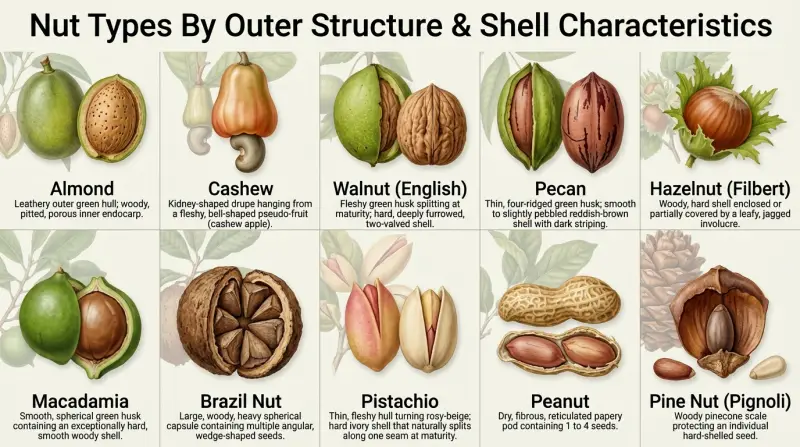
Nut Identification Chart
- Botanical vs. Culinary: Many popular “nuts” (such as almonds, pecans, cashews, and peanuts) are not true botanical nuts, but rather drupes, seeds, or legumes.
- Allergen Compliance: Current regulatory guidelines require exact, explicit naming of tree nuts (e.g., “almonds,” “cashews”) rather than broad categories like “mixed nuts,” ensuring complete consumer transparency.
- Structural Morphology: Shell hardness, ribbing, suture lines, kernel symmetry, and oil content provide the most reliable physical clues for accurate field identification.
- Look-Alike Differentiation: Distinguishing between closely related species—such as English walnuts versus black walnuts, or edible hickories versus bitter untamed varieties—relies heavily on husk morphology and endocarp ridging.
- Culinary Functionality: Understanding the fat profile and moisture content of each kernel dictates whether it is best suited for raw consumption, roasting, oil extraction, or baking.
To establish a reliable baseline for identification, one must first understand that the term “nut” holds two entirely different meanings: the strict botanical definition and the loose culinary definition. Botanically speaking, a true nut is a dry, indehiscent fruit with a hard wall (pericarp) that surrounds a single seed, where the pericarp remains entirely free or fused to the seed coat at maturity (such as true chestnuts, hazelnuts, and acorns). However, the food industry and culinary traditions classify a much broader range of oil-rich seeds and drupes under the banner of “nuts.”
| Common Name | Botanical Classification | Family | Shell / Exterior Characteristics | Kernel Morphology | Primary Allergen / Safety Notes |
|---|---|---|---|---|---|
| Almond | Drupe (Stone Fruit) | Rosaceae | Leathery outer green hull; woody, pitted, porous inner endocarp. | Teardrop-shaped, pointed tip, flat-convex cross section, brown skin. | Major tree nut allergen; must be explicitly labeled. |
| Cashew | Drupe Seed | Anacardiaceae | Kidney-shaped drupe hanging from a fleshy, bell-shaped pseudo-fruit (cashew apple). | Crescent or kidney-shaped, pale ivory, smooth surface. | Major tree nut allergen; raw forms contain toxic urushiol oil. |
| Walnut (English) | Drupe (Pseudonut) | Juglandaceae | Fleshy green husk splitting at maturity; hard, deeply furrowed, two-valved shell. | Two convoluted, brain-like lobes, high polyunsaturated oil content. | Major tree nut allergen; prone to rapid rancidity. |
| Pecan | Drupe (Pseudonut) | Juglandaceae | Thin, four-ridged green husk; smooth to slightly pebbled reddish-brown shell with dark striping. | Elongated, smooth-contoured kernel with distinct longitudinal grooves. | Major tree nut allergen; related to walnut and hickory families. |
| Hazelnut (Filbert) | True Nut | Betulaceae | Woody, hard shell enclosed or partially covered by a leafy, jagged involucre. | Spherical to oval kernel covered in a thin, bitter, reddish-brown pellicle. | Major tree nut allergen; highly valued in confectionery applications. |
| Macadamia | Follicle (Drupaceous) | Proteaceae | Smooth, spherical green husk containing an exceptionally hard, smooth woody shell. | Round, uniform cream-colored kernel with very high oil density. | Major tree nut allergen; requires specialized industrial cracking machinery. |
| Brazil Nut | Pyrene (Capsule Seed) | Lecythidaceae | Large, woody, heavy spherical capsule containing multiple angular, wedge-shaped seeds. | Elongated, triangular cross-section, white flesh encased in rough brown skin. | Major tree nut allergen; naturally high concentration of selenium. |
| Pistachio | Drupe (Stone Fruit) | Anacardiaceae | Thin, fleshy hull turning rosy-beige; hard ivory shell that naturally splits along one seam at maturity. | Plump, oblong kernel with distinctive green and purple/mauve skin. | Major tree nut allergen; split shell indicates peak ripeness. |
| Peanut | Legume (Pod) | Fabaceae | Dry, fibrous, reticulated papery pod containing 1 to 4 seeds. | Oval to cylindrical seeds wrapped in a thin, papery red-brown skin. | Legume (not a botanical nut); major food allergen regulated separately. |
| Pine Nut (Pignoli) | Gymnosperm Seed | Pinaceae | Woody pinecone scale protecting an individual hard-shelled seed. | Elongated, tear-shaped, ivory-white kernel with soft, buttery texture. | Tree nut allergy profile; can occasionally cause temporary taste disturbances (“pine mouth”). |
The table above illustrates the diverse evolutionary origins of foods commonly grouped together in the pantry. Recognizing whether a specimen is a true nut, a drupe, a gymnosperm seed, or a legume is foundational for any systematic identification process.
Taxonomic Foundations: True Nuts vs. Drupes and Seeds
To master nut identification, one must understand how botanical morphology dictates structural appearance. The plant kingdom utilizes various protective enclosures to safeguard its reproductive seeds.
True Nuts (Botanical Achenes and Nuts)
True nuts develop from a compound ovary and feature a hard, stony pericarp that does not open (dehisce) on its own to release the seed. Classic examples include chestnuts (genus Castanea) and hazelnuts (genus Corylus). Their identification markers include a singular, solid inner seed cavity and an exterior protective structure known as an involucre—often seen as the leafy husk surrounding a hazelnut or the spiny burr encasing a chestnut.
Drupes (Stone Fruits)
A staggering percentage of commercial “nuts” are actually the internal seeds of drupes. In a drupe, the outer layer of the pericarp is fleshy or leathery (the exocarp and mesocarp), while the inner layer (the endocarp) becomes hard and stony, forming what we commonly call the “shell.”
- Almonds: The fleshy outer hull dries and splits open at maturity, exposing a pitted, woody endocarp.
- Walnuts and Pecans: Encased in a smooth or fibrous green husk that rots or splits away, revealing a hard, ridged inner shell enclosing a highly convoluted, two-lobed kernel.
- Drupe Seeds (Cashews and Pistachios): Cashews feature an eccentric growth habit where the seed develops externally at the base of a swollen pedicel (the cashew apple). Pistachios grow in clusters with a hull that splits naturally along a suture line when ripe.
Gymnosperm Seeds and Legumes
Pine nuts are not fruits at all; they are the naked seeds harvested from the cones of specific pine species (such as the stone pine). They lack a true fruit wall, residing instead beneath woody cone scales. Peanuts, meanwhile, are underground-maturing pods belonging to the legume family (Fabaceae), sharing a closer biological kinship with beans and lentils than with tree nuts.
Detailed Visual and Morphological Identification Profiles
When conducting field identification or quality inspection, professionals rely on distinct physical markers. Examining the exterior husk, shell texture, suture patterns, and kernel interior eliminates guesswork.
The Juglandaceae Family: Walnuts, Pecans, and Hickories
Members of the walnut family share complex pinnate leaves and large, heavy nuts enclosed in husks.
- English Walnut (Juglans regia): Shells are relatively thin, light brown, oval to round, and feature shallow, brain-like ridges. The kernel breaks easily into two distinct halves.
- Black Walnut (Juglans nigra): Easily distinguished by its intensely hard, thick, deeply grooved, and heavily corrugated blackish-brown shell. The kernel is strongly flavored, dark, and notoriously difficult to extract in whole halves.
- Pecans (Carya illinoinensis): Elongated, smooth-contoured shells with dark brown longitudinal stripes. The kernel is smooth, butter-colored, and marked by shallow interior channels.
- Bitternut and Pignut Hickories (Carya cordiformis and Carya glabra): Wild hickory nuts feature four distinct seams or ridges on their husks and extremely hard, bony shells. Bitternut hickory nuts are notably bitter and astringent, whereas shagbark hickory nuts yield sweet, highly prized edible kernels.
The Rosaceae Family: Almonds
Almonds (Prunus dulcis) are instantly recognizable by their compressed, teardrop-shaped profile. The outer shell is heavily pitted with small, irregular holes resembling a sponge or porous stone. Inside lies a single smooth-skinned kernel characterized by a pointed apex, a rounded base, and a flat-convex cross-section. The interior flesh is solid, white, and dense, releasing a distinctly sweet, marzipan-like aroma when crushed due to natural benzaldehyde compounds.
The Betulaceae Family: Hazelnuts and Filberts
Hazelnuts (genus Corylus) present a spherical to slightly oval profile. Their woody shells vary in thickness and are wrapped in a fibrous, light-brown layer marked by a pale, oval attachment scar (the hilum) at the base. The kernel is spherical, tightly wrapped in a papery, astringent reddish-brown skin (pellicle) that must often be blanched and rubbed off for premium confectionery use.
The Anacardiaceae Family: Cashews and Pistachios
Both cashews and pistachios belong to a botanical family known for containing irritating phenolic compounds (such as urushiol), though processing neutralizes these threats in commercial supplies.
- Cashews (Anacardium occidentale): Curved, kidney-bean-shaped structure with a smooth surface and an ivory-white interior. Raw cashews are never sold in their natural shells because the outer pericarp contains caustic oil.
- Pistachios (Pistacia vera): Oval kernels encased in a hard, cream-colored shell that naturally splits open along a lateral suture line at maturity. The underlying kernel features vibrant green flesh covered by a purplish-pink skin.
Commercial Grading, Quality Defects, and Sizing Standards
In agricultural commerce, nut identification extends beyond species recognition to grading and defect analysis. International and domestic standards (such as USDA grading guidelines) evaluate kernel integrity, moisture content, and visual defects.
Common commercial quality defects include:
- Insect Damage: Tiny circular boreholes or fine powdery frass visible on the shell or entering the kernel cavity.
- Rancidity: Exhibited by a sharp, chemical off-odor, deep yellow discoloration, and a bitter or metallic taste caused by lipid oxidation.
- Mold and Decay: Fungal hyphae, white or green powdery webbing, or discoloration appearing on the kernel surface, often resulting from improper drying or excessive storage humidity.
- Shriveling: Underdeveloped, wrinkled, or paper-thin kernels resulting from drought stress during the growing season.
- Chipping and Scratching: Mechanical damage to the kernel surface during industrial shelling, which reduces commercial grade value.
Allergen Regulations and Modern Compliance (2026 Standards)
Regulatory frameworks—most notably updated FDA guidelines—place strict legal requirements on food manufacturers regarding how tree nuts and major allergens are identified and declared on packaging.
Key compliance mandates include:
- Explicit Naming: Blanket terms such as “mixed nuts” or generic “tree nuts” are legally insufficient for allergen declaration. Labels must explicitly state the exact species, such as “almonds,” “cashews,” “pecans,” or “walnuts.”
- Derivative Tracking: Every ingredient, oil, flour, extract, or protein derived from a tree nut must be explicitly identified in the ingredient list and reinforced within the “Contains” statement.
- Allergen Inclusion Limits: Only genuine tree nuts recognized on current regulatory major allergen lists may appear in allergen warning statements. Notably, while coconut is derived from a palm and historically grouped colloquially with tree nuts, regulatory agencies have refined its specific status, yet rigorous precise labeling remains standard industry best practice to protect sensitive consumers.
Common Identification Mistakes and Look-Alike Traps
Even seasoned field botanists and culinary inspectors occasionally stumble upon deceptive look-alikes. Avoiding these common mistakes prevents safety hazards and culinary failures.
- Confusing Black Walnut with English Walnut: While both belong to the genus Juglans, black walnut shells are nearly indestructible without heavy mechanical crushers, and their flavor is aggressively earthy and pungent. Substituting black walnuts into a delicate baking recipe meant for English walnuts will overwhelm the dish.
- Mistaking Horse Chestnuts (Conkers) for Edible Chestnuts: True edible chestnuts (Castanea sativa) feature a tuft of hair at the apex and a flat side on one end, enclosed in a densely spiny burr. Horse chestnuts (Aesculus hippocastanum) are poisonous, featuring smooth, warted husks and a rounder kernel marked by a pale, prominent scar. Ingestion causes severe gastrointestinal distress.
- Assuming Peanuts are True Nuts: Because of the word “nut” in their name and their culinary use as snack items, peanuts are frequently misclassified. From an allergy perspective, this confusion is dangerous; peanut allergies represent an entirely distinct immunological profile from tree nut allergies.
- Confusing Bitter Hickory with Sweet Hickory: Foraging wild hickories requires caution. Bitternut hickory nuts contain high levels of tannins, rendering them intensely bitter and unpalatable, whereas neighboring shagbark hickory trees produce sweet, delicious yields.
Frequently Asked Questions
A true botanical nut is a dry, indehiscent fruit where the ovary wall becomes hard and stony while remaining entirely free of or fused to a single seed at maturity (such as hazelnuts). A culinary nut encompasses a much wider commercial category that includes drupe seeds (almonds, cashews, pistachios), pseudonuts (walnuts, pecans), gymnosperm seeds (pine nuts), and legumes (peanuts).
Cashews grow inside a double-layered shell that contains an acrid, toxic resin composed of phenolic compounds like urushiol—the same skin-irritating oil found in poison ivy. Industrial processing involves roasting, steaming, and mechanically cracking the shells to safely extract the edible inner kernel.
Rancidity occurs when polyunsaturated fats oxidize over time due to exposure to heat, light, and oxygen. A rancid nut loses its sweet, nutty aroma and instead emits a harsh, paint-like, chemical, or stale odor. Visually, the kernel may appear darker, dull, or slightly yellowed, and tasting it will reveal a sharp, bitter, or soapy flavor.
While coconuts are the fruit of the coconut palm (Cocos nucifera) and are sometimes grouped with tree nuts in culinary contexts, regulatory bodies maintain specific distinction guidelines. However, food safety compliance dictates clear, unambiguous listing on ingredient declarations to protect consumers with specific sensitivities.
Known colloquially as “pine mouth” or dysgeusia, this temporary condition can occur days after consuming certain species of pine nuts (most frequently traced to imported Pinus armandii kernels rather than traditional European or North American culinary pine nuts). The bitterness is harmless and typically resolves on its own within a few days to two weeks without long-term health consequences.
Conclusion
Mastering the identification of nuts requires an appreciation of botanical morphology, structural shell characteristics, and rigorous regulatory standards. Whether you are sorting commercial agricultural yields, verifying food safety compliance, or exploring foraging trails, understanding the fundamental differences between drupes, true nuts, legumes, and seeds ensures precision. By relying on structural markers such as suture lines, endocarp texture, and kernel symmetry, you can navigate the complex spectrum of nut identification with absolute confidence and accuracy.