
Quick Answer: Pest droppings vary significantly by species in size, shape, color, and location. Mouse and rat pellets are small and dark with pointed or blunt ends, while larger mammal waste like raccoon or opossum droppings are tubular and often contain undigested seeds or hair. Accurate identification requires analyzing morphological traits, distribution patterns, and implementing strict personal protective equipment (PPE) protocols before handling.
Encountering animal waste within a residential or commercial structure is typically the primary diagnostic indicator of an infestation. Beyond the immediate aesthetic and sanitary concerns, exuviae and fecal deposits serve as critical forensic evidence for pest control professionals and academic entomologists alike. The morphology, deposition sites, and organic composition of these deposits provide a definitive roadmap for identifying the intruder, assessing population density, and determining behavioral patterns. However, misidentifying a biological vector based solely on superficial resemblance can lead to ineffective remediation efforts, ongoing structural damage, and continued exposure to zoonotic pathogens. This comprehensive guide details the anatomical, morphological, and behavioral characteristics of various pest droppings, offering a rigorous framework for precise identification and safe management.
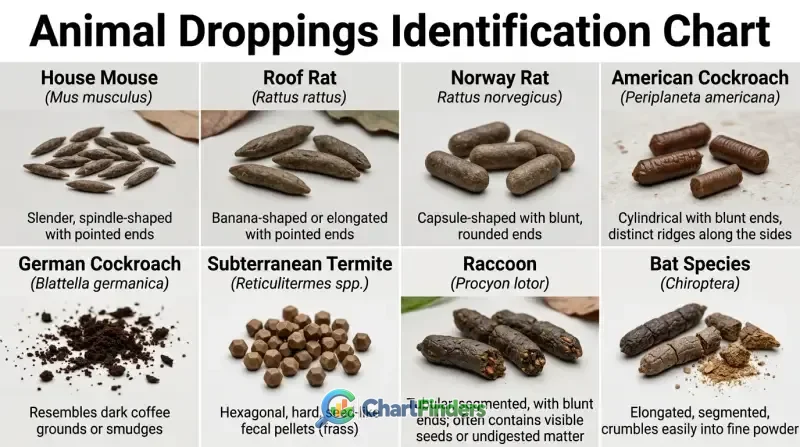
Pest Droppings Identification Chart
- Rodent pellets (Rattus and Mus species) feature distinct morphological differences, with house mice producing small, spindle-shaped droppings measuring roughly 3/16 inch, while Norway and roof rats produce substantially larger, capsule-shaped deposits.
- Insect frass—such as that produced by wood-boring beetles and subterranean termites—presents as fine, hard, grain-like pellets rather than mammalian waste, often accumulating in conical mounds beneath structural timbers.
- Larger urban and rural intruders, including Procyon lotor (raccoons) and Didelphis virginiana (opossums), leave behind segmented, tubular wastes characterized by macroscopic inclusions like fruit seeds, hair, and chitinous insect fragments.
- All fecal matter associated with vertebrate pests presents severe biological hazards, necessitating rigorous personal protective equipment, respiratory filtration (N95 or higher), and damp-cleanup methodologies to prevent aerosolization of viral and bacterial pathogens.
- Spatial distribution is as crucial as physical morphology; isolated, scattered droppings indicate foraging mice, whereas concentrated latrine sites or high-volume accumulation zones point toward colonial rodents, bats, or larger wildlife.
To assist in field identification, the following reference table outlines the primary physical metrics and diagnostic markers associated with common structural and agricultural pests.
| Pest Species | Average Size | Shape & Morphology | Color & Texture | Common Deposition Locations |
|---|---|---|---|---|
| House Mouse (Mus musculus) | 1/8 to 3/16 inch long | Slender, spindle-shaped with pointed ends | Dark brown to black; matte texture | Along baseboards, inside pantries, behind appliances, dark corners |
| Roof Rat (Rattus rattus) | 1/2 inch long | Banana-shaped or elongated with pointed ends | Dark brown to black; smooth or slightly curved | Attics, upper rafters, upper storage areas, tree branches near rooflines |
| Norway Rat (Rattus norvegicus) | 3/4 inch long | Capsule-shaped with blunt, rounded ends | Dark brown; dense and hard | Basements, crawlspaces, ground-level burrows, near garbage receptacles |
| American Cockroach (Periplaneta americana) | 1/16 inch (grain-like) | Cylindrical with blunt ends, distinct ridges along the sides | Dark brown to black; resembles cracked black pepper or mouse droppings | Moist utility areas, damp basements, floor drains, commercial kitchens |
| German Cockroach (Blattella germanica) | Pinpoint to speck size | Resembles dark coffee grounds or smudges | Black or dark brown | Cabinet hinges, cracks in kitchen counters, behind refrigerators, near water sources |
| Subterranean Termite (Reticulitermes spp.) | Less than 1 millimeter | Hexagonal, hard, seed-like fecal pellets (frass) | Tan to dark brown | Pushed out of tiny kick-out holes in wood; accumulates in neat piles beneath damaged timber |
| Raccoon (Procyon lotor) | 2 to 3 inches long, 1/2 inch thick | Tubular, segmented, with blunt ends; often contains visible seeds or undigested matter | Dark brown to black | Roof decks, base of large trees, flat attic spaces, chimney tops (latrines) |
| Bat Species (Chiroptera) | 1/8 to 3/8 inch long | Elongated, segmented, crumbles easily into fine powder | Dark brown or black; often glitters due to insect exoskeleton fragments | Attic floors, hanging directly below roosting sites, exterior siding |
Reading this diagnostic matrix requires evaluating multiple physical parameters simultaneously. A single characteristic—such as dark color—is insufficient for identification, as environmental oxidation alters the appearance of organic waste over time. Observers must cross-reference length, end-cap morphology (pointed versus blunt), structural integrity, and the micro-habitat where the deposit was discovered.
Anatomical and Morphological Breakdown of Rodent Waste
Rodents represent the most frequent vertebrate intruders in human habitations. Differentiating between murine (mouse) and cricetid/murine rat waste is foundational to effective pest management.
House Mouse (Mus musculus) Characteristics
House mouse droppings are remarkably diminutive, typically averaging between 3 to 5 millimeters in length (roughly 1/8 to 3/16 of an inch). Structurally, they are spindle-shaped, tapering noticeably at one or both ends. An active infestation by Mus musculus will yield an immense volume of waste relative to the animal’s body mass—often dropping between 50 and 80 pellets per individual per day. These are distributed randomly along runways, inside stored goods, and within nesting chambers.
Roof Rat (Rattus rattus) Versus Norway Rat (Rattus norvegicus)
Distinguishing between the two primary peridomestic rat species relies heavily on fecal geometry:
- Roof Rat (Rattus rattus): The droppings measure approximately 1/2 inch in length and display a distinctly elongated, curved profile often described as banana-shaped, featuring sharply pointed ends. Because roof rats are agile climbers, these deposits are frequently encountered in elevated locations such as ceiling voids, attics, and rafters.
- Norway Rat (Rattus norvegicus): The droppings are larger, robust, and measure up to 3/4 inch long. Unlike the sleek profile of the roof rat, Norway rat waste features blunt, rounded ends and a thicker, capsule-like cylindrical body. These are deposited primarily at ground level, near exterior foundations, in crawlspaces, and inside burrow entrances.
Comparative Analysis of Pest Droppings
To further streamline identification and eliminate confusion between similar-looking deposits, the following comparative table contrasts overlapping pest categories across critical diagnostic vectors.
| Pest Group | Primary Lookalikes | Key Differentiating Feature | Typical Volume / Distribution |
|---|---|---|---|
| House Mouse vs. German Cockroach Nymph | Small dark pellets vs. ink smudges/grounds | Mice produce distinct 3mm spindle pellets; German roaches leave smears or microscopic specks. | Mice scatter widely along runways; roaches concentrate near moisture and heat sources. |
| Roof Rat vs. Norway Rat | Banana-shaped with points vs. capsule-shaped with blunt ends | Roof rat droppings are curved (1/2″); Norway rat droppings are straight and thick (3/4″). | Roof rats deposit elevated in attics/rafters; Norway rats deposit low in crawlspaces/burrows. |
| American Cockroach vs. Mouse | Ridged cylindrical pellets vs. smooth spindle pellets | Cockroach pellets feature distinct longitudinal ridges under magnification; mice taper to points. | Roach waste found near drains and kitchens; mouse waste scattered throughout structures. |
| Bat Guano vs. Mouse Droppings | Small dark elongated pellets | Bat guano crumbles into glittering chitin dust when squeezed; mouse droppings remain hard. | Bat guano forms massive pyramidal piles beneath roosts; mouse pellets scatter along baseboards. |
Invertebrate Feces and Frass Identification
Not all concerning deposits originate from mammals. Invertebrate waste—frequently termed frass—presents distinct morphological clues that prevent costly confusion with vertebrate vectors.
Cockroach Excrement
German cockroaches (Blattella germanica) produce microscopic fecal deposits that mimic dark coffee grounds or black ink smudges smeared onto surfaces near harborages. Conversely, larger peridomestic species such as the American cockroach (Periplaneta americana) deposit cylindrical pellets roughly 1/16 of an inch long. These exhibit distinct longitudinal ridges running down the sides and blunt ends, frequently leading untrained observers to mistake them for miniature rodent droppings.
Wood-Boring Insects and Termites
Drywood termites (family Kalotermitidae) and various wood-boring beetles (such as powderpost beetles, family Bostrichidae) expel dry frass from structural wood. Drywood termite pellets are hard, elongated, and possess six distinct concave surfaces with rounded ends, stacking up in distinct, uniform mounds. Powderpost beetle frass, by contrast, is exceptionally fine, resembling talcum powder or wood flour, often accompanied by tiny exit holes in the timber matrix.
Wildlife and Nuisance Mammal Droppings
When properties border wooded or suburban-wildland interfaces, larger mammalian intruders frequently leave behind characteristic fecal signatures.
Raccoon (Procyon lotor) Latrines
Raccoon droppings are substantial—often rivaling those of a medium-sized domestic dog—measuring 2 to 3 inches in length and roughly 1/2 inch in diameter. They are tubular, have blunt ends, and are dark in color. A critical diagnostic feature of raccoon waste is its content; because they are opportunistic omnivores, their feces frequently contain recognizable fragments of undigested seeds, whole berries, fruit skins, corn kernels, or chitinous insect remains. Raccoons typically establish communal latrine sites on flat roofs, fallen logs, or attic insulation.
Bat Guano (Order Chiroptera)
Insectivorous bat guano accumulates in massive quantities beneath roosting colonies in attics and wall voids. Individual pellets are small (1/4 inch or less) and elongated, superficially resembling mouse droppings. However, bat guano is composed entirely of digested insect exoskeletons. When compressed, it crumbles instantly into a fine, glittering powder composed of reflective chitin flakes rather than maintaining the hard, fibrous consistency of rodent waste.
Spatial Distribution and Environmental Context
The micro-location of fecal deposits is as diagnostically valuable as their physical morphology. Pest species exhibit distinct behavioral habits regarding where they void waste:
- Linear Runways: Mice and rats possess poor vision and navigate by touch, hugging vertical walls. Consequently, their droppings accumulate in linear trails along baseboards, pipe chases, and structural framing.
- Clustered Accumulations: High-density clusters in tight corners or behind major appliances indicate fixed resting or feeding stations.
- Elevated vs. Ground-Level Placement: Elevated deposits immediately implicate climbing species such as roof rats, squirrels, or bats, whereas ground-level concentrations point toward subterranean rodents, voles, or terrestrial wildlife.
- Scattered vs. Consolidated: Animals with broad foraging ranges, such as mice, scatter droppings haphazardly across wide areas. Territorial or den-dwelling species often consolidate waste into latrines.
Diagnostic Methodology and Field Investigation
Executing a reliable pest identification via fecal inspection requires a structured, methodical protocol. Pest management professionals adhere to a strict investigative sequence to minimize contamination risks and ensure diagnostic accuracy.
- Preparation and PPE Deployment: Don appropriate personal protective equipment before entering any suspected infestation zone, including nitrile gloves, disposable coveralls, and an N95 or P100 particulate respirator.
- Visual Survey and Mapping: Survey the structure systematically using high-intensity illumination. Note all locations where droppings are present, recording whether they are isolated, linear, or clustered.
- Physical Examination: Using a blunt probe or gloved hand, assess a representative sample. Measure length and width using a standard scale. Evaluate surface texture, end morphology, and structural rigidity (whether the sample is hard, pliable, or crumbly).
- Inclusion Analysis: Check for macroscopic inclusions such as hair, seed coats, or insect parts. For suspected insect frass, inspect under magnification to identify geometric facets or powdery consistency.
- Environmental Context Correlation: Correlate the physical findings with secondary evidence, such as gnaw marks, rub marks (sebum stains), nesting material, and structural entry points.
Common Mistakes and Diagnostic Limitations
Even experienced technicians encounter diagnostic challenges when evaluating pest waste. Recognizing common pitfalls prevents erroneous treatment strategies.
- Assuming Age Based on Color: Fresh droppings are typically darker, softer, and possess a slight sheen. Over time, environmental oxidation and desiccation turn droppings lighter brown or grey and cause them to become brittle. Evaluating age based strictly on color without considering ambient humidity is a frequent error.
- Confusing Cockroach Frass with Rodent Waste: Large American cockroach nymphs deposit ridged cylindrical frass that mimics mouse pellets. Failing to examine the object under magnification for distinct longitudinal ridges leads to misdiagnosed rodent issues when the actual vector is an insect.
- Overlooking Pet Waste Contamination: Domestic canine and feline waste can occasionally be tracked into utility areas or basements by pests, or deposited by stray animals entering crawlspaces, complicating indoor pest assessments.
- Ignoring Zoonotic Hazards: Attempting to sweep dry rodent or bat waste with a standard broom aerosolizes infectious dried particles containing hantavirus, leptospirosis, or fungal spores. Fecal matter should never be dry-swept.
Frequently Asked Questions
Fresh droppings are typically darker, slightly pliable, and maintain a moist sheen. As fecal matter ages, ambient air currents and low humidity cause desiccation, turning the material lighter in color, dull, and brittle. Pressing gently on a sample can help determine moisture content, though this should always be done with proper respiratory and hand protection.
No. Standard vacuum cleaners exhaust fine air currents that aerosolize dried viral and bacterial pathogens—such as Hantavirus Pulmonary Syndrome—from disturbed feces. Cleanup must always begin by misting the area with a 10% bleach solution or commercial disinfectant, allowing it to soak for five minutes, and wiping the waste away with damp paper towels.
This morphological difference stems from anatomical scaling and digestive tract geometry. Mice possess much smaller intestinal sphincters and colonic diameters, producing tapered, spindle-shaped pellets. Larger rodents like Norway rats possess wider colons that shape waste into cylindrical capsules with blunt, squared-off terminal ends.
While both are small and dark, mouse droppings are dense, hard, and maintain their structural integrity when handled. Bat guano is composed entirely of brittle insect exoskeletons; under minimal pressure, it collapses instantly into a fine powder that often sparkles due to reflective chitin fragments.
Yes, though through entirely different mechanisms. While rodents cause damage by gnawing wood and electrical wiring to wear down continuously growing incisors, wood-boring insects and termites cause structural damage by consuming cellulose internally, leaving behind hollowed timbers and characteristic external frass accumulations.
Conclusion
Accurate identification of pest droppings is an indispensable diagnostic skill in structural pest management. By systematically analyzing physical dimensions, morphological features, spatial distribution, and organic composition, property owners and professionals can pinpoint the exact biological vector responsible for an infestation. Moving beyond superficial assumptions ensures that remediation protocols target the correct organism, mitigating structural degradation while safeguarding human health against vector-borne pathogens. Always prioritize personal protection, adhere to damp-cleanup standards, and consult certified pest control professionals when managing complex or high-density infestations.