
Walking through a hardwood forest in autumn or admiring a sprawling canopy in mid-summer, encountering the vast diversity of the genus Quercus (oaks) can quickly become an exercise in botanical humility. With over 90 species native to North America alone—and countless natural hybrids that blur traditional taxonomic lines—identifying an oak tree strictly by eye can feel daunting. Yet, nature provides a reliable, elegant architectural blueprint written directly into the foliage. By learning how to read the geometry of an oak leaf, arborists, foresters, and nature enthusiasts can unlock the identity of almost any oak tree they encounter.
(Reference: Complete Guide to Oak Trees | BBC Gardeners World Magazine)This comprehensive guide provides an authoritative reference framework for oak leaf identification. It explores the foundational morphological traits that separate red oaks from white oaks, examines regional variations, details the microscopic and macroscopic nuances of leaf structures, and highlights the crucial contextual clues—such as bark texture, twig morphology, and acorn maturation cycles—that prevent misidentification. Whether you are managing a woodlot, studying dendrology, or simply trying to name the majestic tree in your backyard, mastering this structural chart will transform how you interact with the natural world.
Explore our detailed breakdown on Texas Caterpillar Identification Chart (Complete Data Matrix).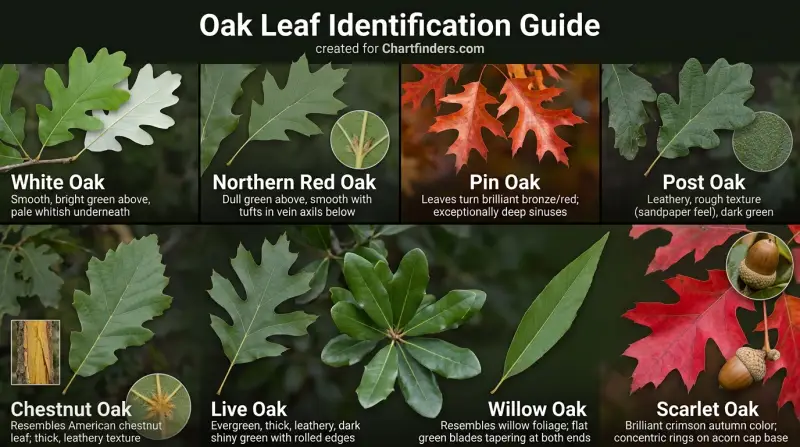
Oak Tree Leaf Identification Chart
- The Golden Rule: The single most reliable divider in oak identification is lobe tip morphology—bristle tips mean Red Oak, rounded tips mean White Oak.
- Sinus Depth Matters: The spaces between lobes (sinuses) vary drastically by species, ranging from shallow, wavy undulations to deep clefts that reach almost to the central midrib.
- Leaf Base Variations: Bases can be wedge-shaped (cuneate), rounded, heart-shaped (cordate), or asymmetric, providing critical clues when lobe shapes look similar.
- Surface Texture and Color: Hairs (trichomes), glossiness, leatheriness, and underside coloration separate look-alike species within the same subsection.
- Multimodal Verification: Leaves tell a compelling story, but confirming tree species requires examining bark furrowing, twig characteristics, and acorn maturation cycles.
To successfully navigate the taxonomy of oaks, one must rely on a systematic approach. The following comprehensive reference table categorizes the most common North American oak species based on their definitive leaf characteristics, lobe geometries, and structural traits.
| Common Name | Scientific Name | Group | Lobe & Tip Characteristics | Sinus Depth | Key Leaf Differentiator |
|---|---|---|---|---|---|
| White Oak | Quercus alba | White | 5–9 rounded lobes; no bristles | Variable, sometimes deep | Smooth, bright green above, pale whitish underneath |
| Northern Red Oak | Quercus rubra | Red | 7–11 lobes with bristled tips | Cuts about halfway to midrib | Dull green above, smooth with tufts in vein axils below |
| Pin Oak | Quercus palustris | Red | 5–7 deeply cut lobes, bristled | Deep, U-shaped, almost reaching midrib | Leaves turn brilliant bronze/red; exceptionally deep sinuses |
| Post Oak | Quercus stellata | White | 5 distinct lobes; cross-shaped | Deep, irregular | Leathery, rough texture (sandpaper feel), dark green |
| Water Oak | Quercus nigra | Red | Spatulate (paddle-shaped); unlobed | None (entire margin) | Widest near the apex, narrow wedge-like base |
| Chestnut Oak | Quercus montana | White | Coarsely toothed/crenated (no lobes) | Shallow, rounded teeth | Resembles American chestnut leaf; thick, leathery texture |
| Black Oak | Quercus velutina | Red | 7–9 lobes, bristled tips, variable cuts | Deep to moderate | Yellowish inner bark; star-shaped hairs underneath |
| Live Oak | Quercus virginiana | White | Entire margins (unlobed), oblong | None | Evergreen, thick, leathery, dark shiny green with rolled edges |
| Willow Oak | Quercus phellos | Red | Narrow, lanceolate; unlobed | None (entire margin) | Resembles willow foliage; flat green blades tapering at both ends |
| Scarlet Oak | Quercus coccinea | Red | 7–9 lobes with bristle tips | Very deep, C-shaped sinuses | Brilliant crimson autumn color; concentric rings on acorn cap base |
This reference table establishes the foundational divide. However, interpreting these features in the field requires an understanding of botanical morphology, anatomy, and seasonal variability.
Understanding the Great Botanical Divide: Red Oaks vs. White Oaks
Every field-experienced arborist begins identification by assigning an unknown oak to one of two major subgenera: Erythrobalanus (the red oak group) or Lepidobalanus (the white oak group). This distinction is not merely academic; it dictates physiological traits, timber density, acorn maturation timelines, and ecological interactions.
Red Oak Group Characteristics:
- Lobe Tips: Every lobe terminates in a fine, hair-like bristle. These microscopic extensions are dead vascular endings that protect the leaf margin during expansion.
- Acorn Maturation: Red oak acorns take two full growing seasons to mature. They drop in the autumn of their second year.
- Wood Anatomy: The inner pores of red oak wood are open and porous, making the wood permeable to water and unsuitable for liquid-tight containers like whiskey barrels.
- Kernel Tannin Content: Generally higher in bitter tannins, requiring longer leaching before being consumed by wildlife or humans.
White Oak Group Characteristics:
- Lobe Tips: Lobes are rounded and completely devoid of bristles. When you run your finger along the leaf edge, it feels smooth and blunted.
- Acorn Maturation: White oak acorns mature in a single growing season, dropping in their first autumn. Because they lack internal dormancy inhibitors, they often germinate immediately upon touching the ground.
- Wood Anatomy: White oak wood features tyloses—cellular outgrowths that plug the xylem pores—making the heartwood completely waterproof and ideal for shipbuilding and cooperage.
- Kernel Tannin Content: Typically lower in tannins, making them sweeter and favored by wildlife (such as deer and turkeys) as soon as they drop.
Anatomy of an Oak Leaf: Key Morphological Features
To move beyond the red-versus-white dichotomy and pinpoint an exact species, you must dissect the leaf into its constituent anatomical parts. Each feature provides a vital data point on the identification chart.
1. Margin Architecture: Lobes, Sinuses, and Teeth
The margin (outer edge) of an oak leaf defines its architectural silhouette. Botanists divide margins into three primary categories:
- Lobed: Projections extending outward from the central axis. Lobes can be shallow and rounded (like the White Oak) or deep and sharply angled (like the Pin or Scarlet Oak).
- Toothed (Serrate/Crenate): Rather than forming lobes, the margin features small, pointed teeth (saw-like) or rounded bumps (crenate), as seen in the Chestnut Oak and Chinquapin Oak.
- Entire: Smooth margins with no lobes or teeth whatsoever. Species like the Willow Oak (Quercus phellos) and Shingle Oak (Quercus imbricaria) possess entire margins, causing them to be easily mistaken for non-oak species like willows or laurels.
The sinus—the recessed space or indentation cut into the leaf blade between adjacent lobes—is equally critical. Sinuses can be U-shaped (broad and rounded) or V-shaped (narrow and acute). The depth of the sinus relative to the distance to the midrib is a primary diagnostic metric in regional keys.
2. Leaf Shape and Geometry
Overall leaf geometry varies dramatically across the genus. While most people picture a standard lobed leaf, oaks exhibit surprising diversity:
- Obovate: Widest above the middle, tapering toward the base (e.g., Post Oak).
- Oblanceolate: Lance-shaped but wider near the tip.
- Spatulate: Spoon-shaped, expanding broadly near the apex (e.g., Water Oak).
- Lanceolate: Narrow and tapering at both ends, resembling a spear point (e.g., Willow Oak).
- Elliptic: Oval-shaped, roughly equal in width above and below the center point.
3. Surface Textures, Pubescence, and Coloration
A tactile examination is often necessary when visual cues overlap. Pubescence (the presence of hairs) on the abaxial (underside) surface of the leaf is a definitive identifier for tricky species pairs.
- Axillary Tufts: Tiny bundles of hair found in the corners where lateral veins branch off the midrib. Northern Red Oaks feature distinct tufts, whereas Shumard Oaks typically lack them.
- Tomentum: A dense layer of matted, woolly hairs. Species like the Blackjack Oak (Quercus marilandica) feature heavily tomentose undersides that feel velvety or rusty-brown.
- Glaucousness: A fine, waxy, bluish-white powdery coating on the underside of leaves, common in Swamp White Oaks (Quercus bicolor), giving the lower surface a distinctly pale cast.
- Scabrous/Sandpaper Texture: Leaves with stiff, microscopic trichomes that give the upper blade a rough feel, characteristic of Post Oak and Blackjack Oak.
Step-by-Step Field Identification Process
When standing before an unfamiliar oak tree, following a structured sequence prevents confusion and speeds up identification. Use this four-step field protocol:
- Examine the Lobe Tips: Pull a leaf down and inspect the tips of the lobes. Are they tipped with stiff, needle-like bristles, or are they smooth and rounded? This instantly splits your options in half.
- Analyze the Sinus Depth: Look at how deeply the margins are carved. Do the sinuses reach only a quarter of the way to the midrib, or do they slice deeply, nearly dividing the leaf into separate segments?
- Check the Underside and Petiole: Turn the leaf over. Look for hair tufts in the vein junctions, check for a whitish/silvery cast, and feel the texture of the petiole (leaf stem). Is the petiole long and slender, or short and stout?
- Corroborate with Bark, Twigs, and Acorns: Never rely on leaves alone if the tree is mature. Look down at the forest floor for fallen acorns and cupules, examine the bark texture on the lower trunk, and check terminal buds on twigs (clustered buds are typical of red oaks).
Regional Oak Identification Focus
Oak diversity shifts dramatically across North American geographic zones. Understanding regional dominance helps narrow down field possibilities.
Eastern and Midwestern Hardwood Forests
The temperate deciduous forests of the East and Midwest host the highest concentration of oak species. Here, the dominant canopy species include the White Oak (Quercus alba), Northern Red Oak (Quercus rubra), Black Oak (Quercus velutina), and Chestnut Oak (Quercus montana). Forest floor identification relies heavily on leaf fall accumulation, where the massive, deeply lobed leaves of the White Oak carpet the ground alongside the bristled foliage of red oak complexes.
Southern Coastal Plain and Bottomlands
Moving south into the humid coastal plains and river floodplains, traditional lobed oak leaves give way to entire-margined and evergreen species. The Live Oak (Quercus virginiana) dominates coastal hammocks with its thick, leathery, evergreen leaves that curl slightly at the margins. Meanwhile, swampy bottomlands support the Water Oak (Quercus nigra), Laurel Oak (Quercus laurifolia), and Willow Oak (Quercus phellos), all of which produce unlobed leaves that confound amateur naturalists looking for classic oak lobes.
Western and Southwestern Arid Zones
Western oaks have adapted to Mediterranean climates and dry foothills. Species like the Valley Oak (Quercus lobata)—the largest North American oak—feature deeply lobed leaves reminiscent of Eastern white oaks. In contrast, chaparral species such as the Scrub Oak (Quercus berberidifolia) produce small, leathery, spiny-toothed leaves that resemble holly rather than traditional deciduous oaks.
Common Pitfalls and Identification Mistakes
Even experienced field botanists occasionally stumble when identifying oaks due to biological complexities. Avoiding these common mistakes ensures accurate identification.
1. Falling Victim to Natural Hybridization
Oaks are notoriously promiscuous. Species within the same subgenus readily cross-pollinate when growing in close proximity, producing hybrid offspring that display intermediate leaf characteristics. For example, the “Schnell’s Oak” (a hybrid between the Pin Oak and Willow Oak) displays lobed leaves on some branches and unlobed, willow-like leaves on others. When a leaf defies standard chart keys, hybridization is often the culprit.
2. Sun Leaves vs. Shade Leaves
A single oak tree can produce dramatically different leaves depending on canopy position. Sun leaves (exposed to high light at the outer canopy) tend to be smaller, thicker, and deeply lobed with pronounced sinuses to shed excess heat and wind stress. Shade leaves (sheltered deep within the inner canopy) are typically larger, broader, thinner, and feature shallower sinuses. Always sample leaves from the lower, well-lit exterior of the canopy for identification.
3. Juvenile vs. Mature Foliage
Saplings and root sprouts (epicormic growth) frequently produce aberrant leaves that bear little resemblance to mature canopy foliage. Young red oak sprouts often produce massive, exaggerated lobes with sharp bristles, while young white oaks can display atypical toothing. Always verify your identification against mature leaves higher up on the tree.
Frequently Asked Questions
The definitive indicator is the tip of the leaf lobes. Red oak leaves have lobes that terminate in tiny, sharp bristles. White oak leaves have entirely rounded lobes with no bristles. Additionally, red oak acorns take two years to mature, while white oak acorns mature in a single season.
Certain oak species—such as the Willow Oak (Quercus phellos), Laurel Oak (Quercus laurifolia), and Shingle Oak (Quercus imbricaria)—belong to the red oak group but have evolved unlobed, entire-margined leaves (known as willow-form or lanceolate leaves) to reduce transpirational water loss in specific ecological niches.
Yes. Oak trees exhibit heterophylly. Leaves growing in deep shade in the interior of the canopy are often broader with shallower sinuses, while sun-exposed leaves on the outer perimeter are smaller and more deeply lobed. Epicormic shoots and juvenile saplings also produce abnormal leaf shapes.
Pin oaks are recognized by their deeply cut sinuses that reach almost to the central midrib, U-shaped spaces between narrow lobes, bristled tips, and the tree’s distinctive growth habit where lower branches droop downward toward the ground.
Yes. Oak leaves and acorns contain high concentrations of tannins. Ingesting large quantities of young spring leaves or green acorns can cause severe gastrointestinal distress, kidney damage, and systemic toxicity in horses, cattle, sheep, and dogs.
Conclusion
Mastering oak tree leaf identification is an exercise in pattern recognition, botanical morphology, and ecological context. By anchoring your search in the fundamental division between bristle-tipped red oaks and rounded white oaks, you establish a reliable baseline. From there, examining sinus depth, leaf bases, surface pubescence, and structural bark patterns transforms an ambiguous green canopy into an easily readable catalog of species. Keep this identification framework close at hand, observe the subtle variations in your local woodlands, and let the architecture of the leaf reveal the true identity of the mighty oak.