
Discovering unexplained droppings in a pantry, attic, crawlspace, or garage is often the very first sign of an unwanted rodent infestation. Because rodents are predominantly nocturnal, elusive, and capable of squeezing through remarkably small gaps, property owners rarely see the animals themselves before noticing the physical evidence they leave behind. Among all physical indicators, fecal matter—commonly referred to as scat or droppings—is the most reliable, abundant, and telling forensic clue available.
(Reference: Companion Animal Parasite Council | Home)However, misidentifying pest droppings can lead to wasted time, ineffective traps, and escalating structural or health hazards. Mistaking mouse droppings for insect frass, or confusing rat scat with squirrel or bat droppings, means the underlying infestation goes unaddressed while populations multiply. This comprehensive guide provides a definitive field reference for identifying rodent waste, evaluating freshness, understanding species-specific morphology, and executing safe clean-up procedures.
Explore our detailed guide on Shore Bird Identification Chart [Full Reference Chart].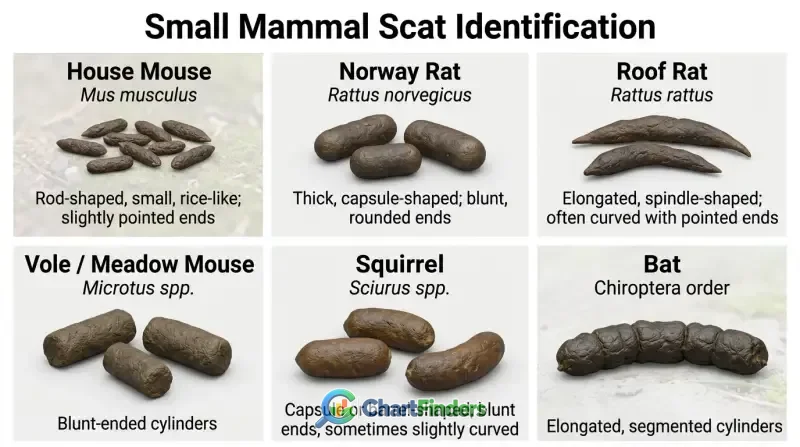
Rodent Poop Identification Chart
- Size Matters: Mouse droppings average 1/8 to 1/4 inch (3–6 mm) long; rat droppings average 1/2 to 3/4 inch (13–19 mm) long.
- Shape Indicators: Mice leave spindle or rice-shaped pellets with pointed ends. Norway rats leave capsule-shaped droppings with blunt ends. Roof rats produce curved, sausage-shaped pellets with tapered ends.
- Age Determination: Fresh droppings are dark, glossy, and pliable. Old droppings are faded gray, chalky, and crumble easily under pressure.
- Distribution Patterns: Droppings are concentrated along runways, near food sources, and inside nesting zones rather than randomly scattered.
- Health Risks: Disturbing dry rodent feces can aerosolize dangerous pathogens; proper personal protective equipment (PPE) is mandatory during inspection and clean-up.
- Look-Alikes: Cockroach frass, lizard droppings, and small carnivore scat are frequently mistaken for rodent waste.
To accurately diagnose a rodent issue, field identification must be systematic. The following detailed reference table contrasts the physical characteristics, typical environments, and deposition habits of the most common per-domestic rodents and frequent look-alike wildlife species encountered in residential and commercial structures.
| Pest Species | Average Length | Shape & Ends | Color (Fresh vs. Old) | Common Locations | Key Diagnostic Clue |
|---|---|---|---|---|---|
| House Mouse (Mus musculus) | 1/8 to 1/4 inch (3–6 mm) | Rod-shaped, small, rice-like; slightly pointed ends | Dark brown to black; fades to gray/dusty | Scattered randomly along baseboards, inside pantries, behind appliances | Smallest common indoor dropping; often found in large, haphazard clusters. |
| Norway Rat (Rattus norvegicus) | 3/4 inch (13–19 mm) | Thick, capsule-shaped; blunt, rounded ends | Dark brown; lightens to gray with age | Low levels, basements, crawlspaces, burrows, near ground-level food | Large, chunky pellets with blunt tips; resembles dark coffee beans. |
| Roof Rat (Rattus rattus) | 1/2 to 3/4 inch (12–18 mm) | Elongated, spindle-shaped; often curved with pointed ends | Dark brown to black | Attics, high rafters, upper wall voids, trees near rooflines | Pointed tips and banana-like curve; found elevated high above ground. |
| Vole / Meadow Mouse (Microtus spp.) | 1/4 to 3/8 inch (6–10 mm) | Blunt-ended cylinders | Greenish-brown to dark brown | Surface runways in lawns, mulch beds, under heavy thatch, near garden roots | Found strictly outdoors or under heavy ground cover; often accompanied by girdled stems. |
| Squirrel (Sciurus spp.) | 3/8 to 5/8 inch (10–16 mm) | Capsule or barrel-shaped; blunt ends, sometimes slightly curved | Tan, brown, or reddish-brown (diet-dependent) | Attics, roof decks, gutters, base of trees | Larger and lighter-colored than rat droppings; irregular surface texture. |
| Bat (Chiroptera order) | 1/8 to 3/8 inch (3–9 mm) | Elongated, segmented cylinders | Dark brown to black | Attic floors, directly beneath wall/roof entry points, window sills | Crumbles into fine powdery dust containing shimmering insect exoskeletons under light. |
When analyzing this data, pest management professionals emphasize that location is just as vital as morphology. Finding large, blunt droppings in a high attic points directly to roof rats, whereas identical droppings found in a damp crawlspace point toward Norway rats.
Detailed Breakdown of Rodent Dropping Morphology
Differentiating rodent species requires an understanding of how diet, digestive anatomy, and metabolic rate influence fecal output. Rodents possess continuously growing incisors and specialized digestive tracts designed to process high-fiber, high-starch diets. The physical output reflects this biology.
Mouse Droppings: Characteristics and Habits
House mice are prolific excretors, dropping between 50 and 80 pellets per day per individual. Because mice graze continuously as they explore their territory, their droppings are rarely deposited in a single pile. Instead, inspectors find them scattered along travel routes, tucked into corners, inside sofa cushions, or mixed into nesting materials.
Mouse scat is distinguished by its minute scale—rarely exceeding a quarter-inch in length—and its resemblance to dark grains of rice. Fresh mouse droppings are shiny, wet in appearance, and dark brown. As they age over several days, moisture evaporates, turning the exterior a dull, dusty gray. Pressing an old dropping between gloved fingers causes it to break apart instantly into dry powder.
Norway Rat Droppings: Characteristics and Habits
The Norway rat (Rattus norvegicus) is a heavy-bodied burrowing rodent. An adult excretes roughly 40 to 50 large droppings daily. These pellets are substantial—typically measuring 3/4 of an inch in length—and are characterized by distinctively blunt, squared-off ends that look like miniature dark capsules or roasted coffee beans.
Norway rat droppings are concentrated in specific latrine areas or along well-worn runways close to their subterranean burrows or ground-level nesting sites. When multiple Norway rats occupy a harbor, droppings of varying sizes are often found together, representing different age classes within the colony.
Roof Rat Droppings: Characteristics and Habits
Roof rats (Rattus rattus) are agile climbers that favor elevated environments. While their droppings are similar in length to those of Norway rats (about 1/2 to 3/4 of an inch), their geometry is notably different. Roof rat scat is narrower, more tapered at the ends, and frequently exhibits a slight curve, earning them descriptive comparisons to tiny sausages or curved seeds.
Because roof rats inhabit upper levels of structures, their droppings are discovered in attics, drop ceilings, overhead duct insulation, and along rafters. Finding elongated, pointed droppings high up in a building immediately shifts suspicion away from ground-dwelling Norway rats and toward roof rats.
How to Determine Dropping Freshness
Assessing the age of rodent droppings is critical for diagnosing whether an infestation is active or historical. Treatment strategies depend entirely on this distinction: treating an old, abandoned infestation with rodenticide or traps wastes resources, whereas ignoring a fresh infestation allows populations to expand exponentially.
| Feature | Fresh Droppings (Active) | Old Droppings (Inactive) |
|---|---|---|
| Texture & Moisture | Pliable, slightly soft or rubbery when pressed; moist interior. | Hard, brittle, completely desiccated. |
| Color & Sheen | Dark brown to jet black; glossy or shiny surface sheen. | Faded gray, chalky, dusty; matte finish. |
| Structural Integrity | Resists light pressure; smears or flattens slightly if fresh. | Crumbles immediately into dust or shatters under minimal pressure. |
| Odors | May emit a faint, musky, ammonia-like odor if concentrated. | Odorsless unless disturbed or exposed to moisture. |
Field technicians often utilize a “clear-and-monitor” test to verify activity. By vacuuming or sweeping away all existing droppings in a suspected zone and marking the perimeter, an inspector can return 24 to 48 hours later. The appearance of new, shiny pellets confirms active rodent traffic.
Common Wildlife and Insect Look-Alikes
Homeowners frequently misidentify non-rodent scat as mouse or rat activity. Confusing insect frass or reptile waste with rodent droppings leads to misdirected control efforts. Examining key structural differences prevents common identification errors.
Cockroach Frass vs. Mouse Droppings
German and American cockroaches produce tiny fecal pellets that are frequently mistaken for mouse droppings. However, cockroach frass is microscopic (resembling black pepper grains or coffee grounds) and exhibits blunt, squared ends with distinct longitudinal ridges or grooves visible under magnification. Mouse droppings lack these ridged textures and are significantly larger.
Bat Guano vs. Mouse Droppings
Bat guano found in attics closely resembles mouse droppings due to its dark color and small size. The definitive diagnostic test involves crushing the pellet. Because bats are insectivores, their guano consists almost entirely of crushed, chitinous insect exoskeletons. When crushed between gloved fingers or on a paper towel, bat guano crumbles into a glistening, metallic dust sparkling with insect fragments. Mouse droppings crush into a dull, fibrous, or powdery soil-like consistency.
Lizard and Snake Scat vs. Rodent Droppings
Reptile droppings often feature a distinct white cap or chalky tip. This white cap represents uric acid crystals, which reptiles excrete alongside solid waste. Mammalian rodents do not excrete uric acid in this manner; their droppings are uniform in color throughout without distinct white terminal deposits.
Health Risks and Safe Inspection Protocols
Disturbing accumulated rodent feces creates serious public health hazards. Rodents are vectors for numerous pathogens that affect humans, primarily transmitted through the inhalation of dust from dried droppings, urine, or saliva.
Major Pathogens Associated with Rodent Waste
- Hantavirus Pulmonary Syndrome (HPS): Carried primarily by deer mice, hantavirus is transmitted when dried rodent excretions become airborne and are inhaled.
- Leptospirosis: A bacterial infection spread through water or soil contaminated with rodent urine, entering the body through broken skin or mucous membranes.
- Salmonellosis: Food-borne illness resulting from rodent feces contaminating pantry surfaces, food prep areas, or stored foodstuffs.
- Lymphocytic Choriomeningitis (LCMV): A rodent-borne viral infectious disease that poses particular risks to pregnant individuals.
Safe Clean-Up and Handling Procedures
Never sweep or vacuum dry rodent droppings. Sweeping aerosolizes microscopic dust particles and dried pathogens into the breathing zone, dramatically increasing infection risks.
- Ventilate the Area: Open all windows and doors leading to the infested space for at least 30 minutes prior to beginning clean-up work.
- Wear Proper PPE: Don disposable nitrile gloves, protective eyewear, and a properly fitted N95 or HEPA-rated respirator mask.
- Apply Disinfectant: Thoroughly saturate the droppings, nesting materials, and surrounding contaminated surfaces with a 10% bleach solution (1 part household bleach to 9 parts water) or an EPA-registered hospital-grade disinfectant. Allow it to sit undisturbed for 10 minutes.
- Collect and Seal: Carefully pick up the soaked droppings using paper towels or disposable cloths. Place all contaminated material into a heavy-duty plastic trash bag.
- Sanitize Surfaces: Mop or wipe down surrounding hard surfaces, flooring, and baseboards with the disinfectant solution. Remove gloves, wash hands thoroughly with soap and warm water, and dispose of PPE safely.
Frequently Asked Questions
While an overwhelming volume of droppings generally indicates a severe or long-standing infestation, counting pellets cannot provide an exact census. Mice and rats have high metabolic rates, with a single animal producing dozens of droppings daily. Accumulated droppings over several weeks can make a minor infestation look massive.
Rodents frequently seek shelter in vehicle engine compartments during colder months, using insulation materials for nests and depositing droppings near wiring harnesses. This indicates active harboring. Promptly clean the engine bay using pet-safe cleaners and inspect wiring for gnaw damage, which poses severe fire and mechanical failure risks.
Yes. While squirrels are less commonly associated with Hantavirus than deer mice, their droppings can still harbor histoplasmosis spores, parasites, and bacteria. Treat any accumulated wildlife scat in an attic with the same cautious PPE protocols and disinfectant standards used for rat waste.
Texture reflects moisture content and age. Freshly excreted droppings contain significant moisture and remain soft or pliable for hours or days depending on ambient humidity. Droppings exposed to dry indoor air or attic heat desiccate rapidly, turning hard, brittle, and chalky within 48 to 72 hours.
Finding multiple sizes of droppings typically indicates a mixed-species infestation (often house mice and roof rats sharing a structure) or a well-established rat colony containing multiple generations of offspring. This scenario requires a comprehensive pest control strategy addressing both climbing and ground-level entry points.
Conclusion
Mastering rodent poop identification transforms ambiguous household noises into actionable diagnostic data. By evaluating drop dimensions, terminal shapes, surface textures, and spatial distribution, property owners and pest professionals can pinpoint exact pest species, gauge infestation scale, and determine whether activity is current. Armed with this knowledge—and practicing strict safety protocols during clean-up—you can eliminate pests efficiently and safeguard your living environment.