
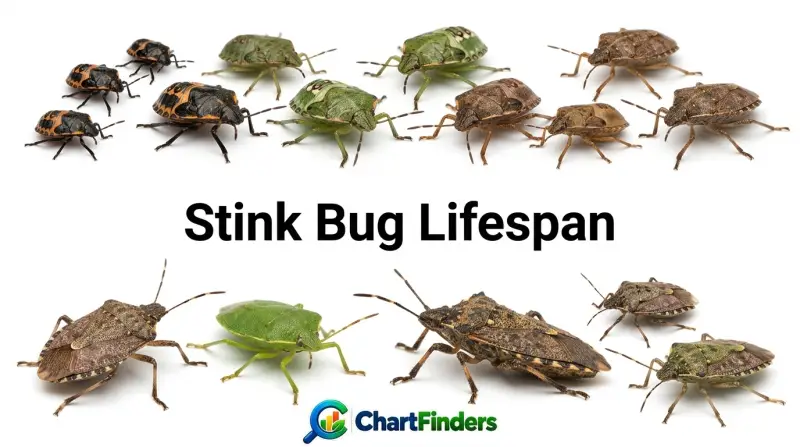
The ecological impact and household nuisance of true bugs belonging to the family Pentatomidae have escalated across North America over recent decades. Among these, the brown marmorated stink bug (Halyomorpha halys) stands out not merely as an agricultural pest of profound economic consequence, but as a master of seasonal adaptation. Understanding the biological timeline of these insects requires an examination of their complete hemimetabolous metamorphosis, the physiological triggers of overwintering, and the environmental pressures that dictate their survival from egg to senescence.
This comprehensive inquiry explores the exact chronological milestones of pentatomid life histories, detailing the physiological mechanisms of diapause, developmental instars, geographic generational variance, and the practical implications of their longevity for pest management.
Stink Bug Lifespan and Developmental Chronology
- Adult brown marmorated stink bugs (Halyomorpha halys) can achieve an adult lifespan of up to 119 days under observation, while total generation time from egg to natural mortality varies.
- Overwintering occurs strictly in the adult stage (imago), where insects enter a state of reproductive diapause within sheltered structural or natural cavities.
- In temperate zones such as Wisconsin, most pentatomid species complete precisely one generation per year (univoltine), whereas southern latitudes may support two or more.
- Development proceeds via hemimetabolous metamorphosis, passing through five distinct nymphal instars before reaching the winged adult stage.
- Temperature and photoperiod serve as the primary abiotic regulators governing metabolic rate, developmental velocity, and the onset of diapause.
To fully grasp the temporal parameters of pentatomid existence, researchers examine the organism across its distinct life stages: egg, five nymphal instars, and the adult imago. Each developmental transition is strictly governed by accumulated degree-days and photoperiodic cues.
Egg Stage and Oviposition Dynamics
The life cycle initiates when an overwintered female, having replenished her nutrient reserves through spring feeding, deposits spherical to barrel-shaped eggs on the underside of host plant leaves. A typical female lays egg masses containing approximately 28 eggs, arranged in neat, geometrically precise rows. The incubation period spans between 4 to 7 days, fluctuating according to ambient thermal conditions. During this embryonic phase, cellular differentiation proceeds rapidly within the chorion, culminating in the eclosion of first-instar nymphs.
Nymphal Instars and Hemimetabolous Development
Unlike holometabolous insects (such as beetles or butterflies), pentatomids undergo hemimetabolous development, lacking a pupal stage. The juvenile phase is partitioned into five distinct nymphal instars:
- First Instar: Non-feeding or minimally feeding nymphs that tend to aggregate around the empty egg mass for mutual protection and acquisition of essential gut symbionts.
- Second through Fourth Instars: Highly mobile, brightly marked juveniles that feed aggressively on plant sap, fruit, and developing seeds using their piercing-sucking mouthparts (rostrum).
- Fifth Instar: The final juvenile stage, characterized by significant wing pad development and physiological preparation for the final ecdysis into the winged adult form.
The entire nymphal developmental phase—from the first instar emergence to the final adult molt—typically requires 30 to 50 days, heavily dependent on the nutritional quality of the host plant and prevailing ambient temperatures.
Adult Longevity and Reproductive Diapause
Once the final ecdysis occurs, the adult imago emerges with a soft exoskeleton that hardens over several hours. The post-molt adult lifespan is characterized by a pre-reproductive feeding period, subsequent mating, and a prolonged phase of seasonal survival. While summer generations may live for several weeks to a few months while actively reproducing, overwintering adults exhibit extended longevity. By entering a state of physiological diapause triggered by shortening autumn photoperiods, these adults drastically suppress their metabolic rates, allowing them to survive harsh winter conditions and attain lifespans approaching or exceeding 110 to 120 days.
| Life Stage | Morphological Characteristics | Duration / Timeline | Primary Biological Function |
|---|---|---|---|
| Egg | Spherical, pale green or white, laid in rigid clusters of ~28 on leaf undersides. | 4 – 7 days | Embryonic development and protection. |
| 1st Instar Nymph | Small, tick-like, dark markings, tightly aggregated near egg mass. | 5 – 7 days | Acquisition of bacterial symbionts; initial dispersal. |
| 2nd – 4th Instar Nymphs | Vibrant patterning (red, black, white highlights), wing pads absent or small. | 3 – 4 weeks total | Active herbivory, rapid biomass accumulation and structural growth. |
| 5th Instar Nymph | Larger body, distinct wing pads visible, precursor to adult morphology. | 7 – 14 days | Final juvenile stage preceding terminal ecdysis. |
| Adult (Summer Generation) | Fully winged imago, shielded dorsal pronotum, active scent glands. | 4 – 8 weeks | Active reproduction, mating, and agricultural foraging. |
| Adult (Overwintering Diapause) | Hardened imago, elevated lipid reserves, metabolic suppression. | Up to 119+ days | Survival through suboptimal winter conditions; spring propagation. |
The comparative timeline outlined in the table above illustrates the stark contrast between active summer morphs and quiescent overwintering morphs. While active adults focus energy reserves on rapid reproduction and host relocation, diapausing adults channel metabolic energy into lipid storage for long-term dormancy.
Environmental and Geographic Drivers of Development
The biological clock of Halyomorpha halys and other pentatomids is not rigidly fixed by a calendar; rather, it is highly plastic and responsive to environmental cues. Geographic latitude plays a decisive role in determining generational frequency.
Generational Voltinism Across Latitudes
In northern temperate regions, such as Wisconsin and parts of southern Canada, the brown marmorated stink bug typically exhibits a strictly univoltine life cycle—meaning it produces only one generation per year. The compressed frost-free window restricts the time available for egg deposition, nymphal maturation, and adult emergence before autumn triggers diapause.
Conversely, in mid-Atlantic and southern agricultural zones, rising ambient temperatures and extended photoperiods permit a bivoltine or even multivoltine life cycle, yielding two or more complete generations within a single calendar year. This multi-generational capacity exponentially increases population density and agricultural pressure in warmer climates.
Thermal Accumulation and Degree-Days
Insect metabolism is ectothermic, dictating that developmental velocity scales directly with ambient heat within viable physiological thresholds. Researchers calculate developmental milestones using lower developmental thresholds (often baseline temperatures around 14°C or 50°F). Accumulated degree-days govern whether a nymph successfully transitions through its five instars or experiences developmental arrest. Unseasonably cool summers can delay adult emergence, leaving late-stage nymphs vulnerable to early autumn frosts.
Physiological Adaptations for Overwintering Survival
The ability of adult stink bugs to survive up to 119 days or more is directly tied to their overwintering strategy. As day lengths shorten below critical threshold levels in late August and September, adults cease reproductive development and enter reproductive diapause.
Metabolic Suppression and Lipid Accumulation
Prior to seeking overwintering shelter, pentatomids engage in hyperphagia—intense feeding to build up massive abdominal fat bodies. These lipid reserves serve as the sole metabolic fuel source during the dormant period. Once inside structural crevices, tree bark, or dead timber, the insect depresses its metabolic rate, minimizes oxygen consumption, and halts gametogenesis.
Aggregation Pheromones and Structural Infiltration
To withstand sub-zero temperatures, stink bugs frequently aggregate in massive numbers, utilizing secreted aggregation pheromones to signal ideal micro-climates to conspecifics. This communal clustering behavior reduces surface-area-to-volume heat loss. Human structures—particularly residential and commercial buildings—mimic natural rocky outcroppings and dead tree hollows, explaining why millions of adults migrate into attics, wall voids, and siding during autumn.
Agricultural and Domestic Implications
The extended lifespan of adult pentatomids, combined with their diapause habits, creates distinct management challenges for both agriculturalists and homeowners.
Crop Damage and Feeding Mechanics
Throughout their active adult and nymphal life stages, stink bugs utilize piercing-sucking mouthparts to pierce plant tissues, inject digestive enzymes, and liquefy cellular contents. This feeding action causes severe cosmetic and structural damage to high-value crops, including apples, peaches, tomatoes, peppers, soybeans, and corn. Because individual adults can survive for months during the growing season, a single population cohort can inflict prolonged, cumulative damage across multiple crop varieties.
Structural Nuisance Dynamics
From a domestic perspective, the lifespan of the insect intersects with human habitation during the autumn migration and spring emergence phases. While stink bugs do not bite humans, reproduce indoors, or transmit diseases, their sheer volume and defensive chemical emissions—released via metathoracic scent glands containing aldehydes—render them significant household pests. Crushing an adult releases these foul-smelling compounds, turning physical removal into a delicate operation.
Frequently Asked Questions
How long can an individual stink bug live?
Under optimal conditions, an adult brown marmorated stink bug can live for approximately 3 to 4 months (up to 119 days or slightly more), particularly when factoring in the overwintering period where metabolic rate is heavily suppressed.
Do stink bugs reproduce inside houses during the winter?
No. Adult stink bugs enter a physiological state known as reproductive diapause when they overwinter indoors. Their reproductive systems remain inactive during the winter months, meaning they do not mate, lay eggs, or establish infestations inside wall voids or living spaces.
How many generations of stink bugs are born each year?
Generational frequency depends entirely on geographic latitude. In northern regions, they are typically univoltine (one generation per year), whereas in warmer southern climates, they can produce two or more generations (bivoltine or multivoltine) annually.
What triggers stink bugs to enter homes in the autumn?
The primary triggers are declining ambient temperatures and shortening daylight hours (photoperiod). These environmental shifts signal to the adult bugs that winter is approaching, prompting them to seek dry, protected vertical cavities that mimic natural overwintering sites like cliff faces or hollow trees.
Do stink bugs feed on plants while they are overwintering?
No. During diapause, stink bugs cease active feeding entirely. They rely exclusively on stored lipid and glycogen reserves accumulated during their autumn hyperphagia phase until they emerge in the spring to resume feeding and reproduction.
Conclusion
The lifespan of the stink bug is a finely tuned biological timeline adapted for survival across diverse environments. From the initial 4-to-7-day embryonic incubation and the rapid 30-to-50-day progression through five nymphal instars, to the remarkable 119-day potential longevity of diapausing adults, every phase of the pentatomid life cycle underscores evolutionary resilience. By understanding the precise developmental triggers, thermal requirements, and overwintering strategies of these organisms, researchers and pest management professionals can better anticipate population surges and mitigate their agricultural impact.