
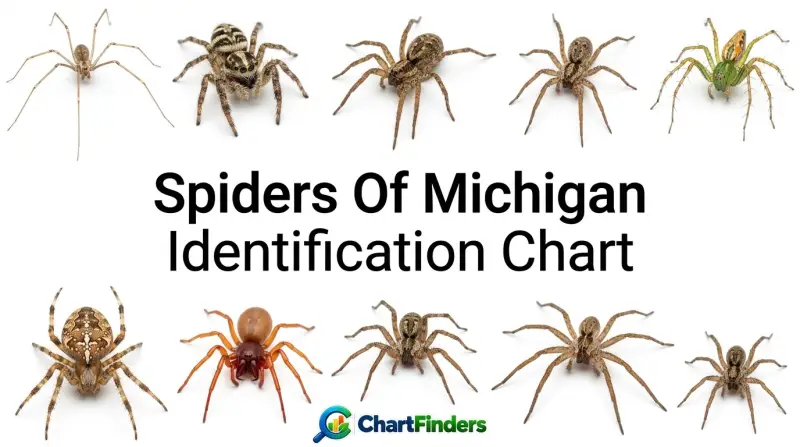
The arachnofauna of the Great Lakes State is remarkably diverse, reflecting varied microhabitats ranging from dense northern pine forests to southern agricultural tracts, wetlands, and urban ecosystems. While human encounters with spiders often provoke anxiety, most species found in Michigan perform essential biological regulation by managing insect populations, including agricultural pests and disease vectors. Understanding which species inhabit the region, how to morphology-match them correctly, and recognizing the rare exceptions requiring caution transforms fear into scientific appreciation.
This comprehensive guide provides an in-depth framework for identifying Michigan’s arachnid species. By breaking down anatomical characteristics, behavioral patterns, habitat preferences, venom profiles, and anatomical exceptions, this manual serves as an authoritative resource for naturalists, pest management professionals, and curious residents alike.
Spiders Of Michigan Identification Chart
- Michigan harbors hundreds of spider species, but only two possess venom medically significant to humans: the Northern Black Widow and the Brown Recluse.
- Wolf spiders (Lycosidae) are robust, ground-dwelling hunters that do not build webs to capture prey and carry their egg sacs and spiderlings on their abdomens.
- Orb weavers (Araneidae) construct , wheel-shaped geometrical webs and exhibit high sexual dimorphism with large, bulbous abdomens.
- The Northern Black Widow (Latrodectus variolus) is native to Michigan and identifiable by a glossy black exoskeleton and red hourglass or split red spot markings.
- The Brown Recluse (Loxosceles reclusa) is exceedingly rare in Michigan, typically arriving via commercial transport rather than establishing wild endemic populations.
- Accurate identification requires careful observation of ocular patterns, spinneret placement, and structural web morphology rather than relying solely on coloration.
To accurately identify the arachnids encountered in Michigan structures and landscapes, a systematic approach is necessary. The following data table contrasts the key morphological, behavioral, and ecological traits of the most frequently encountered spider families and species in the state.
| Common Name | Scientific Name | Primary Habitat | Web Type / Hunting Strategy | Distinguishing Morphological Features | Medical Significance |
|---|---|---|---|---|---|
| Northern Black Widow | Latrodectus variolus | Woodpiles, crawlspaces, stone walls, meter boxes | Irregular, three-dimensional tangle web | Glossy black body, red hourglass or split red spots ventrally/dorsally | High (Neurotoxic venom / latrotoxin) |
| Brown Recluse | Loxosceles reclusa | Dark, undisturbed indoor areas (rare in MI) | Irregular retreat web, active nocturnal hunter | Uniform brown color, violin-shaped cephalothorax marking, 3 pairs of eyes | High (Necrotic venom / sphingomyelinase D) |
| Carolina Wolf Spider | Hogna carolinensis | Ground, burrows, leaf litter, open fields | Active cursorial hunter; no web | Large size (up to 35mm body), mottled gray-brown coloration, robust spiny legs | None (Mild mechanical bite if provoked) |
| Barn Funnel Weaver | Tegenaria domestica | Basements, sheds, structural corners | Flat sheet web terminating in a silken funnel retreat | Brownish-grey with distinct chevron patterns on abdomen | None |
| Cross Orb Weaver | Araneus diadematus | Gardens, shrubs, structural eaves | Vertical orb web | Bulbous abdomen with white cross-like markings on brown/tan background | None |
| Bold Jumping Spider | Phidippus audax | Sunny exterior walls, fences, low vegetation | Active stalker; uses dragline, no web | Hairy, compact body, iridescent green/copper chelicerae, white abdominal spots | None |
| Grass Spider | Agelenopsis spp. | Lawns, tall grass, shrub bases | Horizontal sheet web with funnel retreat | Long spinnerets visible at rear, two dark parallel bands on cephalothorax | None |
| Yellow Sac Spider | Cheiracanthium inclusum | Foliage, indoor corners, ceilings | Silken daytime retreat tube; active hunter at night | Pale yellow-green hue, dark cardiac line, symmetrical leg length | Mild (Local necrosis possible from defensive bite) |
Analyzing this distribution highlights that while encounters with generalist predators are common, encounters with medically significant species remain statistically low across Michigan’s distinct ecological zones.
Anatomical Foundations of Arachnid Identification
Before examining specific families, understanding basic arachnid morphology is essential. Unlike insects, which possess three distinct body segments (head, thorax, abdomen), spiders possess two primary tagmata: the cephalothorax (prosoma) and the abdomen (opisthosoma), joined by a narrow pedicel.
- Ocular Arrangement: Spiders typically possess eight simple eyes (ocelli), though some cave-dwelling, subterranean, or specialized hunting species have fewer (such as the six-eyed recluses). The arrangement, spacing, and relative sizes of these eyes are primary taxonomic keys used by entomologists to separate families (e.g., Lycosidae versus Salticidae versus Sicariidae).
- Chelicerae and Pedipalps: The chelicerae bear the basal segments and terminal fangs used to inject venom and immobilize prey. In mature males, the pedipalps (the short, leg-like appendages near the mouth) are modified into specialized reproductive bulb organs often resembling tiny boxing gloves.
- Spinnerets: Located at the posterior ventral end of the abdomen, spinnerets extrude liquid silk proteins from various internal silk glands, producing specialized fibers deployed for draglines, egg sacs, prey wrapping, and structural web architecture.
- Respiratory Systems: Michigan spiders respire using book lungs, a series of internal leaf-like vascular folds, and/or a network of fine air tubes called trachea that open through spiracles on the ventral abdomen.
Medically Significant Spiders in Michigan
Public concern regarding venomous arachnids typically centers on two taxa. While sensationalized media reports frequently exaggerate their distribution in Michigan, confirming their presence requires rigorous biological verification.
Northern Black Widow (Latrodectus variolus)
The Northern Black Widow is native to Michigan, inhabiting the southern lower peninsula and isolated microhabitats northward. Unlike its southern counterpart (Latrodectus mactans), the northern species features a more variable dorsal pattern consisting of red spots flanked by white or yellow diagonal stripes, alongside the classic ventral red hourglass mark (which is sometimes broken or split into two separate red triangles).
Females measure approximately 8 to 10 millimeters in body length, excluding long, slender legs, while males are significantly smaller (3 to 5 millimeters), lighter in color, and entirely harmless. They construct irregular, coarse, three-dimensional tangle webs in protected microhabitats such as woodpiles, meter boxes, under stones, and crawlspaces. Envenomation delivers latrotoxin, a potent neurotoxin that triggers massive, uncontrolled neurotransmitter release across motor nerve terminals. This results in severe systemic symptoms, including intense muscle cramps, rigid abdominal wall spasms, profuse sweating, nausea, and systemic pain requiring medical evaluation and, when indicated, antivenom administration.
Brown Recluse (Loxosceles reclusa)
The Brown Recluse is not considered established in Michigan’s native ecosystems. The state lies well outside its primary historical and geographic range of the south-central United States. However, individual specimens occasionally hitchhike into the state via commercial transport, furniture shipments, storage boxes, or luggage.
Field identification of Loxosceles reclusa relies on three definitive morphological criteria:
- An absence of spines on the legs (legs are uniformly covered in fine, microscopic hairs without coarse bristles or spines).
- An evenly colored, light brown to grayish-tan abdomen without stripes, chevrons, or distinct contrasting patterns.
- A distinct dark fiddle-shaped (violin) marking on the dorsal cephalothorax, with the neck or handle of the violin pointing backward toward the abdomen. Crucially, verify the eye arrangement: recluses possess precisely six eyes arranged in three distinct dyads (pairs)—one pair anteriorly and two pairs laterally—rather than the standard eight eyes found in most other spiders.
Bites from the brown recluse introduce sphingomyelinase D, an enzyme that destroys cell membranes and can cause localized tissue necrosis (dermonecrotic lesions), though many bites heal without severe complications.
Common Non-Venomous Wandering and Ground Spiders
The majority of spiders encountered walking across living room floors, basement walls, or garden paths in Michigan are harmless wandering hunters that do not spin traditional aerial webs.
Wolf Spiders (Family Lycosidae)
Wolf spiders represent one of the most visible and ecologically important families in Michigan. Large, hairy, and agile, species such as Hogna carolinensis (Carolina wolf spider) can exceed 35 millimeters in body length. They are primarily nocturnal or ambush predators that patrol lawns, leaf litter, agricultural fields, and basements.
Identification Clues: Lycosidae are instantly recognizable by their unique ocular arrangement: they possess a prominent row of four small eyes below two very large, forward-directed principal eyes, situated above two medium-sized posterior eyes. , female wolf spiders exhibit extraordinary maternal behavior, constructing a silken egg sac attached to their spinnerets and, upon hatching, transporting hundreds of newly transported spiderlings on their dorsal abdomen for several weeks.
Jumping Spiders (Family Salticidae)
Jumping spiders are charismatic, diurnal hunters renowned for exceptional visual acuity and acrobatic leaping ability. Species like the Bold Jumping Spider (Phidippus audax) feature compact, robust bodies, hairy legs, and large, forward-facing principal eyes that grant them trichromatic, stereoscopic color vision.
Identification Clues: Look for a square-ish, robust cephalothorax, a short abdomen often marked with striking white, orange, or red geometric spots, and iridescent, metallic-green or copper chelicerae. They do not build webs for capturing prey; instead, they stalk targets like cats and deploy a silken safety dragline before executing powerful leaps.
Web-Building Spiders of Michigan Gardens and Homes
Web builders stationary in their architecture are frequently encountered around human dwellings and gardens, particularly during late summer and autumn when mating adults reach peak size.
Orb Weavers (Family Araneidae)
Orb weavers construct the iconic, highly symmetrical wheel-shaped webs found suspended between garden plants, porch railings, tall grasses, and tree branches. The Cross Orb Weaver (Araneus diadematus), commonly known as the European garden spider, exhibits a large, bulbous abdomen marked with white lines forming a distinct cross.
Identification Clues: High sexual dimorphism is standard; females are massive, heavy, and round, while males are tiny, slender, and short-lived. Their legs feature prominent sensory spines, and many species systematically consume and rebuild their complex webs daily to recycle silk proteins.
Funnel Weavers and Grass Spiders (Family Agelenidae)
Grass spiders (Agelenopsis species) build dense, horizontal sheet webs across lawns and low shrubs that do not use sticky adhesive droplets; instead, fast-moving insect prey lands on the sheet and is subdued, while the web terminates in a tubular silken funnel where the spider lies in wait.
Identification Clues: Agelenids are yellowish-gray with two dark, parallel longitudinal bands running down the dorsal cephalothorax. They possess exceptionally long, distinct, two-segmented spinnerets protruding from the posterior end of the abdomen, clearly visible from above.
Indoor Nuisance and Cellar Spiders
When homeowners encounter spiders indoors, specific structural species are typically responsible for webs in corners, basements, and living areas.
Cellar Spiders (Family Pholcidae)
Often colloquially misidentified as “daddy longlegs” (a common name shared with harvestmen, which are non-spider arachnids), cellar spiders possess remarkably long, thread-like delicate legs and small, oval bodies.
Identification Clues: They construct messy, irregular, three-dimensional tangle webs in dark corners, damp basements, crawlspaces, and ceiling junctions. When disturbed, pholcids vibrate rapidly within their web in a circular motion to blur their outline against predators—earning them the descriptive moniker “vibrating spiders.” They are entirely harmless to humans and frequently prey upon other household spiders, including occasional wandering pests.
Yellow Sac Spiders (Family Clubionidae / Eutichuridae)
Yellow sac spiders (Cheiracanthium species) are pale yellow to light green wanderers that construct small, silken sac-like retreats in wall corners, ceilings, behind pictures, and under leaf folds during daylight hours.
Identification Clues: Uniform pale coloration with a subtle darker central stripe (cardiac line) running down the dorsal abdomen. Their front legs are notably longer than the other pairs, and they lack complex color patterns. When trapped against human skin, their defensive bite can cause localized pain and minor tissue irritation.
Practical Management and Identification Framework
Determining whether an encountered arachnid requires intervention involves a structured assessment protocol. Property owners can utilize the following decision framework to evaluate potential risks:
- Observe Location and Microhabitat: Is the specimen found in an open garden web, high on an exterior wall, or concealed deep within a dark, undisturbed woodpile, stone foundation, or stored cardboard box? (Medically significant species strongly favor secluded, dark, low-disturbance voids).
- Analyze Body Shape and Markings: Does the specimen feature a glossy jet-black exterior with ventral red marks (Northern Black Widow), or an unicolorous brown body with a cephalothorax violin? If neither, the specimen is biologically benign.
- Examine Locomotion or Web Structure: Is it a heavy cursorial ground hunter (Wolf Spider), an agile leaper (Jumping Spider), or a stationary architect of a wheel web (Orb Weaver)? Recognizing these traits confirms non-medical status.
- Implement Environmental Modifications: Reduce harborage sites by elevating firewood at least twelve inches off the ground, clearing dense vegetation and mulch from foundation walls, sealing structural entry points, and reducing indoor humidity.
Common Identification Mistakes and Misconceptions
Misidentifying Michigan spiders frequently leads to unnecessary panic, improper pesticide use, or needless property treatments. Understanding common errors prevents these mistakes.
- Assuming All Brown Spiders are Recluse Spiders: Michigan hosts dozens of harmless brown spiders—including grass spiders, nursery web spiders, wolf spiders, and funnel weavers—that are routinely misidentified as brown recluses due to general coloration. Always check for the violin mark and six-eye configuration before jumping to conclusions.
- Confusing Harvestmen with Spiders: Harvestmen (Order Opiliones), commonly called “daddy longlegs,” possess a single fused body segment (the head, thorax, and abdomen are merged into one oval unit) and lack venom glands or silk production entirely, separating them from true cellar spiders.
- Misinterpreting Wolf Spider Bites: While large wolf spiders possess robust chelicerae capable of piercing human skin if trapped against the body, their venom is non-necrotic and produces localized pain comparable to a bee sting rather than systemic illness.
- Overestimating Infestation Rates: Discovering a single wandering spider indoors does not indicate an active structural infestation; most indoor wanderers are accidental intruders seeking shelter, moisture, or wandering males searching for mates during seasonal shifts.
Frequently Asked Questions
Are there tarantulas native to Michigan?
No, true tarantulas (family Theraphosidae) are not native to Michigan, as the state’s harsh winters and freezing temperatures exceed their physiological thermal tolerances. Any large, hairy spider found outdoors in Michigan is invariably a large native Wolf Spider (Lycosidae) or Fishing Spider (Pisauridae).
How can I safely remove a spider from my home without killing it?
Place a clear glass or rigid plastic container directly over the spider. Carefully slide a stiff piece of paper or thin cardboard underneath the container, sealing the opening against the rim. Lift the apparatus and transport the specimen outdoors, releasing it into suitable garden cover, woodpiles, or woodland habitat.
Do house spiders bite in their sleep?
Most house spiders are docile and actively avoid human contact. Bites typically occur only when a spider is accidentally trapped against bare skin, such as being rolled onto in bed or squeezed inside clothing or shoes. Spiders do not seek out humans to bite for sustenance.
What is the best way to proof a home against venomous spiders?
To discourage black widows or other unwanted arachnids, seal cracks in foundation walls, install tight-fitting window screens, clear woodpiles and heavy vegetation at least several feet away from exterior walls, and reduce clutter in dark basement and garage storage areas.
How long do typical Michigan spiders live?
Most common urban and garden spiders complete their life cycle within a single year, hatching in spring, maturing by late summer, and perishing with the first hard autumn frosts after laying overwintering egg sacs. Certain larger species, such as specific wolf spiders, can survive for several years by seeking deep subterranean hibernacula.
Conclusion
Michigan’s arachnid population is a diverse and ecologically vital component of the state’s natural heritage. While encounters with species like the Northern Black Widow warrant cautious management, the vast majority of web-builders, ground hunters, and jumpers pose zero threat to human health. By utilizing proper morphological identification keys—focusing on ocular patterns, structural markings, and behavioral traits—residents can accurately catalog Michigan spiders, distinguish rare medically significant taxa, and coexist safely with these beneficial predators.