
Discovering a line of ants marching across your kitchen counter or emerging from a baseboard instantly shifts your home from a comfortable sanctuary to an active battleground. However, deploying a generic bug spray or placing random traps rarely solves the problem. In fact, using the wrong product can make a bad infestation much worse by causing colonies to split, scatter, or undergo destructive budding.
Ant biology and behavior vary wildly across species. Some species are structurally destructive, while others are mere nuisance pests or sanitation hazards. Some colonies reject sweet baits entirely in favor of grease, while others require specialized insect growth regulators to disrupt their reproductive cycle. To achieve permanent control, you must look past the sheer number of bugs and focus on thorough identification and behavioral mapping.
This master guide examines the most common ant species found inside residential structures, breaking down their distinct physical characteristics, anatomical markers, foraging preferences, nesting sites, and tailored elimination protocols. By understanding what you are dealing with, you can cut through trial-and-error treatments and target the colony at its core.
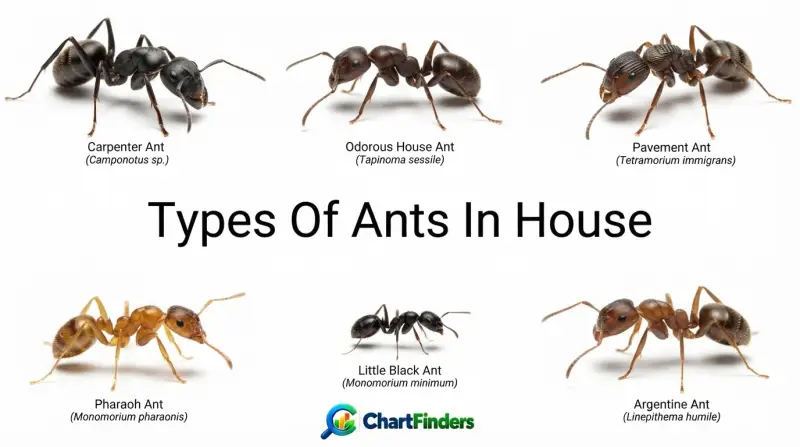
Types Of Ants In House
- Accurate species identification dictates your entire pest control strategy; treating carpenter ants like odorous house ants will result in continued structural damage.
- Odorous house ants are the most frequent kitchen invaders, highly attracted to sugary residues and named for the foul smell they emit when crushed.
- Carpenter ants do not eat wood, but rather excavate smooth galleries inside damp or decaying timber to rear their brood, threatening structural integrity.
- Pharaoh ants must never be treated with standard aerosol sprays, as chemical irritants trigger “budding,” instantly turning one colony into dozens.
- Pavement ants establish shallow nests beneath slabs and walkways, readily consuming both greasy foods and sweets depending on seasonal nutritional needs.
- Thief ants exploit their microscopic size to infiltrate sealed packaging and nest inside the wall voids or auxiliary spaces of larger ant species.
- Effective long-term control relies on slow-acting liquid or gel baits that foraging workers carry back to share with the queen, brood, and other workers.
When investigating an indoor ant problem, you cannot rely on visual appearance alone; size, color, microscopic anatomical features, geographic location, and specific foraging behavior provide critical clues. The following sections detail the primary ant species that breach residential perimeters, offering a blueprint for identification and tactical response.
Odorous House Ants (Tapinoma sessile)
Odorous house ants are among the most frequently encountered nuisance pests in domestic settings. Measuring roughly 1/16 to 1/8 of an inch long, these ants are dark brown to black. Their defining characteristic is the pungent, chemical odor they release when crushed—often compared to rotten coconut, blue cheese, or rancid butter, caused by volatile organic compounds called iridomyrmecins.
These resilient insects build multi-queen colonies containing thousands of workers and multiple satellite nests. While they prefer nesting outdoors beneath logs, stones, or mulch, they frequently migrate indoors during heavy rainfall, drought, or extreme heat. Inside homes, they seek out warm, moist voids near hot water pipes, heaters, dishwashers, and wall insulation. They forage aggressively for sugary substances like fruit juice, syrup, and honeydew produced by aphids, though they will also consume grease and proteins when nutritional demands shift.
Carpenter Ants (Camponotus species)
Carpenter ants are among the largest ants found in North America, with workers ranging from 1/4 to 1/2 of an inch long, and queens reaching up to 3/4 of an inch. They typically feature a uniform black coloration, though some species exhibit reddish-black or entirely red bodies. Under magnification, they possess a single, evenly rounded or pointed node (the petiole) between the thorax and abdomen, and a distinct circle of tiny, yellowish hairs at the tip of the gaster (abdomen).
The primary danger of carpenter ants lies not in stinging or food contamination, but in structural damage. They do not consume wood for nutrition; instead, they excavate smooth, sandpaper-like tunnels and galleries within damp, decayed, or water-damaged timber to house their expanding colonies. Common indoor nesting sites include window frames, leaky roof junctions, sink bases, shower surrounds, and poorly ventilated crawlspaces. Finding large, coarse sawdust (frass) mixed with insect body parts and soil debris beneath structural framing is a classic warning sign of a carpenter ant infestation.
Pavement Ants (Tetramorium caespitum)
True to their name, pavement ants build their nests primarily in soil beneath concrete slabs, asphalt driveways, walkways, and stone patios. Workers are small, measuring about 1/8 of an inch, and vary in color from dark brown to blackish-red. Under magnification, you can spot parallel lines (grooves) etched across their head and thorax, along with a pair of distinct spines on the back of the thorax and a two-node waist.
These opportunistic foragers enter homes at ground level through expansion joints, cracks in foundation walls, and gaps around plumbing penetrations. Once inside, they exploit a diverse diet. While they aggressively recruit to sugary foods during spring and early summer, they switch to high-protein and greasy items—such as meats, pet food, nuts, and cheese—later in the season. Small mounds of fine sandy soil piled between floor tiles, along expansion joints, or near baseboards usually signal an active pavement ant trail.
Pharaoh Ants (Monomorium pharaonis)
Pharaoh ants are exceptionally small—about 1/16 of an inch long (roughly 1.5 to 2 millimeters)—and range in color from light yellow to reddish-brown with a darker abdomen tip. Originally tropical insects, they cannot survive outdoors in temperate climates and instead establish permanent indoor nesting domains inside heated structures like apartment buildings, hospitals, office complexes, multi-family housing, and residential homes.
What makes Pharaoh ants uniquely challenging is their reproductive strategy. Colonies feature multiple queens and spread via “budding,” a process where a queen and a fraction of the worker force abandon the main nest to establish a new satellite colony nearby in response to environmental stress or chemical disturbances. Traditional repellent sprays cause immediate colony fragmentation, turning a single manageable infestation into a widespread multi-room crisis. They are omnivorous, consuming grease, protein, blood, dead insects, and sweets, and are notorious for chewing through soft plastics, rubber insulation, and sterile medical packaging.
Thief Ants (Solenopsis molesta)
Often mistaken for Pharaoh ants due to their microscopic size (1/32 to 1/16 of an inch) and yellowish color, thief ants get their name from their habit of nesting near or inside the nests of larger ant species (such as pavement ants or field ants) to steal their brood, larvae, and food stores. Also known as grease ants, they possess a distinct two-node waist, a 10-segmented antenna ending in a two-segmented club, and exhibit a strong preference for high-protein foods, fats, oils, grease, and meats rather than pure sweets.
Thief ants nest in both indoor and outdoor environments. Indoors, they exploit tiny cracks in baseboards, masonry, cabinets, door frames, and behind wall voids. Because of their minute size, they easily penetrate poorly sealed food packaging, rendering stored pantry goods unusable.
| Ant Species | Average Size | Color Profile | Waist Nodes | Primary Food Preference | Common Nesting Locations | Structural Threat |
|---|---|---|---|---|---|---|
| Odorous House Ant | 1/16″ – 1/8″ | Dark brown to black | 1 (hidden) | Sweets, syrups, honeydew | Wall voids, near water heaters, soil | None (Nuisance pest) |
| Carpenter Ant | 1/4″ – 1/2″ | Black, red/black | 1 (prominent) | Dead insects, honeydew, meats | Damp, decaying timber, hollow doors | High (Destroys wood framing) |
| Pavement Ant | 1/8″ | Dark brown/blackish | 2 nodes | Grease, meat, seeds, sweets | Beneath slabs, foundations, patios | Low (May undermine soil) |
| Pharaoh Ant | 1/16″ | Yellow to light brown | 2 nodes | Grease, proteins, sweets | Warm indoor voids, wall insulation | None (Sanitation/health hazard) |
| Thief Ant | 1/32″ – 1/16″ | Yellow to light brown | 2 nodes | Grease, fats, meat, dead insects | Wall voids, baseboards, masonry | None (Pantry contamination) |
The comparative matrix above outlines the primary diagnostic identifiers across the five most common indoor ant species. Reviewing size, coloration, anatomical node counts, and dietary preferences helps narrow down the culprit before applying any control measures.
Visualizing Ant Activity Patterns By Season
Understanding when different ant species become active indoors helps homeowners anticipate infestations and deploy preventative barriers before foraging trails establish.
Indoor Foraging Intensity by Species Across Seasons
Note: Pharaoh ants maintain high activity indoors regardless of external weather conditions due to centralized heating.
As illustrated in the comparison above, while outdoor-nesting species like odorous house ants and pavement ants peak during the warmer spring and summer months, indoor-adapted species like Pharaoh ants represent a constant, year-round management challenge. Recognizing these temporal patterns ensures that preventative sealing and inspection schedules align with actual pest pressure.
Diagnostic Identification Framework
When you spot ants in your living space, rushing to grab a can of surface spray often disrupts the infestation rather than curing it. Use this diagnostic sequence to determine the exact species and formulate a reliable extermination plan.
Step 1: Physical Examination and Measurement
Capture a single ant using a piece of clear packing tape or examine one closely with a magnifying glass. Note three critical features:
- Size: Is it microscopic (like Pharaoh or thief ants—under 1/16 inch), medium (pavement and odorous house ants—around 1/8 inch), or exceptionally large (carpenter ants—over 1/4 inch)?
- Color: Is the body monochromatic black, reddish-brown, yellow-gold, or bi-colored?
- Profile & Nodes: Examine the waist (pedicel) connecting the thorax to the abdomen. Count the bumps (nodes). Carpenter ants have one prominent node, while pavement, Pharaoh, and thief ants feature two distinct nodes.
Step 2: Assessing Foraging Preferences
Observe what the ants are eating. Place small test drops of distinct baits—such as honey or sugar syrup on one piece of foil, and a smear of peanut butter or bacon grease on another—near their primary trail. Note which substance draws immediate recruitment. Sugar-seeking species (like odorous house ants) respond best to carbohydrate liquid baits, while protein- and grease-seeking species (like thief ants and pavement ants) require formulated bait matrices containing active ingredients like borax, indoxacarb, or hydramethylnon.
Step 3: Tracking Trail Behavior and Nest Localization
Follow the worker ants backward from your kitchen counters or pantry shelves. Where do they disappear? Are they emerging from electrical outlets, baseboard cracks, window frames, or damp crawlspace joists? Identifying the entry point helps differentiate between an exterior foraging party and an internal structural nesting site.
Common Control Mistakes To Avoid
Even well-intentioned homeowners frequently sabotage their own pest control efforts by making classic tactical errors. Avoiding these pitfalls saves time, money, and structural damage.
- Relying Solely on Aerosol Surface Sprays: Over-the-counter contact sprays kill only the visible forager workers—less than 10% of the total colony. Worse, chemical repellents cause surviving workers to scatter and establish multiple secondary colonies.
- Using Repellent Chemicals Near Baits: Never spray residual insecticides across active ant trails or around bait stations. Repellent odors contaminate the bait, causing foraging ants to reject it entirely.
- Ignoring Moisture Problems: Treating carpenter ants with insecticides without repairing the underlying plumbing leak, roof rot, or poor ventilation guarantees that new colonies will quickly reinvade the softened wood.
- Applying Immediate Kill Tactics to Pharaoh Ants: Spraying Pharaoh ants with contact chemicals triggers budding, rapidly multiplying the number of active queens and nesting sites throughout your home.
Frequently Asked Questions
How do I know if ants in my house are carpenter ants or pavement ants?
Size and nesting habits are the primary differentiators. Carpenter ants are very large (1/4 to 1/2 inch) and nest inside hollow wooden structures, window frames, or rotting timber. Pavement ants are much smaller (about 1/8 inch), dark brown, and build shallow nests in soil beneath concrete slabs, often leaving small piles of sand or grit near baseboards.
Why do ants suddenly appear in my kitchen even when it is spotless?
Worker ants scout continuously for basic survival necessities: water, sugar, and protein. Even if counters are wiped down, ants will forage along invisible pheromone trails for microscopic food residues, moisture around sink drains, or pet food bowls left unattended.
What is the most effective way to eliminate odorous house ants?
The most reliable method combines sanitation with slow-acting liquid borax or sugar-based baits. Workers consume the bait and carry it back to share with the queen and larvae. Because these colonies often have multiple queens and satellite nests, baiting can take anywhere from several days to a couple of weeks to achieve total colony collapse.
Should I spray ant trails with vinegar or bleach?
Vinegar and bleach do not kill or eliminate an ant colony. While wiping a trail with vinegar or soapy water temporarily disrupts the chemical pheromone trails ants use to navigate, it merely reroutes them. You must eliminate the core nest or deploy systemic baits to solve the underlying infestation.
How can I prevent ants from getting into my house in the first place?
Prevention relies on exclusion and moisture control. Seal all exterior gaps around plumbing penetrations, windows, and doors using silicone caulk. Trim tree branches and shrubs that touch your siding. Store pantry dry goods in airtight plastic or glass containers, clean up kitchen crumbs immediately, and repair any leaky pipes or damp crawlspace conditions.
Conclusion
Dealing with an ant infestation in your home can be frustrating, but victory depends on precision rather than brute force. By accurately identifying the species—whether it is the structural threat of a carpenter ant, the nuisance of an odorous house ant, or the fragile complexity of a Pharaoh ant—you can deploy the correct baiting strategy and eliminate the problem at its source. Skip the reactive sprays, focus on identifying the nesting and nutritional drivers, and secure your living space against future invasions.