
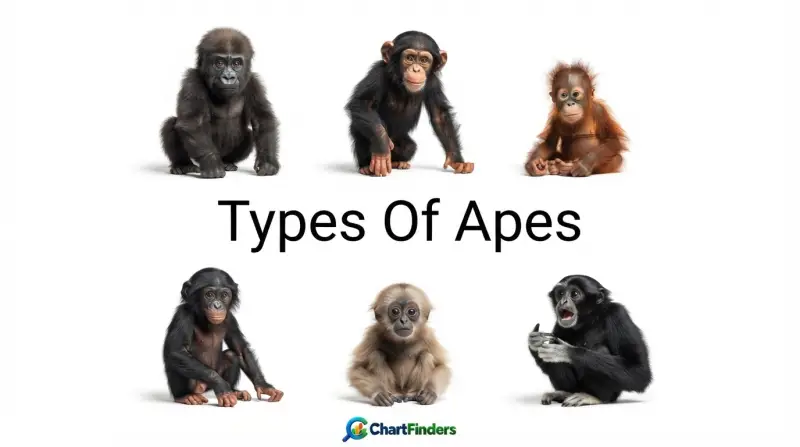
The order Primates is diverse, yet few branches capture human curiosity as intensely as the apes. Separated from Old and New World monkeys by critical anatomical, behavioral, and genetic distinctions, apes represent the pinnacle of primate behavioral complexity, tool use, and cognitive evolution. Understanding the types of apes requires looking past casual generalizations to examine the specific biological families, genera, and distinct species that populate our planet’s remaining tropical forests and mountain strongholds.
From the solitary canopy-dwellers of Southeast Asia to the deeply social troop structures of Central African rainforests, each type of ape has evolved specialized traits to survive in its niche. However, habitat fragmentation, illegal wildlife trade, and climate disruption have placed immense pressure on these populations. Today, humans stand as the sole non-endangered great ape species, while all other great apes—and many lesser apes—face severe survival threats in the wild. This guide breaks down the biological taxonomy, physical characteristics, behavioral traits, and conservation status of every major type of ape.
The Complete Biological Classification and Types Of Apes
- Apes split into two major taxonomic families: Hominidae (Great Apes) and Hylobatidae (Lesser Apes).
- All apes are distinguished from monkeys by the complete absence of a tail and the presence of a broad chest and flexible shoulder girdle.
- Great apes include gorillas, chimpanzees, bonobos, orangutans, and humans; lesser apes comprise gibbons and siamangs.
- Orangutans are native exclusively to the islands of Borneo and Sumatra, with three distinct species now recognized.
- Bonobos and chimpanzees share approximately 98.7% of their DNA with humans, yet exhibit profoundly different social structures.
- With the exception of humans, every other great ape species is classified as Endangered or Critically Endangered by the IUCN.
To understand the diversity of apes, primatologists rely on strict phylogenetic classification. The superfamily Hominoidea diverges from Old World monkeys roughly 25 million years ago during the Miocene epoch. Hominoidea is subdivided into two distinct families based on physical size, social organization, and genetic divergence.
| Common Name | Family / Genus | Geographic Range | Primary Locomotion | IUCN Status |
|---|---|---|---|---|
| Western & Eastern Gorilla | Hominidae / Gorilla | Central Africa | Quadrupedal knuckle-walking | Critically Endangered / Endangered |
| Chimpanzee | Hominidae / Pan | Central and West Africa | Quadrupedal knuckle-walking / Climbing | Endangered |
| Bonobo | Hominidae / Pan | Democratic Republic of the Congo | Quadrupedal / Bipedal tendencies | Endangered |
| Bornean, Sumatran, Tapanuli Orangutan | Hominidae / Pongo | Borneo and Sumatra (Indonesia/Malaysia) | Fist-walking / Arboreal scrambling | Critically Endangered |
| Gibbons & Siamangs | Hylobatidae / Multiple genera | Southeast Asia (Tropical forests) | Brachiation (Arm-swinging) | Varying (Mostly Endangered / Vulnerable) |
This table summarizes the high-level taxonomic breakdown, geographic distribution, and conservation urgency of extant ape groups. As detailed below, each category contains complex behavioral adaptations that separate them sharply from one another.
Great Apes (Family Hominidae)
The great apes represent the largest living primates. Beyond their substantial physical mass, they exhibit complex self-awareness, advanced tool-making capabilities, and rich emotional lives. They communicate through vocalizations, facial expressions, and body postures.
1. Gorillas (Genus Gorilla)
Gorillas are the largest living primates on Earth. They are ground-dwelling, predominantly herbivorous apes that inhabit the forests of central sub-Saharan Africa. Their sheer physical power is matched by a gentle, cohesive social structure led by a dominant silverback.
- Western Gorilla (Gorilla gorilla): Includes the Western Lowland Gorilla and the Cross River Gorilla. They feature slightly browner coats and broader skulls than their eastern counterparts.
- Eastern Gorilla (Gorilla beringei): Comprises the Mountain Gorilla and the Eastern Lowland (Grauer’s) Gorilla. Eastern gorillas have darker, longer hair (especially mountain gorillas living at high altitudes) and larger facial features.
Gorillas move via knuckle-walking, supporting their weight on the knuckles of their hands rather than their palms. Their diet consists primarily of foliage, shoots, stems, fruit, and occasional bark.
2. Chimpanzees (Genus Pan troglodytes)
Chimpanzees are our closest genetic living relatives alongside bonobos. Highly intelligent, adaptable, and opportunistic omnivores, chimps inhabit tropical rainforests, swamp forests, and open savannas across equatorial Africa.
Chimp societies are male-dominated, fission-fusion networks characterized by fierce territorial defense, political hierarchies, and cultural transmission of tool-use traditions. Populations across different regions have been documented using customized stone hammers to crack nuts, fashioning spears for hunting bushbabies, and utilizing sponges made of chewed leaves to harvest fresh water.
3. Bonobos (Genus Pan paniscus)
Historically referred to as the pygmy chimpanzee, the bonobo is a distinct species separated from the common chimpanzee by the Congo River. Physically, bonobos are slightly more gracile, possessing darker faces, longer limbs, and distinct parted hair on their heads.
Unlike chimpanzee societies, bonobo communities are female-centered and egalitarian. Conflict resolution in bonobo society relies heavily on socio-sexual interactions, making them unique among primates. They share the same 98.7% DNA match with humans as chimpanzees, serving as a critical evolutionary window into cooperative behaviors.
4. Orangutans (Genus Pongo)
Orangutans are the world’s largest arboreal mammals, spending the vast majority of their lives high in the forest canopy of Borneo and Sumatra. Recognized by their striking long, shaggy reddish-orange hair, these solitary apes exhibit a slow life history, with females giving birth only once every six to eight years.
Modern taxonomy recognizes three distinct species:
- Bornean Orangutan (Pongo pygmaeus): Characterized by broader faces and darker coats, adapted to the variable food availability of Borneo.
- Sumatran Orangutan (Pongo abelii): Tends to have longer facial hair, lighter coats, and a more strictly arboreal, frugivorous lifestyle.
- Tapanuli Orangutan (Pongo tapanuliensis): Discovered in the Batang Toru ecosystem of Sumatra and formally described as a distinct species in 2017, making it the most endangered great ape on the planet with fewer than 800 individuals remaining.
Lesser Apes (Family Hylobatidae)
Often overlooked in casual discussions, the lesser apes comprise the family Hylobatidae, containing over 20 species of gibbons and the closely related siamang. The term “lesser” refers exclusively to their smaller body size and lower sexual dimorphism compared to great apes, not to their intelligence or ecological complexity.
Gibbons are absolute masters of brachiation—a form of arboreal locomotion where they propel themselves rapidly beneath tree branches using alternating arm swings. Their wrists feature a ball-and-socket joint mechanism that allows incredible rotational flexibility, reducing stress on their shoulder joints during high-speed swings.
- Siamang (Symphalangus syndactylus): The largest of the lesser apes, easily identified by its throat sac that inflates to produce booming, resonant territorial duets echoing across the Sumatran and Malay rainforests.
- Hoolock Gibbons, Crested Gibbons (Genus Nomascus, Hoolock, Hylobates): Known for striking sexual dichromatism where males and females exhibit completely different fur colorations (such as black versus blonde/buff), making visual identification straightforward.
Anatomical and Behavioral Differences: Apes vs. Monkeys
A common mistake among casual observers is confusing apes with monkeys. While both belong to the order Primates, millions of years of divergent evolution separate them. Recognizing the structural and behavioral markers ensures precise classification.
The single most reliable morphological identifier is the tail. No living ape species possesses a tail. Monkeys, conversely, almost universally retain tails—though some Old World monkey species have extremely short, vestigial tail remnants, they never possess the fully articulated, balancing tails seen in New World monkeys.
, apes possess a significantly broader thorax (chest cavity) oriented front-to-back rather than side-to-side. This skeletal adaptation accommodates an expanded, highly flexible shoulder girdle that permits complete 360-degree rotation of the arms—an essential trait for swinging through trees or lifting heavy loads. Monkeys have narrow, laterally compressed shoulders designed for running and leaping along the tops of branches rather than hanging beneath them.
| Anatomical / Behavioral Trait | Apes (Hominoidea) | Monkeys (Old & New World) |
|---|---|---|
| Tail Presence | Completely absent | Present in almost all species |
| Shoulder Structure | Flexible, broad; adapted for brachiation/hanging | Narrow, side-to-side; adapted for quadrupedal running |
| Brain-to-Body Mass Ratio | Significantly larger; complex problem-solving | Smaller; instinct-driven behavioral patterns |
| Gestational & Maturation Period | Extended childhood, slow reproduction rates | Shorter lifecycles, rapid maturation |
| Dentition (Molars) | Y-5 molar pattern | Bilophodont molar pattern (Old World) |
Dental anatomy also provides a definitive diagnostic tool for biological anthropologists. Apes exhibit a distinctive Y-5 molar pattern on their lower cheek teeth, featuring five distinct cusps arranged in a Y-shaped groove. Old World monkeys possess a bilophodont pattern, featuring four cusps arranged in two parallel ridges.
Cognitive Evolution, Tool Use, and Communication
The evolutionary trajectory of apes is defined by advanced encephalization—the scaling of brain size relative to body mass. This neurological expansion supports complex cognitive capacities, including abstract reasoning, spatial mapping, self-recognition in mirror tests, and cumulative cultural transmission.
Tool Technologies and Problem Solving
While tool use was once considered exclusively human, field research pioneered by Jane Goodall and expanded by decades of primatology proved otherwise. Wild chimpanzees select specific stone grades to crack hard-shelled nuts, fashion flexible twigs into probes to extract termites from subterranean nests, and construct folded leaves to act as drinking vessels. Sumatran orangutans have been observed using specialized sticks to pry open encased seeds from fibrous fruit pods and utilizing leaves as acoustic megaphones to modify their alarm calls.
Vocalizations and Cultural Dialects
Ape communication extends far beyond simple reactive calling. Orangutans pass down cultural “long calls” across generations, enabling juveniles to learn the territorial boundaries and social standings of neighboring males. Chimpanzees exhibit distinct vocal dialects depending on their regional troop communities; individuals migrating between groups have even been documented altering their pant-hoots to match the local dialect of their new peers, demonstrating sophisticated vocal learning.
Conservation Crisis and Habitat Pressures
The survival of the world’s non-human apes hangs in a precarious balance. According to recent conservation assessments, habitat loss driven by industrial logging, the rapid expansion of monoculture palm oil plantations, and illegal wildlife trafficking have decimated wild populations.
Mountain gorillas, once numbering fewer than 300 individuals, have seen slight population recoveries thanks to intensive, community-led veterinary monitoring and anti-poaching patrols in Virunga and Bwindi. However, they remain critically vulnerable to localized disease outbreaks, civil unrest, and human-wildlife conflict. Similarly, the newly identified Tapanuli orangutan faces imminent extinction as dam construction and infrastructure fragmentation threaten its tiny, isolated habitat range in Sumatra.
Lesser apes face parallel threats. Gibbons are heavily impacted by the illegal pet trade, where mothers are routinely killed to capture dependent infants, alongside widespread lowland forest clearance across Southeast Asia.
Frequently Asked Questions
Are humans considered apes?
Yes. Taxonomically, humans (Homo sapiens) are great apes belonging to the family Hominidae, subfamily Homininae, and tribe Hominini. We share a common ancestral lineage with chimpanzees, bonobos, gorillas, and orangutans.
What is the difference between a monkey and an ape?
The most reliable physical differences are that apes do not have tails, possess broad, highly flexible shoulder joints for arm-swinging, and have significantly larger brains relative to body size. Monkeys typically have tails, narrow shoulders built for running along branches, and different molar tooth patterns.
Why are all great apes except humans endangered?
Non-human great apes face extreme anthropogenic pressures, including massive deforestation for agriculture (such as palm oil plantations), illegal poaching for the bushmeat and pet trades, and susceptibility to human-transmitted infectious diseases due to our close genetic proximity.
Can lesser apes like gibbons walk on the ground?
Yes, though their primary mode of movement is rapid brachiation through trees, gibbons can and do descend to the ground. When walking on two legs on the ground or across wide branches, they typically hold their long arms high above their heads for balance.
What do bonobos and chimpanzees have in common, and how do they differ?
Both species share roughly 98.7% of their DNA with humans and belong to the genus Pan. However, chimpanzees live in male-dominated, highly territorial groups prone to lethal inter-group aggression, whereas bonobos live in female-centered, peaceful societies that utilize socio-sexual behavior to resolve social tension.
Conclusion
The diversity of apes—spanning from the massive, ground-foraging gorillas of African cloud forests to the nimble, singing gibbons of Asian canopies—reflects the remarkable adaptability of the primate lineage. As our closest biological relatives, apes provide irreplaceable insights into our own evolutionary origins, social behavior, and cognitive development. Ensuring the continued survival of these magnificent species requires active conservation, rigorous protection of fragile tropical ecosystems, and sustained global commitment to mitigating human-wildlife conflict.