
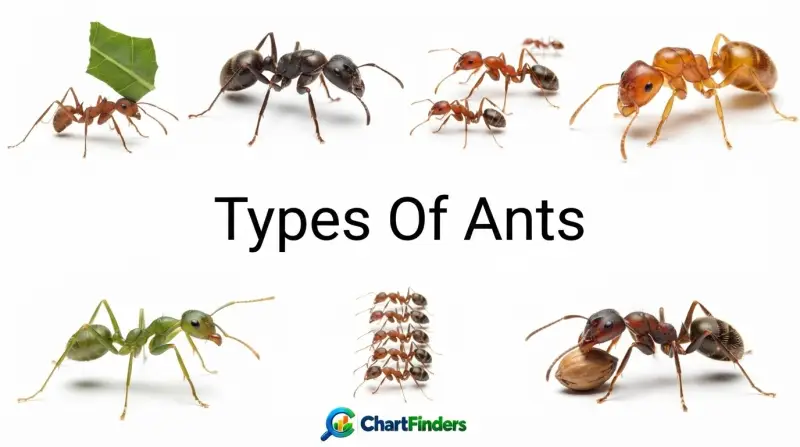
Ant infestations are among the most common household and commercial challenges, yet attempting to eliminate them without understanding species-specific behavior often results in frustration and wasted effort. Different ant varieties require entirely different bait formulations, treatment zones, and moisture-control strategies. A bait that clears out sugar-loving odorous house ants will be completely ignored by protein-seeking pavement ants or wood-destroying carpenter ants. Mastering the identification, morphology, biology, and behavioral patterns of these resilient insects is the first and most vital step toward achieving lasting control in any residential or commercial environment.
Types Of Ants
- Accurate species identification determines whether an infestation requires structural timber repairs, exterior perimeter treatments, or targeted indoor baiting.
- Pavement ants establish large colonies under slabs and stone pathways, readily foraging for both greasy foods and sweets depending on seasonal needs.
- Odorous house ants produce a distinct foul odor resembling rotten coconut or blue cheese when crushed and frequently relocate (“bud”) their nests indoors when disturbed by repellent sprays.
- Carpenter ants do not eat wood for nutrition, but instead excavate clean, smooth galleries within damp structural timbers to rear their brood.
- Little black ants form moderate-to-large colonies with multiple queens and swarm actively from June to August to establish new satellite colonies.
- Professional pest control relies on combining non-repellent liquid insecticides with slow-acting gel baits to eliminate entire colonies at the queen level via trophallaxis.
Urban and suburban landscapes host a diverse array of ant species. Each type has evolved specific survival mechanisms, environmental preferences, and dietary triggers that dictate how they interact with human structures. To manage them effectively, one must look beyond simple pest presence and examine physical morphology, nesting sites, foraging trails, and colonial organization.
| Ant Species | Color & Appearance | Size | Primary Nesting Sites | Preferred Diet | Key Identification Clue |
|---|---|---|---|---|---|
| Pavement Ants | Dark brown to jet black; parallel grooves on head and thorax | 1/8 to 3/16 inch | Concrete cracks, stone patios, lawns, under slabs | Grease, meats, sweets, dead insects | Swarms outdoors in spring/summer; piles of excavated sandy soil near slabs |
| Odorous House Ants | Dark brown to jet black; uneven thorax profile | 1/16 to 1/8 inch | Wall voids, near hot water pipes, mulch beds, rotting logs | Sweets, honeydew, sugary liquids, proteins | Emits a strong, unpleasant rotten-coconut or blue cheese odor when crushed |
| Carpenter Ants | Black, red-and-black, or solid red; single node on petiole | 1/4 to 1/2 inch | Damp wood, hollow trees, structural timbers, deck posts | Protein, insect prey, honeydew, sugar | Leaves behind coarse sawdust (frass) mixed with insect body parts |
| Little Black Ants | Jet black or dark brown; 12-segmented antennae with 3-segmented club | 1/16 inch | Woodwork voids, rotting logs, masonry cracks, lawns | Grease, sweets, meat, bread, honeydew | Multi-queen colonies; tiny size; distinct swarms occurring from June to August |
The table above outlines the core distinguishing features of four prominent ant species. Understanding these baseline parameters prevents common misidentifications that lead to failed control applications.
Pavement Ants: Identification and Behavior
Pavement ants are small, dark brown to black insects measuring roughly 1/8 to 3/16 of an inch in length. Under magnification, distinct parallel grooves (striae) are visible on their head and thorax. They derive their common name from their nesting habits; they frequently establish massive colonies beneath concrete slabs, sidewalks, driveways, and stone patios.
Outside of hardscaping, pavement ants construct nests in lawns and open soil areas, often marking their underground territory with small mounds of excavated sandy soil. Their colonies are moderately large and can contain several thousand workers and multiple queens. Pavement ants are opportunistic omnivores. While they have a strong preference for greasy and protein-rich foods, they readily consume sweet substances when foraging for colony energy needs. During spring and early summer, colonies frequently engage in turf wars, resulting in visible swarms of workers battling across sidewalks.
Odorous House Ants: The Coconut Odor Phenomenon
Odorous house ants (often abbreviated as OHAs) are small, ranging from 1/16 to 1/8 of an inch, and vary in color from dark brown to jet black. When disturbed or crushed, they release a volatile chemical compound (iridomyrmex) that produces a pungent, unmistakable scent frequently compared to rotten coconut, overripe fruit, or blue cheese. This defense mechanism is their most reliable field-identification marker.
These ants are notoriously adaptable. Outdoors, they nest beneath stones, logs, mulch, and loose tree bark. Indoors, they are drawn to warm, moist microclimates, frequently nesting inside wall voids near hot water heaters, dishwashers, and bathroom plumbing. Odorous house ants have multi-queen colonies and practice “budding”—a survival strategy where a harassed colony splits into multiple sub-colonies, making traditional spray treatments counterproductive because it accelerates population dispersal.
Carpenter Ants: Structural Invaders
Carpenter ants are among the largest household ants encountered in North America, with workers ranging from 1/4 to a full 1/2 inch in length. Depending on the species, they can be entirely jet black, reddish-black, or dark brown. Unlike termites, carpenter ants do not consume wood for nutrition. Instead, they excavate clean, smooth tunnels and galleries within damp, decaying structural wood to create nesting chambers for their brood.
A primary indicator of a carpenter ant infestation is the presence of frass—coarse, fibrous sawdust expelled from exit holes, often mixed with the remains of dead insects. Foraging worker ants travel long distances from their primary outdoor nest to structural wood inside buildings, seeking moisture and accessible entry points. Left unchecked, mature colonies can severely compromise structural timber integrity.
Little Black Ants: Prolific Colonizers
Little black ants are minute insects, measuring only about 1/16 of an inch, with a shiny jet-black or dark brown body. Despite their tiny stature, they form moderate-to-large colonies that contain two or more egg-laying queens. Outside, they build nests in a wide variety of microhabitats, including woodwork voids, rotting logs, cracks in cement, lawns, and open soil areas.
Little black ant swarms are common from June to August. During these peak summer months, winged reproductive males and females emerge to mate, after which fertilized females shed their wings and establish new satellite colonies. Because these colonies grow rapidly and can house multiple queens, spot-treating visible workers rarely solves the infestation; a systematic baiting approach is required.
The Biology and Social Structure of Ant Colonies
Understanding why ants are so difficult to eradicate requires a look into their eusocial organization. An ant colony functions as a single superorganism divided into distinct castes, each dedicated to specific biological roles.
Queens and Reproductive Castes
The queen serves as the biological engine of the colony. Depending on the species, a colony may feature a single queen (monogyny) or hundreds of queens (polygyny). Polygynous species, such as odorous house ants and certain pavement ant populations, are exceptionally resilient because the removal or death of a single queen does not threaten the survival of the colony. Alates—the winged reproductive males and females—leave the nest during seasonal swarming events to mate in flight, initiating the lifecycle of entirely new colonies.
Worker Castes and Foraging Dynamics
Workers are sterile female ants responsible for nest construction, brood rearing, defense, and food collection. In species with polymorphism (such as carpenter ants), workers vary significantly in size, featuring minor workers that handle nursing duties and major soldiers equipped with large mandibles for defense. Foragers lay chemical pheromone trails to guide nestmates directly to reliable food sources, which explains why a single wandering scout can quickly escalate into a dense column of thousands of ants marching across a kitchen counter.
Effective Pest Control Strategies
Eliminating an ant infestation requires shifting focus from treating visible symptoms—the foraging workers—to neutralizing the unseen core of the colony.
Baiting Mechanics
Slow-acting stomach poisons integrated into gel, liquid, or granular baits represent the gold standard of professional ant management. Foragers consume the bait and transport it back to the nest, sharing the toxic active ingredient via trophallaxis (food sharing) with larvae and queens. Quick-kill contact sprays only eliminate foraging workers, often triggering colony stress responses that prompt the remaining population to scatter and multiply.
Exclusion and Moisture Management
Because most pest ants are drawn to moisture and structural vulnerabilities, long-term prevention demands physical remediation:
- Seal exterior utility penetrations, window frames, and foundation cracks using high-grade silicone caulk.
- Eliminate wood-to-soil contacts around porches, decks, and siding to deter carpenter ants.
- Fix leaky plumbing, clear clogged gutters, and ensure proper drainage to deprive moisture-seeking species of essential hydration.
- Store pantry foods in airtight glass or heavy-duty plastic containers to remove attractive foraging cues.
Common Mistakes in Ant Management
Homeowners frequently struggle with recurring infestations due to predictable missteps in execution and product selection.
- Relying Solely on Aerosol Sprays: Spraying surface repellents kills visible workers but leaves queens and brood safely insulated within wall voids or beneath concrete slabs.
- Using Too Much Repellent: Applying strong synthetic pyrethroid sprays directly over bait stations deters ants from consuming the bait, neutralizing its effectiveness.
- Ignoring Outdoor Nesting Zones: Focusing entirely on indoor kitchen treatments fails when the primary colony resides in an exterior mulch bed or rotting tree stump just outside the foundation wall.
- Misidentifying the Target Species: Treating protein-seeking pavement ants exclusively with sweet sugar baits yields poor results, as acceptance rates drop significantly based on seasonal nutritional needs.
Frequently Asked Questions
Why do ants suddenly appear in my kitchen during spring?
Spring warming triggers increased metabolic activity and colony expansion. As outdoor temperatures rise and ground moisture shifts, overwintering colonies ramp up foraging efforts to feed growing broods, leading scouts to explore residential kitchens for reliable sources of carbohydrates, proteins, and water.
Can I get rid of an ant infestation without professional help?
Minor infestations of odorous house ants or pavement ants can often be managed using commercial-grade slow-acting gel baits and rigorous sanitation. However, established carpenter ant infestations involving structural timbers or multi-queen colonies with hidden nests usually require professional intervention to locate and eliminate deep-seated nests.
How do I know if I have carpenter ants or termites?
Carpenter ants feature pinched waists, elbowed antennae, and front wings that are longer than their hind wings; they leave behind smooth galleries and fibrous frass. Termites possess broad waists, straight antennae, equal-length wings, and pack their mud-lined tunnels with soil and excrement.
Why do ants keep coming back after I spray them?
Surface sprays only eliminate the visible workers currently exposed on the treated area. If the queen and brood remain untouched inside the nest, the colony quickly produces replacement workers, resulting in a persistent cycle of reinfestation.
Are DIY home remedies like vinegar or essential oils effective?
Substances like white vinegar, peppermint oil, and lemon juice disrupt chemical pheromone trails, causing temporary confusion among foraging scouts. However, they act strictly as temporary deterrents and do nothing to kill the queen or address the underlying colony population.
Conclusion
Successfully managing ant pressures in an urban or suburban environment requires moving past temporary fixes and embracing targeted, biology-driven strategies. By accurately identifying the specific species—whether it is the concrete-dwelling pavement ant, the coconut-scented odorous house ant, or the wood-excavating carpenter ant—you can deploy the correct combination of non-repellent barriers, slow-acting baits, and moisture mitigation. Prioritizing colony-level elimination ensures long-term protection for your property.