

Few creatures capture the imagination quite like butterflies. With over 17,000 known species globally—and thousands more documented in regional databases like North America’s extensive species profiles—the diversity within the order Lepidoptera is staggering. From the massive, high-contrast wings of swallowtails to the tiny, metallic shimmer of gossamer-wings, understanding the types of butterfly goes far beyond simply admiring their beauty. It requires a structured look at taxonomy, evolutionary adaptations, regional distribution, and physical morphology.
For naturalists, conservationists, and gardeners alike, categorizing butterflies provides critical insight into ecological health, plant-pollinator interactions, and seasonal migration patterns. Recent seasonal data highlights how observation dates and emergence cycles shift in response to environmental conditions, with early-year sightings of species like the Peacock (Aglais io) and Red Admiral (Vanessa atalanta) providing baseline indicators for phenology tracking. This master guide breaks down the major families of butterflies, examines their defining characteristics, compares their ecological niches, explores edge cases and exceptions, and equips you with the field knowledge necessary to identify them accurately.
Types Of Butterfly: Comprehensive Taxonomic Breakdown
- Butterflies are classified into six major families within the Lepidoptera order, each featuring distinct anatomical and behavioral traits.
- The family Nymphalidae (brush-footed butterflies) is the largest, recognized by its reduced, brush-like front legs.
- Papilionidae (swallowtails) include some of the world’s largest and most recognizable species, frequently featuring distinctive tail extensions on the hindwings.
- Pieridae (whites, yellows, and sulphurs) are predominantly white or yellow with simple tarsal claws, often migrating in large numbers.
- Lycaenidae (gossamer-winged butterflies) are small, delicate insects that frequently display metallic hues or false head patterns to confuse predators.
- Hesperiidae (skippers) represent a transitional group bridging butterflies and moths, characterized by hooked antennae and rapid, darting flight.
To understand the different types of butterfly, one must first look at how science organizes them. Lepidopterists classify butterflies based on morphology, wing venation, larval host plants, and genetic lineage. Below is an exhaustive breakdown of the primary families that make up the global butterfly population.
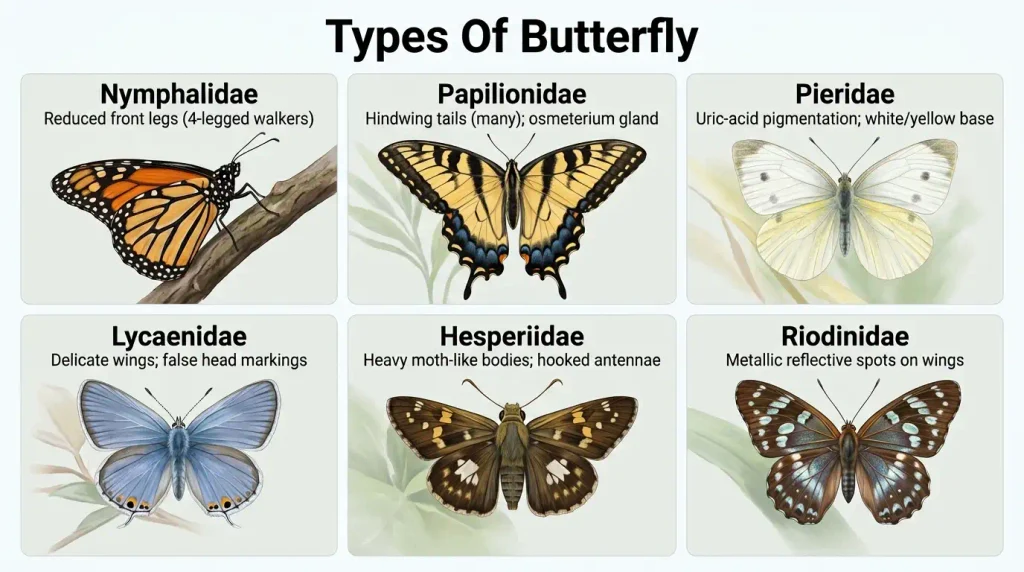
1. Nymphalidae: The Brush-Footed Butterflies
Nymphalidae is the largest butterfly family, comprising over 6,000 species worldwide. Commonly known as brush-footed butterflies, their most defining characteristic is the reduction of their front pair of legs. Instead of walking on six legs, they stand on four, holding their shortened front legs close to their bodies like a brush. This adaptation gives them a distinct, four-legged appearance.
This family exhibits immense diversity in pattern, size, and behavior. It includes sub-groups such as:
- Monarchs and Milkweed Butterflies (Danainae): Renowned for long-distance migrations and unpalatable chemical defenses derived from host plants like milkweed (cardenolides stored in their tissues).
- Admirals, Tortoiseshells, and Commas (Nymphalinae): Fast-flying, aggressive defenders of territory that often hibernate as adults (as imagos), accounting for early spring sightings when temperatures fluctuate.
- Emperors (Apaturinae): Arboreal canopy dwellers, such as the elusive Purple Emperor (Apatura iris), known for structural violet-blue iridescence on male wings caused by microscopic light-refracting scales.
- Satyrs and Ringlets (Satyrinae): Typically dull-colored (browns and grays) with distinctive eyespots on the wings to deflect predator strikes away from the vital head and body.
2. Papilionidae: The Swallowtails
Papilionidae contains roughly 550 species, including some of the largest and most visually striking butterflies on earth. While not all swallowtails possess the characteristic tail-like extensions on their hindwings (for example, the Parnassians or Apollos lack tails entirely), many do, earning the family its common name. Beyond their tails, swallowtails are easily recognized by their full set of six functional walking legs and a specialized internal organ called the osmeterium—a foul-smelling, Y-shaped gland behind the head that caterpillars pop out when threatened.
Swallowtails are strong, deliberate flyers. Notable examples include the Tiger Swallowtail (Papilio glaucus) and the Black Swallowtail (Papilio polyxenes). Many species exhibit sexual dimorphism, where males and females display completely different color patterns to avoid competition or mimic unpalatable species.
3. Pieridae: Whites, Sulphurs, and Yellows
Comprising approximately 1,100 species, the Pieridae family is globally distributed and familiar to anyone with a backyard. These medium-sized butterflies are predominantly white, yellow, or orange, often marked with contrasting black spots or wing margins. Pigmentation in Pieridae is unique; unlike most butterflies that derive color from scales refracting light or melanin, pierids utilize unique uric acid derivatives (pterin pigments) stored in their wings.
Well-known members include the Large White (Pieris brassicae) and the Clouded Sulphur (Colias eurytheme). Many Pieridae species are notorious agricultural pests in their caterpillar stage, feeding heavily on brassica crops like cabbages and mustard plants. They are also famous for mass migrations, where millions of individuals move in a single direction in response to population density or seasonal shifts.
4. Lycaenidae: The Gossamer-Winged Butterflies
Making up roughly 30% of all butterfly species, Lycaenidae is a massive family of small, delicate butterflies that includes the blues, coppers, hairstreaks, and metalmarks (though true metalmarks are often broken out into Riodinidae). They are called “gossamer-winged” due to the fine, delicate texture of their wings, which frequently flash brilliant metallic blues, coppers, or purples.
Lycaenids possess fascinating ecological adaptations. Many species have complex, mutualistic relationships with ants (myrmecophily). Their caterpillars secrete a sugary substance (honeydew) that ants consume, and in return, the ants protect the larvae from parasitic wasps. , many lycaenids feature “false heads” on their hindwings—complete with tiny tail filaments and eyespots—designed to trick predatory birds into attacking the rear of the butterfly rather than the head, allowing the insect to escape with minor wing damage.
5. Hesperiidae: The Skippers
Skippers are named for their erratic, fast, “skipping” flight pattern. With over 4,000 species, they occupy an evolutionary gray area between true butterflies and moths. Physically, skippers differ from other butterflies in several distinct ways:
- Their antennae tips are hooked or bent backward into a sharp point, unlike the clubbed or straight tips of other butterflies.
- Their bodies are unusually heavy and robust, resembling moths more than delicate butterflies.
- Their compound eyes are widely separated, and their forewing venation differs fundamentally from the other four families, with all veins running straight to the wing margin without branching.
Skippers include species like the Zabulon Skipper (Poanes zabulon) and the Dun Skipper. They are notoriously difficult to identify to the species level, often requiring microscopic examination of male genitalia or subtle variations in brown and gold wing markings.
6. Riodinidae: The Metalmarks
Often grouped with Lycaenidae historically, the Riodinidae family consists of roughly 1,500 species, the vast majority of which reside in the Neotropics, though a few species are found in North America and Europe. They earn their common name from small, metallic, or reflective spots embedded on their wings that look like polished metal flakes.
Metalmarks exhibit unique behavioral quirks, such as perching beneath leaves with their wings held flat against the surface. Males are fiercely territorial and will frequently return to the exact same perching twig day after day.
| Family Name | Common Name Examples | Defining Physical Trait | Flight & Behavioral Style | Antennae Structure |
|---|---|---|---|---|
| Nymphalidae | Monarchs, Admirals, Fritillaries | Reduced front legs (4-legged walkers) | Gliding and soaring; territorial | Clubbed tips |
| Papilionidae | Swallowtails, Apollos | Hindwing tails (many); osmeterium gland | Strong, powerful, deliberate strokes | Clubbed tips |
| Pieridae | Whites, Sulphurs, Oranges | Uric-acid pigmentation; white/yellow base | Direct, fluttering, migratory streams | Clubbed tips |
| Lycaenidae | Blues, Coppers, Hairstreaks | Delicate wings; false head markings | Erratic, low to the ground, quick | Ringed/clubbed |
| Hesperiidae | Skippers, Darts, Branded Skippers | Heavy moth-like bodies; hooked antennae | Fast, darting, “skipping” motion | Hooked tips |
| Riodinidae | Metalmarks | Metallic reflective spots on wings | Perched flat under leaves; quick dart | Clubbed tips |
The table above outlines the core taxonomic pillars of butterfly classification. Understanding these fundamental divisions allows field researchers and enthusiasts to narrow down an unknown sighting from thousands of global possibilities to a specific family within seconds.
Comparative Analysis: Butterfly Families at a Glance
Distinguishing between butterfly families requires looking beyond simple color patterns, which can vary wildly due to sexual dimorphism, seasonal morphs, and geographic variation. Structural morphology offers the most reliable path to identification.
For example, if you observe a medium-sized butterfly resting with its wings held wide open, exposing brilliant orange and black patterns, you are likely looking at a member of the Nymphalidae family (such as a Tortoiseshell or Fritillary). If that same butterfly closes its wings tightly over its back when resting, hiding the bright colors in favor of camouflaged underwings, it reinforces the Nymphalidae classification, where vertical resting postures are standard for sub-families like Nymphalinae and Satyrinae.
In contrast, if you spot a tiny, brilliant blue insect hovering close to the ground, fluttering with a jittery motion, examining the rear wings for hair-like tail filaments will immediately point you toward the Lycaenidae family. If those tail filaments are accompanied by tiny black dots that mimic eyes, the evolutionary purpose becomes clear: the butterfly is actively deflecting predatory attacks away from its head.
Regional Sightings and Seasonal Emergence Patterns
Butterfly populations are inextricably linked to climate, photoperiod, and the availability of larval host plants. Monitoring seasonal emergence provides critical baseline data for entomologists tracking ecological health. For instance, hardy overwintering species such as the Peacock (Aglais io) and the Red Admiral (Vanessa atalanta) are frequently recorded on unseasonably warm winter days—such as early January sightings in southern coastal regions.
As spring progresses, successive waves of species emerge:
- Late Winter / Early Spring (February – March): Small Tortoiseshell (Aglais urticae), Large Tortoiseshell (Nymphalis polychloros), and Comma (Polygonia c-album) wake from diapause. The first migratory whites, such as the Large White, appear by late February, followed by the distinctive bright-tipped wings of the Orange-tip in mid-March.
- Late Spring / Early Summer (May – June): The peak of biodiversity arrives. Iconic migratory species like the Painted Lady (Vanessa cardui) establish breeding populations, while specialized canopy dwellers like the Purple Emperor emerge by mid-June in mature deciduous woodlands.
- Mid-to-Late Summer (July – August): Peak flight seasons for Gatekeepers, Ringlets, and various Hairstreaks. North American regional databases show heavy summer activity for swallowtails (Papilio glaucus, Papilio polyxenes) and sulphurs (Colias eurytheme).
Anatomy, Morphology, and Evolutionary Adaptations
To accurately differentiate butterfly types, a firm grasp of morphological features is indispensable. The table below compares internal and external traits across the major lineages:
| Family | Functional Walking Legs | Larval Defense Mechanism | Primary Pigment Basis | Resting Wing Habit |
|---|---|---|---|---|
| Nymphalidae | 4 legs (Forelegs reduced/brush-like) | Scoli (spiky horns), chemical sequestration | Melanin, ommochromes | Vertical or wide flat-spread |
| Papilionidae | 6 functional legs | Osmeterium (stinky gland) | Melanin, papiliochrome | Usually closed vertical |
| Pieridae | 6 functional legs | Gregarious feeding, cryptic green body | Pterins (uric acid derivatives) | Closed vertical |
| Lycaenidae | 6 functional legs (tarsi modified in males) | Honeydew secretion / ant mutualism | Structural iridescence (scales) | Closed vertical (sometimes open flat) |
| Hesperiidae | 6 functional legs | Leaf shelters (silked retreats) | Melanin, carotenes | Forewings and hindwings held at different angles |
| Riodinidae | 4 legs in males, 6 in females | Myrmecophily, hairy larval integument | Metallic reflective scales | Flat horizontal spread |
Practical Field Identification Framework
When encountering an unfamiliar butterfly in the field, making a positive identification without capturing or harming the specimen requires a systematic observational approach. Follow this step-by-step framework to narrow down your options:
- Examine the Resting Wing Posture: Does the butterfly rest with its wings open flat (common in Nymphalidae and males basking in the sun) or closed vertically over its back (common in Pieridae, Lycaenidae, and resting Nymphalidae)? Note that skippers often hold their forewings and hindwings at slightly different angles.
- Check the Antennae Tips: Look closely with binoculars or a macro lens. Are the tips simple clubs (standard butterflies), or do they feature a sharp, backward hook (Skippers)?
- Count the Walking Legs: If the butterfly lands on a flat surface, does it stand high on six legs (Swallowtails, Whites, Skippers), or does it tuck its front legs against its chest, appearing to stand on four legs (Brush-foots)?
- Analyze Flight Dynamics: Is the flight powerful and soaring (Swallowtails), erratic and low to the turf (Gossamer-wings), or fast and darting (Skippers)?
- Inspect Wing Margins and Tails: Check for hindwing tails (Swallowtails, certain Hairstreaks) or eyespots designed to misdirect predators.
Common Identification Mistakes and Pitfalls
Even experienced naturalists occasionally misidentify butterflies due to several common traps:
- Confusing Butterflies and Moths: While the rule of thumb states that butterflies have clubbed antennae and rest with wings vertical while moths have feathery/filiform antennae and rest with wings flat, numerous exceptions exist. Some day-flying moths (such as Clearwing moths or Burnet moths) mimic butterflies closely, while certain skipper butterflies possess moth-like bodies and rest with wings partially spread.
- Overlooking Seasonal Morphs: Many butterfly species produce distinct generations throughout the year (multivoltine species). Spring broods can look significantly smaller, duller, or feature different coloration than summer broods of the exact same species, leading observers to assume they are looking at two entirely different types.
- Relying Solely on Color: Environmental temperature during the pupal stage can alter wing coloration and pattern intensity. Relying on color alone without checking structural morphology or wing venation frequently leads to misclassifications.
- Failures in Scale Wear: Tattered, old butterflies may lose their colorful scales entirely, appearing as translucent or dull gray ghosts of their former selves, making family or species identification heavily reliant on underlying wing venation patterns.
Frequently Asked Questions
How many families of butterflies exist?
There are six generally recognized families of true butterflies: Nymphalidae, Papilionidae, Pieridae, Lycaenidae, Hesperiidae, and Riodinidae. Some historical taxonomists combine Riodinidae into Lycaenidae, but modern consensus maintains six distinct groups.
What is the difference between a butterfly and a moth?
While both belong to the order Lepidoptera, butterflies are typically active during the day, possess clubbed or hooked antennae without feathery plumes, and usually fold their wings vertically over their backs when resting. Moths are mostly nocturnal, possess feathery or thread-like antennae, and rest with their wings spread flat against their bodies or tented over their abdomens.
Why do some butterflies have tails on their hindwings?
Tails serve primarily as evolutionary decoys. Predators like birds often aim for the head of the insect. The delicate tail extensions and false eyespots on the rear wings trick the predator into striking the less vital wing margin, allowing the butterfly to escape with minor, non-fatal damage.
How long do adult butterflies live?
The lifespan of an adult butterfly varies wildly by species. Smaller species, such as certain blues and coppers, may live for only a week or two. Larger migratory species, such as the Monarch or long-lived hibernating species like the Peacock and Tortoiseshell, can live for several months.
Why do butterflies visit mud puddles?
This behavior, known as “puddling,” is performed primarily by male butterflies. They drink mineral-rich water from damp soil or mud to absorb essential salts and amino acids, which are then transferred to females during mating to increase reproductive success.
Conclusion
Categorizing and understanding the various types of butterfly provides a profound window into the complexity of the natural world. From the four-legged brush-foots of the Nymphalidae family to the rapid-fire skippers and the delicate, metallic gossamer-wings, each group has carved out an evolutionary niche essential to global ecosystems. By mastering the fundamental structural traits, observing seasonal emergence cues, and applying systematic field identification techniques, you can move beyond simple observation and gain a deeper, scientifically grounded appreciation for these remarkable insects.