
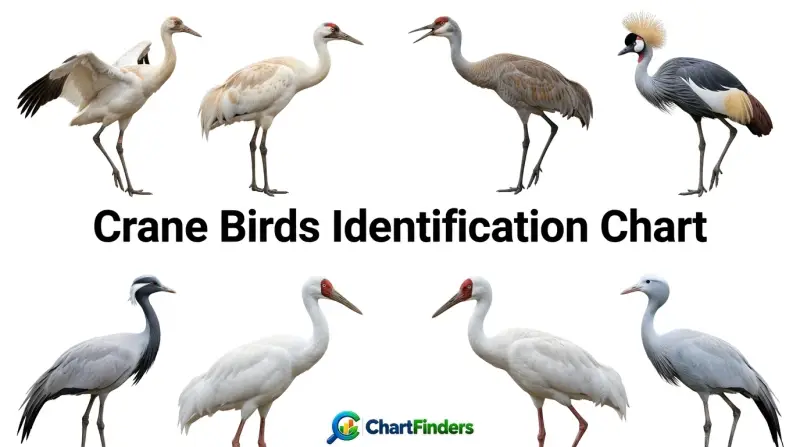
To the untrained observer scanning a wetland or agricultural plain, any large wading bird with elongated legs and a straight bill is often broadly categorized as a crane. However, true cranes represent a deeply specialized evolutionary lineage quite distinct from superficial look-alikes such as herons, storks, and flamingos. While storks belong to Ciconiidae and herons to Ardeidae, true cranes make up the family Gruidae within the order Gruiformes. Understanding this biological distinction opens the door to appreciating one of the world’s most ancient and magnificent avian families.
The evolutionary history of cranes stretches back millions of years, leaving behind a legacy of remarkable behavioral adaptations. Their migratory journeys span continents, crossing some of the highest mountain ranges on earth, while their behavioral repertoires include lifelong pair bonding and dancing rituals. This comprehensive master guide examines the taxonomy, physical characteristics, distinct species types, migratory patterns, and vital conservation frameworks surrounding crane birds.
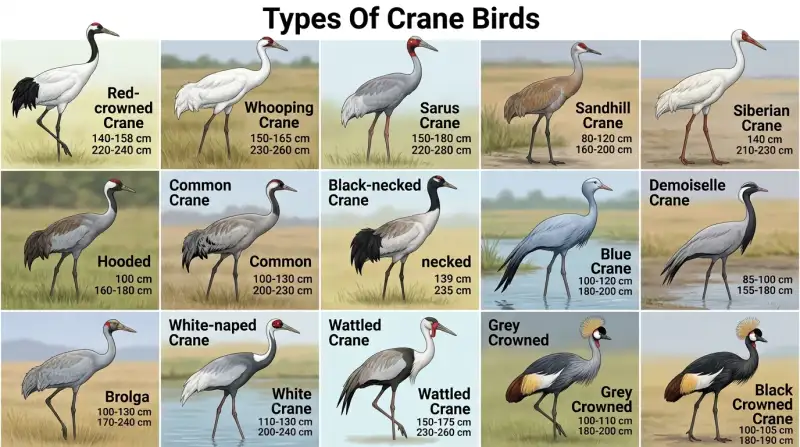
Types Of Crane Birds
- Taxonomic Distinctiveness: True cranes belong exclusively to the family Gruidae (order Gruiformes) and are structurally separate from herons, storks, and egrets.
- Global Diversity: There are 15 living crane species distributed worldwide, divided into two distinct subfamilies: Crowned cranes (Balearicinae) and true cranes (Gruinae).
- Conservation Status: A significant majority of the 15 crane species are listed as vulnerable, endangered, or critically endangered due to intensive agricultural expansion and wetland loss.
- Behavioral Adaptations: Cranes are famous for lifelong monogamy, elaborate leaping and bowing courtship dances, and powerful, trumpet-like unison calls.
- Flight Mechanics: Unlike herons that fly with their necks curved in an “S” shape, cranes fly with their necks and legs fully extended straight.
The family Gruidae is split into two living subfamilies: the Crowned Cranes (genus Balearica), which retain primitive morphological traits such as a stiff golden crest and the ability to roost in trees, and the True Cranes (genera Antigone, Grus, and Leucogeranus), which are ground-nesting specialists with elongated tracheae coiled within their sternums to produce booming calls.
Below is a comparative reference table outlining the 15 recognized crane species, detailing their primary geographic distributions, global conservation statuses, and approximate physical statures.
| Common Name | Scientific Name | Primary Distribution | Conservation Status (IUCN) | Height / Wingspan |
|---|---|---|---|---|
| Red-crowned Crane | Grus japonensis | East Asia (Japan, China, Korean Peninsula) | Vulnerable | 140-158 cm / 220-240 cm |
| Whooping Crane | Grus americana | North America (Canada to Texas) | Endangered | 150-165 cm / 230-260 cm |
| Sarus Crane | Antigone antigone | South and Southeast Asia, Australia | Vulnerable | 150-180 cm / 220-280 cm |
| Sandhill Crane | Antigone canadensis | North America, Eastern Siberia | Least Concern | 80-120 cm / 160-200 cm |
| Siberian Crane | Leucogeranus leucogeranus | Northern Siberia, wintering in China/Iran | Critically Endangered | 140 cm / 210-230 cm |
| Hooded Crane | Grus monacha | Siberia, wintering in Japan and South Korea | Vulnerable | 100 cm / 160-180 cm |
| Common Crane | Grus grus | Eurasia (Northern Europe/Asia to Africa) | Least Concern | 100-130 cm / 200-230 cm |
| Black-necked Crane | Grus nigricollis | Tibetan Plateau, wintering in India/Bhutan | Vulnerable | 139 cm / 235 cm |
| Blue Crane | Anthropoides paradiseus | Southern Africa (primarily South Africa) | Vulnerable | 100-120 cm / 180-200 cm |
| Demoiselle Crane | Anthropoides virgo | Black Sea to Mongolia, wintering in Africa/India | Least Concern | 85-100 cm / 155-180 cm |
| Brolga | Antigone rubicunda | Australia and New Guinea | Least Concern | 100-130 cm / 170-240 cm |
| White-naped Crane | Grus vipio | Mongolia, Southeastern Russia, China, Korea | Vulnerable | 110-130 cm / 200-240 cm |
| Wattled Crane | Bugeranus carunculatus | Sub-Saharan Africa (Central/Southern) | Vulnerable | 150-175 cm / 230-260 cm |
| Grey Crowned Crane | Balearica regulorum | Eastern and Southern Africa | Endangered | 100-110 cm / 180-200 cm |
| Black Crowned Crane | Balearica pavonina | Sahel region of Africa | Vulnerable | 100-105 cm / 180-190 cm |
This table demonstrates the immense morphological diversity across the family, ranging from the towering Sarus crane—the world’s tallest flying bird—to smaller, highly adaptable species like the Demoiselle crane.
The Subfamily Gruinae: True Cranes
True cranes comprise the vast majority of extant species and are characterized by their strictly terrestrial nesting habits. They build large mounded nests of plant material directly on the ground or in shallow marshes. Their tracheal anatomy features long windpipes that loop and coil within the sternum, providing the acoustic resonance necessary to project their calls across miles of open tundra or agricultural fields.
Prominent members of this group include the iconic Red-crowned crane of East Asian folklore, celebrated as a symbol of longevity and fidelity, and the Whooping crane, North America’s tallest native bird, which clawed its way back from the brink of extinction in the mid-20th century when its wild population dipped to fewer than 20 individuals.
The Subfamily Balearicinae: Crowned Cranes
Representing the most ancient lineage of cranes, the crowned cranes are endemic to the African continent. Unlike true cranes, crowned cranes possess a hindtoe that is long and fully functional, allowing them to grasp branches and perch in trees—a unique behavioral trait among Gruidae. They are instantly recognized by the striking, stiff golden crown feathers that radiate from the back of their heads like a sunburst.
The two species in this subfamily, the Grey Crowned Crane and the Black Crowned Crane, favor open savannas, grasslands, and seasonal wetlands. They are heavily impacted by habitat fragmentation, the illegal pet trade, and the agricultural conversion of their traditional foraging grounds.
Morphology and Field Identification Cues
Accurately identifying crane birds in the field requires separating them from superficially similar wetland species. While herons, egrets, storks, and ibises share wetland habitats with cranes, their skeletal proportions and flight dynamics are structurally distinct.
Distinguishing Cranes from Look-Alikes
To avoid misidentification, field ornithologists rely on three primary morphological axes: neck posture in flight, bill shape, and vocalization profile.
- Flight Posture: Cranes fly with their necks and heads extended straight forward and their legs trailing out behind them. Herons typically retract their necks into a tight “S” shape during flight, while storks and ibises fly with extended necks but often drop their legs or hold them differently.
- Bill Morphology: Crane bills are straight, stout, and multi-purpose tools designed for probing soil, digging tubers, and catching small vertebrates. Storks possess heavier, dagger-like bills for striking fish, whereas herons possess sharp, spearing mandibles.
- Facial Skin: Many crane species feature patches of unfeathered, highly vascularized red skin on their crowns or cheeks, which can flush or pale depending on their emotional and social arousal state.
Plumage Variation and Age Classes
Juvenile cranes generally exhibit distinct plumage compared to adults, lacking the sharp facial contrasts and vivid feather highlights of mature birds. For example, juvenile Whooping cranes and Sandhill cranes display cinnamon-brown body plumage that gradually molts into pure white or slate gray over their first one to two years of life. Crowned cranes display softer, downy grey feathering on their bodies before developing the contrasting facial wattles and head ornamentation of adulthood.
Behavioral Ecology: Social Structure and Reproduction
Cranes are renowned for complex social behaviors that revolve around long-term pair bonds, territorial defense, and elaborate communal displays. Their behavioral ecology underpins their survival across unpredictable seasonal landscapes.
Lifelong Monogamy and Pair Formation
Most crane species mate for life. Pair bonds are reinforced annually through synchronized behaviors, most notably the famous “unison call.” When performing a unison call, the male and female stand close together; the female raises her bill vertically and emits two high-pitched notes for every single low-pitched note produced by the male, whose head remains horizontal. This vocal duet cements territory ownership and strengthens the bond between partners.
The Mechanics of the Crane Dance
While courtship dancing peaks during the breeding season, cranes execute these elaborate displays year-round as a form of social communication and stress relief. The dance involves running, bowing, leaping gracefully into the air, picking up sticks or vegetation and tossing them skyward, and flapping their wings. These movements are performed by both established pairs and juveniles learning social cues from older flock members.
Migratory Strategies and Flyways
Many crane species are long-distance migrants, undertaking perilous seasonal journeys between northern breeding grounds and southern wintering areas. These migrations require immense physiological preparation and precise navigation along ancient flyways.
The following table illustrates the relative migratory distance categories among representative crane species, measured in average one-way transit kilometers.
| Species | Migratory Classification | Average One-Way Distance (km) | Primary Flyway Obstacles |
|---|---|---|---|
| Siberian Crane | Obligate Long-Distance Migrant | 5,000+ | Arctic tundra, industrial corridors, desert basins |
| Whooping Crane | Obligate Long-Distance Migrant | 4,000 | Great Plains weather systems, power lines |
| Demoiselle Crane | High-Altitude Migrant | 2,500+ | Himalayan mountain ranges |
| Sandhill Crane (Resident Populations) | Non-migratory / Sedentary | < 50 | Local habitat fragmentation |
| Blue Crane | Altitudinal / Regional Migrant | 200–500 | Agricultural fencing, localized land conversion |
Migratory cranes rely on traditional stopover sites—shallow wetlands, agricultural stubble fields, and river valleys—where they refuel on high-energy grains and invertebrates. The loss of a single critical stopover wetland can jeopardize an entire flyway population.
Conservation Challenges and Recovery Frameworks
The conservation status of crane birds is a bellwether for the health of global wetland and grassland ecosystems. Because cranes require extensive, undisturbed habitats for breeding and foraging, they are acutely vulnerable to anthropogenic pressures.
Primary Threats to Wild Populations
- Wetland Drainage and Conversion: The systematic draining of marshes for agricultural expansion and real estate development destroys the primary nesting and feeding grounds of true cranes.
- Power Line Collisions: Due to their large wingspans and heavy bodies, flying cranes frequently collide with unmarked high-voltage transmission lines during low-visibility conditions.
- Poisoning and Hunting: In parts of their wintering range, cranes foraging on agricultural crops are occasionally targeted by poisoned bait or illegal hunting.
- Climate Change: Altered precipitation patterns lead to the premature drying of ephemeral wetlands, stranding breeding pairs and reducing chick survival rates.
Success Stories: Reintroduction and Habitat Management
Intensive conservation breeding, puppet-rearing methodologies, and ultralight-led migration training have pulled species like the Whooping crane back from total extinction. International treaties, such as the Ramsar Convention on Wetlands and bilateral migratory bird agreements, continue to provide the legal scaffolding necessary to protect critical crane stopover sites across borders.
Frequently Asked Questions
Are herons and cranes the same family of birds?
No. While they share similar body plans as large wading birds, cranes belong to the family Gruidae within the order Gruiformes. Herons belong to the family Ardeidae within the order Ciconiiformes. They have distinct skeletal structures, vocal apparatuses, and flight postures.
How many species of cranes exist in the world today?
There are 15 distinct living species of cranes recognized globally. They are divided into two subfamilies: the crowned cranes (2 species) and the true cranes (13 species).
Do all crane species migrate?
No. While many northern-breeding species such as the Siberian, Whooping, and Red-crowned cranes undertake massive seasonal migrations, several species or regional populations—such as the Brolga in Australia and certain subspecies of Sandhill cranes—are largely sedentary or engage in short-distance altitudinal movements.
Why do cranes dance?
Crane dancing is a complex form of social communication. While it peaks during courtship to strengthen pair bonds and stimulate reproductive readiness, cranes dance year-round to relieve stress, practice motor skills, and coordinate flock movements.
What is the tallest flying bird in the world?
The Sarus Crane (Antigone antigone) holds the record as the tallest flying bird in the world, with mature individuals standing up to 1.8 meters (nearly 6 feet) tall.
Conclusion
Crane birds represent a pinnacle of avian evolution, combining physical majesty, complex social bonds, and specialized ecological requirements. From the high-altitude flights of Demoiselle cranes over the Himalayas to the poignant, marshland calls of Whooping cranes in North America, these 15 species command our stewardship and admiration. Ensuring the future of crane birds requires a steadfast commitment to preserving the global wetlands and grasslands upon which their survival depends.