
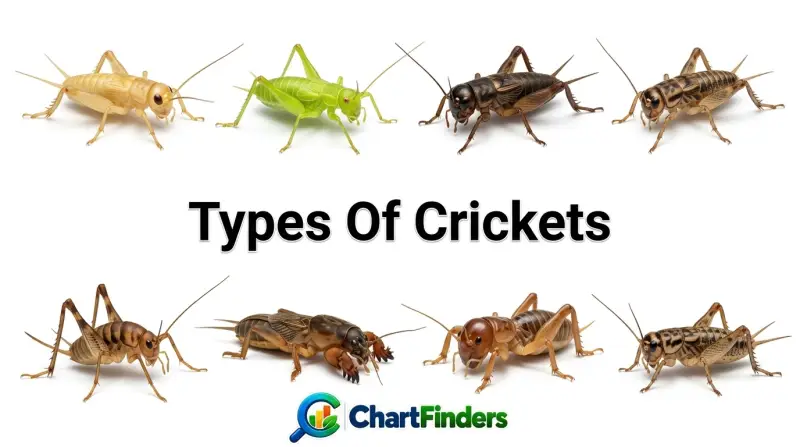
Crickets are among the most recognizable yet misunderstood insects in the world. To the average homeowner, a cricket is simply an unexpected nighttime visitor producing a high-pitched nocturnal serenade or an unwelcome muncher of household fabrics. To the turf manager or agriculturist, certain species represent subterranean pests capable of destroying root systems and ruining acres of pristine turfgrass. To the pet owner or reptile enthusiast, they serve as an essential, nutrient-rich feeder insect. Because the order Orthoptera encompasses a vast array of species with radically different life histories, understanding the distinct types of crickets is the first step toward effective management, appropriate care, or simply appreciating their ecological role.
The complexity of identifying and managing these insects stems from their diverse ecological niches. Some species thrive exclusively in arid grasslands, while others require subterranean burrows or damp, subterranean crawlspaces. Their physical adaptations vary just as widely: some possess powerful hind legs engineered for dramatic leaps, while others have flattened, paddle-like front legs built for tunneling through heavy soil. , not all crickets chirp, and not all crickets eat plants. By examining the biological and behavioral characteristics of each major group, this guide provides a definitive resource for identifying, understanding, and managing the various types of crickets.
Types Of Crickets
- House Crickets: Recognized by their pale yellowish-gray color and three dark bands on the head; they readily breed indoors and consume fabrics and paper.
- Field Crickets: Robust, dark brown or black insects that prefer outdoor living in grassy fields, occasionally invading homes during extreme temperature swings.
- Camel Crickets: Humpbacked, wingless creatures that do not chirp; they thrive in high-moisture environments like basements, crawlspaces, and caves.
- Mole Crickets: Heavily modified subterranean insects with shovel-like front legs designed for tunneling; they cause severe damage to lawns and root systems.
- Tree Crickets: Slender, pale green or translucent canopy dwellers known for their melodious, bell-like calls and egg-laying scars on woody stems.
- Behavioral Divergence: Sound production, diet, and habitat requirements vary dramatically across groups—some species are strictly predatory, while others are herbivorous or omnivorous.
- Integrated Management: Effective control requires sealing entry points, eliminating moisture traps, clearing outdoor debris, and applying targeted treatments only when necessary.
To accurately navigate the world of orthopterans, one must look beyond superficial resemblances. The following sections break down the primary categories of crickets, detailing their physical morphology, distinct behaviors, geographic distribution, and ecological impact.
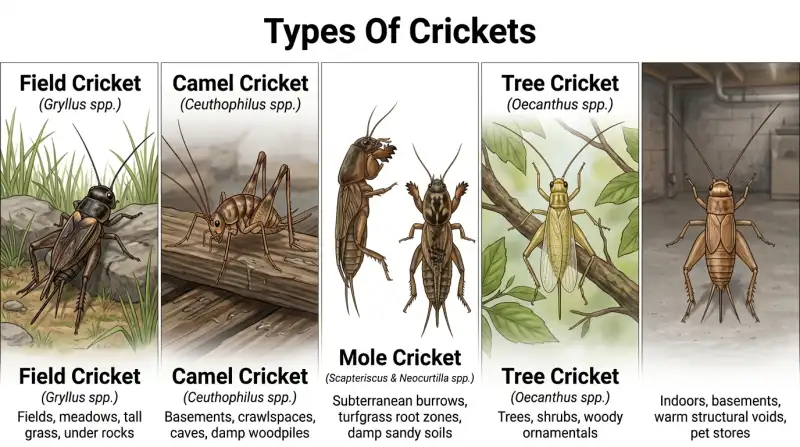
| Cricket Type | Primary Color | Typical Size | Chirping Ability | Primary Habitat | Main Pest Concern |
|---|---|---|---|---|---|
| House Cricket (Acheta domesticus) | Light yellowish-gray with dark head bands | 3/4 to 7/8 inch | Yes (High-pitched) | Indoors, basements, warm structural voids, pet stores | Chewing fabrics, paper, wallpaper; annoying nighttime noise |
| Field Cricket (Gryllus spp.) | Dark brown, gray, or black | 3/4 to 1 inch | Yes (Loud, rhythmic) | Fields, meadows, tall grass, under rocks | Accidental indoor invasion during temperature extremes; chewing crops |
| Camel Cricket (Ceuthophilus spp.) | Light to dark brown, mottled; humpbacked | 1/2 to 1 1/2 inches | No | Basements, crawlspaces, caves, damp woodpiles | Startling appearance; minor fabric damage in extreme infestations |
| Mole Cricket (Scapteriscus & Neocurtilla spp.) | Light brown to dark gray; velvet-like body | 1 1/4 to 1 1/2 inches | Yes (Soft, muffled underground trill) | Subterranean burrows, turfgrass root zones, damp sandy soils | Extensive tunneling damage, destroying lawns and root systems |
| Tree Cricket (Oecanthus spp.) | Pale green or whitish-translucent | 1/2 to 3/4 inch | Yes (Melodious, bell-like) | Trees, shrubs, woody ornamentals | Egg-laying scars on twigs and branches of fruit trees |
The table above highlights the core distinctions among the most common species encountered by homeowners and property managers. Understanding these baseline traits allows for rapid identification and prevents misdirected pest control efforts.
1. House Crickets (Acheta domesticus)
The house cricket is perhaps the most culturally recognized species, historically celebrated in literature for its hearth-warming song, yet reviled in modern households for its destructive habits. Originating in Southwest Asia, Acheta domesticus has spread globally through human commerce, pet trade distribution, and structural adaptation.
Physical Identification
House crickets typically measure between 3/4 and 7/8 of an inch in length. Their bodies are straw-colored to light yellowish-gray, distinguished instantly by three distinct dark transverse bands running across the head between the compound eyes. They possess long, thread-like antennae, fully developed wings folded flat over the abdomen, and powerful hind legs adapted for jumping.
Behavior and Habitat
Unlike many outdoor species, house crickets readily complete their entire life cycle indoors if warmth, moisture, and food are available. They thrive in dark, warm environments such as near furnaces, behind water heaters, in basements, and inside wall voids. Omnivorous by nature, they consume organic debris, dead insects, and various household items. When populations swell, they actively chew on cotton, wool, silk, synthetic fabrics, and paper products, especially items stained with perspiration or food residue. Their continuous nighttime chirping—produced by males rubbing their forewings together—can also become a significant psychological nuisance.
2. Field Crickets (Gryllus Species)
Field crickets comprise a complex of several closely related species within the genus Gryllus. They are robust, heavy-bodied insects that dominate outdoor ecosystems across North America, Europe, and Asia.
Physical Identification
Slightly larger than house crickets, field crickets generally range from 3/4 to 1 inch long. Their coloration is predominantly black, though some regional variants display dark brown or grayish hues. Their robust heads, strong mandibles, and thick, shiny exoskeletons give them a distinctively rugged appearance compared to their delicate-looking indoor counterparts.
Behavior and Habitat
Field crickets are strictly outdoor insects, inhabiting grassy fields, pastures, meadows, and overgrown yards. They shelter under logs, stones, woodpiles, and landscape mulch during the day, emerging at dusk to feed on vegetation, decaying organic matter, and occasionally other insects. While they prefer the outdoors, they are strongly attracted to artificial lights at night. During prolonged summer droughts or sudden autumn cold snaps, millions of field crickets may migrate toward homes, accumulating around foundations, porches, and entryways before accidentally slipping inside.
3. Camel Crickets (Cave Crickets / Spider Crickets)
Belonging to the family Rhaphidophoridae, camel crickets earn their moniker from their pronounced, arched, humpbacked appearance. Because they frequently inhabit dark, subterranean spaces and display long, spider-like legs, they are also widely known as cave crickets or spider crickets.
Physical Identification
Camel crickets range from 1/2 to 1 1/2 inches in body length, with exceptionally long, spindly legs that make them appear much larger. They are wingless, meaning they lack the stridulating organs required to produce sound; consequently, camel crickets do not chirp. Their coloration is usually a mottled light or dark brown, often featuring glossy exoskeletons.
Behavior and Habitat
Moisture is the single most critical survival factor for camel crickets. They naturally inhabit caves, hollow logs, and dense, damp leaf litter. When they approach human structures, they seek out dark, humid microclimates such as unfinished basements, crawlspaces, damp garages, and ground-level utility rooms. When startled, camel crickets do not flee by running or flying; instead, they execute erratic, powerful leaps directly toward the source of disturbance—a defensive behavior that frequently startles unsuspecting humans.
4. Mole Crickets (Subfamily Gryllotalpidae)
Mole crickets are among the most bizarre and specialized orthopterans. Highly adapted for a subterranean existence, they spend nearly their entire lives underground, making them notorious agricultural and turfgrass pests.
Physical Identification
Measuring between 1 1/4 and 1 1/2 inches long, mole crickets have cylindrical, velvety bodies covered in dense, fine hair that prevents soil from adhering to them. Their most defining feature is their modified front legs, which are broad, flattened, and equipped with heavy, claw-like projections. These limbs resemble the digging claws of a mammalian mole, perfectly engineered for excavating soil.
Behavior and Habitat
Mole crickets inhabit damp soils in lawns, pastures, and agricultural fields. They tunnel extensively just beneath the soil surface, creating raised ridges of earth that disrupt root systems and cause turfgrass to wither and die. Many species are omnivorous, feeding on plant roots, tubers, earthworms, and other soil-dwelling insects. While they possess wings and are capable of weak flight, they rarely fly except during seasonal mating swarms. Males construct specialized, trumpet-shaped burrows that amplify their soft, muffled chirping calls to attract females.
5. Tree Crickets (Oecanthus Species)
Tree crickets add an ethereal, melodic quality to late-summer evenings. Unlike ground-dwelling relatives, these delicate insects live high in the canopy of trees and shrubs.
Physical Identification
Tree crickets are small, slender insects measuring 1/2 to 3/4 of an inch long. Their bodies are typically pale green, translucent white, or yellowish, allowing them to blend into foliage. Their wings are broad and flat, held vertically or horizontally over the body depending on the species.
Behavior and Habitat
Inhabiting orchards, deciduous forests, and ornamental shrubs, tree crickets feed on aphids, scale insects, pollen, nectar, and tender leaves. Their mating calls are exceptionally musical, often described as a clear, continuous ringing trill. While beneficial due to their predatory appetite for soft-bodied garden pests, female tree crickets can cause structural damage to woody plants. During egg-laying, females puncture twigs and small branches to insert rows of eggs, which can weaken the stems of fruit trees and berry bushes.
Comparative Analysis of Cricket Orders and Families
To fully grasp the taxonomy and behavioral differences among crickets, it is helpful to contrast true crickets with their close relatives, such as bush crickets, katydids, and camel crickets, which all belong to the insect order Orthoptera. The table below outlines key taxonomic and biological distinctions.
| Family / Group | Scientific Family | Antennae Length | Wings / Flight | Dietary Preference |
|---|---|---|---|---|
| True Crickets | Gryllidae | Long, thread-like | Usually present; flat over abdomen | Omnivorous (plants, insects, detritus) |
| Camel / Cave Crickets | Rhaphidophoridae | Extremely long | Wingless | Omnivorous / Scavengers |
| Mole Crickets | Gryllotalpidae | Moderate | Short, stubby; rarely used for flight | Omnivorous (roots, grubs, worms) |
| Bush Crickets / Katydids | Tettigoniidae | Very long (often exceeding body) | Broad, roof-like over body | Mainly herbivorous / arboreal foliage |
Ecological Roles and Economic Impact of Crickets
Crickets occupy a complex ecological position, functioning simultaneously as beneficial environmental recyclers, vital links in the food web, and destructive agricultural pests.
Nutrient Cycling and the Food Web
In natural ecosystems, crickets play a fundamental role in decomposition and nutrient cycling. By consuming decaying vegetation, fallen seeds, and organic detritus, they accelerate the breakdown of organic matter, returning vital nitrogen and minerals to the soil. , crickets form an indispensable dietary staple for countless vertebrate and invertebrate predators. Amphibians, reptiles, birds, small mammals, and predatory spiders rely heavily on cricket populations for sustenance.
Agricultural and Structural Damage
Despite their ecological utility, certain cricket populations inflict severe economic damage:
- Turf Destruction: Mole crickets tear apart root systems across golf courses, athletic fields, and residential lawns, costing millions of dollars annually in repair and remediation.
- Crop Consumption: Massive swarms of field crickets can devastate agricultural crops, including alfalfa, cotton, clover, and various vegetables, stripping leaves and damaging grain heads.
- Material Degradation: House crickets nesting inside structures chew through textiles, upholstered furniture, and paper wallpaper, leaving unsightly holes and staining fabrics with regurgitated digestive fluids.
- Arboreal Scarring: Tree cricket oviposition scars introduce fungal pathogens or weaken young fruit-bearing branches, impacting commercial orchard yields.
Practical Identification and Inspection Framework
Effectively managing crickets or mitigating an indoor invasion requires systematic inspection. Because different species demand entirely different control strategies, diagnosing the exact type of cricket present is essential.
- Audit the Sound: Listen carefully to the vocalizations. A loud, rhythmic chirp from the baseboards points to field or house crickets. A soft, continuous underground trill indicates mole crickets in the lawn. A bell-like canopy trill indicates tree crickets. Absolute silence accompanied by leaping brown insects points directly to camel crickets.
- Evaluate the Location: Note where the insects are most concentrated. Finding crickets in dry, warm wall voids or near pantry areas suggests house crickets. Finding them exclusively in a damp basement or crawlspace indicates camel crickets. Discovering raised soil ridges in the lawn points to mole crickets. Finding them in shrubbery points to tree crickets.
- Inspect Physical Morphology: Examine trapped or deceased specimens. Look for the three dark head bands (house cricket), shiny black armor (field cricket), humpbacked profile (camel cricket), shovel-like front claws (mole cricket), or pale green translucent bodies (tree crickets).
- Assess Environmental Triggers: Check exterior perimeters for woodpiles, heavy mulch beds, dense vegetation, and unsealed foundation cracks that facilitate entry.
Common Mistakes in Cricket Management
When dealing with crickets, homeowners and property managers frequently commit errors that exacerbate infestations or waste resources.
- Treating Indoor Spaces for Camel Crickets: Spraying broad-spectrum insecticides inside living rooms or bedrooms will not solve a camel cricket problem. Because these insects require high humidity, the true source is always an unsealed crawlspace, damp basement, or moisture leak that must be corrected.
- Ignoring Exterior Lighting: Leaving bright porch lights on throughout the night acts as a for field crickets, drawing thousands of insects directly to exterior doorways and window wells. Switching to yellow sodium-vapor or warm LED insect bulbs drastically reduces this attraction.
- Confusing Crickets with Roaches: House and field crickets are occasionally misidentified as cockroaches, leading to improper chemical applications. Unlike roaches, crickets require moisture and open vegetation; they do not harbor human pathogens in the same manner, and their control protocols focus heavily on moisture abatement and exterior barrier sealing.
- Applying Mole Cricket Treatments at the Wrong Time: Treating lawns for mole crickets late in the season when nymphs have matured into hardened adults results in poor control. Applications must target vulnerable newly hatched nymphs in early summer for maximum efficacy.
Frequently Asked Questions
Do all types of crickets chirp?
No. Only specific species and primarily adult males produce chirping sounds. They achieve this through stridulation—rubbing a specialized scraper on one forewing against a ribbed file on the other forewing. Species such as camel crickets completely lack wings and are entirely silent.
Why are camel crickets attracted to basements?
Camel crickets require high relative humidity to keep their respiratory systems functioning and to prevent desiccation. Basements, crawlspaces, and sumps provide the damp, dark, cool microclimates they naturally seek out in caves and under rotting logs.
Can house crickets bite humans?
House crickets possess chewing mouthparts, but they rarely bite humans. On very rare occasions, an exceptionally large cricket may attempt to pinch human skin if handled roughly, but their mandibles lack the strength to break skin or inject venom.
How do I stop crickets from entering my home in the autumn?
Prevention relies on exclusion and environmental modification. Seal all gaps around doors, windows, and utility penetrations with silicone caulk and weatherstripping. Clear away heavy vegetation, leaf litter, and woodpiles from within three feet of the foundation perimeter.
Are mole crickets harmful to household pets?
Mole crickets are not venomous and do not transmit diseases to dogs or cats. However, if a pet ingests large numbers of mole crickets from a treated lawn, pesticide residue on the insects could pose a secondary poisoning risk, making professional landscape management supervision important.
Conclusion
Navigating the diverse world of orthopterans reveals an balance between ecological necessity and pest pressure. From the melodious tree crickets of the high forest canopy to the destructive subterranean tunnels of the mole cricket and the quiet, damp-loving camel cricket in the basement, each type occupies a distinct evolutionary niche. By understanding their unique morphological traits, behavioral triggers, and habitat requirements, property owners can accurately identify infestations, implement targeted, non-toxic management strategies, and maintain harmonious pest control without unnecessary chemical overapplication.