
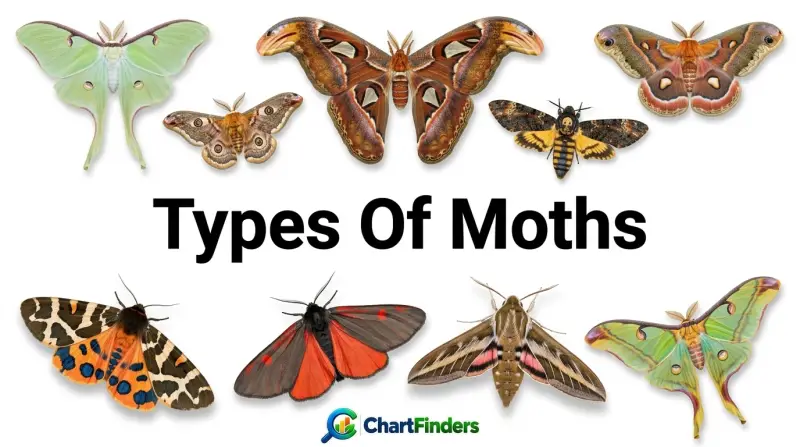
The vast universe of moths represents one of the most successful adaptive radiations in the insect world. While public perception often reduces these creatures to household pests that chew through wool sweaters or harmless brown insects fluttering toward a porch light, entomologists recognize them as crucial ecological players, sophisticated pollinators, and masters of evolutionary camouflage. Their life cycle—progressing through egg, caterpillar, pupa, and winged adult—presents a masterclass in metamorphosis. Understanding the different types of moths requires looking beyond superficial colorations to examine wing venation, larval behavior, feeding habits, and ecological roles.
This comprehensive guide explores the rich taxonomy of moths, examining major families, migratory marvels, striking specialists, common misconceptions, and identification strategies. Whether you are an amateur naturalist trying to identify a visitor to your garden moth trap, a gardener studying nocturnal pollinators, or simply curious about the astonishing variety of winged life that emerges after dark, the following sections provide a thorough examination of the types of moths inhabiting our ecosystems.
Understanding The Diversity And Classification Of Types Of Moths
- Moths vastly outnumber butterflies, making up approximately 90% of all known Lepidoptera species worldwide.
- Classification relies on wing coupling mechanisms, mouthpart structures, and larval habits rather than simple daytime or nighttime activity patterns.
- Migratory species such as the Humming-bird Hawk-moth and Silver Y regularly traverse vast geographic boundaries, tracking seasonal blooms.
- Caterpillar morphology varies immensely, ranging from smooth loopers to densely bristled tussocks and white ermines.
- Accurate identification requires observing resting posture, antenna structure, wing markings, and ecological associations with specific host plants.
Taxonomically, moths do not form a single distinct biological clade separate from butterflies; rather, butterflies represent a specialized, day-flying lineage nested deep within the evolutionary tree of Lepidoptera. Because of this, distinguishing types of moths relies on a mix of morphological traits, ecological niches, and evolutionary history. Lepidopterists divide moths into numerous superfamilies and families, ranging from primitive ghost moths (Hepialidae) with simple wing structures to highly evolved snout moths (Pyralidae) and giant silkmoths (Saturniidae).
To navigate this incredible biological richness, scientists group moths into functional categories based on their physical attributes, behavioral patterns, and ecological interactions. Below, we examine the primary categories and families of moths that capture the interest of researchers and enthusiasts alike.
| Common Family / Group | Representative Species | Key Identifying Traits | Primary Ecological Role / Habit |
|---|---|---|---|
| Sphingidae (Hawk-moths / Sphinx Moths) | Humming-bird Hawk-moth, Death’s-head Hawk-moth | Streamlined bodies, long proboscis, powerful rapid flight | Specialized nocturnal and crepuscular long-tongued pollinators |
| Noctuidae (Owlet Moths) | Silver Y, Clifden Nonpareil, Campion Moth | Dull forewings with distinct kidney/orbicular spots, robust builds | Largest moth family; caterpillars often feed on herbaceous plants and crops |
| Saturniidae (Giant Silkmoths) | Luna Moth, Emperor Moth, Cecropia | Large wingspan, often feature eyespots, reduced adult mouthparts | Non-feeding adults focused entirely on reproduction; large, ornate larvae |
| Erebidae (Tiger Moths & Allies) | White Ermine, Crimson Speckled, Cinnabar Moth | Bright warning colors (aposematism) or furry, hairy ermine patterns | Larvae feed on low-growing vegetation; many sequester toxins from plants |
| Geometridae (Geometer Moths) | Gold Spot Moth, Peppered Moth | Slender bodies, broad wings held flat; “looper” caterpillars | Caterpillars move by looping their bodies; masters of twig mimicry |
| Pyralidae (Snout Moths) | Indian Meal Moth, Bee Moths | Prominent, forward-projecting labial palps forming a “snout” | Includes agricultural pests, stored-product invaders, and ecosystem specialists |
The table above illustrates the broad morphological and behavioral divergence found across major moth groups. While some families have evolved specialized mouthparts to sip nectar from deep-throated flowers, others possess no functioning mouthparts at all as adults, living solely off energy reserves accumulated during their caterpillar stage.
Migratory Powerhouses: Long-Distance Travelers
While many people view insects as sedentary residents of a single garden or woodlot, an elite group of moths undertakes astonishing seasonal migrations. These journeys span hundreds or even thousands of miles, crossing mountain ranges, seas, and national borders in response to changing climate fronts and resource availability.
- Humming-bird Hawk-moth (Macroglossum stellatarum): Famous for hovering in front of flowers with a high-pitched hum and an exceptionally rapid wingbeat, this species migrates northward into temperate regions every spring, astonishing gardeners by visiting petunias and verbena in broad daylight.
- Silver Y (Autographa gamma): Named for the distinct metallic silver marking on its forewings, the Silver Y is a prolific migrant that arrives in waves from southern breeding grounds, influencing agricultural ecosystems across Europe and parts of Asia.
- Death’s-head Hawk-moth (Acherontia atropos): Known for the chilling skull-like pattern on its thorax and its ability to emit a squeaking sound when disturbed, this massive migrant travels from Africa and southern Europe, occasionally raiding beehives to consume stored honey.
- Clifden Nonpareil (Catocala fraxini): A stunning underwing moth featuring dramatic blue bands on its hindwings, this species has expanded its migratory and breeding footprint northward, becoming a prized sighting for woodland moth enthusiasts.
- Crimson Speckled (Utetheisa pulchella): Marked with striking crimson dots and black dashes on pristine white wings, this delicate migratory tiger moth arrives sporadically on southern coasts following warm southerly airflow.
Specialized Garden And Woodland Dwellers
Beyond migratory wanderers, local habitats support an web of resident species adapted to specific microclimates and host plants.
For instance, the White Ermine Moth (Spilosoma lubricipeda) emerges with a furry, snowy-white coat dotted with black spots, its caterpillars easily spotted crossing autumn footpaths as hairy brown generalists. Similarly, the Campion Moth (Hadena bicruris) maintains a synchronized lifecycle with campion flowers, its larvae burrowing directly inside seed capsules to feed securely.
In riparian zones and near waterways, the Gold Spot Moth (Plusia festucae) flashes two brilliant, metallic golden spots on its rich bronze-brown forewings, blending into reed beds and damp meadows where its preferred host plants thrive.
The Life Cycle And Metamorphosis Of Moths
The success of moths as an evolutionary lineage is fundamentally tied to complete metamorphosis (holometabolism), a four-stage biological journey that partitions growth, feeding, and reproduction into distinct phases.
1. The Egg Stage
Female moths deposit fertilized eggs—often numbering in the hundreds—directly onto or near specific host plants. These eggs vary dramatically in shape; some are spherical and ribbed, while others are flattened disks. The placement is rarely random; evolution has programmed females to locate exact chemical signatures released by host foliage to ensure that newly hatched caterpillars have immediate access to digestible nutrition.
2. The Caterpillar (Larval) Stage
The larval stage is the primary engine of growth. Caterpillars spend their days eating and molting multiple times (instars) to accommodate their expanding bodies. Larval morphology provides key clues for identification:
- Loopers (Geometrid larvae): Possess prolegs only at the front and rear ends of the body, forcing them to loop their bodies upward as they crawl.
- Hairy Caterpillars (Tiger moths and Ermines): Covered in dense setae (hairs) that deter vertebrate predators and, in some species, cause skin irritation upon contact.
- Hornworms (Sphingid larvae): Feature a distinct, harmless horn at the posterior end of the body and often display camouflage stripes resembling tropical foliage.
3. The Pupa (Chrysalis/Cocoon) Stage
Once fully grown, the caterpillar ceases feeding and searches for a safe pupation site—either underground in the soil, tucked beneath leaf litter, or enclosed within a protective silken cocoon spun against a tree trunk. Inside the pupa, tissues break down entirely through histolysis and reorganize into the adult structures of the imago.
4. The Adult (Imago) Stage
The newly emerged adult must pump hemolymph into its crumpled wings and allow them to dry before taking flight. The adult phase is brief and intensely focused on dispersal, mate location, and reproduction. While female silkmoths emit potent chemical pheromones that males can detect over miles using specialized feathery antennae, other species rely on visual cues or acoustic signaling.
Distinguishing Moths From Butterflies: Separating Myths From Facts
A common educational exercise involves separating moths from butterflies. While general rules exist, nature frequently breaks them, leading to widespread identification confusion.
| Feature | Typical Butterflies | Typical Moths |
|---|---|---|
| Activity Pattern | Diurnal (Active during daylight) | Predominantly nocturnal or crepuscular (some diurnal exceptions) |
| Antenna Structure | Slender with clubbed or hooked tips | Feathery (pectinate), thread-like, or saw-toothed without clubs |
| Resting Wing Position | Held vertically upright together over the back | Spread flat, roof-like (tent), or wrapped tightly around the body |
| Wing Coupling | Uncoupled wings; hindwing overlaps forewing (amplexiform) | Connected by a specialized bristle and hook system (frenulum and retinaculum) |
| Pupation Form | Naked pupa (chrysalis) attached to a surface | Frequently enclosed within a silk cocoon or pupating underground |
Understanding these distinctions prevents common misclassifications. For instance, the Humming-bird Hawk-moth flies by day and hovers like a bird, leading many observers to assume it is a butterfly or an actual hummingbird. However, its thick, spindle-shaped body, feathery-tipped antennae, and nocturnal evolutionary relatives firmly place it among the moths.
Ecological Importance And Conservation Of Moths
Moths are far more than nighttime pests; they are foundational components of global terrestrial ecosystems.
The Unsung Heroes Of Pollination
While bees receive the lion’s share of conservation attention, nocturnal moths are premier pollinators. Many pale, highly fragrant flowers—such as evening primrose, honeysuckle, and campion—have evolved specifically to attract night-flying moths. As moths visit these blossoms to drink nectar, pollen grains adhere to their hairy bodies and are transferred from flower to flower. Research shows that moth pollination networks operate across wide temporal windows, securing reproductive success for numerous native plant species that daytime insects never visit.
Trophic Web Anchors
Moths occupy a vital middle tier in the food web. Millions of insectivorous birds, bats, small mammals, and amphibians rely heavily on adult moths and their protein-rich caterpillars to feed their developing young. Without robust moth populations, woodland bird counts and bat colonies experience severe reproductive decline.
Environmental Indicators
Because different types of moths have strict host-plant requirements and narrow microclimate tolerances, monitoring moth diversity provides researchers with a clear gauge of environmental health. Shifts in moth populations often signal habitat fragmentation, pesticide accumulation, or climate-driven range expansions long before larger animals show visible distress.
Common Identification Pitfalls And Challenges
Identifying moths in the field or from porch-light observations presents several unique hurdles that can trip up even experienced naturalists.
- Sexual Dimorphism: In many species, males and females look drastically different. A male may feature large, feather-like antennae to track pheromones, while the female possesses simple, thread-like antennae and a heavier, egg-laden abdomen.
- Color Polymorphism: Species like the Peppered Moth (Biston betularia) display distinct color morphs (light and dark forms) driven by natural selection within industrial and rural landscapes, making coloration an unreliable standalone key.
- Worn Specimens: Moths that have flown for weeks lose scales from their wings, obliterating delicate diagnostic bands, eyespots, and coloration lines, leaving behind translucent or drab parchment-like membranes.
- Cryptic Mimicry: Numerous moths have evolved to mimic inedible objects, such as bird droppings, dry leaves, broken twigs, or tree bark, making them virtually invisible against their natural backgrounds.
Frequently Asked Questions
Why do moths fly toward lights at night?
Entomologists debate the exact mechanism, but the leading theory involves celestial navigation. For millions of years, moths navigated at night by maintaining a fixed angle relative to the moon or stars. Artificial porch lights and streetlamps disrupt this evolutionary compass, causing the moth to continually correct its flight path and spiral inward toward the artificial light source.
Do all moths eat clothes?
No. Out of more than 160,000 species, only a tiny handful—most notably the Webbing Clothes Moth (Tineola bisselliella) and the Case-bearing Clothes Moth (Tinea pellionella)—target animal fibers such as wool, silk, feathers, and fur. The vast majority of moths feed on living plants, flower nectar, tree sap, or fruit juices, while some adult moths do not feed at all.
How can I attract moths to my garden for observation?
You can attract a rich diversity of moths using two primary methods: “mothing” lights and “sugar baiting.” Setting up a simple white bedsheet illuminated by a mercury-vapor or UV blacklight will draw hundreds of nocturnal species. Alternatively, painting a sweet mixture of fermented fruit, brown sugar, and dark beer onto tree trunks will attract hungry adult owlet moths and underwings.
Are hairy caterpillars dangerous to touch?
Some are, while others are entirely harmless. Caterpillars covered in dense, stiff hairs or brightly colored tufts—such as the tussock moths or flannel moths—possess specialized urticating hairs connected to venom glands. Touching these bristles can cause painful rashes, allergic reactions, or skin irritation. It is best to observe all hairy caterpillars visually without handling them bare-handed.
How long do adult moths live?
Lifespans vary wildly depending on the species and family. Many large silkmoths (Saturniidae) emerge entirely without functional mouthparts and survive for only one to two weeks, utilizing stored fat reserves solely to find a mate and reproduce. Conversely, certain hibernating species (such as some underwings or herald moths) can survive as adults for several months by entering a state of dormancy over winter.
Conclusion
The study of types of moths reveals a staggering of biological adaptation, ecological complexity, and evolutionary beauty. From migratory hawk-moths crossing continents to tiny micro-moths engineering leaf-mining architectures, these insects play irreplaceable roles in pollinating ecosystems and sustaining wildlife food webs. By moving past outdated stigmas and learning to appreciate their subtle behaviors, hidden markings, and nighttime habits, observers open a fascinating window into the nocturnal natural world.