
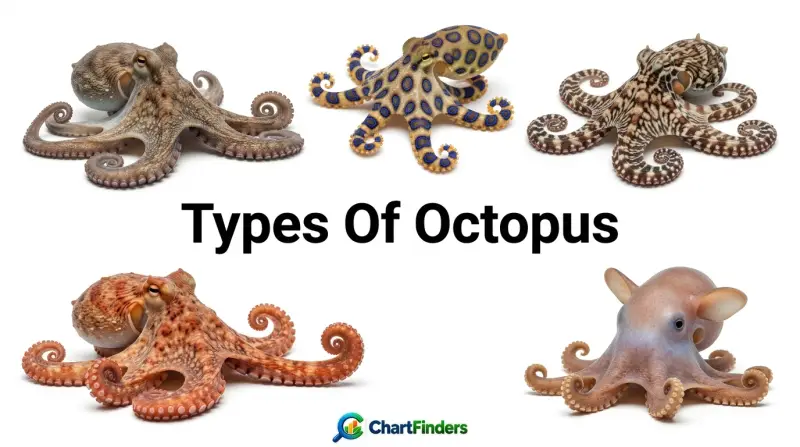
Few marine animals capture the human imagination quite like the octopus. With their decentralized nervous systems, astonishing shape-shifting capabilities, and lack of a rigid skeleton, these cephalopods represent one of nature’s most successful evolutionary experiments. Yet, when people search for information on the types of octopus, they often discover a taxonomic landscape that is as vast as it is mysterious. Science continuously updates this classification; recent marine expeditions have identified new deep-sea species in remote abyssal zones and unique blue variants near the Galápagos Islands, proving that our oceans still harbor countless secrets.
Understanding the full spectrum of octopuses requires moving beyond simplistic categories. It involves examining how different species have adapted to distinct ecological niches—from freezing polar waters to sun-drenched coral reefs and pitch-black hydrothermal vents thousands of feet below the surface. This guide explores the major taxonomic divisions, standout species, distinct physiological traits, behavioral characteristics, and ecological limitations that define the diverse world of octopuses.
Understanding the Incredible Diversity and Classification of Types Of Octopus
- Octopuses are divided into two primary suborders: Incirrina (finless, most common species) and Cirrina (finned, deep-sea dwellers).
- Size varies dramatically, from the massive Giant Pacific Octopus down to dwarf species weighing mere fractions of a gram.
- Modern marine expeditions continue to uncover novel species, including deep-sea dwellers and unique island-specific blue octopuses.
- Venom is universal among octopuses, though only the Blue-ringed octopus poses a lethal threat to humans.
- Different types exhibit highly specialized survival strategies, ranging from hyper-intelligent problem-solving to pelagic drifting and tool use.
To make sense of over 300 species, marine biologists rely on a structural taxonomy that splits the order Octopoda into two distinct suborders. This division is based primarily on anatomical features like internal fins, shell remnants, and the presence of small, hair-like cilia flanking the suction cups.
| Suborder | Habitat Depth | Fins Present? | Cirri (Fringe Hairs)? | Representative Examples |
|---|---|---|---|---|
| Incirrina | Shallow intertidal to deep abyss | No | No | Common Octopus, Giant Pacific Octopus, Blue-ringed Octopus |
| Cirrina | Deep sea (200m to 5,000m+) | Yes | Yes | Dumbo Octopus, Grimpoteuthis genus |
The table above highlights the primary morphological split within the octopus family. Recognizing these distinctions is the first step toward understanding how an animal designed for shallow coral heads shares a common ancestry with one living in the freezing, crushing darkness of the deep ocean.
The Suborder Incirrina: The Common and Coastal Dwellers
The suborder Incirrina contains the vast majority of species familiar to divers, researchers, and seafood markets. These octopuses lack fins on their mantle and possess no internal shell structure (aside from vestigial stylets in some species). They rely entirely on their muscular hydrostat arms, jet propulsion via a siphon, and skin papillae for mobility and camouflage.
1. The Common Octopus (Octopus vulgaris)
Widely distributed in tropical, subtropical, and temperate waters around the globe, Octopus vulgaris is the baseline reference for behavioral studies. Known for exceptional spatial memory and learning capabilities, it can navigate complex mazes, open jars, and recognize human faces. They typically inhabit rocky crevices, reefs, and benthic zones down to 200 meters.
2. The Giant Pacific Octopus (Enteroctopus dofleini)
The undisputed titan of the octopus world, the Giant Pacific Octopus reigns supreme in the cold, nutrient-rich waters of the North Pacific. Weighing an average of 33 pounds (15 kg) with a span reaching up to 14 to 20 feet, individuals have occasionally exceeded 100 pounds. Their lifespan, however, remains brief at 3 to 5 years, ending shortly after brooding their eggs.
3. The Blue-Ringed Octopus (Genus Hapalochlaena)
Despite their diminutive size—often fitting comfortably in the palm of a hand—blue-ringed octopuses are among the most venomous marine animals on Earth. Native to tide pools and coral reefs in the Pacific and Indian Oceans, particularly around Australia, they display striking iridescent blue rings when threatened. Their saliva contains tetrodotoxin, a potent neurotoxin capable of causing rapid human paralysis and respiratory failure.
4. The Coconut Octopus (Amphioctopus marginatus)
Famous for its tool-using behavior, the coconut octopus gathers discarded half-coconut shells or large clamshells on sandy Indonesian seabeds, carrying them along to assemble into a portable mobile armor fortress when hiding spots are scarce.
The Suborder Cirrina: The Finned Deep-Sea Dwellers
Living in the abyssal and bathypelagic zones, the suborder Cirrina represents a stark evolutionary departure from coastal species. These creatures possess umbrella-like webbing between their arms, small ear-like fins on their mantles used for steering, and delicate cirri (fringe-like strands) beside their suckers that help detect prey in total darkness.
1. The Dumbo Octopus (Genus Grimpoteuthis)
Named for its resemblance to Disney’s flying elephant, the Dumbo octopus uses its prominent fin-like ears to gracefully pulse through the water column at depths exceeding 13,000 feet (4,000 meters). They do not possess an ink sac, relying instead on their immense depth and lack of predators for defense.
2. Abyssal and Recently Discovered Deep-Sea Species
Deep-sea exploration continues to reveal novel cirrate octopuses. Recent marine surveys, including deep-water expeditions near the Galápagos Islands and abyssal trenches, have identified previously unknown species adapted to high-pressure, freezing environments. These discoveries how little we know about benthic biodiversity below the sunlight zone.
Comparative Analysis of Major Octopus Families
To further differentiate the vast array of octopuses, marine scientists evaluate physiological and ecological metrics across major families and genera. The following table provides a structural comparison of key taxonomic groups:
| Family / Group | Typical Size / Weight | Primary Locomotion | Dietary Specialization | Notable Defense Mechanism |
|---|---|---|---|---|
| Octopodidae (e.g., Common, GPO) | Varies (1 oz to 100+ lbs) | Crawling, jet propulsion | Crabs, bivalves, fish | Chromatophore camouflage, ink cloud |
| Hapalochlaena (Blue-ringed) | Tiny (2–8 inches) | Benthic crawling | Small crabs, shrimp | Tetrodotoxin venom, flashing rings |
| Opisthoteuthidae (Dumbo octopuses) | Small to medium (8–12 inches) | Fin-swimming, umbrella pulsing | Pelagic copepods, amphipods | Abyssal depth, lack of ink sac |
| Thaumoctopus (Mimic octopus) | Medium (approx. 2 feet) | Benthic crawling, swimming | Small fish, crustaceans | Behavioral mimicry (sea snakes, flounders) |
Evolutionary Adaptations Across Different Octopus Habitats
An octopus’s physical characteristics are tightly coupled with its environment. Natural selection has engineered distinct solutions for survival depending on whether a species lives in a shallow, high-competition coral reef or a barren, high-pressure abyssal plain.
Camouflage and Mimicry Masters
Incirrate octopuses utilize specialized skin cells called chromatophores (pigment sacs), iridophores (reflective structural plates), and leucophores (white light scatterers) controlled directly by their decentralized nervous system. This allows them to change color and texture in milliseconds.
The Mimic Octopus (Thaumoctopus mimicus) takes this a step further. Found in the tropical waters of Southeast Asia, it doesn’t just blend into the background—it actively impersonates toxic models such as venomous sole fish, lionfish, and banded sea snakes depending on which predator is approaching.
Reproductive Strategies and Lifecycle Diversity
All octopuses are semelparous, meaning they reproduce only once in their lifetime. However, the strategies leading up to that moment vary widely:
- Benthic Brooding: Females like the Giant Pacific Octopus guard thousands of grape-like egg clusters in a den for months, refusing to eat and ultimately perishing from starvation once the eggs hatch.
- Pelagic Spawning: Certain deep-sea and pelagic species release millions of tiny planktonic eggs into the open water column, leaving them to drift rather than brooding them actively.
Physiological Quirks and Edge Cases
Beyond standard classifications, several biological anomalies distinguish octopuses from almost all other animal groups:
- Three Hearts: Two branchial hearts pump blood through the gills, while a systemic heart circulates blood to the rest of the body. Notably, their blood is copper-based (hemocyanin), which appears blue and is highly efficient at transporting oxygen in cold, low-oxygen marine environments.
- Decentralized Nervous System: Two-thirds of an octopus’s neurons reside in its arms. Each arm can taste, touch, and move semi-autonomously without direct commands from the brain.
- Lack of Rigid Skeleton: The only hard part in an incirrate octopus is its chitinous beak (similar to a parrot’s), allowing individuals to squeeze through any opening larger than their beak.
Common Mistakes and Misconceptions
When studying or identifying types of octopus, several persistent misconceptions often arise:
- Confusing Octopuses with Squids: While both are cephalopods, squids possess internal pens, triangular fins, and two specialized tentacles for hunting, whereas octopuses have eight flexible arms, no internal skeleton, and rounded bodies.
- Assuming All Octopuses are Venomous to Humans: While venom is ancestral across the order, only the blue-ringed octopus carries a toxin dangerous to humans; most species have venom tailored exclusively for immobilizing crustaceans.
- Viewing Octopuses as Social Animals: With rare exceptions, octopuses are strictly solitary and territorial. Housing multiple individuals together in captivity often results in cannibalism or severe stress.
Frequently Asked Questions About Types Of Octopus
How many species of octopus are there?
Science currently recognizes over 300 distinct species of octopus, but this number grows regularly as marine biologists explore deep-sea trenches and remote marine reserves using advanced submersible technology.
What is the smallest type of octopus?
The star-sucker pygmy octopus (Octopus wolfi) is widely considered one of the smallest, measuring less than an inch (2.5 cm) in length and weighing less than a gram as an adult.
Do all types of octopus produce venom?
Yes, genomic research shows that venom production is an ancestral trait shared by virtually all octopuses. However, the vast majority of species possess venom so weak it only affects small crabs and crustaceans, posing zero threat to humans.
Can any octopus live out of water?
Many intertidal species, such as the Gloomy Octopus or certain intertidal rockpool dwellers, can crawl across dry land between tide pools for short periods (sometimes up to 30 minutes) as long as their gills remain wet and capable of absorbing oxygen from the air.
What is the difference between an octopus and a squid?
While both are cephalopods, octopuses generally have rounded, soft bodies, eight arms lined with suckers, and no internal shell, whereas squids possess elongated bodies with triangular fins, eight arms plus two specialized hunting tentacles, and a stiff internal structure called a pen.
Conclusion
The staggering variety of types of octopus highlights the wonders of marine evolution. From the heavy-hitting, cold-water Giant Pacific Octopus to the delicate, finned Dumbo octopus gliding through the abyss, and miniature venomous wonders like the blue-ringed octopus, these cephalopods occupy nearly every marine ecosystem. As ongoing marine research continues to uncover new species in deep-sea habitats and remote island chains, our appreciation for these highly intelligent, adaptable creatures deepens. Preserving their natural habitats remains vital to ensuring these masters of disguise continue to thrive in our oceans.