
The arid basins, high mountain ranges, and varied microclimates of Utah provide an ideal habitat for a multitude of arachnid species. For residents and naturalists alike, encountering these eight-legged arthropods is an everyday occurrence, particularly during seasonal shifts when temperature and moisture fluctuations drive them toward human habitations. Because arachnophobia is deeply rooted in human psychology—often exacerbated by sensationalized media and a general lack of taxonomic literacy—misidentifying a benign house guest as a lethal threat is a common occurrence. Conversely, failing to recognize medically significant species can lead to severe envenomation scenarios.
This master guide is engineered to bridge the gap between casual observation and academic entomology. By breaking down the anatomical structures, behavioral patterns, and ecological roles of Utah’s most prominent spiders, this resource will transform how you interpret the web-spinners and hunters found in your basement, garden, or local trail. We will explore structural morphology, differentiate between harmless look-alikes and hazardous species, examine geographical distributions, and provide a rigorous framework for safe, scientific identification.
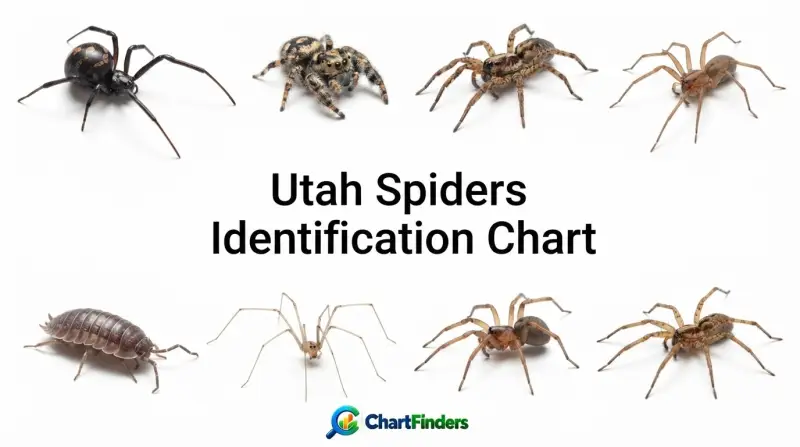
Utah Spiders Identification Chart
- Ocular arrangement (the number, size, and spatial distribution of eyes) is the primary taxonomic key used by entomologists to separate spider families in Utah.
- The western black widow (Latrodectus hesperus) is Utah’s only prevalent spider of true medical significance, identifiable by its globose shiny black abdomen and often a red hourglass silhouette.
- Jumping spiders (Salticidae) are easily recognized by their forward-facing, large principal eyes and exceptional leaping ability, serving as completely harmless biological pest controls.
- Cellar spiders (Pholcus phalangioides) are frequently confused with recluses due to their long, delicate legs, but they possess a fused body segment appearance and lack any cytotoxic danger.
- True brown recluses (Loxosceles reclusa) are not native to Utah; reports of “brown recluse bites” are almost universally misdiagnosed infections, localized necrotic lesions from other arthropods, or encounters with harmless native look-alikes.
- Habitat selection—ranging from subterranean retreats and chaotic web structures to open-air active hunting—provides immediate behavioral clues for identification.
To establish a systematic approach to identification, the following matrix categorizes the primary arachnid groups found across Utah. This reference compares their morphological dimensions, web architecture or hunting strategies, ocular configurations, medical relevance, and preferred microhabitats.
| Common Name | Scientific Nomenclature | Size Range (Body) | Key Morphological Markers | Web / Hunting Strategy | Medical Significance | Preferred Habitat |
|---|---|---|---|---|---|---|
| Western Black Widow | Latrodectus hesperus | 8–15 mm (Females) | Shiny jet-black globose abdomen; ventral red hourglass; slender legs. | Irregular, three-dimensional scaffolding webs in dark crevices. | High (Latrodectism; neurotoxic venom affecting motor nerves). | Dark, undisturbed spaces: woodpiles, meter boxes, crawlspaces. |
| Bold Jumping Spider | Phidippus audax | 6–18 mm | Compact, hairy body; metallic green or blue chelicerae; white dorsal abdominal spots. | Active diurnal stalker; uses silk dragline; does not spin webs for catching prey. | None (Non-aggressive; mechanical bite only if severely squeezed). | Sunlit vertical surfaces, garden foliage, rock faces, exterior walls. |
| Cellar Spider | Pholcus phalangioides | 7–10 mm | Extremely long, fragile stilt-like legs; pale tan-to-gray translucent body. | Messy, irregular, non-sticky space webs in corners; vibrates rapidly when disturbed. | None (Harmless; mythical venom claims are entirely false). | Damp cellars, dark corners of rooms, garage ceilings, under sinks. |
| Hobo Spider | Eratigena agrestis | 11–14 mm | Mottled brown chevron pattern on abdomen; uniform light-brown legs without banding. | Funnel-shaped sheet web ending in a retreat tube near ground level. | Low/Disputed (Historically feared for necrosis, modern toxicology suggests mild localized tissue irritation). | Low-lying vegetation, rock gardens, woodpiles, occasionally basements. |
| Wolf Spider | Family Lycosidae | 10–35 mm | Robust, hairy, earth-toned body; distinctive eye arrangement featuring two enormous posterior-median eyes. | Active nocturnal ground runner; females carry egg sacs attached to spinnerets. | None (Venom is mild; defensive bite causes localized swelling, comparable to a bee sting). | Ground-dwelling; leaf litter, grassy fields, under stones, riverbanks. |
| Giant Crab Spider | Family Sparassidae | 15–25 mm | Flattened body profile; lateral-facing legs allowing crab-like sideways locomotion. | No web; nocturnal ambush hunter roaming vertical surfaces. | None (Timid; bite is rare and generally produces transient minor pain). | Beneath loose tree bark, rock crevices, and occasionally entering rural homes. |
Analyzing this table reveals that while Utah hosts a wide spectrum of physical forms, only one species—the western black widow—presents a genuine physiological hazard to humans. Understanding the precise anatomical markers of these groups prevents unnecessary eradication of beneficial predators.
Anatomical Breakdown: Reading the Exoskeleton
To accurately identify any specimen down to family or species level, an entomologist relies on clear external anatomical landmarks. Spiders belong to the class Arachnida, characterized by a fused cephalothorax (prosoma) and an unsegmented abdomen (opisthosoma) connected by a narrow pedicel. They possess four pairs of walking legs, pedipalps (sensory and reproductive appendages near the mouth), and chelicerae (pincer-like jaws terminating in fangs).
Ocular morphology is arguably the most critical diagnostic tool. Unlike insects with compound eyes, spiders possess simple eyes (ocelli), typically numbering eight arranged in two or three rows across the anterior portion of the cephalothorax. The size ratios, curvature, and relative spacing of these eyes are family-specific:
- Salticidae (Jumping Spiders): Feature a prominent frontal row with two massive median lenses that provide stereoscopic, color vision, flanked by smaller secondary eyes. This gives them a distinct facial profile resembling human intelligence or large nostrils.
- Lycosidae (Wolf Spiders): Distinguished by a trapezoidal eye arrangement where the bottom row features four small eyes, the middle row features two extraordinarily large eyes facing forward, and the top row features two eyes directed sideways or backward.
- Theridiidae (Cobweb Spiders): Including the genus Latrodectus, these spiders possess eight small, uniform eyes arranged in two parallel, slightly curved rows.
The Medically Significant Exception: The Western Black Widow (Latrodectus hesperus)
No discussion of Utah arachnology is complete without a thorough analysis of the western black widow. Latrodectus hesperus is widely distributed across the Great Basin and the Colorado Plateau. Females are easily distinguished by their glossy, jet-black, spherical opisthosoma and long, slender legs. While the classic red hourglass mark is present on the ventral (underside) surface of the abdomen in most mature females, color variations can include red spots, broken bands, or entirely melanistic forms lacking red markings altogether.
Male black widows are significantly smaller (roughly half the size of females), lighter in color, and adorned with harmless red and white lateral striping. They do not possess functional venom glands capable of threatening human health and are rarely seen as they spend their brief adult lives wandering in search of mates.
The venom of the female black widow is a potent neurotoxin containing alpha-latrotoxin. This compound triggers a massive, uncontrolled exocytosis of neurotransmitters across motor nerve terminals. Envenomation symptoms—collectively termed latrodectism—typically manifest within 30 to 120 minutes as intense local pain, spreading muscle cramps, rigid abdominal musculature, diaphoresis (excessive sweating), nausea, and hypertension. While rarely fatal to healthy adults due to modern medical interventions and antivenom protocols, a bite requires immediate professional medical evaluation, particularly for children, the elderly, or individuals with underlying cardiovascular conditions.
Harmless Common Residents: Jumping, Cellar, and Wolf Spiders
The vast majority of spiders encountered in Utah homes and wildlands are entirely harmless and act as critical biological controls against agricultural pests, nuisance flies, and mosquitoes.
Bold Jumping Spiders (Phidippus audax)
The bold jumping spider is an iconic resident of Utah’s urban and rural landscapes. Ranging from 6 to 18 millimeters in length, they are robustly built and covered in dense, velvety setae (hairs). Their coloration is predominantly black with striking white or orange geometric markings on the dorsal abdomen, complemented by iridescent, metallic green or blue-green chelicerae. As visual hunters, they do not spin webs to capture prey; instead, they stalk their targets and execute calculated leaps up to fifty times their body length using hydraulic blood pressure shifts. They are exceptionally docile and curious, making them popular subjects for amateur entomologists.
Long-Bodied Cellar Spiders (Pholcus phalangioides)
Often colloquially mislabeled as “daddy longlegs” (a title properly reserved for harvestmen, which are an entirely different order of arachnid, Opiliones), cellar spiders are ubiquitous in damp basements, crawlspaces, and corners. They possess translucent, pale-yellowish-brown bodies and legs that stretch several times their body length. When disturbed in their chaotic, non-sticky sheet webs, cellar spiders engage in a characteristic defensive maneuver: they vibrate their bodies at high frequencies within the web, rendering themselves optically blurred to confuse potential predators.
Wolf Spiders (Family Lycosidae)
Wolf spiders are robust, ground-dwelling hunters that do not spin webs. Sporting earthy tones of brown, gray, and black, they rely on speed and camouflage to run down invertebrate prey. A unique maternal behavior separates lycosids from almost all other spiders: after hatching, the hundreds of spiderlings climb onto the mother’s dorsal abdomen, where she carries them for weeks until they are ready for independent dispersal.
The Hobo Spider and The Brown Recluse Myth
Public perception in Utah regarding dangerous spiders is frequently clouded by persistent urban legends, chief among them the fear of the brown recluser (Loxosceles reclusa) and exaggerated claims regarding the hobo spider (Eratigena agrestis).
The Brown Recluse Reality: Authentic populations of the brown recluse do not exist in Utah. The native range of Loxosceles reclusa is restricted to the south-central and midwestern United States. Specimens found in Utah shipping containers or luggage are extremely rare, accidental imports that fail to establish breeding populations. Countless necrotic lesions, staph infections (such as MRSA), and localized insect bites are misdiagnosed annually as “brown recluse bites” by both patients and untrained medical personnel.
The Hobo Spider Debate: Introduced from Europe via the Pacific Northwest, the hobo spider is established in parts of northern Utah. Historically vilified as a dangerous species whose bite caused severe tissue necrosis (dermonecrotic arachnidism), contemporary toxicological research has heavily challenged these claims. Controlled studies indicate that hobo spider venom lacks the specific enzymatic machinery required to cause human tissue breakdown on the scale once reported. Bites typically result in mild, localized redness and transient pain comparable to that of a minor bee sting.
Spider Behavioral & Ecological Classification Matrix
To deepen your understanding of how these arachnids interact with their environments across Utah, the following classification matrix breaks down their hunting mechanics, primary prey targets, seasonal activity peaks, and typical lifespan.
| Spider Group | Hunting Guild / Niche | Primary Prey Targets | Seasonal Peak in Utah | Typical Lifespan |
|---|---|---|---|---|
| Western Black Widow | Sit-and-wait web builder | Beetles, grasshoppers, roaches, crickets | Late Summer to Autumn (August–October) | 1 to 3 Years (Females) |
| Bold Jumping Spider | Diurnal active stalker / visual hunter | Flies, moths, small beetles, other spiders | Late Spring to Early Fall (May–September) | 1 Year |
| Cellar Spider | Sessile web-spinner / opportunist | Other spiders (including widows), crawling insects | Year-round indoors; Summer outdoors | 2 Years |
| Hobo Spider | Funnel-web ground stalker | Ground beetles, crickets, earwigs | Late Summer to Autumn (August–November) | 1 to 2 Years |
| Wolf Spider | Nocturnal ground-running cursorial hunter | Crickets, grasshoppers, cutworms, roaches | Autumn (September–November indoor migrations) | 1 to 2 Years |
| Giant Crab Spider | Nocturnal ambush hunter (bark/rock specialist) | Moths, roaches, crickets, silverfish | Summer (June–August) | 1 to 3 Years |
Field Identification Checklist and Decision Framework
When you encounter an unfamiliar spider in your home or garden, follow this systematic decision-making framework to determine its identity and potential risk level without resorting to panic or indiscriminate killing.
- Assess the Web Structure:
- Is it an untidy, three-dimensional tangled mesh near the floor or dark corners? Candidate: Cobweb spider family (Theridiidae), check for black widow features.
- Is it a flat, horizontal sheet web with a funnel-shaped retreat at the back? Candidate: Agelenidae (Funnel-weaver / Hobo spider).
- Is there no web at all, and is the specimen actively running across the floor, wall, or vegetation? Candidate: Lycosidae (Wolf spider), Salticidae (Jumping spider), or Sparassidae (Crab spider).
- Examine Body Proportions and Coloration:
- Is the abdomen bulbous, shiny black, and suspended by thin legs? Inspect the underside for a red marking. If positive, handle with extreme caution—Western Black Widow.
- Is the body compact with large, forward-facing eyes and hairy legs, perhaps displaying metallic green mouthparts? Harmless Jumping Spider.
- Are the legs exceptionally long and thread-like relative to a small, pale body? Harmless Cellar Spider.
- Observe Behavior:
- Does the spider bounce or vibrate rapidly when approached? Cellar Spider.
- Does it track your finger or stop to look up at you with large eyes? Jumping Spider.
- Does it scurry rapidly into dark floor-level cracks when exposed to light? Wolf Spider or Funnel Weaver.
Frequently Asked Questions
Are there any deadly spiders native to Utah?
No spiders native to Utah are considered consistently “deadly” to healthy human adults, provided proper medical attention is sought. The western black widow possesses a potent neurotoxic venom that can cause severe systemic pain and medical distress, but fatalities are exceedingly rare thanks to modern supportive care and antivenom availability.
How can I tell the difference between a male black widow and a dangerous female?
Female western black widows are glossy black, globose, and measure up to 15 mm in body length with a ventral red hourglass. Male black widows are much smaller, elongated, and feature prominent tan-and-white lateral striping with minimal black coloration. Males do not possess functional venom delivery systems capable of harming humans and are entirely non-threatening.
Why do I keep finding wolf spiders inside my Utah home during autumn?
As outdoor temperatures drop in the fall, insects and wandering arthropods seek thermal refuge and shelter. Wolf spiders are active hunters that do not maintain permanent web retreats, making them prone to wandering across foundation gaps, sliding glass doors, and ground-level entry points into residential structures.
Is it true that the brown recluse lives in Utah?
No. Entomological surveys confirm that Loxosceles reclusa (the brown recluse) is not established in Utah. Most suspected recluse bites are actually skin infections (such as methicillin-resistant Staphylococcus aureus or MRSA), tick-borne illnesses, or reactions to other arthropod bites.
What is the best way to prevent spiders from entering living spaces?
Integrated Pest Management (IPM) is the most effective approach. Seal cracks around foundations, install fine-mesh window and door screens, repair damaged weatherstripping, clear dense vegetation and woodpiles away from exterior walls, and reduce indoor clutter where spiders can find harborage.
Conclusion
Navigating the rich biodiversity of Utah’s arachnid population requires moving past cultural stigma and embracing empirical observation. While the western black widow demands respect and cautious mitigation around high-traffic human zones, the vast majority of Utah spiders—from the agile jumping spider to the utilitarian wolf spider—serve as valuable, harmless guardians of ecological balance. By utilizing anatomical markers like ocular arrangements, web architectures, and morphological proportions, you can accurately identify these fascinating creatures and maintain a harmonious, informed coexistence within the unique ecosystems of the Beehive State.