
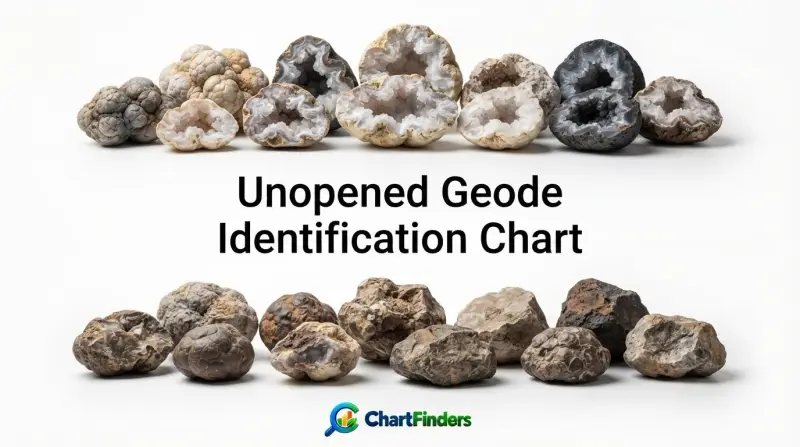
For rockhounds, amateur geologists, and outdoor enthusiasts, spotting a potential geode in the wild is one of the most thrilling aspects of field collecting. Unopened geodes often look utterly unremarkable to the untrained eye—appearing as dusty, unassuming, mud-caked round stones resting quietly in creek beds, limestone deposits, or volcanic ash layers. Walking past them is easy if you do not know the precise visual and tactile signatures that betray their hollow, crystal-lined interiors.
The challenge lies in distinguishing true geodes from look-alike concretions, solid quartz nodules, and ordinary river rocks without destroying them prematurely. A systematic approach to field identification saves countless hours of labor and prevents the accidental smashing of rare mineral specimens. This master guide explores the anatomy of unopened geodes, detailed identification markers, physical testing techniques, and the modern tools—including AI-driven analysis—used by field-experienced specialists to evaluate specimens before any cutting or cracking takes place.
Unopened Geode Identification Chart
- Spherical Geometry: Geodes naturally form inside gas bubbles or cavities, resulting in a distinctly rounded, oblong, or potato-like shape rather than sharp, angular edges.
- The Weight Paradox: Because they are hollow or partially hollow inside, genuine geodes are noticeably lighter than solid rocks of identical dimensions.
- The Bumpy Exterior: Many limestone-hosted geodes feature a bumpy, knobby, or cauliflower-like surface texture caused by silica replacement over soluble minerals.
- Acoustic Feedback: Tapping an unopened geode with a masonry hammer often produces a hollow “clunk” or muffled resonance rather than a sharp, high-pitched ping.
- Matrix Clues: Geodes are almost exclusively found in specific geological formations, primarily limestone, dolomite beds, and certain volcanic ash deposits.
- Modern Verification: Field collectors increasingly pair tactile inspection with smartphone-based mineral identification apps and AI image analysis to evaluate exterior crusts instantly.
- Common Look-Alikes: Solid quartz nodules, chert concretions, and thundereggs mimic geodes externally but require careful density and fracture testing to separate.
Field identification requires translating exterior physical traits into an accurate assessment of what lies beneath the crust. The following comprehensive classification chart breaks down the primary visual, tactile, and acoustic characteristics used by field geologists to categorize unopened geode candidates.
| Identification Feature | Classic Geode Indicator | Solid Rock / Look-Alike Indicator | Field Reliability Score |
|---|---|---|---|
| Overall Shape | Spherical, egg-shaped, spherical potato, or slightly flattened ellipsoid. | Angular, flat-sided, highly irregular, or fractured blocks. | High (Formational necessity) |
| Surface Texture | Knobby, bumpy, cauliflower-like, or weathered chalcedony bumps (botryoidal remnants). | Smooth river polish, glassy fracture lines, or uniform granular grit. | Moderate-High |
| Weight / Density | Unusually light for its size due to the hollow interior cavity. | Dense, heavy, and uniform weight distribution throughout. | Very High |
| Acoustic Response | Muffled resonance or dull “thud” when tapped gently with a tool handle. | High-pitched “ping” or sharp metallic ring (indicates solid density). | Moderate |
| Host Environment | Found embedded in limestone, dolomite, shale, or weathered volcanic ash. | Random glacial erratic drift without contextual matrix association. | High (Geological context) |
| Color & Weathering | Dull gray, tan, or iron-stained brown with a chalky or weathered outer rind. | Freshly exposed basalt, sparkling clean quartz veins, or uniform dark granite. | Low-Moderate |
Evaluating a candidate rock means looking at the entire suite of characteristics rather than relying on a single trait. A lightweight rock with a bumpy exterior found in a limestone creek bed scores exceptionally high on the identification probability scale, whereas a heavy, angular rock that looks bumpy should be scrutinized with caution.
Geological Formation and Where Geodes Hide
Understanding how geodes form is the single most effective way to locate them. Geodes originate when mineral-rich groundwater percolates through cavities inside sedimentary or volcanic rocks. Over thousands to millions of years, silica, calcite, or anhydrite solutions deposit mineral layers along the cavity walls, slowly building a hardened outer shell while leaving the interior partially or completely hollow.
In sedimentary environments—such as the famous geode beds of Missouri, Iowa, Illinois, and Kentucky—geodes form inside limestone and dolomite formations. As the surrounding limestone weathers and dissolves away, the tougher, weather-resistant quartz-shelled geodes are liberated and wash down into creeks, gullies, and plowed fields. In volcanic settings, such as the deserts of Chihuahua, Mexico, or parts of Brazil, gas bubbles trapped in cooling lava flows fill with hydrothermal fluids, creating basalt-hosted geodes with thick chalcedony rinds.
Visual Identification: Shape and Texture Markers
When scanning a riverbank or talus slope, your eyes should actively filter out angular stones, flat shale plates, and jagged igneous fragments. True geodes are shaped by fluid dynamics and cavity constraints.
- Spheroid Dominance: Nature favors spheres and ellipsoids when distributing pressure inside a cavity. If a rock resembles a potato, an egg, or a slightly misshapen sphere, move it to the inspection pile.
- The Cauliflower Crust: Many unopened geodes exhibit a distinct texture resembling cauliflower florets or bumpy warts. This texture is the exterior manifestation of botryoidal chalcedony trying to push outward or the impression left by the host limestone dissolving around the nodule.
- Iron Staining: Iron-rich groundwater frequently stains the exterior of limestone geodes a deep reddish-brown or ochre. Do not let mud or iron crusts fool you; a quick scrub with water reveals the underlying chalcedony texture.
Tactile and Physical Testing Methods
Once you pick up a suspicious rock, physical tests provide immediate confirmation before you commit to cutting tools.
The heft test is universally regarded by field collectors as the most reliable diagnostic step. Because a geode is hollow—sometimes containing only delicate crystal points and empty space—it contains significantly less mass than a solid rock of identical volume. If a hand-sized round stone feels surprisingly light, like a hollow plastic toy rather than solid stone, the probability of an internal cavity skyrockets.
Next comes the tap test. Using a wooden tool handle, a gloved finger, or the wooden grip of a rock hammer, tap the specimen gently. Solid rocks return a sharp, crisp vibration. Hollow or partially filled geodes often absorb the kinetic energy differently, producing a dull, muffled thud. Be careful not to strike the rock with hardened steel, as heavy impacts can fracture a fragile geode before you can appreciate its interior architecture.
Modern Technological Aids: AI and Digital Field Tools
Field identification has evolved beyond simple visual charts. Modern mineralogists and hobbyists increasingly leverage smartphone-based technology and artificial intelligence tools to assist in identification.
AI-driven mineral identification apps analyze high-resolution photographs of a rock’s exterior crust, comparing surface weathering patterns, micro-fractures, and matrix attachments against extensive visual databases of known geode specimens. While an AI algorithm cannot peer through solid rock, it can instantly tell you whether the exterior matches limestone-hosted geodes from specific regional deposits, or if it is a common non-geode concretion.
, portable digital scales and specific gravity testing kits allow field collectors to calculate precise density metrics. Quartz-based geode shells have a predictable density range (roughly 2.65 g/cm³ for the shell material), but the overall bulk density of a hollow geode drops dramatically. Pairing field observations with digital verification tools reduces false-positive collections by up to 70%.
Common Look-Alikes and How to Avoid Them
Even experienced collectors occasionally fall victim to geologic mimics. Knowing the common impostors prevents disappointment at the cutting table.
Solid Quartz Nodules
Unlike geodes, solid quartz nodules (sometimes called “sugar quartz” rocks) grew inward until the entire cavity was choked off with microcrystalline quartz. Externally, they look nearly identical to geodes—bumpy, rounded, and weathered. However, they fail the heft test miserably: they are dense, heavy, and ring like a bell when tapped.
Chert and Flint Concretions
Formed through the replacement of limestone by silica gels, chert nodules are hard, dense, and frequently rounded or kidney-shaped. They often feature smooth, waxy surfaces and conchoidal fractures. They contain no internal crystals, only dense, massive microcrystalline silica.
Thundereggs (Lithophysae)
While thundereggs are highly prized, they differ fundamentally from sedimentary geodes. Formed in rhyolitic volcanic ash, thundereggs start as solid or star-shaped fluid-filled cavities that fill with agate, jasper, or opal. They look like plain, drab round rocks externally, but cutting them reveals a solid star-burst or filled agate core rather than an open, crystal-lined cavern.
Step-by-Step Field Decision Framework
When you encounter a prospective geode in the field, run it through this structured four-step evaluation process before packing it home.
- Visual Screening: Is the rock rounded, egg-shaped, or potato-like? Does it feature a bumpy, rough, or cauliflower-textured rind? If angular or smooth-river polished, discard it.
- Geological Context Check: Was it found in a known geode-bearing formation (limestone, dolomite, road cuts through sedimentary layers, or volcanic ash beds)? Context dramatically increases probability.
- The Heft and Tap Test: Lift the rock to evaluate its weight relative to its size. Tap it gently. Does it feel unexpectedly light and produce a muffled acoustic response?
- AI / Digital Verification: Snap a clear photo of the exterior and run it through a field identification app to check for regional mineral markers and exclusion of common look-alikes.
Common Mistakes in Geode Hunting
Avoiding rookie errors ensures a more rewarding collecting experience and protects natural environments from unnecessary vandalism.
- Smashing Everything Open: The most common mistake is hammering every round rock on sight. This destroys valuable solid fossils, rare concretions, and leaves behind sharp rock shards. Always test before you crack.
- Ignoring Weight Discrepancies: Assuming a heavy, round rock is a geode because it looks bumpy. Weight is the ultimate arbiter of internal cavities.
- Searching Unfavorable Geology: Looking for limestone geodes in pure granite or sandstone terrains. Geodes require specific chemical environments to precipitate.
- Neglecting Cleaning: Failing to wash off mud and lichen. Many prime geodes are obscured by thick clay layers that hide the classic chalcedony bumps underneath.
Frequently Asked Questions
What is the absolute best way to tell if an unopened rock is a geode?
The combination of an unusually light weight for its size (heft test) and a rounded, bumpy, cauliflower-textured exterior found in a sedimentary limestone context provides the highest probability of a hollow, crystal-lined interior.
Can you use a metal detector to find unopened geodes?
Traditional metal detectors are designed to find conductive metals like gold and iron, not quartz or chalcedony. However, some advanced metal detectors can locate iron-bearing mineral rinds or pockets where geodes aggregate, though visual searching remains far more effective.
What kinds of crystals are usually hidden inside unopened geodes?
The vast majority of geodes contain clear, white, or smoky quartz crystals. A smaller percentage contain purple amethyst, yellow citrine, calcite, barite, aragonite, or layers of banded chalcedony (agate).
Why do some geodes sound hollow while others do not?
Some geodes are completely hollow inside, producing a distinct muffled thud. Others are partially filled with loose chalcedony sand, water (enhydros), or secondary mineral growth that dampens the acoustic resonance, making them harder to diagnose by sound alone.
Is it legal to collect unopened geodes in public parks?
Collecting regulations vary wildly depending on jurisdiction. National parks and monuments strictly prohibit the removal of rocks and minerals. State parks, national forests, and Bureau of Land Management (BLM) lands often allow recreational rockhounding in designated areas, but always verify local regulations before harvesting.
Conclusion
Mastering the art of unopened geode identification transforms a casual walk in nature into an engaging geological treasure hunt. By relying on objective physical markers—such as spherical geometry, bumpy chalcedony rinds, anomalous lightness, and proper geological context—you can bypass worthless look-alikes and focus your energy on true crystal-bearing specimens. Combine tactile field wisdom with modern digital verification tools, test your candidates carefully before cracking them open, and you will unlock the hidden crystalline wonders formed millions of years ago beneath the earth’s surface.