
The family Lycosidae represents one of the most successful, diverse, and ubiquitous lineages of terrestrial arachnids on Earth. Found across virtually every terrestrial biome—from high-alpine scree slopes and dense temperate deciduous forests to arid semi-deserts and suburban backyards—these vagile apex predators play an indispensable ecological role in regulating insect populations. However, their wandering habits, robust build, and substantial size frequently cause alarm among human observers who confuse them with medically significant species such as recluses or wandering spiders. Developing a systematic approach to morphological classification is essential not only for eliminating unnecessary panic but also for appreciating the extraordinary evolutionary adaptations that enable these arthropods to thrive without the aid of silken snares.
This master guide provides an exhaustive framework for examining, differentiating, and understanding lycosid morphology. By moving past superficial color variations—which fluctuate wildly even within a single clutch—and focusing on fixed anatomical structures, field researchers, pest management professionals, and curious naturalists can master the intricacies of lycosid taxonomy.
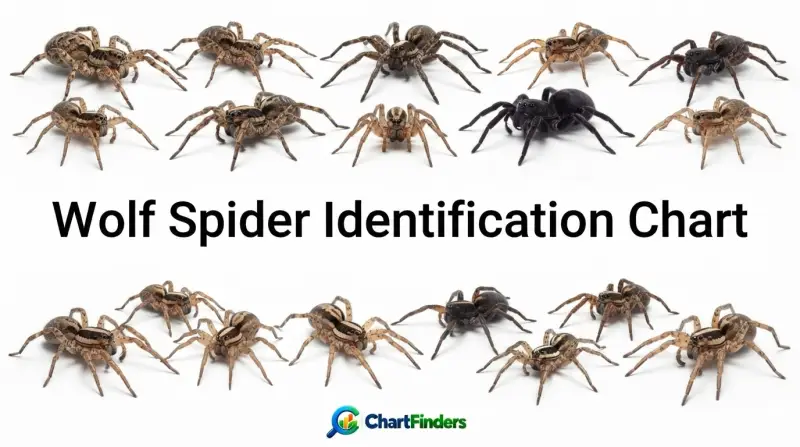
Wolf Spider Identification Chart
- Unique Ocular Arrangement: Lycosids are instantly distinguished by their three-row eye pattern (4-2-2), featuring four small anterior eyes and two massive posterior-median eyes staring directly forward.
- Absence of Web Architecture: Unlike orb-weavers or funnel-weavers, wolf spiders construct no aerial snares; they rely exclusively on active cursorial hunting and burrow systems.
- Maternal Investment: Female wolf spiders are unique in carrying their egg sacs attached to their spinnerets and subsequently transporting hundreds of emerging spiderlings on their dorsal opisthosoma.
- Morphological Variability: Coloration alone is an unreliable diagnostic tool due to extreme intraspecific polymorphism and environmental camouflage adaptations.
- Taxonomic confirmation of species often requires microscopic examination of the female epigynum or male pedipalpal bulb structures.
To accurately parse the vast diversity of the family Lycosidae, observers must rely on a standardized diagnostic matrix. The following comprehensive breakdown contrasts wolf spiders with common look-alike families, highlighting the structural divergences that separate true apex cursorial hunters from web-builders and ambush specialists.
| Morphological Trait | Family Lycosidae (Wolf Spiders) | Family Agelenidae (Grass Spiders) | Family Pisauridae (Fishing/Nursery Web) | Family Sparassidae (Huntsman Spiders) |
|---|---|---|---|---|
| Eye Arrangement | 3 rows (4-2-2); huge posterior-medians, small anterior row. | 2 curved rows; all eyes roughly equal in size. | 2 rows; anterior row slightly recurved, posterior procurved. | 2 rows of 4; eyes small, uniform, spread across a flattened face. |
| Leg Spination | Extremely heavy, prominent spines on tibiae and metatarsi. | Moderate spination; long, hairy legs adapted for running. | Long, slender legs with distinct spines; held out to the sides. | Crab-like lateral orientation; robust, forward-facing joints. |
| Hunting Strategy | Active nocturnal/diurnal cursorial stalking; no permanent web. | Constructs flat sheet webs with a funnel-shaped retreat. | Waits near vegetation edges or water; builds nursery webs. | Active wandering and ambush on vertical surfaces and bark. |
| Egg Sac Carriage | Attached securely to the spinnerets at the rear of the abdomen. | Deposited in protected retreats or under debris. | Carried in the chelicerae until transferred to a nursery web. | Guarded inside a flattened silk sac fixed under bark or stones. |
| Carapace Markings | Typically features distinct light median and lateral longitudinal bands. | Two dark, parallel longitudinal stripes running the length. | Varying patterns, often with a darker median V-shape or bands. | Usually uniform brown or grey, sometimes with complex facial masks. |
The comparative data above demonstrates that while many wandering spiders share superficial similarities in coloration or movement, their underlying anatomical blueprints—particularly the ocular arrangement and reproductive transport mechanisms—provide definitive boundaries for taxonomic separation.
Ocular Architecture: The Definitive Diagnostic Marker
The most reliable field-identification feature for any member of the Lycosidae family is the arrangement of their eight simple eyes (ocelli). Unlike most spiders that possess two compact rows of four eyes, wolf spiders exhibit a distinctive three-row schema denoted numerically as 4-2-2.
- The Anterior Row (4 Small Eyes): Positioned low on the clypeus, these four small eyes form a nearly straight or slightly curved horizontal line across the front of the face. They are generally uniform in size and point forward.
- The Median Row (2 Massive Eyes): Situated on the front face of the cephalothorax, these two eyes are disproportionately large, spherical, and directed forward. They provide the primary binocular vision necessary for stalking and calculating strike distances.
- The Posterior Row (2 Lateral Eyes): Located further back and wider apart on the dorsal surface of the cephalothorax, these final two eyes point upward and backward, giving the spider a nearly 360-degree field of awareness to detect overhead avian and mammalian predators.
This unique spatial distribution creates a high, boxy facial profile that immediately separates lycosids from jumping spiders (Salticidae), which possess one massive central pair flanked by three smaller pairs, and nursery web spiders (Pisauridae), whose eyes are more uniform in size and arranged in two distinct, gently curved arches.
Cephalothorax and Abdomen Morphology
The body of a wolf spider is divided into two primary tagmata: the prosoma (cephalothorax) and the opisthosoma (abdomen), connected by a narrow pedicel. Understanding the proportions and sclerotization of these segments is vital for accurate identification.
The prosoma is hard, convex, and densely covered in short setae. It is typically marked by a contrasting color palette consisting of a dark brown, black, or grey base overlaid with a prominent, pale yellowish or tan median stripe running down the center, flanked by matching lateral bands. A distinct radial furrow (fovea) sits medially on the carapace, serving as an internal muscle attachment point for the sucking stomach.
The opisthosoma is oval, slightly pointed posteriorly, and heavily textured with variable cardiac marks, chevron patterns, and spots. In gravid females, the abdomen swells significantly, sometimes obscuring underlying dorsal patterns. At the posterior terminus of the venter sit the spinnerets. In female lycosids, the spinnerets are stout, conical, and modified to securely grip the silk ring of their spherical egg sacs.
Leg Anatomy and Locomotion Adaptations
Wolf spiders do not build webs; consequently, their appendages are engineered entirely for hydraulic locomotion, tactile sensing, and prey subjugation. The legs are arranged in four pairs, with the fourth pair typically being the longest, providing the explosive propulsive power needed for high-speed dashes.
A careful anatomical examination of the legs reveals dense arrays of tactile hairs (setae) and mechanoreceptive slit sensilla that detect minute substrate vibrations. , the tibia and metatarsi of all four legs are armed with heavy, erect macrosetae (spines). These spines are not used for envenomation but rather act as physical barriers and gripping aids to prevent struggling insect prey from escaping the spider’s embrace during the initial strike.
At the terminal tip of each leg, tarsal claws (typically three in number) feature serrated teeth. Unlike web-weaving spiders that possess specialized calamistrum and cribellum structures for combing adhesive hackled band silk, lycosids rely on raw muscular force and sharp claws to master their quarry.
Taxonomic Subfamilies and Major Genera
The family Lycosidae is vast, encompassing over 120 genera worldwide. Within North America, Europe, and temperate Asia, several key genera dominate the landscape. Recognizing these genera requires examining subtle variations in leg length ratios, eye spacing, and burrowing behaviors.
The Genus Rabidosa
Represented by iconic species such as Rabidosa rabida (the rabid wolf spider—so named erroneously due to erratic running behavior, not venom toxicity) and Rabidosa punctulata, this genus contains some of the largest wandering spiders in North America.
- Morphological Markers: Elongated bodies, striking dark longitudinal stripes running down both the carapace and the dorsal abdomen, and long, heavily spined yellowish legs.
- Behavioral Context: Commonly found active at night in tall grass, fields, and forest floors. Females do not construct permanent burrows but instead roam freely, spinning temporary silken retreats under logs or rocks during daylight hours.
The Genus Hogna
Home to the largest wolf spiders in the world, including the infamous Hogna carolinensis (Carolina wolf spider) and Hogna lenta, this genus is defined by sheer bulk and robust proportions.
- Morphological Markers: Broad, heavy cephalothoraces, dark coloration ranging from charcoal grey to mottled brown, and distinctly darkened anterior legs. The ventral surface (sternum and coxae) is often pitch black.
- Behavioral Context: Obligate burrowers. Hogna species excavate deep, vertical cylindrical shafts in the soil, often rimmed with a neat collar of silk and debris. They sit near the entrance, ambushing passing arthropods.
The Genus Pardosa
Often referred to as thin-legged wolf spiders, the genus Pardosa contains dozens of smaller species that are exceptionally common in damp environments, agricultural fields, and along the margins of ponds and streams.
- Morphological Markers: Significantly smaller body size (often under 10 mm), markedly longer legs relative to body mass, and complex, mottled grey-and-brown camouflage patterns that mimic granite or leaf litter.
- Behavioral Context: Highly diurnal. Pardosa species can often be seen executing rapid, erratic zig-zag runs across open soil or even skating across the surface film of standing water when startled.
The Genus Alopecosa
Widespread throughout the Holarctic ecozone, Alopecosa species are robust, stocky spiders that favor open, sun-baked environments, dry grasslands, and rocky outcrops.
- Morphological Markers: Broad, robust bodies covered in dense, velvety pubescence. The median band on the carapace is typically narrower and sharply defined compared to Hogna.
- Behavioral Context: Often construct shallow, silk-lined depressions under heavy stones rather than deep vertical burrows.
Life Cycle, Reproductive Biology, and Diagnostic Implications
A complete understanding of wolf spider identification must account for ontogenetic development. Juvenile wolf spiders undergo multiple instars (molts) before reaching sexual maturity, and their coloration, relative eye proportions, and pattern clarity can shift dramatically between instars. Field identifiers must account for these developmental phases to avoid misclassifying juveniles as entirely separate species.
, female reproductive behavior introduces a striking visual marker unique to the family. When a female mates, she constructs a tough, spherical silken egg sac containing anywhere from 40 to over 300 eggs. She attaches this sac securely to her spinnerets using strong silk threads.
For weeks, the female drags this heavy white or greenish-grey sphere behind her, elevating her abdomen slightly to prevent it from dragging on the ground. Despite this encumbrance, she remains fully capable of hunting and defending herself. Once the eggs incubate and the spiderlings hatch, they immediately climb onto the female’s dorsal opisthosoma, carpeting her entire back in a writhing mass of dozens of tiny spiders. A female wolf spider carrying her young on her back is unmistakable and represents the single most definitive field-identification confirmation for the family Lycosidae.
Common Look-Alikes and Misidentification Pitfalls
Because arachnophobia is widespread, many harmless or medically insignificant spiders are incorrectly branded as dangerous “wolf spiders” or, conversely, actual wolf spiders are mistaken for threatening species. Resolving these identification errors requires careful anatomical scrutiny.
Wolf Spiders vs. Brown Recluse (Loxosceles reclusa)
This is the most critical medical distinction in North American arachnology. While wolf spiders are harmless vagrants, brown recluses possess necrotic venom requiring medical attention.
- Eye Count: Brown recluses possess exactly six eyes arranged in three dyads (pairs), whereas wolf spiders have eight eyes arranged in three rows.
- Carapace Patterns: Recluses feature a distinct, violin-shaped dark marking pointing toward the abdomen on a uniform brown cephalothorax. Wolf spiders lack this violin; their carapace is boldly striped.
- Body Texture and Hair: Wolf spiders are noticeably hairy, robust, and spiny. Recluses have smooth, delicate legs devoid of heavy spines and lack contrasting dorsal patterns on the abdomen.
Wolf Spiders vs. Grass Spiders (Family Agelenidae)
Grass spiders are extremely common lawn-dwellers that spin large, flat sheet webs terminating in a silken funnel retreat. They are frequently encountered running across carpets after wandering indoors during autumn.
- Spinneret Length: Grass spiders possess exceptionally long, prominent, two-segmented posterior spinnerets that project noticeably past the rear of the abdomen. Wolf spider spinnerets are short and compact.
- Facial Profile: Grass spiders have two curved rows of eyes of uniform size, entirely lacking the huge, forward-facing median eyes of lycosids.
Wolf Spiders vs. Fishing Spiders (Family Pisauridae)
Dolphins of the arachnid world, fishing spiders are massive, semi-aquatic hunters that closely mirror wolf spiders in size, coloration, and hunting prowess.
- Egg Transport: While female wolf spiders attach their egg sacs to their spinnerets, female pisaurids carry their spherical egg sacs in their chelicerae (mouthparts) until they construct a nursery web in vegetation.
- Eye Arrangement: Pisaurid eyes are arranged in two distinct, curved rows of four, lacking the distinct boxy, three-row layout of the Lycosidae.
Frequently Asked Questions
How can I tell if a spider in my house is a wolf spider or a brown recluse?
Examine the eyes and the carapace. Wolf spiders have eight eyes arranged in three distinct rows and a striped carapace. Brown recluses have six eyes arranged in three pairs (dyads) and a uniform brown carapace featuring a distinct dark violin shape. , wolf spiders are large, hairy, and robust, whereas recluses are delicate and smooth.
Do wolf spiders spin webs to catch prey?
No. Wolf spiders do not construct aerial webs or silken snares. They are active cursorial hunters that rely on their exceptional eyesight, speed, and heavy leg spination to stalk, chase, and overpower insects on the ground.
Why do wolf spiders carry their babies on their backs?
Female wolf spiders exhibit advanced maternal care. After carrying their spherical silk egg sac attached to their spinnerets until the young hatch, the tiny spiderlings climb onto the mother’s dorsal abdomen. She transports them for up to several weeks until they undergo their first independent molt and disperse into the environment.
Are wolf spider bites dangerous to humans or pets?
Wolf spider venom is not medically significant to humans. A bite may cause localized pain, redness, swelling, and mild itching similar to a bee or wasp sting, but systemic toxicity is absent. They are docile creatures that only bite defensively when trapped against the skin.
What environmental conditions attract wolf spiders indoors?
Wolf spiders typically wander indoors accidentally during autumn when dropping temperatures and decreasing prey availability drive them to seek shelter. They are ground-dwellers and are most frequently discovered in basements, ground-level entryways, garage corners, and near sliding glass doors where gaps allow entry.
Conclusion
Mastering wolf spider identification requires shifting away from unreliable visual cues like shade and spot patterns, focusing instead on robust anatomical anchors. By analyzing ocular geometry (the 4-2-2 eye arrangement), leg spination, spinneret configuration, and behavioral traits such as egg-sac carriage, observers can easily separate the family Lycosidae from both harmless look-alikes and medically significant species. Recognizing these resilient, beneficial predators ensures both accurate scientific classification and a deeper appreciation for the complex biodiversity functioning quietly right beneath our feet.