
Quick Answer: Praying mantis species identification relies primarily on structural morphology, ootheca (egg case) geometry, and diagnostic anatomical markings. Globally, over 2,400 species exist within the order Mantodea, with approximately 22 species established in North America. Identification of common regional variants—such as the native Carolina mantis (Stagmomantis carolina), the introduced Chinese mantis (Tenodera sinensis), and the European mantis (Mantis religiosa)—is achieved by examining pronotum proportions, foreleg coxal spines, wing transparency, and the physical architecture of their hardened oothecae.
The order Mantodea represents one of the most visually distinct lineages within class Insecta. These hemimetabolous predators command immediate recognition through their highly specialized adaptations: a hyper-mobile triangular cranium supported by a flexible cervical region, compound ommatidia positioned laterally for panoramic stereoscopic vision, and hypertrophied raptorial forelegs engineered for ambushing and securing volatile invertebrate prey. Yet, despite widespread familiarity among naturalists, agriculturalists, and entomology enthusiasts, differentiating between regional specimens frequently presents a taxonomic challenge.
Misidentifying mantis species carries significant ecological implications. While native populations fulfill localized predatory roles within natural food webs, invasive or non-native species—most notably large Asian imports—can exert intense competitive pressure on indigenous fauna, sometimes predating upon small vertebrates or native pollinators indiscriminately. This comprehensive reference guide provides a definitive framework for examining and categorizing mantodean specimens. By exploring detailed morphological breakdowns, developmental egg case structures, and comparative diagnostic criteria, field researchers and hobbyists can accurately navigate the taxonomy of these fascinating apex ambush predators.
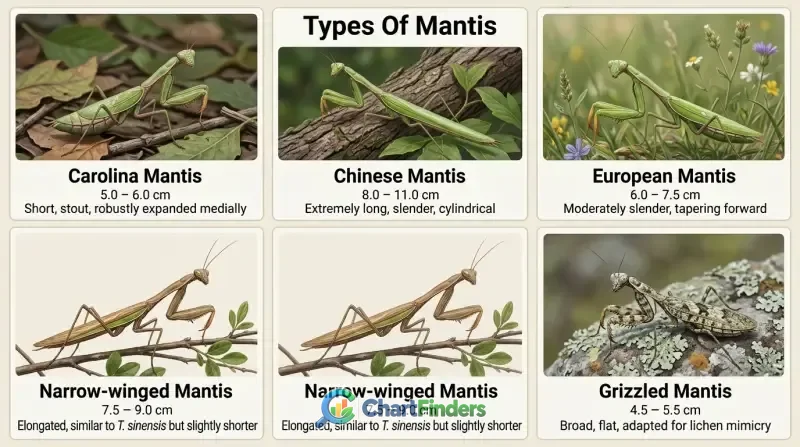
Praying Mantis Species Identification Chart
- Mantodea encompasses over 2,400 global species, categorized by elongated bodies, specialized raptorial appendages, and highly mobile triangular heads.
- North America hosts around 22 distinct species, balancing native populations with well-established non-native introductions.
- Oothecae (egg cases) provide the most reliable field identification markers during dormant winter months when adult specimens are absent.
- Key anatomical diagnostic features include the length-to-width ratio of the pronotum, coloration patterns on the inner forecoxae, and wing venation.
- Differentiating between native species like Stagmomantis carolina and invasive giants like Tenodera sinensis is critical for monitoring regional ecological health.
To accurately identify an individual specimen, entomologists rely on a systematic examination of external anatomy. The morphological traits below serve as the foundation for the comparative identification chart that follows. Understanding these anatomical structures ensures reliable classification regardless of color phase variations within a single species.
Core Anatomical Markers Used in Mantid Taxonomy
- Pronotum Proportions: The dorsal plate of the first thoracic segment. Short, broad pronotums typically indicate native ambush strategists, whereas exceptionally elongated pronotums characterize wandering stalkers.
- Raptorial Forelegs: The first pair of thoracic appendages, modified into lethal grasping tools. Taxonomists count and measure the arrangement of femoral and tibial spines, as well as distinct brightly colored spots on the inner coxa.
- Alary Development (Wings): The presence, length, and transparency of forewings (tegmina) and hindwings. Sexual dimorphism often dictates whether females are brachypterous (short-winged) or fully winged.
- Ootheca Architecture: The foamy proteinaceous matrix secreted by females during oviposition. Hardened structural walls, aeration chambers, and exit route geometry are species-specific signatures.
| Common Name | Scientific Nomenclature | Adult Size Range | Primary Pronotum Shape | Diagnostic Foreleg Markings | Ootheca Structure & Appearance |
|---|---|---|---|---|---|
| Carolina Mantis | Stagmomantis carolina | 5.0 – 6.0 cm | Short, stout, robustly expanded medially | Inner coxa lacks vivid contrasting warning coloration; uniform tone | Elongated, paper-textured, grayish-tan, tightly bound along twigs |
| Chinese Mantis | Tenodera sinensis | 8.0 – 11.0 cm | Extremely long, slender, cylindrical | Bright yellow spot between the inner forecoxal spines | Large, rounded, spherical to globose, frothy tan foam mass |
| European Mantis | Mantis religiosa | 6.0 – 7.5 cm | Moderately slender, tapering forward | Dark, bullseye-like black mark surrounded by a white ring on inner coxa | Elongated, parallel-sided, hard crustaceous shell with central exit stripe |
| Narrow-winged Mantis | Tenodera angustipennis | 7.5 – 9.0 cm | Elongated, similar to T. sinensis but slightly shorter | Orange-yellow spot on inner coxa (less vivid than Chinese variant) | Similar to Chinese mantis ootheca, but narrower and more streamlined |
| Grizzled Mantis | Gonatista grisea | 4.5 – 5.5 cm | Broad, flat, adapted for lichen mimicry | Camouflaged with mottled grey and white bands; bark-matching | Flat, papery patch glued tightly against tree bark surfaces |
Note on Table Interpretation: Size ranges reflect total body length from the labrum (front of the head) to the tip of the abdomen or folded wings. Color phases (green versus brown) frequently occur within the same species depending on ambient humidity, temperature, and background foliage during nymphal molting stages, making coloration an unreliable primary metric.
Detailed Species Breakdown and Morphological Analysis
To deepen the identification process, individual species require rigorous evaluation of their life history, geographic distribution, and structural nuances. Below is a comprehensive breakdown of the most prevalent mantodean species encountered across North America and temperate regions globally.
Native Strains: The Carolina Mantis (Stagmomantis carolina)
As one of the most widely distributed native species in North America, Stagmomantis carolina is naturally adapted to forest edges, scrublands, and open meadows. Measuring between 5 and 6 centimeters in length, it is considerably smaller and stockier than invasive Asian counterparts.
The head is broad with prominent compound eyes, leading into a noticeably compressed pronotum. Females exhibit pronounced sexual dimorphism: their wings are short and brachypterous, leaving the terminal abdominal segments exposed. Males, conversely, possess fully functional wings that extend past the abdomen, granting them strong flight capabilities. Coloration varies dramatically between a vibrant chlorophyll green and a dry-grass tan or mottled grey. Because of its native status, preserving S. carolina populations supports local insect balance without threatening fragile indigenous pollinator networks.
Introduced Giants: The Chinese Mantis (Tenodera sinensis)
Originally imported from Asia in the late 19th century as a biological control agent for agricultural pests, Tenodera sinensis has successfully naturalized across much of North America. Growing up to 11 centimeters long, it ranks as the largest mantis species found on the continent.
The species is readily identified by its massive, slender body proportions and elongated pronotum. A definitive diagnostic clue is located on the inner base of the raptorial forecoxa: a distinct bright yellow spot directly between the basal spines. The wings are expansive, showing a distinct green or brown margin. Their oothecae are massive, paper-mache-like globes that harden on woody stems through the winter. Due to their formidable size, Chinese mantises are capable of capturing vertebrate prey, including small hummingbirds, reptiles, and amphibians.
The Cosmopolitan European Mantis (Mantis religiosa)
Mantis religiosa holds the distinction of being the state insect of Connecticut and represents another intentionally and accidentally introduced Eurasian species. Medium-large in stature (6 to 7.5 cm), it strikes a balance between native species and the massive Chinese mantis.
The structural hallmark of M. religiosa lies in its forecoxal cavity: lifting the raptorial leg reveals a striking black spot, frequently ringed with brilliant white, forming a pseudo-ocellus (eyespot) that serves as a defensive startle display against avian predators. The pronotum is moderately elongated and smooth. Their oothecae are distinctively symmetrical, featuring a neat central line of emergence pores running down the hardened foamy crust.
Ootheca Identification: Winter Morphology
During autumn senescence, adult mantises perish following oviposition, leaving behind overwintering egg cases known as oothecae. For field researchers, horticulturalists, and pest management professionals, identifying species by their ootheca structure is essential for habitat management.
| Species Ootheca | Primary Deposition Site | Geometric Shape | Texture & Consistency | Overwintering Hardiness |
|---|---|---|---|---|
| Carolina Mantis | Thin twigs, grass stems, low herbaceous plants | Elongated, narrow, flattened profile | Papery, delicate, layered protective plates | Moderate; susceptible to extreme freezing if exposed |
| Chinese Mantis | Thick woody stems, shrubs, fencing | Spherical, globose, ball-like mass | Durable, thick, styrofoam-like hardened foam | Extremely high; tolerates harsh northern winters |
| European Mantis | Stems of weeds, wooden stakes, flat surfaces | Oblong, parallel-sided, crustaceous loaf | Hard, brittle, paper-mache exterior with central ridge | High; robust against moisture and freezing temperatures |
Examining these structures during dormancy prevents accidental destruction of beneficial native oothecae while allowing property owners to monitor or manage invasive egg masses.
Common Identification Pitfalls and Taxonomic Exceptions
Even experienced entomologists encounter diagnostic challenges when evaluating mantids. Misidentifications typically stem from three major biological variables:
- Polychromatism (Color Phases): Assuming a green specimen is a different species from a brown specimen is a common error. Both Mantis religiosa and Stagmomantis carolina exhibit distinct green and brown morphs driven by environmental triggers during nymphal development.
- Hybridization and Overlap: In regions where Tenodera sinensis and Tenodera angustipennis overlap, intermediate body sizes and transitional coxal spot coloration can obscure definitive categorization, requiring microscopic examination of male genitalia for absolute confirmation.
- Damaged Appendages: Predatory skirmishes frequently result in lost raptorial spines or truncated wings, removing key diagnostic features necessary for rapid visual identification.
Frequently Asked Questions
Look primarily at size, pronotum proportions, and inner foreleg markings. Native species like the Carolina mantis are smaller (under 6 cm) with stocky pronotums and lack bright warning colors on their inner forecoxae. Invasive giants like the Chinese mantis exceed 8 cm, possess exceptionally long pronotums, and display vivid yellow spots inside the front leg base.
No. Coloration is an unreliable taxonomic metric because most mantis species undergo phenotypic color switching. Nymphs and adults can shift between bright green, tan, straw-yellow, and dark brown depending on ambient humidity, lighting, and background foliage during their final instar molts.
Females deposit eggs on woody stems, twigs, and man-made structures in late summer to autumn, enveloping them in a frothy protein secretion that hardens into an ootheca. Native Carolina mantis oothecae are sleek, narrow, and papery, whereas Chinese mantis egg cases form large, rounded, spherical globes.
Not all females are fully winged. Sexual dimorphism is common in the order Mantodea. For instance, female Carolina mantises are brachypterous, meaning their wings are severely shortened and fail to cover the terminal abdominal segments, whereas males possess fully developed, functional wings.
The colored markings or eyespots located on the inner coxa of the raptorial forelegs serve as a deimatic (startle) display. When threatened by vertebrate predators like birds or small mammals, the mantis rears back, flashes its forelegs wide, and exposes these contrasting marks to simulate a larger, dangerous animal or toxic face.
Conclusion
Mastering praying mantis species identification requires looking past superficial color variations and focusing on permanent morphological structures. By evaluating pronotum proportions, raptorial foreleg adaptations, wing development, and ootheca architecture, observers can accurately classify specimens ranging from delicate native ambush hunters to large invasive predators. Maintaining taxonomic accuracy ensures a clearer understanding of local biodiversity dynamics and supports informed conservation and garden management practices.