
Few pests evoke as much immediate anxiety as spiders. When an unexplained red mark or blister appears on the skin, panic often sets in, leading many homeowners to assume the worst. However, as any licensed pest control professional or medical clinician will verify, the vast majority of skin lesions blamed on spiders are actually caused by other arthropods, bacterial infections, or contact dermatitis. Accurately identifying a spider bite requires moving past generalized fear and examining specific clinical clues, environmental contexts, and physical symptoms.
Understanding what bit you—or determining whether a spider was involved at all—is critical for ensuring proper treatment, preventing unnecessary medical interventions, and applying targeted pest management strategies to keep your home secure. This comprehensive guide provides an authoritative breakdown of spider bite identification, distinguishing harmless encounters from medical emergencies, and offering practical field strategies for managing and preventing encounters with venomous arachnids.
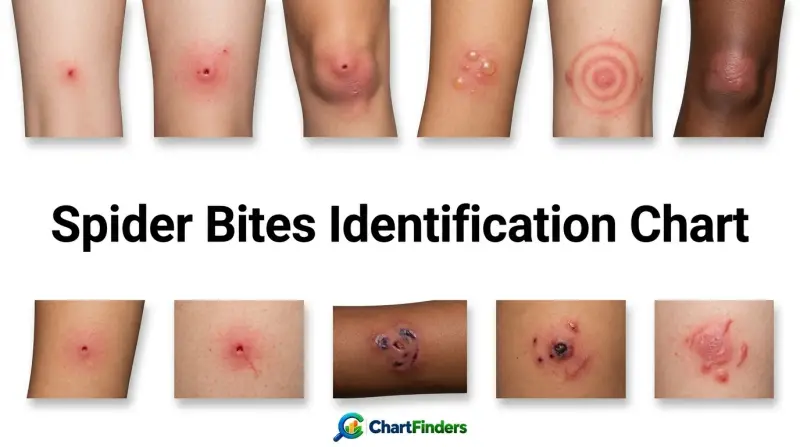
Spider Bites Identification Chart
- Most common house spiders lack mouthparts capable of piercing human skin or inject negligible venom, resulting in minor, short-lived irritation.
- Brown recluse bites typically present with a “bullseye” pattern, central blistering, and localized tissue necrosis that evolves over several days.
- Black widow bites often display two faint puncture marks accompanied by severe, cramping muscle pain spreading from the abdomen to the chest and back.
- Staph infections (such as MRSA) and other bacterial skin conditions are frequently misidentified as brown recluse or necrotic spider bites.
- Professional pest control, combined with habitat reduction and decluttering, is the most effective defense against dangerous indoor spider populations.
When evaluating a skin lesion, a structured visual and symptomatic comparison is the fastest way to differentiate between common harmless encounters and dangerous medical events. The following reference chart details the core physical traits, symptom progression, and general risk levels associated with common household spiders and look-alike conditions.
| Pest / Condition | Initial Appearance | Progression & Symptoms | Common Habitat | Medical Risk Level |
|---|---|---|---|---|
| Common House Spider (e.g., Wolf, Cellar, Grass) | Single red welt or minor bump; mild itching or tenderness. | Fades within 24 to 48 hours without spreading or blistering. | Corners, basements, windowsills, dark undisturbed areas. | Low (Harmless) |
| Brown Recluse (Loxosceles reclusa) | Mild stinging sensation; may form a localized red ring or pale center. | Develops into a deep, painful ulcer with a dark center and blue/purple outer ring (bullseye) over 3–7 days. | Undisturbed boxes, closets, woodpiles, attics, shoes. | High (Necrotic risk; seek medical care) |
| Black Widow (Latrodectus mactans) | Faint pinprick marks; initial sharp pain or mild local swelling. | Intense muscle cramps, rigid abdominal wall, sweating, nausea, and systemic pain within hours. | Dark, sheltered outdoor spots, garage corners, woodpiles. | High (Systemic neurotoxin; emergency care) |
| Hobo Spider (Eratigena agrestis) | Red, hard swelling that may ooze fluid within 24 hours. | Can lead to localized tissue death (dermonecrosis) and severe headaches, though clinical consensus varies. | Low-slung webs in tall grass, woodpiles, foundational cracks. | Moderate to High (Caution advised) |
| Staph Infection / MRSA (Bacterial Look-alike) | Red, warm, swollen bump resembling a pimple or bug bite. | Rapid enlargement, pus formation, central core, persistent fever, and worsening pain. | Skin-to-skin contact, cuts, community environments. | High (Requires antibiotics; bacterial, not arachnid) |
Reading this table correctly requires understanding that physical symptoms can overlap significantly during the first 24 hours. A spider bite is rarely identifiable by sight alone in its earliest stages; tracking the progression of symptoms over time is essential for accurate identification.
Understanding Spider Venoms: Necrotic vs. Neurotoxic
Spider venoms are complex chemical cocktails primarily evolved to immobilize or digest insect prey. When humans are accidentally bitten, these venoms interact with human tissue and nervous systems in two primary ways: through necrotic agents or neurotoxic agents.
Necrotic venoms, characteristic of the recluse spider family (Loxosceles), contain enzymes like sphingomyelinase D. These enzymes destroy cell membranes, trigger severe localized inflammation, and cause blood vessels in the affected area to clot, cutting off oxygen and leading to localized tissue death (necrosis). This process is slow, often taking several days to manifest fully.
Neurotoxic venoms, deployed by widows (Latrodectus) and funnel-web spiders, target the nervous system. Latrotoxin forces the massive, uncontrolled release of neurotransmitters across nerve terminals. This floods the neuromuscular junctions, resulting in severe, painful muscle spasms, autonomic nervous system overstimulation (sweating, salivation), and systemic distress rather than localized tissue destruction.
Detailed Identification of Dangerous Spider Species
To prevent misdiagnosis, you must understand the physical characteristics and behavioral habits of the primary venomous spiders found in North America. While thousands of spider species exist, only a small handful pose genuine medical concerns.
The Brown Recluse (Loxosceles reclusa)
The brown recluse is notorious for its necrotic venom, yet it is frequently misidentified. Homeowners across the country blame mysterious skin lesions on the brown recluse even in regions where the species does not naturally exist.
- Geographic Range: Primarily found in the Midwestern and South-Central United States, stretching south to the Gulf Coast and west to Texas. Sightings outside this core range are exceedingly rare and usually involve introduced specimens via shipping containers or luggage.
- Physical Markers: Light brown to dark brown body, measuring about 1/4 to 3/4 of an inch in length. The definitive identification mark is a dark, violin-shaped pattern on the dorsal cephalothorax (the head-and-chest section), with the neck of the violin pointing backward toward the abdomen.
- Ocular Arrangement: Unlike most spiders that possess eight eyes arranged in pairs, recluses have six eyes arranged in distinct pairs (dyads) in a semicircle. This anatomical detail requires a magnifying glass or microscope to verify.
- Behavioral Habits: As their name implies, these spiders are reclusive. They hide in dark, dry, undisturbed places such as cardboard boxes, woodpiles, unused closets, behind furniture, and inside shoes left on the floor. They only bite when trapped against human skin.
The Black Widow (Latrodectus mactans and related species)
Black widows are easily recognized by their striking coloration, though their venom requires prompt medical evaluation if an envenomation occurs.
- Geographic Range: Distributed widely across temperate and tropical regions worldwide, including the southern, western, and eastern United States.
- Physical Markers: Adult females are glossy, jet-black, and stout-bodied, measuring roughly 1.5 inches across including the legs. The hallmark visual identifier is a bright red or orange hourglass-shaped marking on the underside of the abdomen. (Some species feature red spots or dorsal stripes). Males are much smaller, lighter in color, and harmless to humans.
- Web Architecture: Black widows construct irregular, sticky, three-dimensional cobwebs in low, dark, sheltered locations rather than neat, symmetrical orb webs.
- Behavioral Habits: They prefer outdoor shelters like woodpiles, hollow stumps, stone walls, meter boxes, and cluttered corners of garages or sheds. They are non-aggressive and bite defensively when disturbed or pressed against.
The Hobo Spider (Eratigena agrestis)
The hobo spider is an aggressive funnel-weaver introduced from Europe to the Pacific Northwest region of North America.
- Geographic Range: Primarily established in the Pacific Northwest, extending into Western Canada and parts of the Intermountain West.
- Physical Markers: Brown with complex herringbone or chevron patterns on the abdomen. They lack distinct rings on their legs, which helps distinguish them from harmless wolf spiders or grass spiders.
- Behavioral Habits: They build funnel-shaped retreats in tall grass, under rocks, and in foundational cracks. They are more defensive than house spiders and will bite if cornered or if their egg sacs are threatened.
Common Spider Look-Alikes and Misidentifications
One of the most frequent errors in pest control and home medicine is misattributing common skin conditions to spider bites. When a patient presents with a painful, red, swollen lesion, medical professionals and laypeople alike frequently jump to conclusions.
Methicillin-Resistant Staphylococcus aureus (MRSA) and Staph Infections
By far the most common “brown recluse bite” is actually a staphylococcal skin infection or community-associated MRSA. These bacterial infections begin as a small red bump that resembles an insect bite or a pimple. As the infection progresses over 24 to 48 hours, it becomes increasingly painful, warm, swollen, and develops a purulent center (pus). Because MRSA causes localized tissue breakdown and ulceration, it mimics the exact visual progression of a necrotic spider bite, leading to widespread misdiagnosis.
Tick Bites and Vector-Borne Rash Patterns
Ticks attach to the skin to feed, leaving behind a localized inflammatory response. Certain tick bites, such as those from the blacklegged tick (deer tick), can produce a classic “bullseye” rash (erythema migrans) associated with Lyme disease. Individuals unfamiliar with tick bites frequently mistake this expanding circular rash for the concentric rings of a brown recluse bite.
Other Arthropod Bites
Fleas, bed bugs, mosquitoes, and biting midges often bite multiple times in clusters or linear patterns. When these bites become irritated or infected from scratching, they can swell significantly and develop central fluid-filled blisters that confuse homeowners searching for a culprit.
Comparative Analysis: Venom Types, Onset Times, and Clinical Management
To further assist in clinical differentiation and emergency response, the following table compares the toxicological mechanisms, symptom onset timelines, and primary medical interventions for the major categories of medically significant bites and look-alikes.
| Bite / Condition Type | Primary Toxin / Agent | Onset Timeline | Key Clinical Indicators | Primary Medical Treatment |
|---|---|---|---|---|
| Brown Recluse | Sphingomyelinase D (Necrotic enzyme) | 2 to 8 hours (pain); 24 to 72 hours (necrosis) | Delayed pain, sinking blue-gray center, blistering, slow-healing ulcer. | Wound care, pain management, tetanus booster; surgical debridement rarely needed. |
| Black Widow | Alpha-latrotoxin (Neurotoxin) | 30 minutes to 2 hours | Severe muscle spasms, board-like rigidity of abdomen, diaphoresis (sweating). | Muscle relaxants, pain medications, calcium gluconate (historical), antivenom for severe cases. |
| Hobo Spider | Unclear / Complex cytolytic venom | 24 to 48 hours | Hard red swelling, fluid-filled blister, potential localized tissue sloughing. | Supportive wound care, monitoring for secondary bacterial infection. |
| Staph / MRSA | Bacterial toxins & enzymes | 24 to 48 hours (rapid growth) | Pustule formation, central core, surrounding erythema, fever, warmth. | Targeted systemic antibiotics (e.g., clindamycin, trimethoprim-sulfamethoxazole), incision and drainage. |
Step-by-Step Assessment: What to Do If You Suspect a Spider Bite
If you discover a suspicious lesion on your skin, follow a calm, methodical evaluation and response protocol. Do not panic, but do not ignore potential symptoms.
- Wash and Sanitize: Immediately clean the bite area with mild soap and warm water to eliminate surface bacteria and reduce the risk of secondary infection.
- Apply Cold Therapy: Apply an ice pack wrapped in a clean cloth to the bite site for 10 to 15 minutes at a time to reduce localized swelling, inflammation, and pain.
- Elevate and Rest: If the bite is located on an arm or leg, elevate the limb to minimize swelling.
- Monitor and Document: Take a clear, well-lit photograph of the lesion with a ruler or coin nearby for scale. Note the exact time the bite was discovered and monitor changes in size, color, and pain levels every few hours.
- Assess for Red-Flag Symptoms: Watch closely for systemic indicators, including severe muscle cramps, abdominal rigidity, fever, chills, spreading red streaks, or rapid tissue ulceration.
Common Mistakes in Spider Bite Treatment and Identification
When dealing with suspected spider bites, well-intentioned individuals frequently make critical errors that exacerbate the injury or delay proper medical care. Avoiding these pitfalls ensures a safer, more effective recovery.
- Attempting Folk Remedies: Applying heat packs, tobacco poultices, raw meat, or attempting to cut, lance, or suck venom out of the wound with a razor or suction device increases the risk of severe secondary bacterial infection and tissue damage.
- Self-Diagnosing Necrosis: Assuming every skin ulcer or slow-healing sore is a brown recluse bite without capturing the spider or obtaining a professional clinical diagnosis. True recluse bites require professional medical management, not home remedies.
- Ignoring Bacterial Infections: Treating a rapidly spreading staph infection or MRSA as a simple spider bite and delaying antibiotics can lead to systemic blood infections (sepsis).
- Spraying Random Pesticides Indoors: Panicking and flooding baseboards with heavy aerosol bug sprays often fails to eliminate spiders while exposing household members and pets to unnecessary chemical residues. Targeted IPM (Integrated Pest Management) is required.
Frequently Asked Questions
How can I tell if a bite is from a spider or another bug?
Most insect bites (mosquitoes, fleas) cause immediate itching and multiple welts that fade within a day. Spider bites typically involve a single puncture site (sometimes two for spiders like widows) accompanied by localized pain. However, definitive identification without seeing the spider is clinically unreliable, as skin reactions vary widely based on individual immune responses.
Do all spiders possess venom capable of harming humans?
No. While almost all spider species produce venom to subdue insect prey, the vast majority of spiders possess fangs too short or weak to puncture human skin. , their venom chemistry has no toxic effect on human physiology. Only a handful of species globally present medical significance.
What does a brown recluse bite look like in the first 24 hours?
In the first 24 hours, a brown recluse bite may look relatively innocuous—often presenting as a mild red welt, slight swelling, or a tender spot that may go completely unnoticed. Over the next 2 to 7 days, the center often becomes pale or bluish, surrounded by a distinct red ring, eventually forming a sunken ulcer as tissue breakdown occurs.
Are cellar spiders (daddy longlegs) dangerous?
No. A persistent urban legend claims that cellar spiders possess the most potent venom of any arachnid but lack mouthparts capable of piercing human skin. Modern arachnology has disproven this entirely: cellar spiders do possess fangs capable of biting humans, but their venom is exceptionally weak against mammals, producing at most a mild, fleeting burning sensation.
How can I prevent spiders from nesting in my home?
Effective spider prevention relies on habitat reduction and exclusion. Declutter basements, attics, and closets; seal cracks around windows, doors, and foundations with caulk; shake out shoes and work gloves left on the floor; and vacuum regularly along baseboards and dark corners to remove webs and egg sacs.
Conclusion
Spider bite identification requires a balanced approach rooted in factual observation rather than panic. While venomous species like the brown recluse and black widow demand serious caution and immediate medical attention, the vast majority of bites and skin lesions attributed to spiders are harmless or stem from entirely different medical causes, such as bacterial infections. By learning to recognize genuine physical markers, tracking symptom progression over time, and maintaining a clean, well-sealed living environment, you can protect your household and address potential pest encounters safely and effectively.