
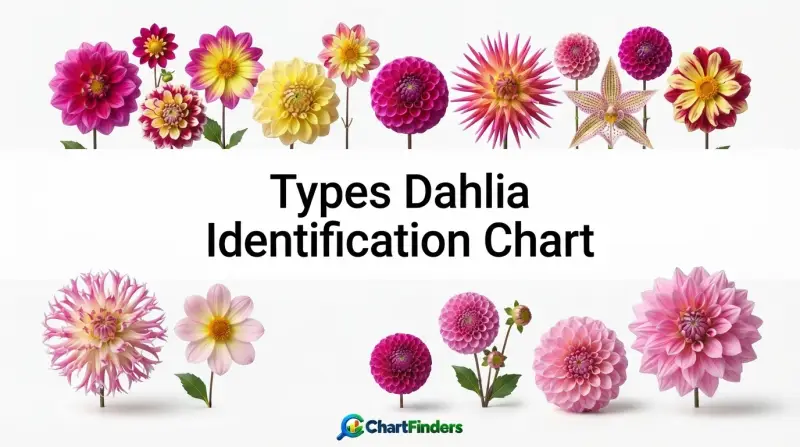
Few plants in the modern ornamental garden command the structural diversity, chromatic brilliance, and sculptural presence of the dahlia. Ranging from tiny, perfectly spherical pompons measuring less than two inches across to massive, dinnerplate-sized blooms stretching past twelve inches, dahlias present an intoxicating identification puzzle for botanists, master gardeners, and floral designers alike. Because centuries of intense hybridizing have produced tens of thousands of registered cultivars, visual identification requires a systematic framework rather than mere guesswork.
Understanding how to use a dahlia identification chart transforms a confusing sea of petals into an orderly taxonomy. Whether you are cataloging tubers rescued from an unlabelled garden bed, selecting cultivars for a professional cut-flower farm, or entering specimens into an exhibition, mastering structural classifications is essential. This guide breaks down the official dahlia types, details the precise physical traits used to identify them, and equips you with a rigorous framework to accurately classify any dahlia you encounter.
Types Dahlia Identification Chart and Classification System
- Dahlia classification is governed primarily by form, petal roll, tip configuration, and overall bloom diameter rather than color or plant height.
- The American Dahlia Society (ADS) organizes dahlias into official structural groups, including Cactus, Semi-Cactus, Ball, Pompon, Waterlily, Decorative, and Anemone-flowered.
- Petal manipulation is a vital diagnostic technique: checking whether petals roll inward (revolute) or outward (involute) separates Cactus types from Decorative types.
- Size categories—ranging from Miniature (under 2 inches) to Dinnerplate (over 8 or 10 inches depending on the form)—further refine cultivar identification.
- Misidentifications frequently occur due to weather-stressed blooms, immature centers, or seasonal color shifts, necessitating inspection of fully open, mature flowers.
To successfully navigate dahlia identification, one must understand that color is secondary to geometry. Two flowers of the exact same magenta hue can belong to entirely different classification groups if one features rolled, spike-like petals and the other displays broad, flat, overlapping petals. The official classification system relies on structural morphology—the architecture of the bloom.
Below is a comprehensive identification chart outlining the primary dahlia types recognized in contemporary horticulture, detailing their defining petal characteristics and structural dimensions.
| Dahlia Type | Petal Roll & Shape | Petal Direction / Tips | Typical Bloom Diameter | Common Identification Clues |
|---|---|---|---|---|
| Incurved Cactus (IC) | Fully rolled (involute) for 80%+ of length | Tips curve toward center of the flower | 4 to 8+ inches | Spiky, claw-like appearance; center is tightly cupped. |
| Straight Cactus (C) | Rolled for half or more of length | Straight or radiating outward | 4 to 8+ inches | Stiff, needle-like rays pointing straight out from the center. |
| Semi-Cactus (SC) | Broadly rolled at base (less than half length) | Tapering to narrow, straight tips | 4 to 8+ inches | Broad base blending into flared, pointed tips; intermediate form. |
| Formal Decorative (FD) | Broad, flat, or slightly cupped | Padded, neatly arranged in regular spirals | 2 to 10+ inches | Symmetrical geometry; petals reflex toward the stem uniformly. |
| Informal Decorative (ID) | Broad, wavy, twisted, or irregularly folded | Irregularly arranged; loose styling | 4 to 10+ inches | Relaxed, shaggy, or ruffled look without strict geometric order. |
| Ball (B) | Quilled petals, tightly packed | Blunt or cupped tips forming a globe | 2 to 3.5 inches | Fully double, spherical flower head; geometrically precise. |
| Pompon (PM) | Quilled petals, completely rolled inward | Rolled full length, forming a tight sphere | Under 2 inches | Miniature ball shape resembling a honeycomb or sphere. |
| Waterlily (WL) | Broad, slightly cupped petals | Open center with broad petals resembling Nymphaea | 4 to 6 inches | Shallow depth; distinctive pond-lily silhouette. |
| Anemone (AN) | Flat outer ray florets surrounding tubular disk florets | Pincushion center | 2 to 4 inches | Contrasting center disk packed with elongated tubular petals. |
| Collerette (CO) | Single outer ring of flat petals with collar | Contrasting inner collar of small petaloids | 3 to 5 inches | Open center with a distinct “necklace” of tiny inner petals. |
Interpreting this table requires examining live specimens with a critical eye. For example, distinguishing between a Formal Decorative and an Informal Decorative dahlia depends entirely on the regularity of the petal arrangement and whether the petals lie flat and neat or twist and curl in random directions.
Anatomy of a Dahlia Bloom: Key Diagnostic Features
Accurate identification requires breaking down the flower into its anatomical components. When evaluating an unknown dahlia cultivar, horticulturists examine specific structural markers that dictate its placement within the classification taxonomy.
Petal Morphology: Revolute vs. Involute
The single most important diagnostic feature in dahlia identification is how the individual florets (petals) roll along their longitudinal axis:
- Involute Petals: Roll upward and inward toward the upper surface of the petal. When rolled for most of their length, they create narrow, tubular spikes characteristic of Cactus and Semi-Cactus types.
- Revolute Petals: Roll downward and backward toward the underside of the petal. This creates a reflexed, curved appearance commonly seen in Decorative types where the outer petals pull backward toward the flower stem.
- Flat Petals: Display little to no longitudinal rolling, remaining broad and planar, which is the hallmark of Waterlily and many Decorative cultivars.
Center Openness and Maturity
The center (or eye) of the dahlia bloom provides crucial diagnostic clues. Single, Collerette, and Anemone types are defined by an open, pollen-bearing central disk. Conversely, fully double types—such as Ball, Pompon, and Decorative dahlias—should feature a tight, fully petaled center when mature. Examining a flower that is too young or past its prime can lead to misidentification; an aging Decorative dahlia may expose an open center, falsely resembling a semi-double or single form if the observer is not careful.
Detailed Breakdown of Major Dahlia Groups
To deepen your identification skills, it is helpful to explore the architectural nuances of the most common and widely cultivated dahlia groups.
The Cactus and Semi-Cactus Spectrum
Cactus dahlias are universally celebrated for their exotic, architectural flair. Their petals are narrow and dramatically rolled. The American Dahlia Society divides them into three strict categories based on the degree of petal roll:
- Incurved Cactus (IC): The petals roll for 80% or more of their length and curve gracefully toward the center of the bloom, giving the flower a ball-like, deeply cupped silhouette with spiky textures.
- Straight Cactus (C): The petals roll for at least half their length but remain straight or radiate outward rather than curving inward, creating a starburst effect.
- Semi-Cactus (SC): An intermediate form where the petals are broad at the base (rolled for less than half their length) but taper into narrow, pointed, straight tips. Cultivars like ‘Ferncliff Copper’ often showcase these dynamic, fiery structural transitions.
Decorative Dahlias: Formal vs. Informal
Decorative dahlias represent the most populous class in cultivation. They feature broad, flat, or only slightly cupped petals that lack the tubular rolling of Cactus types.
Formal Decoratives exhibit strict geometric precision. Their petals are uniformly arranged in neat, overlapping spirals that resemble shingles on a roof. The flower face is symmetrical, and petals reflex evenly toward the stem.
Informal Decoratives abandon rigid geometry for artistic chaos. Their petals may be wavy, twisted, curled, or irregularly arranged. The overall appearance is shaggy, massive, and lush—this group contains the legendary “dinnerplate” dahlias, which regularly exceed ten inches in diameter when properly disbudded.
The Spherical Masters: Ball and Pompon
Spherical dahlias are architectural wonders of the plant kingdom. Distinguished by fully double, completely closed flower heads, their identification relies heavily on exact measurement and petal architecture.
Ball Dahlias range from 2 to 3.5 inches in diameter. Their quilled petals have blunt or slightly cupped tips that fold neatly to form a globe-like structure. Pompon Dahlias are structurally similar but must measure under 2 inches across. Their petals are completely rolled for their entire length, forming miniature, perfect spheres that resemble honeycomb balls.
Comparison of Dahlia Size Classifications
In addition to structural form, the American Dahlia Society classifies dahlias by the physical diameter of the bloom. This matrix helps separate cultivars that might share similar petal shapes but belong to entirely different exhibition or landscape size brackets.
| Size Designation | Maximum Bloom Diameter | Typical Forms Associated |
|---|---|---|
| Dinnerplate (A) | Over 8 to 10+ inches (depending on form) | Informal Decorative, Formal Decorative, Semi-Cactus |
| Large (B) | 6 to 8 inches | Decorative, Cactus, Semi-Cactus |
| Medium (BB) | 4 to 6 inches | Waterlily, Cactus, Decorative, Collerette |
| Small (BA / MB) | 2 to 4 inches | Ball, Anemone, Peony, Waterlily |
| Miniature (M) | Under 2 inches | Pompon, Miniature Decorative, Single |
The Identification Process: A Step-by-Step Field Guide
When standing in front of an unknown dahlia bloom in the field or garden, follow this structured diagnostic sequence to arrive at the correct classification:
- Measure the Bloom Diameter: Use a ruler to measure the widest part of the flower face. Note whether it falls into the miniature category (under 2 inches), small (2 to 4 inches), medium (4 to 8 inches), or large/dinnerplate (over 8 inches). This immediately eliminates several groups.
- Inspect the Petal Architecture: Look closely at the individual ray florets. Are they broad and flat? Are they rolled inward into tubes? Are they rolled backward?
- Check the Petal Tips and Direction: Do the tips point straight out, curve inward toward the center, or flare backward? Are the tips sharp, blunt, or notched?
- Examine the Center: Is the center open, exposing yellow pollen disks (indicating Single, Collerette, Anemone, or Peony types), or is it tightly packed with developing petals (indicating Ball, Pompon, or Decorative types)?
- Evaluate Depth and Profile: View the flower from the side. Is it flat like a saucer (Waterlily), deeply spherical like a ball (Ball/Pompon), or high-centered and conical (Decorative/Cactus)?
Common Identification Pitfalls and Exceptions
Even experienced growers occasionally misidentify dahlias due to environmental variables and plant maturity. Being aware of these pitfalls ensures greater accuracy.
- Weather Stress and Heat Distortion: Extreme summer heat can cause Cactus dahlias to produce wider, less-rolled petals, making them resemble Semi-Cactus or even Informal Decorative types. Always evaluate mid-season blooms grown under optimal conditions.
- The “Open Center” Trap: Younger flowers on double cultivars may show a slight opening in the center before fully maturing. Wait until the bloom is fully developed before judging its classification group.
- Size Overlap Exceptions: A cultivar right on the border of a size category (e.g., a 3.75-inch Ball dahlia or a 2.1-inch Pompon) requires checking petal quilling and tip shape rather than relying strictly on the ruler. Pompons must feature fully rolled, tubular petals throughout, whereas Ball dahlias feature cupped, less tightly rolled petals.
Frequently Asked Questions
How do I know if my dahlia is a Cactus or Semi-Cactus type?
Examine the degree of petal roll. If the petals are rolled for 80% or more of their length and curve toward the center, it is an Incurved Cactus. If they roll for at least half their length and stay straight, it is a Straight Cactus. If they are broad at the base (rolled less than half their length) and taper to narrow, pointed tips, it is a Semi-Cactus.
What is the difference between a Ball dahlia and a Pompon dahlia?
Size and petal formation are the defining factors. Pompon dahlias must measure under 2 inches in diameter and feature petals rolled entirely inward for their full length. Ball dahlias measure between 2 and 3.5 inches in diameter with quilled petals that have blunt or cupped tips, creating a slightly less tight, more honeycomb-like pattern.
Why does my Decorative dahlia have an open yellow center?
An open center on a double dahlia typically indicates one of three things: the flower is either too young and hasn’t fully finished developing its center petals, the plant is experiencing extreme heat stress, or the cultivar is actually a semi-double or waterlily type that was mislabeled. Inspect later-season blooms on the same plant for verification.
Can dahlia flower types change color or shape from year to year?
While the genetic classification (structural type) remains constant, dahlia color and petal fullness can shift based on soil nutrition, pH, temperature, and sunlight exposure. High nitrogen levels can produce distorted petal counts, while intense heat can cause color bleaching or muted tones.
Where can I find official registered dahlia cultivar names and classifications?
The American Dahlia Society (ADS) maintains an exhaustive online classification guide and database that lists thousands of officially registered cultivars, complete with their exact structural type codes, size classifications, and color designations.
Conclusion
Mastering dahlia identification bridges the gap between casual gardening and botanical appreciation. By looking past immediate colors and focusing on structural fundamentals—such as petal roll, depth, center configuration, and bloom diameter—you can confidently classify any dahlia you encounter. Utilize standardized identification charts and field keys as your primary tools, and always evaluate mature, healthy mid-season blooms to ensure absolute accuracy in your horticultural cataloging.