
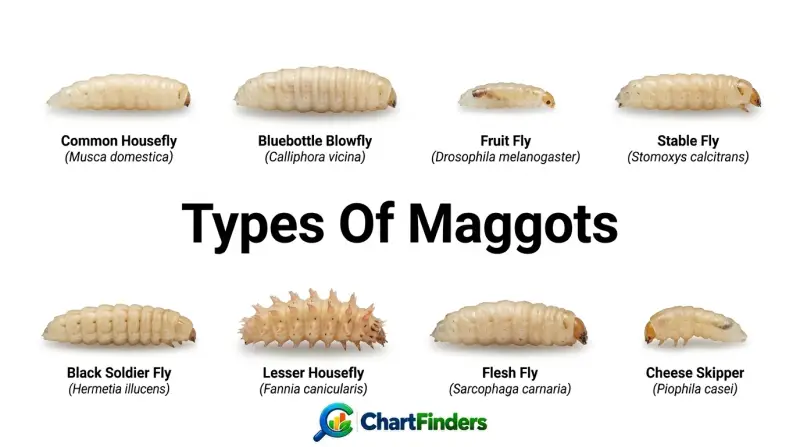
The term “maggot” is a functional, common description rather than a formal taxonomic classification. It universally applies to the soft-bodied, legless larvae of insects belonging to the order Diptera, specifically the suborder Brachycera (higher flies). While many people encounter them as unwelcome visitors in household waste or decaying organic material, these organisms occupy a remarkably sophisticated ecological niche. From recycling essential nutrients back into the soil to serving as precise biological tools in modern medicine and forensic investigations, understanding the distinct types of maggots reveals a complex world of insect biology, larval morphology, and ecological adaptation.
Types Of Maggots
- Maggots are the immature larval stage of Dipteran flies, distinguished by a lack of true legs, a distinct lack of a definitive head capsule (acephalic), and tapered bodies equipped with cephalopharyngeal mouthhooks.
- Blowfly maggots (family Calliphoridae) are shiny, metallic, and among the first colonizers of carrion, making them invaluable in forensic entomology and clinical wound debridement.
- House fly maggots (family Muscidae) thrive in warm, decomposing organic waste, manure, and garbage, featuring distinct button-like posterior spiracles for respiration.
- Flesh fly maggots (family Sarcophagidae) are typically larger, deposit live larvae rather than eggs (viviparity), and are frequently associated with advanced animal decay and deep tissue infestation.
- Medical-grade maggots (specifically selected, sterile strains of Lucilia sericata) are clinically utilized for debriding necrotic tissue and treating chronic non-healing wounds like diabetic ulcers.
- Accidental ingestion or tissue invasion by certain fly larvae results in myiasis, a medical and veterinary condition requiring prompt identification and structural intervention.
Distinguishing between the various types of maggots requires a close look at their physical morphology, developmental stages, and environmental preferences. Because most fly larvae share a generalized cream-to-whitish, worm-like appearance, accurate identification often relies on examining posterior breathing pores (spiracles), mouthparts, segment tubercles, and cuticular patterns under magnification. Below is a comprehensive breakdown of the primary fly families and their corresponding larval types.
Blowfly Maggots (Family Calliphoridae)
Blowflies are perhaps the most recognizable source of maggots, particularly in forensic science and outdoor settings. Adult blowflies are easily identified by their brilliant metallic blue, green, bronze, or black coloration. Their larvae are cylindrical, tapering sharply at the head end where specialized mouthhooks are used to tear food.
- Primary Species: Lucilia sericata (common green bottle fly), Calliphora vomitoria (blue bottle fly).
- Habitat: Fresh carrion, exposed meat, garbage bins with protein waste, and occasionally neglected wounds on living animals.
- Forensic Importance: Because blowflies are often the first insects to locate a carcass—sometimes arriving within minutes of death—their developmental stages provide forensic investigators with a reliable minimum post-mortem interval (PMI).
House Fly Maggots (Family Muscidae)
The common house fly (Musca domestica) produces larvae that are frequently encountered in domestic environments. Unlike the metallic sheen of blowfly adults, house flies are dull gray with dark stripes.
- Morphology: Cream-colored, smooth, and measuring up to 10–12 millimeters in length when fully mature. They feature distinct, button-like posterior spiracles with three straight or slightly curved slits.
- Habitat: Warm, fermenting organic substrates, including household garbage, compost heaps, livestock manure, and spoiled silage.
- Sanitary Significance: House fly maggots thrive in high-pathogen environments. As they feed and develop, they can act as mechanical vectors for numerous human and animal pathogens (such as enteric bacteria and protozoa), making rapid waste management essential.
Flesh Fly Maggots (Family Sarcophagidae)
Flesh flies are medium-to-large flies characterized by a gray thorax marked with three distinct longitudinal dark stripes and a checkerboard pattern on the abdomen.
- Reproductive Strategy: Unlike blowflies and house flies, which lay eggs, many flesh flies are ovoviviparous or viviparous—they deposit active, first-instar larvae directly onto the food source.
- Habitat: Carrion, animal feces, garbage, and occasionally decaying vegetable matter. They are frequently found alongside blowfly larvae in older carcasses.
- Identification: Flesh fly maggots can often be distinguished by deep-set posterior spiracles located within a distinct cavity at the rear of the body, protected by fleshy tubercles.
Drain and Moth Fly Larvae (Family Psychodidae)
Moth fly or drain fly larvae differ significantly from carrion-feeding maggots. They are adapted to aquatic or semi-aquatic environments with high organic content.
- Morphology: Elongated, segmented bodies with dark, hardened sclerotized plates (collar-like bands) on each segment, giving them a distinct caterpillar-like appearance compared to smooth blowfly larvae.
- Habitat: The gelatinous organic film (biofilm) that accumulates inside drain pipes, sewage treatment beds, and overwatered houseplant soil.
- Behavior: They feed on bacteria, fungi, and decaying microscopic matter within the slime layer, making them beneficial natural cleaners of biofilms, though adult flies can become a household nuisance.
Cheese Skipper Larvae (Family Piophilidae)
Cheese skippers (Piophila casei) are small, glossy black or bronze flies whose larvae are famous for a remarkable physical adaptation.
- The “Skipping” Behavior: When disturbed, the mature larva grips its own posterior end with its mouthhooks, forming a tight loop, and then releases suddenly. This action launches the maggot up to 15 centimeters into the air like a spring.
- Habitat: Cured meats, smoked fish, ancient or improperly stored cheeses, and occasionally decomposing animal proteins.
- Culinary Note: While accidental ingestion of standard maggots can cause minor digestive upset, certain traditional delicacies (such as the Sardinian cheese Casu Marzu) intentionally utilize cheese skipper larvae to break down fats and proteins, though food safety regulations restrict their commercial sale.
| Fly Family / Common Name | Primary Habitat | Egg vs. Larva Deposition | Key Identification Clue | Primary Ecological/Practical Role |
|---|---|---|---|---|
| Calliphoridae (Blowflies) | Fresh carrion, meat scraps, open garbage | Lays clustered white eggs | Shiny, smooth body; tapers sharply at head | Forensic indicators; medical debridement |
| Muscidae (House Flies) | Manure, rotting garbage, compost | Lays small batches of white eggs | Button-like posterior spiracles; uniform taper | Nutrient recyclers; potential pathogen vector |
| Sarcophagidae (Flesh Flies) | Advanced carrion, feces, garbage | Deposits live larvae (viviparous) | Deep posterior cavity housing spiracles | Decomposition accelerator; forensic marker |
| Psychodidae (Drain Flies) | Drain sludge, biofilm, sewage filters | Lays eggs in gelatinous films | Segmented body with dark sclerotized plates | Biofilm consumers; drain-line inhabitants |
| Piophilidae (Cheese Skippers) | Cured meats, aged cheese, fats | Lays eggs in cracks of protein foods | Capable of leaping/skipping when disturbed | Protein degradation; specialized food traditions |
The table above outlines the core biological and environmental differences among the most common maggot types. Reviewing these characteristics demonstrates that while all maggots share a legless, vermiform body plan, their micro-habitats and physical adaptations vary widely based on their nutritional requirements.
Biological Structure and Anatomy of Maggots
Despite their simple appearance, maggots possess specialized anatomical adaptations designed for a singular purpose: rapid consumption and conversion of liquid or semi-liquid organic substrates. Because they live immersed in their food source, they do not require complex sensory organs or locomotor appendages.
Headless Morphology and Mouthparts
True maggots lack a distinct, hardened head capsule (a condition known as being acephalic). Instead, the anterior end is retractable and tapers to a point. Inside this region lies the cephalopharyngeal skeleton, which anchors a pair of dark, sclerotized mouthhooks. These hooks move vertically to scrape, tear, and liquefy decomposing tissue, assisted by oral secretions containing powerful proteolytic enzymes that begin external digestion before ingestion.
Respiration via Spiracles
Because maggots lack lungs and complex tracheal systems opening across the entire body wall, they breathe primarily through specialized respiratory pores called spiracles.
- Anterior Spiracles: Located near the front segments (typically on the second thoracic segment), used for secondary air intake and gas exchange in some species.
- Posterior Spiracles: Located at the rear (posterior) end of the body. This allows the larva to submerge its feeding head deep into rotting matter or semi-liquid waste while keeping its posterior exposed to the air for respiration. The shape, slit number, and peritreme structure of these posterior spiracles are the primary diagnostic features used by entomologists to identify specific fly species.
Developmental Stages (Instars)
Like all holometabolous insects, maggots undergo complete metamorphosis, transitioning through distinct phases: egg, larva (divided into three instars), pupa, and adult. Understanding these stages is essential for both pest control and forensic calculations.
- First Instar: Emerging directly from the egg (or deposited live by viviparous flies), first-instar maggots are extremely small (1–2 mm), possess only anterior spiracles (or undeveloped posterior slits), and feed exclusively on soft, easily accessible tissues. They are highly vulnerable to desiccation.
- Second Instar: After molting, the second-instar larva grows larger (typically 5–10 mm) and develops two spirillar slits on its posterior spiracles. Its mouthhooks become more robust, allowing it to penetrate tougher organic layers.
- Third Instar: This is the final and largest larval stage (ranging from 12 to 20 mm depending on the species). Third-instar maggots possess three distinct slits within their posterior spiracles. They feed voraciously before experiencing post-feeding wandering behavior, where they crawl away from the food source to a dry, cool location to pupate.
Ecological and Medical Significance
The interaction between maggots and human environments spans from sanitary challenges to advanced medical therapies.
Maggot Therapy (Biosurgery)
Far from being merely pests, sterile medical-grade maggots—specifically the larvae of the common green bottle fly (Lucilia sericata)—are utilized in clinical settings to treat chronic, non-healing wounds such as diabetic foot ulcers and pressure sores. This treatment, known as larval therapy or biosurgery, relies on three distinct mechanisms:
- Debridement: Maggots exclusively ingest necrotic (dead) and infected tissue while leaving healthy living tissue untouched, dissolving dead cells with secreted enzymes.
- Disinfection: Their secretions exhibit broad antimicrobial properties (including allantoin, urea, and antimicrobial peptides), helping to suppress bacterial populations, including antibiotic-resistant strains like MRSA.
- Healing Promotion: Feeding activity and wound secretions stimulate granulation tissue formation and speed up overall wound closure.
Forensic Entomology
In forensic investigations, entomological evidence is frequently critical for estimating the post-mortem interval (PMI). Because blowflies and flesh flies arrive at a body in a predictable sequence and their developmental rate depends heavily on ambient temperature, forensic scientists can analyze the oldest larval stages recovered from remains to establish a precise timeline of events.
Myiasis and Animal Health
When fly larvae infest the living tissue of humans or warm-blooded animals, the condition is known as myiasis. Depending on the species, myiasis can range from superficial skin irritation (wound myiasis) to severe systemic or cavity damage caused by obligate parasites like the New World screwworm fly (Cochliomyia hominivorax). Effective livestock management and prompt wound care are essential preventive measures against parasitic fly strikes.
Identification and Management Considerations
Managing maggot infestations effectively requires understanding their biology. Because maggots require moisture, high-protein organic material, and warmth to thrive, physical control is far more effective than relying solely on chemical treatments.
- Source Elimination: The single most effective management step is removing the organic material supporting the infestation—such as sealing garbage bags tightly, cleaning out rancid food waste bins, and clearing organic buildup from drain traps.
- Thermal and Desiccation Control: Maggots cannot survive extreme heat or dehydration. Pouring boiling water or applying targeted cleaning agents can eliminate exposed larvae in garbage cans or drains.
- Exclusion: Installing tight-fitting lids on outdoor waste containers and repairing torn window or door screens prevents adult flies from accessing oviposition sites.
Frequently Asked Questions
Are all maggots the same species?
No. “Maggot” is a catch-all term for the larval stage of thousands of different fly species within the order Diptera. Common types include blowflies, house flies, flesh flies, and drain flies, each differing in habitat, appearance, and behavior.
How do maggots breathe if they are buried in garbage or meat?
Maggots breathe primarily through posterior spiracles located at the rear end of their bodies. This adaptation allows them to burrow their feeding mouthparts deep into decaying organic matter while keeping their rear end exposed to the air for respiration.
Can eating food with maggots make you sick?
Accidental ingestion of common house fly or blowfly maggots does not typically cause direct poisoning, but it carries a high risk of bacterial contamination, food poisoning, or gastrointestinal irritation because these larvae frequently inhabit pathogen-rich environments. In rare cases, certain larvae can survive the gastric environment and cause accidental intestinal myiasis.
Why do some maggots jump or skip?
The ability to leap or “skip” is a specialized defense and dispersal mechanism unique to cheese skipper larvae (family Piophilidae). When threatened or ready to pupate, the larva curls into a tight circle, grips its tail with its mouthparts, and snaps free to launch itself through the air.
How long does it take for a maggot to turn into a fly?
The developmental timeline depends heavily on ambient temperature and species, but under optimal warm conditions, the larval stage lasts between 3 to 7 days across three instars. After this feeding phase, the maggot migrates to a dry, cool location to pupate, emerging as an adult fly within 1 to 2 weeks.
Conclusion
Maggots represent a highly successful evolutionary design optimized for rapid organic recycling and survival in nutrient-dense, high-competition environments. Whether acting as forensic clocks helping solve criminal cases, serving as precise biological surgeons in advanced wound care, or functioning as decomposers in natural ecosystems, these specialized fly larvae play crucial roles. Proper identification of different maggot types allows professionals and homeowners alike to distinguish between beneficial medical tools, crucial forensic indicators, and household sanitation challenges.