
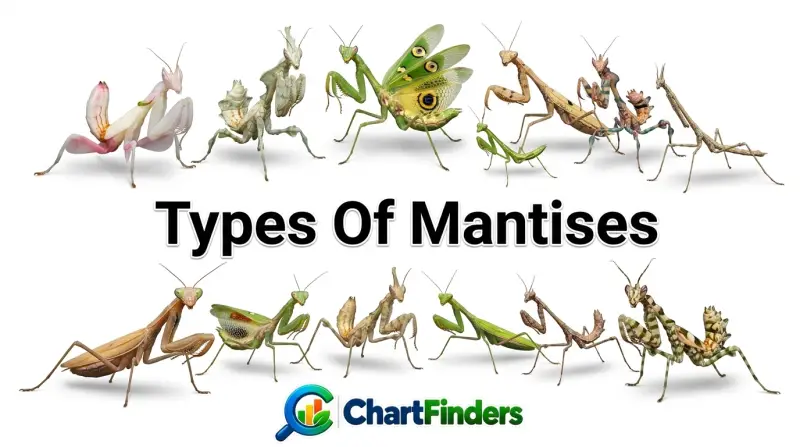
The order Mantodea represents one of the most morphologically specialized and behaviorally distinct groups of predatory hemimetabolous insects on Earth. Characterized by their highly modified raptorial forelegs, triangular heads capable of 180-degree rotation, and exceptional binocular vision, mantises occupy a unique ecological niche as opportunistic ambush hunters. With more than 2,000 species recognized worldwide, the sheer diversity within this lineage extends far beyond the common backyard green mantis. From cryptic mimics that resemble decaying leaves or vibrant orchid blossoms to large-bodied generalist predators capable of consuming small vertebrates, understanding the different types of mantises requires a close examination of their taxonomy, structural adaptations, and global distribution patterns.
This comprehensive guide explores the rich biological diversity of mantises, breaking down major taxonomic groups, specialized ecological adaptations, regional distribution dynamics, and the complexities of identifying both native and invasive species. Whether examining the mechanics of raptorial strikes, the structural integrity of oothecae, or the ecological disruption caused by introduced populations, a rigorous scientific approach reveals why these apex invertebrate predators continue to captivate entomologists and naturalists alike.
Types Of Mantises
- Taxonomic Scale: The order Mantodea contains over 2,000 species classified across multiple families, including Mantidae, Hymenopodidae, and Empusidae.
- Morphological Specialization: Mantis morphology directly reflects predatory strategy, ranging from flattened bark dwellers (Liturgusidae) to blossom-mimicking ambushers (Hymenopodidae).
- Invasive Dynamics: Certain large-bodied species like Tenodera sinensis (Chinese mantis) and various Asian taxa now spreading through Europe exert heavy predation pressure on native pollinators and wildlife.
- Reproductive Architecture: Species identification often relies on the structural architecture of the ootheca (egg case), which exhibits species-specific foam matrix patterns and hardening characteristics.
- Sensory Adaptations: A specialized median ocellus and compound eyes provide a stereoscopic visual field optimized for tracking movement in complex three-dimensional foliage.
- Pest Control Misconceptions: Despite popular garden lore, generalist mantises are not effective biological control agents for targeted pest suppression because they consume beneficial pollinators alongside agricultural pests.
To navigate the vast taxonomy of the Mantodea order, entomologists categorize mantises based on morphological clades, ecological niches, and geographical distribution. The following sections examine the most prominent families, genera, and species, detailing how structural anatomy aligns with survival strategies in the wild.
Generalist and Large-Bodied Mantises (Family Mantidae)
The family Mantidae is the largest and most ecologically widespread family within the order Mantodea, containing many of the large-bodied species encountered in temperate and tropical zones. These generalist predators are characterized by robust raptorial forelegs, strong flight capabilities in males, and adaptable habitat preferences ranging from tall grasses to deciduous canopy layers.
The European Mantis (Mantis religiosa)
Mantis religiosa is perhaps the most widely recognized species across Europe, parts of Asia, and North America, where it was introduced intentionally and accidentally over a century ago. Typically measuring between 50 to 75 millimeters in length, this species exhibits color polymorphism, ranging from bright chlorophyll green to dry-grass brown. A distinct diagnostic feature of Mantis religiosa is the presence of a dark, often black-and-white spot on the inner coxa of the foreleg. As an adaptable generalist, it occupies open meadows and shrublands, preying on orthopterans, dipterans, and lepidopterans.
The Chinese Mantis (Tenodera sinensis)
Originating in East Asia, the Chinese mantis is among the largest mantis species found in North America, frequently exceeding 100 to 110 millimeters in total length. Introduced to Pennsylvania in the late 19th century for agricultural pest management, it has since established widespread populations across eastern and central North America. Tenodera sinensis is distinguished by its massive stature, slender thorax, and a coloration gradient featuring green margins on brown elytra. Because of its sheer size, field studies confirm it regularly captures and consumes not only large insects but occasionally small vertebrates, including hummingbirds and reptiles.
Flower and Blossom Mimics (Family Hymenopodidae)
Representing the pinnacle of cryptically specialized ambush predation, members of the family Hymenopodidae inhabit tropical rainforests, particularly within Southeast Asia and parts of Africa. These taxa have evolved complex morphological appendages that replicate the petal structures, coloration, and scent profiles of native flowers to lure unsuspecting pollinators.
The Orchid Mantis (Hymenopus coronatus)
Widely regarded as one of the most astonishing examples of evolutionary mimicry, Hymenopus coronatus exhibits pink and white cuticular lobes on its legs and thorax that mimic the petals of tropical orchids. Nymphs emerge mimicking predatory assassin bugs before transitioning into floral mimics as they mature. The species displays extreme sexual dimorphism; adult females can reach up to 60 millimeters, whereas adult males remain diminutive, rarely exceeding 30 millimeters. Their visual acuity and stationary positioning allow them to intercept high-value dipteran and hymenopteran pollinators with absolute precision.
Cone-Head and Ground Mantises (Family Empusidae and Others)
Diverging sharply from broad-bodied foliage hunters, cone-head mantises (such as the empusids) and ground-dwelling species exhibit extreme cuticular elongation and coloration optimized for arid or desert environments.
The Ghost Mantis (Phyllocrania paradoxa)
Native to the African continent and Madagascar, Phyllocrania paradoxa is a master of necrotic mimicry. Its flattened, leaf-like cuticular extensions and dark, desynchronized brown coloration cause it to resemble dead, decaying foliage rather than living green vegetation. This defensive morphology is complemented by a swaying gait that simulates leaves moving in a gentle breeze, effectively evading avian and mammalian predators while ambushing passing prey.
The following table provides a taxonomic and morphological comparison of these major mantis groups, contrasting their structural adaptations and native ranges:
| Common Name | Scientific Name | Family | Average Size | Primary Mimicry / Adaptation | Native Distribution |
|---|---|---|---|---|---|
| European Mantis | Mantis religiosa | Mantidae | 50–75 mm | Generalist foliage camouflage; coxal spot | Europe, Asia, Africa; introduced to N. America |
| Chinese Mantis | Tenodera sinensis | Mantidae | 100–110 mm | Large-bodied generalist; slender thorax | East Asia; introduced to North America |
| Orchid Mantis | Hymenopus coronatus | Hymenopodidae | 30–60 mm | Floral petal lobes; aggressive mimicry | Southeast Asia (Malaysia, Indonesia) |
| Ghost Mantis | Phyllocrania paradoxa | Empusidae | 45–50 mm | Dead-leaf mimicry; flattened expansions | Sub-Saharan Africa, Madagascar |
| Carolina Mantis | Stagmomantis carolina | Mantidae | 48–60 mm | Bark/lichen crypsis; compact build | North and Central America |
Interpreting this comparative data illustrates how selective pressures shape mantis morphology. While generalist species in Mantidae rely on broader ecological tolerance and large body size, specialized taxa like Hymenopodidae depend entirely on microhabitat fidelity and precise structural mimicry to secure metabolic requirements.
Anatomical and Physiological Specializations
The evolutionary success of the order Mantodea is anchored in a suite of highly derived anatomical structures. Examining these physiological components explains how mantises dominate their micro-ecosystems.
The Raptorial Foreleg Complex
The forelegs of a mantis are structurally modified for high-speed predatory capture. Anatomically, the coxa is elongated to provide sweeping range, followed by a short trochanter and a robust femur. The ventral margin of the femur is lined with a series of sharp, chitinous spines flanked by a tibial claw groove. When a prey item enters striking distance—often in less than 50 to 70 milliseconds—the tibia snaps shut against the femur like a jackknife. Specialized muscular contractions and spring-like cuticular mechanisms store and release kinetic energy, ensuring that evasive prey cannot escape once contacted.
Visual Systems and Neurological Processing
Mantises possess two large, lateral compound eyes containing thousands of individual ommatidia, complemented by three simple ocelli arranged in a triangle on the frons. Unlike most insects, mantises are the only known invertebrates capable of true stereoscopic vision. Their visual processing centers are specifically wired to detect motion and calculate depth in three-dimensional space. By shifting their triangular heads via a flexible cervical sclerite—allowing a full 180-degree rotation—they track targets without moving their bodies, preserving their camouflage.
Global Distribution, Expansion, and Invasive Status
While the greatest biodiversity of mantises concentrates within tropical and subtropical latitudes, global trade, climate change, and deliberate introductions have significantly altered their geographic distribution. Recent entomological assessments highlight the rapid northward expansion of exotic mantis species across Europe and North America.
Invasive species such as the Chinese mantis (Tenodera sinensis) and the narrow-winged mantis (Tenodera angustipennis) have established robust populations outside their native habitats. Recent 2026 surveillance data from European monitoring programs emphasize that two major Asian mantis species are actively spreading through Central and Southern Europe. Facilitated by urban heat islands and warming thermal baselines, these aggressive predators outcompete native European taxa like Mantis religiosa. , their indiscriminate predatory behavior poses a documented threat to native pollinator populations, including wild bees, syrphid flies, and butterflies, occasionally disrupting local trophic webs.
Reproductive Biology and the Ootheca
Reproduction in mantises involves complex courtship rituals, where females occasionally exhibit sexual cannibalism—consuming the male during or after copulation to secure high-protein resources for egg development. Following fertilization, the female secretes a specialized foamy proteinaceous substance from accessory glands located in the abdomen.
As she deposits her eggs in rows within this matrix, she rapidly beats the foam into a hardened, structural structure known as an ootheca. The ootheca cures into a tough, weather-resistant casing that protects the developing embryos through harsh winter freezes. Because ootheca morphology is structurally distinct across species, entomologists frequently rely on the external architecture, dimensions, and attachment angle of the ootheca to identify specific mantis populations in the field.
Common Misconceptions Regarding Pest Control
A prevalent misconception among gardeners and agriculturalists is that purchasing and releasing mantis oothecae provides effective biological pest control. Controlled studies in entomology contradict this assumption for several critical reasons:
- Generalist Ambush Strategy: Mantises are opportunistic ambush predators. They do not selectively target agricultural pests like aphids, thrips, or spider mites; they consume whatever prey moves within their striking range.
- Beneficial Bycatch: Field assessments demonstrate that mantises consume high quantities of beneficial pollinators—including honeybees, bumblebees, and predatory wasps—which offsets any perceived pest-reduction benefits.
- Cannibalistic Dispersion: High nymphal densities emerging from a single ootheca quickly lead to aggressive intraspecific cannibalism. Within weeks, natural attrition and dispersal reduce local populations to a sparse handful of territorial adults.
Frequently Asked Questions
How many species of mantises exist worldwide?
There are over 2,000 recognized species of mantises globally, classified within approximately 430 genera and 15 families, with new species continuously described from tropical rainforest explorations.
Are green mantises and brown mantises different species?
Coloration is frequently a phenotypic adaptation rather than a species-level distinction. Many common species, such as Mantis religiosa and Stagmomantis carolina, exhibit color polymorphism (green or brown morphs) depending on microhabitat background, humidity, and lighting conditions during their final nymphal molts.
Why do female mantises consume males during mating?
Sexual cannibalism is an evolutionary strategy observed in certain species under specific nutritional stress. Consuming the male provides the female with an immediate influx of amino acids and proteins, which directly increases egg production and clutch viability.
How can you tell the difference between native and invasive mantises?
Distinction relies on anatomical markers and regional provenance. In North America and Europe, large-bodied species exceeding 100 mm with specific thoracic proportions—such as the Chinese mantis—are typically introduced invasive species, whereas smaller, locally adapted taxa like the Carolina mantis or European mantis represent established or native lineages.
Do mantises make suitable pets for beginners?
Certain hardy species, such as the ghost mantis (Phyllocrania paradoxa) or the African mantis (Sphodromantis viridis), are frequently kept in captivity. However, they require precise humidity controls, specialized vertical enclosures, and live insect diets, making them more demanding than traditional mammalian pets.
Conclusion
The order Mantodea represents a remarkable pinnacle of insect evolution, balancing architectural mimicry, advanced stereoscopic vision, and highly specialized raptorial weaponry. From the generalist foraging tactics of Mantis religiosa to the floral deceptions of Hymenopus coronatus, mantises display an extraordinary range of adaptations. As global climate patterns shift and invasive species continue to expand their ranges across European and North American ecosystems, ongoing scientific monitoring remains essential for understanding their ecological impact. Recognizing the distinct types, anatomical structures, and behavioral realities of these apex invertebrate predators ensures a scientifically grounded appreciation for their role in the natural world.