
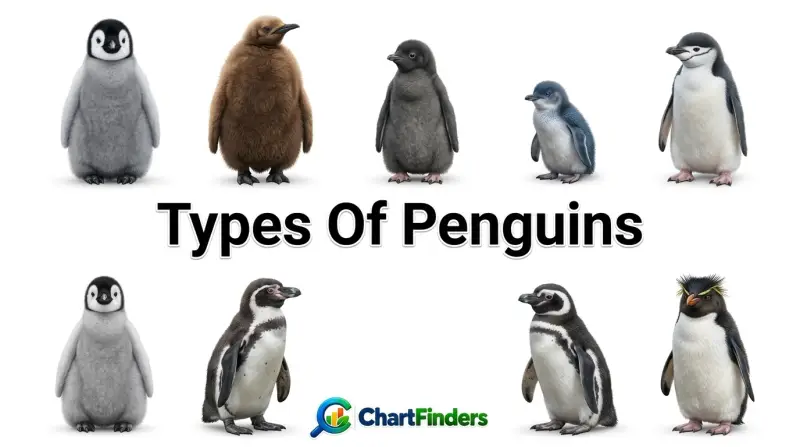
Few animals capture the public imagination quite like penguins. Their upright posture, distinct tuxedo-like countershading, and remarkable adaptations to some of the most unforgiving marine environments on Earth make them enduring symbols of resilience and evolutionary specialization. Yet, beyond their charming appearance lies a diverse, highly specialized group of avian predators whose survival is increasingly tied to the health of global marine ecosystems.
Understanding the different types of penguins requires looking past simplistic pop-culture portrayals and examining how geography, ocean currents, and evolutionary pressures have shaped each species. While many people associate every penguin with frozen landscapes and icebergs, these birds thrive across vastly different climatic zones. From the freezing pack ice of the Ross Sea to the warm, arid coasts of South Africa and the tropical waters of the Galápagos Islands, penguins have occupied a remarkable ecological niche.
This master guide provides a comprehensive exploration of the types of penguins, examining their taxonomy, geographical distribution, morphological differences, behavioral traits, foraging strategies, and the modern conservation crises threatening their survival. By breaking down species groups through comparative data and ecological context, we can better understand the full scope of Earth’s surviving penguin diversity.
Types Of Penguins: The Complete Taxonomic and Ecological Overview
- There are 18 officially recognized extant penguin species, spread across 6 distinct genera within the family Spheniscidae.
- Recent taxonomic updates have split the widespread Gentoo penguin into four distinct species (Pygoscelis papua, P. ellsworthi, P. taeniata, and P.poncetii) based on robust genetic and morphological data.
- Penguins are not restricted to cold climates; species like the Galápagos penguin live on the equator, relying on cold upwelling currents to survive.
- Major threats to global penguin populations include industrial overfishing, marine warming, shifting prey distributions, habitat degradation, and introduced mammalian predators.
- Morphological adaptations vary dramatically, from the 4-foot-tall Emperor penguin down to the 13-inch Little Blue penguin.
- Conservation statuses range from Least Concern (such as the abundant Adélie and King penguins) to Critically Endangered (such as the African penguin).
To systematically understand the types of penguins, scientists rely on both morphological characteristics and modern genetic sequencing. The family Spheniscidae is traditionally divided into six genera: Aptenodytes, Pygoscelis, Eudyptes, Megadyptes, Eudyptula, and Spheniscus. Each genus represents a distinct evolutionary lineage adapted to specific foraging strategies, breeding substrates, and marine habitats.
| Common Name | Scientific Name | Average Height | Global Population Estimate | Conservation Status | Primary Distribution |
|---|---|---|---|---|---|
| Emperor Penguin | Aptenodytes forsteri | 110–120 cm (43–47 in) | ~595,000 mature individuals | Near Threatened | Antarctic circumpolar pack ice |
| King Penguin | Aptenodytes patagonicus | 85–95 cm (33–37 in) | ~2,230,000 mature individuals | Least Concern | Sub-Antarctic islands |
| Adélie Penguin | Pygoscelis adeliae | 70–75 cm (27–30 in) | ~5,000,000+ mature individuals | Least Concern | Antarctic coastline and adjacent islands |
| Chinstrap Penguin | Pygoscelis antarcticus | 68–76 cm (27–30 in) | ~8,000,000 mature individuals | Least Concern | Antarctic Peninsula and sub-Antarctic islands |
| Gentoo Penguin Complex | Pygoscelis papua (et al.) | 51–90 cm (20–35 in) | ~774,000 mature individuals | Least Concern | Sub-Antarctic islands and Antarctic Peninsula |
| Magellanic Penguin | Spheniscus magellanicus | 60–76 cm (24–30 in) | ~2,600,000 mature individuals | Near Threatened | Coasts of Argentina, Chile, and Falklands |
| African Penguin | Spheniscus demersus | 60–70 cm (24–28 in) | ~20,000–30,000 mature individuals | Critically Endangered | Coasts of South Africa and Namibia |
| Humboldt Penguin | Spheniscus humboldti | 56–70 cm (22–28 in) | ~32,000 mature individuals | Vulnerable | Pacific coast of South America (Peru/Chile) |
| Galápagos Penguin | Spheniscus mendiculus | 48–50 cm (19–20 in) | ~1,200 mature individuals | Endangered | Galápagos Islands, Ecuador |
| Northern Rockhopper | Eudyptes moseleyi | 55–60 cm (22–24 in) | ~530,000 mature individuals | Endangered | Tristan da Cunha and Gough Island |
| Southern Rockhopper | Eudyptes chrysocome | 45–55 cm (18–22 in) | ~2,500,000 mature individuals | Vulnerable | Sub-Antarctic islands |
| Fiordland Crested Penguin | Eudyptes pachyrhynchus | 55–60 cm (22–24 in) | ~2,500–3,000 mature individuals | Near Threatened | Coasts of New Zealand (Fiordland/Stewart Island) |
| Snares Crested Penguin | Eudyptes robustus | 50–60 cm (20–24 in) | ~63,000 mature individuals | Vulnerable | Snares Islands, New Zealand |
| Erect-Crested Penguin | Eudyptes sclateri | 50–70 cm (20–28 in) | ~130,000 mature individuals | Endangered | Bounty and Antipodes Islands, New Zealand |
| Macaroni Penguin | Eudyptes chrysolophus | 70 cm (27 in) | ~12,000,000 mature individuals | Vulnerable | Sub-Antarctic to Antarctic Peninsula |
| Royal Penguin | Eudyptes schlegeli | 65–76 cm (26–30 in) | ~850,000 mature individuals | Near Threatened | Macquarie Island |
| Yellow-eyed Penguin (Hoiho) | Megadyptes antipodes | 65–68 cm (26–27 in) | ~3,400 mature individuals | Endangered | Southeast coast of New Zealand and sub-Antarctic islands |
| Little Blue Penguin (Kororā) | Eudyptula minor | 30–33 cm (12–13 in) | ~500,000 mature individuals | Least Concern | Coasts of southern Australia and New Zealand |
The table above highlights the taxonomic breadth, population estimates, and conservation status of all major penguin species. While some populations, such as the Adélie and Macaroni penguins, maintain robust numbers, others face acute ecological pressures driven by climatic shifts, commercial fisheries, and human interference.
The Genus Aptenodytes: The Giant Antarctic Specialists
The genus Aptenodytes contains the two largest living penguin species: the Emperor and the King. These birds are characterized by their imposing size, long spear-like bills, and striking yellow-orange patches on the side of the head and neck. Unlike most other penguins, they do not build traditional nests out of stones or vegetation; instead, they incubate a single large egg by balancing it securely on their feet and covering it with a warm, vascularized fold of abdominal skin known as the brood pouch.
- Emperor Penguin (Aptenodytes forsteri): Standing over a meter tall and weighing up to 40 kg (88 lbs), the Emperor is the undisputed heavyweight of the penguin world. They are the only penguin species that breeds during the brutal Antarctic winter, walking up to 50 miles across stable sea ice to reach their protected breeding colonies. Males endure months of continuous fasting while incubating the egg in temperatures plummeting below -50°C (-58°F) and gale-force winds exceeding 100 mph.
- King Penguin (Aptenodytes patagonicus): Slightly smaller than the Emperor, the King penguin is instantly recognizable by its brilliant, teardrop-shaped orange ear patches and vivid golden-orange chest markings. King penguins breed on ice-free sub-Antarctic islands rather than the Antarctic continent itself. Their breeding cycle is notoriously protracted, taking up to 14 to 16 months to complete a single successful reproductive attempt, which results in parents successfully breeding only twice every three years.
The Genus Pygoscelis: The Brush-Tailed Penguins
The genus Pygoscelis comprises medium-sized penguins distinguished by their long, stiff tails made of prominent tail feathers (rectrices) that sweep the ground like a broom when walking. These species are heavily concentrated around the Antarctic Peninsula and surrounding sub-Antarctic islands, feeding primarily on Antarctic krill, silverfish, and squid.
- Adélie Penguin (Pygoscelis adeliae): The classic “tuxedo” penguin of children’s stories and historic polar exploration logs. Adélie penguins are strictly high-Antarctic breeders, building circular pebble nests on rocky ground during the brief southern summer. They are fierce defenders of their territory against neighbors and predators and have been extensively studied by biologists monitoring Southern Ocean food webs.
- Chinstrap Penguin (Pygoscelis antarcticus): Named for the distinct narrow black band of feathers running under its chin, the chinstrap is an aggressive, highly vocal species. They are primarily distributed across the South Shetland Islands, South Orkney Islands, and parts of the Antarctic Peninsula, where they frequently compete with Adélie and Gentoo penguins for krill resources.
- Gentoo Penguin Complex (Pygoscelis papua et al.): Recognized by a bright orange-red bill and a white triangular patch extending over each eye, the Gentoo is the fastest underwater swimmer among penguins, reaching burst speeds up to 22 mph (36 km/h). Recent taxonomic research has officially split the Gentoo complex into four distinct species (P. papua, P. ellsworthi, P. taeniata, and P. poncetii) based on significant genetic divergence and morphological variation across their expansive sub-Antarctic and sub-polar range.
The Genus Eudyptes: The Crested Penguins
The crested penguins represent the most species-rich genus within the family. Characterized by striking, ornamental yellow or golden feather plumes above their eyes, red-orange bills, and ruby-red eyes, these birds are renowned for their high-energy, pugnacious behavior and challenging breeding habitats on rugged, wave-lashed cliffs.
- Northern and Southern Rockhopper Penguins (Eudyptes moseleyi & Eudyptes chrysocome): Small, spirited penguins that navigate steep rocky shorelines by hopping with both feet clamped together rather than waddling. Both species face severe population declines, with the Northern rockhopper classified as Endangered due to marine ecosystem shifts and historical overfishing.
- Macaroni and Royal Penguins (Eudyptes chrysolophus & Eudyptes schlegeli): The Macaroni features thick, golden-orange crests meeting dramatically on the forehead. It is the most numerous crested penguin in the world, though populations face localized pressures from commercial krill trawling. The Royal penguin, found primarily on Macquarie Island, features a striking white face rather than the dark face of the Macaroni.
- New Zealand Crested Group (Fiordland, Snares, and Erect-Crested): These forest-, scrub-, and coastal-breeding penguins (E. pachyrhynchus, E. robustus, and E. sclateri) represent some of the rarest and most localized seabirds in the world, breeding exclusively within restricted island groups, dense coastal forests, and wave-cut caves around New Zealand and its outlying sub-Antarctic islands.
The Genus Spheniscus: The Banded Penguins
The banded penguins—often referred to as temperate or jackass penguins due to their braying, donkey-like vocalizations—are adapted to warmer climates. They feature contrasting black-and-white facial patterns and a horseshoe-shaped black band running across their chest. Unlike polar penguins, they do not nest on open ice; instead, they dig burrows in sandy soil, nest beneath dense coastal vegetation, or utilize natural rock crevices and guano caves.
- African Penguin (Spheniscus demersus): Endemic to the southwestern coast of Africa, this species is classified as Critically Endangered. Commercial purse-seine fishing competition for sardines and anchovies, historic guano harvesting that destroyed burrowing substrates, and major marine oil spills have devastated historical colonies, leaving population numbers at historic lows.
- Humboldt Penguin (Spheniscus humboldti): Inhabiting the arid Pacific coast of South America, the Humboldt relies heavily on the cold, nutrient-rich waters of the Humboldt Current. El Niño Southern Oscillation (ENSO) events heavily disrupt their food supply, causing widespread starvation and reproductive failure.
- Magellanic Penguin (Spheniscus magellanicus): Named after explorer Ferdinand Magellan, this migratory species breeds in vast colonies along the southern coasts of Argentina, Chile, and the Falkland Islands, wintering as far north as Brazil and Peru where they track schools of pelagic fish.
- Galápagos Penguin (Spheniscus mendiculus): The only penguin species to live north of the equator in the wild. Confined entirely to the volcanic Galápagos archipelago, their survival depends almost exclusively on the Cromwell Current, which brings cold, nutrient-dense water to the equatorial islands.
The Unique Genera: Yellow-eyed and Little Blue Penguins
The final two genera each contain a single, highly specialized species found primarily in the Australasian region.
- Yellow-eyed Penguin / Hoiho (Megadyptes antipodes): Known in the Māori language as the Hoiho (“noise shouter”), this endangered New Zealand endemic is easily identified by its pale yellow eyes and a band of golden feathers stretching from the eyes around the back of the head. Unlike most penguins, Hoiho are solitary nesters, refusing to breed within dense colonies and requiring secluded forest or scrub habitats adjacent to the sea.
- Little Blue Penguin / Kororā (Eudyptula minor): The smallest penguin in the world, standing just 13 inches (30–33 cm) tall and weighing about 2.2 pounds (1 kg). They feature slate-blue to indigo plumage and are strictly nocturnal on land, coming ashore after dark to avoid predatory gulls and raptors along the coasts of southern Australia and New Zealand.
Morphological and Physiological Adaptations Across Species
The incredible distribution of penguins across polar, sub-Antarctic, and temperate zones is made possible by a suite of extraordinary physiological and anatomical adaptations. While they traded the power of flight for aquatic propulsion millions of years ago, their bodies became masterpieces of hydrodynamic and thermodynamic engineering.
Feather Structure and Thermoregulation
Unlike flying birds, whose feathers are arranged in discrete tracts (pterylae), penguin feathers cover their entire bodies in a dense, uniform coat (continuous plumage). An adult penguin possesses roughly 80 feathers per square inch. These short, stiff, heavily curved feathers overlap tightly to form an impenetrable wind- and waterproof barrier. Beneath this outer shell lies a thick layer of down feathers that traps a continuous pocket of warm insulating air against the skin.
To survive freezing polar waters, penguins maintain a high core body temperature of around 38°C to 39°C (100°F–102°F). A specialized counter-current heat exchange system in their flippers and legs (the rete mirabile) prevents heat from escaping through uninsulated extremities. Arteries carrying warm blood from the heart pass directly alongside veins returning cold blood from the feet and flippers, pre-cooling arterial blood on its way out and pre-warming venous blood on its way back to the core.
Hydrodynamics and Diving Physiology
Underwater, penguins are effectively aquatic acrobats. Their bones are heavy, dense, and solid—unlike the hollow, pneumatic bones of flying birds—which acts as natural ballast to counteract buoyancy during deep dives. Their wings have evolved into rigid, tapered, flat flippers operated by powerful pectoral muscles anchored to a prominent keeled sternum.
When diving for prey, penguins exhibit remarkable physiological controls over their oxygen consumption and cardiovascular output:
- Heart Rate Depression: A diving penguin can drop its resting heart rate from over 100 beats per minute down to as low as 15–20 beats per minute, drastically reducing systemic oxygen expenditure.
- Oxygen Storage: Their muscles contain exceptionally high concentrations of myoglobin, an oxygen-binding protein that allows muscles to function efficiently even when peripheral blood flow is restricted during prolonged deep dives.
- Pressure Tolerance: Emperor penguins can dive to depths exceeding 500 meters (1,600 feet) and remain submerged for over 20 minutes, collapsing their respiratory air sacs to withstand crushing hydrostatic pressure without suffering from nitrogen narcosis or decompression sickness (“the bends”).
Global Distribution, Migration, and Foraging Niches
Contrary to the popular misconception that all penguins live alongside polar bears (which are strictly Arctic mammals), penguins are exclusively restricted to the Southern Hemisphere. Their evolutionary origin is intimately tied to the breakup of the supercontinent Gondwana and the opening of the Drake Passage, which established the circumpolar current system and isolated the Antarctic continent.
Foraging strategies vary widely across species based on geographic latitude and local marine productivity. High-Antarctic species like the Adélie and Emperor depend heavily on sea ice dynamics, utilizing the undersides of ice floes as hunting grounds for Antarctic silverfish (Pleuragramma antarcticum) and crystal krill (Euphausia crystallorophias). Conversely, sub-Antarctic crested penguins forage in open pelagic waters, hunting schooling fish and cephalopods.
Banded penguins (genus Spheniscus) rely on coastal upwelling systems—such as the Humboldt, Benguela, and Patagonian currents—where deep, nutrient-rich water is pushed to the surface, fueling massive blooms of phytoplankton that support dense schools of anchovies, sardines, and pilchards.
Conservation Challenges and Threats in the 2020s
Global penguin populations face an unprecedented convergence of anthropogenic and climatic threats. While high-latitude species are acutely vulnerable to rapid climate change and sea-ice loss, temperate species face immediate pressures from industrial overfishing and coastal development.
| Threat Category | Primary Impacted Species | Ecological Mechanism |
|---|---|---|
| Climate Change & Sea-Ice Loss | Emperor, Adélie, Chinstrap | Destruction of stable breeding platforms, early ice breakup leading to chick drowning, and reduction of krill-supporting ice algae. |
| Industrial Overfishing | African, Humboldt, Magellanic | Direct competition for pelagic fish stocks (anchovy, sardine, pilchard) driven by human commercial fisheries operating near breeding colonies. |
| Marine Pollution & Oil Spills | African, Magellanic, Northern Rockhopper | Coating of waterproof plumage with bunker oil or petroleum, leading to fatal hypothermia, toxic ingestion, and complete reproductive failure. |
| Introduced Predators | Yellow-eyed, Little Blue, Snares, Fiordland | Severe predation on eggs, flightless chicks, and nesting adult females by feral cats, rats, stoats, pigs, and dogs. |
| Marine Heatwaves (ENSO) | Galápagos, Humboldt | Severe ocean warming suppresses coastal upwelling currents, starving breeding adults and preventing chick rearing. |
The table above outlines the primary environmental pressures driving modern declines. The African penguin, in particular, teeters on the brink of extinction in the wild, with mathematical models suggesting functional extinction could occur within decades if radical commercial fishery closures around breeding islands are not strictly enforced.
Frequently Asked Questions
How many species of penguins are there?
There are currently 18 recognized extant species of penguins. However, taxonomy remains dynamic; recent genetic and morphological studies led to the splitting of the widespread Gentoo penguin into four distinct species, which may shift the universally accepted total as scientific consensus continues to evolve.
Do all penguins live in cold, icy environments?
No. While several species inhabit Antarctica and sub-Antarctic islands, many penguins live in temperate or even tropical regions. The Galápagos penguin lives directly on the equator, and species like the African, Humboldt, and Magellanic penguins thrive in warm, arid coastal climates.
Can penguins fly?
Penguins cannot fly in the air. Their wings have evolved into rigid, streamlined flippers specialized for “flying” through water at high speeds. Their heavy, solid bones and dense plumage make airborne flight impossible, though many species can leap several feet out of the water onto ice floes or rocky shores.
What do penguins eat?
Penguins are carnivorous marine predators. Their diet depends entirely on their species and geographic range, consisting primarily of Antarctic krill, squid, and various species of schooling fish such as silverfish, anchovies, sardines, and pilchards.
Why are African penguins considered endangered?
African penguins (Spheniscus demersus) are classified as Critically Endangered due to severe food shortages caused by commercial purse-seine fishing competing for prey, historic loss of nesting habitat from commercial guano harvesting, and ongoing vulnerability to catastrophic marine oil spills.
Conclusion
The diversity of penguins—spanning from the monumental Emperor of the frozen polar pack ice to the diminutive Little Blue of sun-drenched Australian and New Zealand shores—reflects one of nature’s most successful evolutionary stories. These specialized seabirds serve as vital biological indicators for the health of Southern Hemisphere marine ecosystems. Protecting the future of all 18 penguin species requires sustained international conservation efforts, stringent management of global fisheries, rigorous predator control on breeding islands, and aggressive action against global climate change to preserve the marine habitats they depend on.