
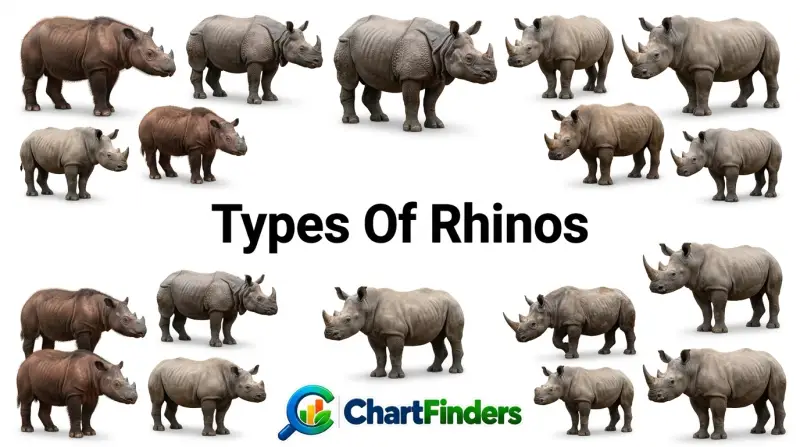
There are five living species of rhinos worldwide: the white rhino, black rhino, greater one-horned (Indian) rhino, Javan rhino, and Sumatran rhino. Together, fewer than 28,000 individuals remain globally. They are divided geographically across Africa and Asia, split into browsers and grazers based on lip morphology, and categorized by either one or two horns. Both the Javan and Sumatran rhinos are critically endangered.
Rhinoceroses represent some of the most iconic yet imperiled megafauna on Earth. These massive perissodactyls (odd-toed ungulates) have walked the planet for millions of years, evolving specialized morphologies that allow them to dominate diverse ecological niches ranging from African savannas to dense Asian tropical rainforests. However, centuries of intense poaching for their keratin horns and severe habitat fragmentation have pushed several species to the absolute brink of extinction. Understanding the distinct types of rhinos, their ecological roles, physiological adaptations, taxonomic classifications, and current conservation statuses is essential for anyone seeking to grasp modern wildlife management and conservation science.
Understanding the Five Surviving Types Of Rhinos
- Five Distinct Species: The rhinoceros family is represented today by five surviving species: White, Black, Greater One-Horned, Javan, and Sumatran.
- Global Population Crisis: Fewer than 28,000 rhinos remain across Africa and Asia combined, driven primarily by illegal poaching and habitat loss.
- Dietary Specialization: Species are broadly split into grazers (such as the wide-lipped white rhino), browsers (such as the hooked-lipped black and Sumatran rhinos), and mixed feeders (greater one-horned rhino).
- Horn Count Variability: African species and the Sumatran rhino possess two horns, while the Indian and Javan rhinos feature a single horn.
- Critical Conservation Extremes: Javan and Sumatran rhinos number fewer than 80 individuals each, making them among the rarest large mammals on Earth.
The family Rhinocerotidae is split into two distinct subfamilies (Rhinocerotinae and Dicerorhininae) and four extant genera (Ceratotherium, Diceros, Rhinoceros, and Dicerorhinus). Despite their heavy, armor-like skin and immense weight, rhinos are surprisingly agile and occupy vastly different ecosystems. To fully understand the diversity within this lineage, we must examine each species individually, noting their morphology, behavior, and unique evolutionary adaptations.
| Species | Scientific Name | Region | Horns | Diet Type | Estimated Global Population (2026) | IUCN Status |
|---|---|---|---|---|---|---|
| White Rhino | Ceratotherium simum | Sub-Saharan Africa | 2 | Grazer (broad square lip) | ~16,800 | Near Threatened |
| Black Rhino | Diceros bicornis | Eastern & Southern Africa | 2 | Browser (hooked lip) | < 6,500 | Critically Endangered |
| Greater One-Horned | Rhinoceros unicornis | Northern India & Nepal | 1 | Mixed Feeder | ~4,000 | Vulnerable |
| Javan Rhino | Rhinoceros sondaicus | Java, Indonesia | 1 (Females often hornless) | Browser | < 80 | Critically Endangered |
| Sumatran Rhino | Dicerorhinus sumatrensis | Sumatra & Borneo | 2 | Browser | < 50 | Critically Endangered |
The table above outlines the core taxonomic, geographic, and demographic metrics of all five surviving rhino species. Each species has adapted specialized physical traits to survive in its particular environment, from the broad, grass-clipping lips of the white rhino to the prehensile, twig-grasping lips of the black rhino.
1. The White Rhino (Ceratotherium simum)
Despite its name, the white rhino is actually slate-grey to yellowish-brown in color. The name is widely believed to be an anglicization of the Dutch word wijd, meaning “wide,” which early Dutch settlers used to describe its broad, flat, square-shaped mouth. This mouth morphology is an evolutionary masterpiece for grazing; it acts like a lawnmower, allowing the animal to sweep across short savanna grasses with maximum efficiency.
White rhinos are the largest of all rhino species. Adult males can weigh up to 2,300 kilograms (5,000 pounds) or more. They are divided into two distinct subspecies: the Southern white rhino (Ceratotherium simum simum) and the Northern white rhino (Ceratotherium simum cottoni). While the Southern white rhino population rebounded significantly through aggressive conservation efforts—moving away from the brink of extinction in the late 19th century when numbers dipped below 100 individuals—the Northern white rhino is functionally extinct, with only two known female individuals (Najin and Fatu) remaining under 24-hour armed guard at Ol Pejeta Conservancy in Kenya.
- Social Structure: Highly social compared to other species, often forming groups known as “crashes” that can number up to 14 individuals. Females and their calves maintain loose bonds, and dominant territorial males defend home ranges using intensive scent-marking via dung middens.
- Habitat: Open tropical and subtropical grasslands, savannas, and shrublands of Southern and East Africa.
2. The Black Rhino (Diceros bicornis)
The black rhino shares the same grey skin color spectrum as its white cousin, but its behavior, ecology, and facial anatomy are radically different. The black rhino is a browser rather than a grazer. Its defining physical feature is a prominent, pointed, hooked upper lip, which acts like a finger to grasp leaves, twigs, and branches from woody bushes, woody herbs, and trees.
Black rhinos are smaller and more agile than white rhinos, possessing a distinct shoulder hump, a more concave back, and two horns (occasionally a third smaller posterior horn). They are notoriously high-strung, independent, and quick to react when startled or cornered, a behavioral trait linked to their poor eyesight and reliance on acute hearing and a powerful sense of smell.
- Subspecies Diversity: Historically divided into four recognized subspecies based on geographic distribution: South-central (Diceros bicornis minor), South-western (Diceros bicornis bicornis), Eastern (Diceros bicornis michaeli), and West African (Diceros bicornis longipes—which was officially declared extinct in 2011).
- Conservation Status: Highly vulnerable to poaching due to high demand for their horns in illicit international markets. Total wild numbers sit below 6,500, keeping them classified as critically endangered, though targeted protection has allowed modest growth in specific strongholds across South Africa, Namibia, Kenya, and Zimbabwe.
3. The Greater One-Horned Rhino (Rhinoceros unicornis)
Also known as the Indian rhinoceros, the greater one-horned rhino is native to the Indian subcontinent, specifically inhabiting the alluvial tall-grass grasslands and swamp forests of the Himalayan foothills in India and Nepal. It is the largest of the Asian rhino species.
Visually, the greater one-horned rhino looks like a prehistoric creature wearing heavy combat armor. Its thick, silver-brown skin forms deep folds across its shoulders, back, and rump, creating the illusion of studded plates connected by softer pinkish skin underneath. Both males and females possess a single black horn, which usually grows between 8 and 25 inches in length.
- Diet and Foraging: Primarily a mixed feeder with a strong preference for grazing, it feeds on tall elephant grass, reeds, leaves, and aquatic plants. They also frequently raid agricultural crops adjacent to protected parks, leading to human-wildlife conflict.
- Conservation Success Story: Thanks to strict anti-poaching patrols, community-based conservation, and intensive habitat management in parks like Kaziranga National Park and Manas National Park in India, as well as Chitwan National Park in Nepal, the greater one-horned rhino has rebounded from fewer than 200 individuals in the early 20th century to approximately 4,000 today. Its IUCN status was successfully upgraded from Endangered to Vulnerable.
4. The Javan Rhino (Rhinoceros sondaicus)
The Javan rhino is widely considered one of the rarest large mammals on the face of the planet. With an estimated global population hovering below 80 individuals confined entirely to a single protected peninsula in Ujung Kulon National Park on the island of Java, Indonesia, this species faces severe extinction risks from disease outbreaks, natural disasters, invasive plant species (like the Arenga palm), and inbreeding depression.
Morphologically similar to the greater one-horned rhino, the Javan rhino is slightly smaller and features a distinctive mosaic pattern of skin polygons that resemble heavy armor plating. A key identification trait is that male Javan rhinos possess a single horn (rarely exceeding 10 inches), while females are generally hornless or carry only a tiny, non-functional bump.
- Habitat Requirements: Dense lowland tropical rainforests, wet grasslands, and expansive floodplain areas rich in permanent mud wallows and water sources.
- Vulnerability: Because the entire global population lives within the shadow of the highly active Anak Krakatoa volcano and coastal tsunami zones, conservationists constantly worry that a catastrophic natural event could wipe out the entire species overnight, making the establishment of a second secure breeding population an urgent, ongoing priority.
5. The Sumatran Rhino (Dicerorhinus sumatrensis)
The Sumatran rhino is the smallest living rhino species and the sole surviving representative of the ancient lineage of hairy rhinos (subfamily Dicerorhininae) that once coexisted with woolly rhinos (Coelodonta antiquitatis) during the Pleistocene epoch. Relict populations survive in isolated, heavily guarded pockets of Sumatra and Indonesian Borneo (Kalimantan).
Unlike their naked, thick-skinned African and Indian relatives, Sumatran rhinos are covered in a sparse coat of reddish-brown hair, which can be surprisingly dense in juveniles and sub-adults. They possess two horns, with the front horn being significantly larger (often up to 10–15 inches) than the rear button-like horn.
- Vocal Communication: Sumatran rhinos are exceptionally vocal animals, communicating across dense rainforest undergrowth using a bizarre repertoire of whines, groans, panting snorts, and high-pitched whistles known as “whale-like” calls.
- Extinction Crisis: Numbering fewer than 50 individuals, the species is severely fragmented into isolated pockets. Extremely low wild population densities prevent individuals from naturally finding mates in the wild, requiring intensive collaborative captive and semi-wild breeding programs (such as the Sumatran Rhino Sanctuary in Way Kambas National Park) to keep the lineage from crossing into total extinction.
Evolutionary Adaptations and Physical Differences
The five surviving rhino species represent millions of years of specialized anatomical and behavioral evolution. When comparing these animals, scientists look closely at three major phenotypic axes: lip structure, horn morphology, and skin adaptation.
Browsers vs. Grazers: Mouth Morphology
The shape of a rhino’s mouth dictates its ecological niche and prevents direct competition for food resources when species overlap:
- Square Lips (Grazers): The white rhino possesses a wide, flat upper lip. This is optimized for mowing down low-growing grasses in open savannas with sweeping horizontal bites.
- Hooked Lips (Browsers): Black, Javan, and Sumatran rhinos feature a prehensile, pointed upper lip designed to hook foliage, strip leaves from branches, and select specific nutritious plant shoots from woody vegetation.
- Semi-Prehensile Lips (Mixed Feeders): The greater one-horned rhino uses a pointed upper lip to grasp tall grasses and aquatic vegetation, operating as an intermediate feeder.
Skin and Thermoregulation
Rhinos lack efficient sweat glands across most of their bodies, making wallowing in mud and water an essential thermoregulatory behavior. Mud coats their skin, protecting them from intense solar radiation, insect bites, and overheating. African rhinos (white and black) lack prominent skin folds and rely on mud baths, shade, and dusting. In contrast, Asian rhinos (greater one-horned, Javan, and Sumatran) feature deep, articulated skin folds that act like accordion joints, allowing flexibility while providing tough physical defense against dense jungle vegetation and predators like tigers.
Global Rhino Distribution and Population Dynamics
The geographic distribution of rhinos has contracted dramatically over the last two centuries. Once roaming widely across Europe, Asia, and Africa, wild rhinos are now restricted to isolated national parks, private reserves, and heavily guarded sanctuaries.
| Continent | Species Present | Primary Strongholds | Main Threat Factors |
|---|---|---|---|
| Africa | White Rhino, Black Rhino | South Africa, Namibia, Kenya, Zimbabwe | Commercial poaching for horn, organized crime syndicates |
| Asia | Greater One-Horned, Javan, Sumatran | India, Nepal, Indonesia | Habitat loss, agricultural encroachment, extreme demographic isolation |
The split between African and Asian conservation landscapes highlights different sets of management challenges. In Africa, vast open reserves require anti-poaching aviation units, tracking dogs, and de-horning programs to deter poachers. In Asia, dense tropical rainforests make monitoring animals like the Javan and Sumatran rhinos exceptionally difficult, relying heavily on camera traps, DNA analysis of dung, and round-the-clock protection units.
Common Misconceptions About Rhinoceroses
Because rhinos are reclusive and heavily mythologized in global culture, several persistent myths surround their biology and behavior:
- Myth: Rhino horns are made of bone or ivory.
Fact: Rhino horns are composed entirely of keratin—the same fibrous structural protein found in human fingernails, hair, and animal hooves. Elephant tusks, by contrast, are modified incisor teeth made of ivory. The center of a rhino horn is softer, packed with melanin and calcium, which causes it to wear away into a sharp point naturally. - Myth: Rhinos are naturally aggressive toward humans without cause.
Fact: Rhinos have notoriously poor eyesight and often rely on sound and scent. When startled, confused, or threatened, a rhino’s defensive instinct may trigger a blind, high-speed charge, but they do not view humans as prey items. - Myth: All rhinos possess two horns.
Fact: While African species and the Sumatran rhino have two horns, both the greater one-horned rhino and the Javan rhino possess only a single horn. , female Javan rhinos are often entirely hornless.
Frequently Asked Questions
What is the difference between a black rhino and a white rhino?
The primary differences lie in their diet and mouth shape. The white rhino is a grazer with a wide, square lip optimized for eating short grass. The black rhino is a browser with a pointed, hooked upper lip used for plucking leaves from bushes and trees. Both species are actually grey in color; the name “white” derives from a mistranslation of the Dutch word for “wide.”
Which rhino species is the rarest in the world?
The Sumatran rhino and the Javan rhino are tied as the rarest large mammals on Earth. Fewer than 50 Sumatran rhinos survive in fragmented rainforest pockets, while fewer than 80 Javan rhinos survive exclusively within Ujung Kulon National Park in Indonesia.
Are rhino horns made of ivory?
No. Elephant tusks are made of ivory (modified teeth), whereas rhino horns are composed of compacted keratin, the same protein that forms human hair and fingernails.
Can rhino horns grow back if removed?
Yes. Because the horn grows continuously from the base of the skull throughout the animal’s life (growing approximately 2 to 3 inches per year), a trimmed horn will gradually regenerate, much like human hair or nails.
Why do rhinos roll in mud?
Rhinos lack efficient sweat glands and use mud wallows to cool their massive bodies. The dried mud layer also acts as a natural sunscreen protecting their sensitive skin from sunburn and forming a physical barrier against biting insects.
Conclusion
The surviving types of rhinos represent irreplaceable links to ancient mammalian history. From the savanna-roaming white and black rhinos of Africa to the armored greater one-horned rhinos of Nepal and India, and the elusive forest-dwelling Javan and Sumatran rhinos of Indonesia, each species fulfills a vital ecological role. Ensuring the survival of these magnificent creatures requires unwavering international cooperation, rigorous anti-poaching enforcement, habitat preservation, and active community engagement to secure a stable future for the world’s remaining rhinoceros populations.