
Discovering a concealed cluster of small speckled treasures tucked inside a nesting box, under a roof eave, or within a dense hedge is an experience that sparks immediate curiosity for backyard naturalists and ornithologists alike. Egg identification is an and rewarding branch of avian study, requiring close attention to subtle physical parameters such as exact dimensions, background pigmentation, spotting patterns, and the architecture of the surrounding nest. Among urban and suburban birds, the house sparrow is one of the most prolific occupants of artificial cavities and crevices. Understanding the precise biometric and morphological markers of house sparrow eggs prevents misidentification with native cavity-nesting species, ensuring that backyard observers can accurately document nesting activity while managing conservation priorities for native wildlife.
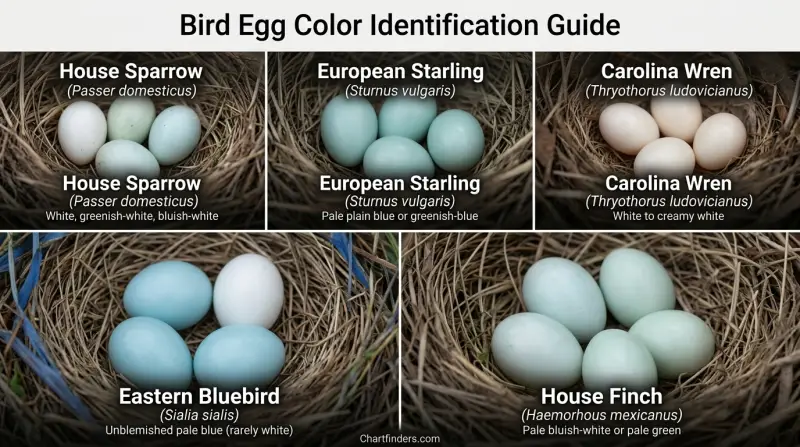
House Sparrow Bird Egg Identification Chart
- House sparrow eggs measure approximately 20–22 mm long and 14–16 mm wide, presenting an oval to short-subelliptical shape.
- Background shell coloration ranges widely from pure white to pale greenish-white, greyish-white, or faint bluish-white.
- Markings consist of dense speckles, spots, or blotches of dark brown, grey, and black, frequently forming a heavy crown or cap at the broader end.
- Clutch size is variable, typically consisting of 4 to 6 eggs, though ranges of 1 to 8 eggs are documented.
- Incubation lasts between 10 and 14 days, shared closely by both male and female parents.
- Nests are notoriously messy, dome-shaped structures constructed from coarse straw, grass, and scrap materials lined with feathers and string.
- House sparrows are non-native in North America and many other regions, often competing aggressively with protected native cavity nesters.
Accurate identification of avian eggs requires a systematic approach that pairs physical metrics with contextual clues. Because many passerine species share similar nesting habitats in suburban gardens and agricultural edges, visual inspection alone can sometimes lead to confusion. The following comparative matrix outlines the primary dimensional and morphological properties of house sparrow eggs alongside common garden look-alikes, providing a reliable diagnostic reference.
Explore our detailed breakdown on Shore Bird Identification Chart [Full Reference Chart].| Species | Average Length (mm) | Average Width (mm) | Background Color | Primary Markings | Clutch Size |
|---|---|---|---|---|---|
| House Sparrow (Passer domesticus) | 20 – 22 | 14 – 16 | White, greenish-white, bluish-white | Brown/grey spots, often heavier at blunt end | 4 – 6 (range 1–8) |
| European Starling (Sturnus vulgaris) | 26 – 32 | 20 – 22 | Pale plain blue or greenish-blue | Usually unspotted; occasionally faint reddish dots | 4 – 6 |
| Carolina Wren (Thryothorus ludovicianus) | 16 – 19 | 13 – 14 | White to creamy white | Reddish-brown speckles concentrated heavily at large end | 4 – 7 |
| Eastern Bluebird (Sialia sialis) | 20 – 24 | 16 – 18 | Unblemished pale blue (rarely white) | Unspotted | 4 – 5 |
| House Finch (Haemorhous mexicanus) | 17 – 20 | 13 – 15 | Pale bluish-white or pale green | Sparse fine black or brown dots/scrawls at large end | 4 – 6 |
How to read this table: Use length and width measurements as your primary elimination filter, then cross-reference background shell color and pigment distribution. Note that while house sparrow eggs overlap in size with bluebirds and finches, their heavy, variable speckling immediately distinguishes them from immaculate bluebird eggs.
Biometric Profiles and Morphological Variations
House sparrow eggs are remarkably variable, a trait that often complicates strict identification keys. Unlike cavity nesters that lay uniform, immaculate eggs, Passer domesticus exhibits high intra-specific variation driven by female age, diet, and seasonal timing. The shell surface is generally smooth with a slight gloss, though worn or thin-shelled specimens may appear chalky or matte.
The standard shape is oval, occasionally tending toward short-subelliptical. The pigment patterns are deposited onto the shell prior to laying within the oviduct. Primary markings consist of shades of dark brown, sepia, grey, and occasionally black. Secondary shell markings—subsurface spots that appear washed-out or grey—frequently underlie the sharper surface spots, creating a layered, textured visual depth.
Sub-Regional and Seasonal Pigment Shifts
Research across different geographic populations reveals subtle shifts in coloration intensity. Clutches laid early in the breeding season (typically March through April in temperate zones) often feature deeper, richer melanin deposition, yielding bold, dark brown blotches. Later summer clutches may show paler, sparser speckling as maternal calcium and pigment reserves become depleted through multiple broods.
Nesting Environment and Architectural Context
An egg is rarely found in total isolation; examining the surrounding nest structure provides definitive corroboration. House sparrows are opportunistic nest-builders that prefer enclosed cavities, street lamps, building soffits, dense evergreen hedges, and standard wooden bird boxes.
- Shape and Structure: In cavities, they construct a bulky, untidy mass of dried grasses, straw, weeds, and rootlets. When nesting in open branches, they build a distinctive domed, globular nest with a side entrance hole.
- Lining Materials: The interior cup is characteristically lined with soft materials, including domestic feathers, animal hair, yarn, string, paper scraps, and cotton thread.
- Clutter and Debris: The presence of discarded trash, cigarette filters, or synthetic insulation within the nesting matrix is a strong indicator of house sparrow architecture over native cavity nesters like bluebirds or tree swallows.
Breeding Biology, Clutch Dynamics, and Incubation
Understanding the reproductive timeline of house sparrows helps observers determine whether an active nest is nearing completion or has been abandoned. House sparrows are prolific breeders, capable of producing up to four successful broods per year in optimal urban and agricultural environments.
- Egg Laying: Females typically lay one egg per day during early morning hours until the clutch is complete. Clutch size normally spans 4 to 6 eggs, though extreme environmental pressures or nest-dumping by rival females can result in clutches ranging from 1 to 8 eggs.
- Incubation Onset: Full-time incubation generally commences only after the final egg is laid, ensuring that all chicks hatch synchronously within a 24- to 36-hour window.
- Incubation Duration: Both the male and female share incubation duties, though the female performs the majority of night-time brooding. The incubation period spans 10 to 14 days.
- Fledging: Once hatched, nestlings remain in the cavity for 14 to 17 days, fed heavily on a diet of insects during early life before transitioning to seeds and grains.
Common Identification Mistakes and Look-Alike Species
Because house sparrows share human-altered habitats with numerous other granivorous and insectivorous passerines, amateur naturalists frequently misidentify their clutches. Distinguishing between similar eggs requires careful attention to minute diagnostic traits.
House Sparrow vs. House Finch
House finches (Haemorhous mexicanus) frequently nest in ornamental garden shrubs, building vents, and hanging planters—habitats overlapping with house sparrows. While house finch eggs are close in size (17–20 × 13–15 mm), their background color is typically a cleaner, paler greenish-blue, and their speckling is much finer, restricted almost exclusively to sparse, hair-like scrawls or tiny dots concentrated around the blunt pole.
House Sparrow vs. Carolina Wren
Carolina wrens build domed, messy nests in similar cavity locations. Their eggs are smaller (16–19 × 13–14 mm) and feature a distinct pinkish-white or creamy background densely covered in reddish-brown freckles rather than the dark grey-brown blotches characteristic of sparrows.
House Sparrow vs. European Starling
Starlings share the preference for building bulky nests inside large cavities and bird boxes. However, starling eggs are substantially larger (26–32 × 20–22 mm) and feature an immaculate, unspotted pale blue or greenish-blue shell that lacks any brown or grey markings.
Conservation, Legal Status, and Backyard Management
An essential element of house sparrow egg identification involves understanding the ecological context of the species. Passer domesticus is native to Eurasia and parts of North Africa. Following intentional and accidental introductions across the globe—most notably in North America during the 19th century—the species established massive feral populations.
Because house sparrows are non-native, highly aggressive competitors that frequently evict protected native cavity nesters (such as bluebirds, tree swallows, and titmice) by destroying their eggs, killing nestlings, and attacking brooding adults, wildlife management protocols differ significantly from native species.
- Legal Protections: In many jurisdictions, including the United States and Canada, house sparrows, their nests, and their eggs are not protected by federal migratory bird acts, allowing landowners to manage active nests in backyard nest boxes.
- Ethical Observation: Observers should confirm positive identification before taking any management action, ensuring that native species are never accidentally disturbed or displaced.
Frequently Asked Questions
House sparrow eggs vary considerably in color. The background is typically white, pale greyish-white, greenish-white, or bluish-white. The shell is heavily marked with spots, speckles, or blotches ranging from dark brown and sepia to grey, often forming a dense crown around the wider end of the egg.
They are relatively small, oval-shaped eggs measuring approximately 20 to 22 millimeters in length and 14 to 16 millimeters in width. They are roughly the size of a small grape or a shelled peanut.
A standard clutch contains 4 to 6 eggs, though clutches can range from 1 to 8 eggs depending on the female’s age, the season, and resource availability.
The incubation period lasts between 10 and 14 days. Both parents share incubation responsibilities, though the female spends more time brooding, especially overnight.
Novice observers sometimes confuse them due to overlapping size parameters, but eastern bluebird eggs are immaculate, unspotted pale blue (rarely white), whereas house sparrow eggs are heavily speckled with brown and grey markings.
In North America and several other introduced regions, house sparrows are classified as non-native pest species. Consequently, their nests, eggs, and adults do not receive federal protection under wildlife conservation acts, unlike native cavity-nesting birds.
Mastering house sparrow egg identification equips backyard bird enthusiasts with the observational skills necessary to interpret avian behavior, understand local ecology, and manage nest box environments effectively. By carefully evaluating dimensions, background shell tints, pigment speckling, and nest architecture, observers can reliably distinguish Passer domesticus from native garden visitors.