
Few backyard visitors command as much fascination as hummingbirds. Their hyper-metabolic hovering, iridescent plumage, and astonishing migratory feats captivate millions of bird enthusiasts each year. Yet, identifying these tiny dynamos can quickly transition from a delightful pastime into a frustrating guessing game. Most North American species measure a mere 3 to 5 inches in length, and many share near-identical shades of metallic green back feathers. To complicate matters further, adult females and juvenile birds often lack the brilliant gorget colors that make adult males so easy to spot.
When multiple species overlap geographically during peak spring and fall migration windows, relying on general impressions is rarely enough. Accurate identification requires breaking down subtle morphological traits: measuring bill length and curvature relative to the head, examining tail feather (retrix) shapes, and observing flight behavior or vocalizations. This master guide and reference chart provides a comprehensive framework for decoding hummingbird anatomy, separating tricky look-alikes, and tracking species across geographic and seasonal ranges.
Explore our detailed breakdown on Quail Bird Lifespan.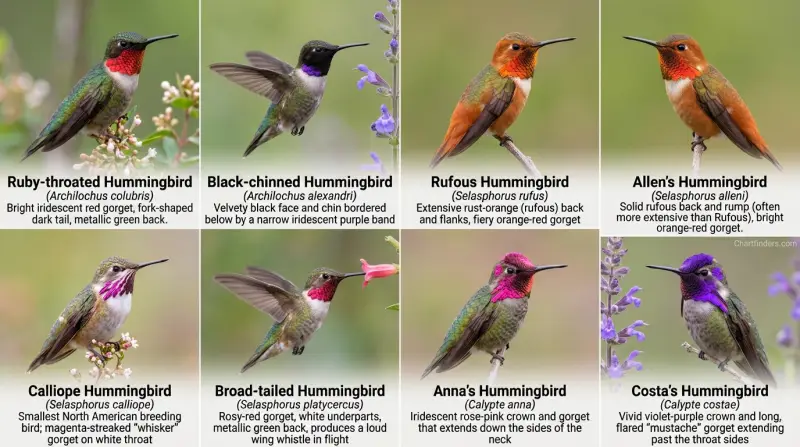
Hummingbird Identification Chart
- Anatomical Markers Matter Most: Plumage fades in different light conditions, but structural elements like bill length, bill curve, and tail shape remain constant across lighting variations.
- Sexual Dimorphism and Age Variations: Adult males are frequently the easiest to identify due to iridescent throat patches (gorgets), whereas females and juveniles often require close inspection of flank markings and tail tip patterns.
- Geographic Range is a Filtering Tool: Knowing which species naturally occur in your region during specific calendar months eliminates dozens of unlikely identification possibilities.
- Migration Timing Correlates with Geography: Tracking arrivals through citizen-science migration maps helps predict when transient species will pass through local backyards.
- Look-Alike Differentiation: Species such as the Ruby-throated and Black-chinned, or the Rufous and Allen’s, require meticulous side-by-side comparison of wingtip shapes and tail feathers.
- Behavioral Clues Support Visual Data: Aggressive hovering, tail pumping, and distinct mechanical wing sounds (such as the high-pitched whistle of a Broad-tailed hummingbird) provide vital context in the field.
Understanding Hummingbird Anatomy for Field Identification
Before diving into specific species comparisons, understanding the fundamental topography of a hummingbird is essential. Every identification chart relies on specific anatomical zones. The most critical regions for field work include the gorget (the patch of iridescent throat feathers found primarily in males), the bill (length, width, and straightness versus curvature), the flanks (sides of the body, which can be green, gray, rufous, or speckled), and the tail (whether feathers are squared, notched, rounded, or sharply pointed).
Lighting conditions drastically alter how gorget colors appear. In low light or overcast conditions, a Ruby-throated hummingbird’s throat may look entirely black or dark gray. Only when light strikes the feathers at a precise angle does the fiery ruby-red iridescence ignite. Consequently, field observers must train themselves to look past color when necessary and focus on structural morphology, proportions, and pattern distribution.
Comprehensive North American Hummingbird Species Comparison Chart
The following reference table organizes the most common North American hummingbird species by physical dimensions, key field marks, and primary geographic distribution. Use this matrix to quickly cross-reference observed traits against likely species candidates.
| Species | Average Length | Primary Male Field Marks | Female & Juvenile Identifiers | Key Tail/Wing Clues | Primary Range & Seasonality |
|---|---|---|---|---|---|
| Ruby-throated Hummingbird (Archilochus colubris) | 3.5 inches | Bright iridescent red gorget, fork-shaped dark tail, metallic green back. | White throat, rounded tail with white tips on outer feathers, grayish-green back. | Outer tail feathers rounded; wings fold just short of tail tip. | Eastern & Central North America (Spring/Summer); winters in Central America. |
| Black-chinned Hummingbird (Archilochus alexandri) | 3.5 inches | Velvety black face and chin bordered below by a narrow iridescent purple band. | Grayish-white throat (sometimes lightly spotted), rounded tail with white outer tips. | Very similar to Ruby-throated; inner primaries sometimes narrowed in males. | Western North America, expanding into desert riparian zones and urban areas. |
| Rufous Hummingbird (Selasphorus rufus) | 3.25–3.75 inches | Extensive rust-orange (rufous) back and flanks, fiery orange-red gorget. | Green crown and back, rufous washed flanks, white throat with green/bronze flecks. | Rusted tail feathers with dark central markings; wingtips show noticeable tapering. | Pacific Northwest breeding; epic migration through Rockies to Gulf Coast/Southeast in winter. |
| Allen’s Hummingbird (Selasphorus alleni) | 3.25 inches | Solid rufous back and rump (often more extensive than Rufous), bright orange-red gorget. | Nearly identical to female Rufous; requires examination of tail feather width. | Narrowed outer tail feathers (R5 is significantly thinner than in Rufous). | Coastal California and Oregon (Resident/Breeding); winters primarily in central Mexico. |
| Calliope Hummingbird (Selasphorus calliope) | 3.0 inches | Smallest North American breeding bird; magenta-streaked “whisker” gorget on white throat. | Short, squared tail with dark central feathers and white-tipped outer feathers; green back. | Extremely short tail and wings that project past tail tip when perched. | Mountainous regions of Western North America; winters in Mexico. |
| Broad-tailed Hummingbird (Selasphorus platycercus) | 4.0 inches | Rosy-red gorget, white underparts, metallic green back, produces a loud wing whistle in flight. | White throat with dark flecks, rounded tail with white tips, green flanks. | Wings produce a distinct metallic trill/whistle during flight; broader tail structure. | High-elevation forests of the Intermountain West and Rocky Mountains. |
| Anna’s Hummingbird (Calypte anna) | 4.0 inches | Iridescent rose-pink crown and gorget that extends down the sides of the neck. | Grayish throat with occasional pink flecks, green back, straight medium bill. | Squared tail; lack of rufous coloring separates it from western migratory species. | Pacific Coast from British Columbia down to Baja California (year-round resident). |
| Costa’s Hummingbird (Calypte costae) | 3.0–3.5 inches | Vivid violet-purple crown and long, flared “mustache” gorget extending past the throat sides. | Plain grayish throat, short green tail, greenish-gray flanks, short straight bill. | Short tail does not reach wingtips when perched; flared gorget sides are diagnostic. | Desert scrublands of the Southwestern US and Northwestern Mexico. |
When analyzing the table above, note how subtle differences in geographic range and physical dimensions separate species that otherwise share general color palettes. For instance, while both the Rufous and Allen’s hummingbirds feature extensive rust-colored plumage, their breeding and migration corridors, combined with microscopic tail feather width variations, are the definitive keys to separation.
Visualizing Regional Diversity and Migration Patterns
To better understand how hummingbird species distribute across North America, population concentrations and seasonal migration waves provide a helpful macro-view. The following conceptual breakdown illustrates the distribution density of dominant species across geographic zones.
| Geographic Region | Dominant Breeding Species | Primary Wintering / Resident Species | Key Migration Peak Months |
|---|---|---|---|
| Eastern North America | Ruby-throated Hummingbird | Rare winter visitors (Rufous, Calliope along Gulf Coast) | April–May (Spring); August–October (Fall) |
| Pacific Coast (PNW to California) | Rufous, Allen’s, Anna’s, Calliope | Anna’s Hummingbird (Year-round resident) | February–April (Spring); July–September (Fall) |
| Rocky Mountains / Intermountain West | Broad-tailed, Calliope, Rufous, Black-chinned | Limited resident populations | May–June (Spring); August–September (Fall) |
| Southwestern Deserts | Black-chinned, Costa’s, Broad-tailed | Anna’s, Costa’s, Rufous (wintering) | March–April (Spring); July–October (Fall) |
Deep Dive: Separating Tricky Hummingbird Look-Alikes
The greatest challenge in hummingbird identification lies in untangling groups of species that exhibit high phenotypic similarity. Field guides frequently group these into complex identification challenges where microscopic details dictate correct classification.
Ruby-throated vs. Black-chinned Hummingbirds
Across eastern and central North America, the Ruby-throated hummingbird reigns supreme. However, as ranges overlap in the Great Plains and parts of Texas, distinguishing female and juvenile Ruby-throated hummingbirds from Black-chinned hummingbirds becomes exceedingly difficult.
- Bill Characteristics: Black-chinned hummingbirds tend to have a slightly longer, often perceptibly drooped bill tip compared to the relatively straight, stout bill of the Ruby-throated.
- Facial Pattern: Black-chinned females often display a slightly darker gray cheek patch that contrasts more sharply with the throat than the cleaner, paler face of a female Ruby-throated.
- Wing Extension: When perched, the wingtips of a Black-chinned hummingbird extend just slightly further past the tail tip than those of a Ruby-throated.
- Vocalization: The call note of a Black-chinned is a dry, soft purr, whereas the Ruby-throated emits a higher-pitched, more rapid series of chipping notes.
Rufous vs. Allen’s Hummingbirds
The Selasphorus genus contains some of the most notoriously difficult identification puzzles in North American ornithology. Adult male Rufous hummingbirds feature a brilliant rust-colored back, but roughly 20% of adult males also display green backs, making them virtually indistinguishable from Allen’s hummingbirds in the field.
Females and juveniles of both species possess green crowns and backs, washed rufous flanks, and white throats. To separate them with 100% certainty:
- Examine the Tail Feathers: In an adult male Allen’s hummingbird, the fifth (outermost) retrix is dramatically narrowed—often appearing toothpick-thin. In a Rufous hummingbird, that same feather is significantly broader.
- Check the Rump: Allen’s hummingbirds almost invariably have a solid green rump (lower back), whereas adult male Rufous hummingbirds display a completely rufous back and rump. However, green-backed Rufous males complicate this rule, making tail inspection mandatory.
- Geographic Probability: If you are observing a rust-colored hummingbird along the immediate coastline of central California during breeding season, it is almost certainly an Allen’s. If you spot one migrating through the high Rockies in August, it is almost certainly a Rufous.
Calliope vs. Broad-tailed vs. Other Mountain Dwellers
High-altitude environments in the western United States often host three or four small hummingbird species simultaneously. The Calliope hummingbird—weighing barely as much as a penny—is easily recognized by its tiny size, short tail, and distinct magenta throat streaks that form a spreading fan rather than a solid bib. By contrast, the Broad-tailed hummingbird is noticeably larger, with a longer tail and a distinct metallic wing whistle that sounds remarkably like a buzzing insect.
Step-by-Step Field Identification Process
When you spot a hummingbird darting near a feeder or tubular perennial, follow this systematic four-step identification framework to narrow down the species rapidly.
Step 1: Determine Gender and Age Class
Look immediately at the throat. Does the bird display a brilliant, glowing gorget of ruby, magenta, violet, or orange-red? If yes, you are almost certainly looking at an adult male. If the throat is plain white, grayish, or lightly speckled with dark spots, you are observing an adult female or a juvenile bird. Note that juvenile males often show patchy gorget development (scattered metallic feathers appearing mid-season).
Step 2: Evaluate Body Shape and Proportions
Assess the overall bulk of the bird. Is it compact and short-tailed (like the Calliope or Costa’s), or longer and more robust (like the Anna’s or Broad-tailed)? Observe the bill length relative to the head: short and straight, or long and slightly decurved? Check whether the wings extend past the tail tip when the bird is perched at rest.
Step 3: Analyze Plumage and Color Distribution
Scan the back and flanks. Is the upper body entirely metallic green, or is there extensive rust-orange (rufous) coloring on the flanks and back? Check the tail feather pattern: are there white tips on the outer corners? Do the tail feathers show dark bands or rust-red bases?
Step 4: Factor in Location and Season
Consult a seasonal migration map for your specific coordinates. If it is November in New England, a visiting hummingbird is almost certainly a vagrant Rufous or Selasphorus species, not a Ruby-throated (which departs for the tropics by October). Geographic context eliminates impossible options instantly.
Common Identification Mistakes and Pitfalls
Even experienced birders occasionally misidentify hummingbirds due to optical illusions and biological variables. Avoid these frequent errors:
- Assuming Gorget Color is Static: Failing to account for lighting angles. A black-looking throat can flash brilliant red or purple the moment the bird shifts its head relative to the sun. Always wait for a lighting shift before ruling out iridescent colors.
- Overlooking Immature Plumage: Assuming all birds visiting a feeder in summer are breeding adults. Juvenile birds often show blended characteristics, delayed gorget coloration, and retained juvenile wing feather shapes that confuse standard keys.
- Ignoring Geographic Anomalies: Assuming a bird cannot be a rare vagrant. Due to shifting migration patterns and winter feeding stations, western species (such as Rufous and Allen’s) regularly turn up in eastern states during late fall and winter.
- Confusing Wing Noise with Vocalization: Attributing mechanical wing sounds (such as the high-pitched whistle generated by the wingtips of Broad-tailed or Rufous hummingbirds) to vocal singing. These sounds are aerodynamic vibrations created by air rushing over modified primary flight feathers.
Frequently Asked Questions
Adult males typically feature brilliant, iridescent throat patches (gorgets) in colors ranging from ruby-red and magenta to violet and orange, accompanied by sleek, clean plumage. Females and juveniles lack these bright throat patches, generally displaying plain white, grayish, or dark-spotted throats, and often possess white-tipped outer tail feathers that help them signal during courtship or aggressive displays.
Hummingbird gorget feathers are not pigmented with red or purple dyes. Instead, they contain microscopic air bubbles in the feather barbules that act as prisms, refracting light structurally. If light does not strike the gorget at a precise angle relative to the observer’s eye, the feathers absorb light and appear jet black or dark gray.
The Calliope hummingbird is the smallest breeding bird in North America, measuring approximately 3 inches in length and weighing between 2 and 3 grams. Despite its tiny stature, it undertakes one of the longest migratory journeys relative to body size of any bird in the world.
Hummingbirds migrate primarily during daylight hours. They travel relatively low to the ground, stopping frequently at flowering meadows, gardens, and backyard feeders to refuel on nectar and small insects before continuing their journey.
Different species produce distinct aerodynamic sounds with their wings during flight. Broad-tailed hummingbirds produce a sharp, high-pitched metallic trill or whistle. Rufous hummingbirds produce a distinct buzzing or winged hum, while Anna’s hummingbirds emit sharp, metallic chipping calls and a distinctive dive-display sound produced by air rushing through their tail feathers during aggressive aerial descents.
Conclusion
Mastering hummingbird identification requires a shift from casual observation to methodical analysis. By combining a solid understanding of anatomical topography—such as bill length, tail shape, and flank coloration—with regional and seasonal migration data, even the most elusive female or juvenile hummingbird can be classified with confidence. Keep a reliable identification chart nearby, pay close attention to structural morphology over shifting light conditions, and enjoy the remarkable diversity of these extraordinary avian visitors.