
The genus Hoya, belonging to the dogbane family Apocynaceae, comprises hundreds of species widely distributed across tropical and subtropical Asia, through the Malay Archipelago, to Australia and the Western Pacific. Known broadly as wax plants due to their thick, waxy foliage and porcelain-like star-shaped flower clusters, hoyas have captured the devotion of plant collectors worldwide. However, because hoyas frequently spend years in a vegetative juvenile state without blooming, enthusiasts and botanists alike must rely almost entirely on foliage to determine a plant’s identity.
This reliance introduces significant complexity. Many species exhibit high phenotypic plasticity, meaning leaf size, color intensity, and even shape can shift dramatically depending on light levels, humidity, temperature, and maturity. , natural hybridization and extensive selective breeding within horticulture have produced countless cultivars, sports, and complex crosses that blur classical botanical boundaries. To navigate this botanical labyrinth, one must move beyond casual glances and adopt a structured, analytical approach to foliar morphology.
Explore our detailed breakdown on White Mushroom Identification Chart (Complete Data Matrix).This master guide explores the anatomical intricacies of hoya foliage, deconstructs how to build and read a comparative identification framework, examines major leaf variations across the genus, and highlights the practical methodologies required to decode even the most challenging specimens in your collection.
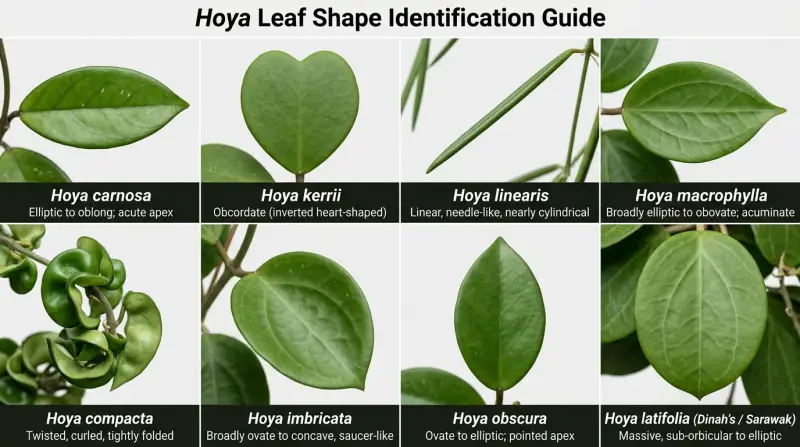
Hoya Leaf Identification Chart
- No Single Universal Chart Exists: Due to phenotypic plasticity and over 300+ species, identification requires evaluating a matrix of traits rather than matching a single picture.
- The Five Core Traits: Accurate classification relies on leaf shape/apex/base, texture/succulence, venation patterns, petiole characteristics, and new growth coloration.
- Phenotypic Plasticity: Environmental factors such as intense light (sun-stressing) and drought can alter leaf coloration, thickness, and marginal curl.
- Juvenile vs. Adult Foliage: Many hoyas undergo dramatic heteroblasty, producing small, unremarkable juvenile leaves before developing massive, highly textured adult leaves.
- Taxonomic Verification: While foliar charts narrow down possibilities to a species complex, definitive botanical confirmation often requires examining floral structures (corolla, corona, and pollinia).
To approach hoya identification methodically, botanists and experienced growers utilize comparative matrices that break down physical specimens into distinct anatomical descriptors. Below is a comprehensive reference framework comparing classic, widely cultivated hoya species across their primary diagnostic foliar criteria.
| Species Name | Primary Leaf Shape | Texture & Thickness | Venation Visibility | Diagnostic Clues & Key Features |
|---|---|---|---|---|
| Hoya carnosa | Elliptic to oblong; acute apex | Fleshy, stiff, waxy, medium-thick | Faint; primary vein visible, laterals obscure | The classic wax plant; smooth margin, flat profile, silver flecking common under bright light. |
| Hoya kerrii | Obcordate (inverted heart-shaped) | Extremely thick, succulent, rigid | Obscure; sunken midrib on upper surface | Distinct notched apex resembling a Valentine’s heart; sold often as single rooted leaves (“sweethearts”). |
| Hoya linearis | Linear, needle-like, nearly cylindrical | Softly succulent, densely pubescent | Invisible due to narrow, folded leaf structure | Himalayan native with a pendulous, waterfall habit; fine white hairs cover the entire leaf surface. |
| Hoya macrophylla | Broadly elliptic to obovate; acuminate | Leathery, stiff, medium thickness | Prominent, highly visible palmate/reticulate veins | Striking light-green or creamy venation network contrasting against dark green or variegated margins. |
| Hoya compacta | Twisted, curled, tightly folded | Very thick, rigid, intensely waxy | Completely obscured by extreme foliar folding | Known as the Hindu Rope plant; leaves cup tightly inward, creating deep ripples and protective niches. |
| Hoya imbricata | Broadly ovate to concave, saucer-like | Thinly succulent, cupped downward | Faintly visible branching network | Myrmecophytic epiphyte; leaves press flat against tree trunks, overlapping like shingles to house ants. |
| Hoya obscura | Ovate to elliptic; pointed apex | Smooth, glossy, medium thickness | Visible, delicate parallel-lateral veins | Famous for extreme sun-stressing; leaves turn a vibrant red-orange, bronze, or peach in high light. |
| Hoya latifolia (Dinah’s / Sarawak) | Massive, sub-orbicular to elliptic | Leathery, rigid, exceptionally wide | Extremely prominent, deeply impressed venation | Produces some of the largest leaves in cultivation; prominent raised veins give a quilted appearance. |
Analyzing this table reveals why a single visual snapshot is insufficient. For instance, while Hoya carnosa and Hoya obscura share broadly elliptic shapes, their environmental reactions (sun-stressing in obscura) and subtle venation differences separate them. Utilizing a structured chart requires moving sequentially through distinct anatomical layers.
Anatomical Breakdown: The Five Non-Negotiable Identification Traits
When attempting to identify an unknown hoya, visual impressions can be deceiving due to environmental modifications. To achieve botanical accuracy, you must dissect the leaf into five primary morphological pillars. Each pillar provides filtering criteria that systematically narrow down the candidate species.
1. Geometry: Shape, Apex, and Base Morphology
The overall silhouette of a hoya leaf is defined by its geometric classification, coupled with the exact structure of its tip (apex) and point of attachment (base).
- Shape Categories: Hoyas display linear (needle-like), lanceolate (lance-shaped), elliptic (widest at the middle, tapering equally), oblong (parallel sides with rounded ends), ovate (egg-shaped, widest below the middle), obovate (inverted egg-shaped, widest above the middle), and cordate (heart-shaped) profiles.
- Apex Variations: The leaf tip can be acute (sharp point), acuminate (tapering into a long, drawn-out point), obtuse (bluntly rounded), retuse (notched inward slightly at the tip), or cuspidate (ending in a sharp, rigid point).
- Base Variations: Bases may be cuneate (wedge-shaped tapering), rounded, cordate (lobed inward around the petiole), or peltate (petiole attached to the center of the underside, as seen in species like Hoya darwinii).
2. Texture, Thickness, and Pubescence (Surface Anatomy)
The tactile quality of a hoya leaf reflects its evolutionary adaptations to moisture conservation in epiphyte-heavy rainforest canopies.
- Succulence: Ranging from paper-thin membranes (found in certain shaded understory species like Hoya campanulata) to ultra-thick, rock-hard blocks of water-storing tissue (such as Hoya pachyclada or Hoya kerrii).
- Cuticle Composition: A thick, waxy cuticle protects against intense tropical sun. Some leaves feel slick, polished, and glass-like, while others possess a matte, velvety, or suede-like finish.
- Pubescence: Hairs (trichomes) can be entirely absent (glabrous) or present in varying densities. Species like Hoya linearis, Hoya serpens, and Hoya pubicalyx feature fine indumentum ranging from sparse fuzz to a dense, woolly felt that captures morning dew and reduces transpiration.
3. Venation Patterns and Vascular Architecture
Venation is one of the most stable taxonomic indicators because internal vascular structure is less prone to temporary environmental fluctuations than outer coloration or leaf size.
- Pinnate Venation: A prominent central midrib runs from base to apex, with lateral veins branching off at regular intervals (common in Hoya carnosa and Hoya carnosa ‘Crimson Queen’).
- Palmate/Reticulate Venation: Multiple primary veins radiate outward from the petiole junction, creating a web-like network. This is heavily pronounced in large-leafed species such as Hoya macrophylla, Hoya latifolia, and Hoya finlaysonii, where the veins are often raised, sunken, or colored differently from the lamina.
- Obscure Venation: In heavily succulent or cylindrical species (like Hoya compacta or Hoya linearis), internal water storage completely masks vascular lines, leaving the surface smooth and featureless.
4. Petiole Structure and Stem Junctions
The petiole—the miniature stalk connecting the leaf blade to the main vine—holds valuable diagnostic secrets that are frequently overlooked by casual hobbyists.
- Length and Thickness: Petioles can range from virtually nonexistent (sessile leaves that clasp the stem directly) to elongated, slender, or thick and woody stalks.
- Coloration and Glands: Examine the point where the petiole meets the stem. Many hoyas possess tiny nectar-producing glands (extrafloral nectaries) on the upper surface of the petiole or base of the leaf blade. The coloration of the petiole—often flushing bright red, purple, or deep burgundy—frequently matches the coloration of young emergent leaves.
5. Ontogeny: Juvenile vs. Adult Foliage and Sun-Stressing
A major pitfall in hoya identification is failing to account for plant maturity and environmental exposure.
- Heteroblasty: Many climbing hoyas produce tiny, scale-like, or narrow juvenile leaves while creeping up a dark tree trunk. Once the vine reaches the canopy and experiences high light, it undergoes a radical morphological shift, producing massive, heavily textured adult leaves.
- Sun-Stressing: Anthocyanin production in response to high ultraviolet radiation can transform plain green leaves into striking canvases of bronze, purple, pink, or neon orange. A green-leafed cutting of Hoya obscura or Hoya vitellinoides looks vastly different from a high-light specimen, making baseline identification tricky without knowing growing conditions.
Major Hoya Foliage Groupings for Rapid Identification
To make identification practical in real-world settings, it is helpful to group hoyas into macro-categories based on their dominant visual and structural attributes. When encountering an unidentified specimen, determine which of the following five morphological archetypes it fits into before narrowing down the specific species.
Archetype A: The Succulent & Geometric Group
Characterized by extreme water retention, rigid structures, and geometric precision. These species are typically drought-tolerant and slow-growing.
- Representative Species: Hoya kerrii, Hoya pachyclada, Hoya obovata, Hoya australis.
- Diagnostic Rule: If the leaf is thick enough to snap when bent sharply, or forms a distinct geometric shape (such as an exact circle in obovata or a heart in kerrii), look first within the heavy succulent clade.
Archetype B: The Vein-Prominent & Textured Group
Characterized by striking venation networks, depressed or raised reticulation, and leathery or stiff blades.
- Representative Species: Hoya finlaysonii, Hoya macrophylla, Hoya latifolia, Hoya callistophylla.
- Diagnostic Rule: If the leaf surface resembles a topographical map with deeply etched or contrasting veins running in patterns (often called “vein porn” in the collector community), the specimen almost certainly belongs to this tropical Southeast Asian complex.
Archetype C: The Pubescent & Soft-Textured Group
Characterized by fuzzy, velvet, or hairy leaf surfaces that feel distinctively soft or suede-like to the touch.
- Representative Species: Hoya linearis, Hoya serpens, Hoya curtisii, Hoya squamigera.
- Diagnostic Rule: If trichomes are clearly visible without a hand lens and the leaf lacks a waxy, glossy sheen, investigate Himalayan and high-altitude epiphytic species.
Archetype D: The Splash, Variegated, and Long-Vine Group
Characterized by high levels of silver flecking (splash), stable genetic variegation (inner/outer margins), or elongated, narrow profiles.
- Representative Species: Hoya pubicalyx, Hoya carnosa ‘Variegata’, Hoya krohniana.
- Diagnostic Rule: Examine the distribution of silver cells. Splash patterns often appear as irregular paint-splatter spots caused by air pockets beneath the epidermis. Variegation must be checked for stability (sectoral vs. chimeric).
Archetype E: The Miniature & Specialized Epiphytic Group
Characterized by tiny leaves (often under one inch), specialized growth habits, or unusual adaptations like shingle growth.
- Representative Species: Hoya imbricata, Hoya lacunosa, Hoya nummularioides, Hoya curtisii.
- Diagnostic Rule: Measure leaf length. If mature leaves consistently measure under two centimeters and possess distinctive boat-shaped, diamond-shaped, or overlapping forms, focus on miniature micro-hoyas.
Step-by-Step Identification Workflow for Collectors
When you acquire an unlabeled cutting or rescue an unverified hoya, follow this rigorous diagnostic workflow to arrive at an accurate identification.
- Examine Mature Growth: Never base an identification entirely on a newly emerged cutting or a juvenile basal shoot. Wait until the plant has produced at least one set of fully hardened, mature leaves under stable indoor conditions.
- Inspect the Petiole and Stem: Check for milky latex sap when a leaf or stem is slightly nicked (a defining characteristic of Apocynaceae). Observe petiole length, thickness, and whether new stems exhibit climbing or trailing tendencies.
- Measure Foliar Dimensions: Record the exact length-to-width ratio. Calculate whether the leaf is twice as long as it is wide (lanceolate), equal in length and width (orbicular), or exceptionally narrow (linear).
- Evaluate Surface Topography: Run your fingers across both the adaxial (upper) and abaxial (lower) surfaces. Note glossiness, matte finishes, tackiness, or hair density. Hold the leaf up to a strong backlight to check for hidden venation networks that are invisible under direct lighting.
- Compare Against Known Taxa and Consult Experts: Cross-reference your physical observations against botanical monographs, specialized hoya databases, and peer-reviewed horticultural archives. If ambiguity remains, acknowledge that floral confirmation may be required for species-level certainty.
Common Pitfalls, Look-Alikes, and Limitations
Even experienced botanists encounter hurdles when identifying hoyas solely by foliage. Being aware of common pitfalls prevents mislabeling and frustration.
The Convergence Problem: Unrelated hoya species growing in similar ecological niches often evolve convergent foliar traits. For example, several distinct species across different sections of the genus produce small, spade-shaped leaves with silver speckling, making vegetative separation nearly impossible without flowers.
Cultivar Confusion: Horticultural breeding has generated thousands of registered and unregistered cultivars. A single species like Hoya carnosa encompasses dozens of variations—including ‘Crimson Queen’, ‘Crimson Princess’, ‘Krimson Queen’, ‘Exotica’, ‘Tri-color’, and ‘Chelsea’—all possessing radically different foliar expressions derived from the exact same baseline botanical species.
Environmental Mimicry: Under-watering can cause succulent leaves to pucker and wrinkle, mimicking species that naturally feature wavy or curled foliage (such as Hoya compacta). Conversely, over-fertilization with nitrogen can cause leaves to grow abnormally large, dark, and misshapen, masking their true genetic identity.
Frequently Asked Questions
No. While a comprehensive comparative chart can narrow an unknown specimen down to a specific species complex or closely related group, definitive botanical identification for many hoyas requires examining floral morphology—specifically the structure of the corolla, the staminal corona, and the shape of the pollinia.
This phenomenon is known as heteroblasty. Many climbing hoyas produce small, inconspicuous juvenile leaves while searching for a host tree in dim understory conditions. Once the vine ascends into higher light and matures into an adult phase, it triggers hormonal shifts that produce larger, structurally complex adult foliage.
Silver splash is caused by microscopic air pockets trapped just beneath the upper epidermis of the leaf, which reflect light and create a silvery appearance. While some species possess this trait genetically (such as Hoya pubicalyx), intense lighting and nutritional factors can also intensify splash development across many cultivars.
While both are thick, succulent wax plants, their geometry differs significantly. Hoya carnosa produces elliptic to oblong leaves with distinct acute or pointed tips. In contrast, Hoya obovata produces nearly circular (orbicular) or broadly ovate leaves with distinctly rounded, blunt tips, often featuring light circular silver spotting.
Phenotypic plasticity plays a major role in hoya morphology. Plants grown in high-light environments develop thicker, more rigid, and heavily sun-stressed leaves, whereas identical cuttings grown in low-light, high-humidity greenhouse environments will produce thinner, flatter, and darker green leaves.
Mastering hoya leaf identification requires patience, keen observation, and an appreciation for botanical nuance. By evaluating shape, texture, venation, petiole structure, and maturity concurrently, you can decode the foliar signatures of the wax plant family and bring structural clarity to your plant collection.