
The pursuit of true Ameraucana chickens begins the moment a clutch of chicks hatches in the incubator or under a broody hen. Unlike Easter Eggers, which are multi-colored crossbreeds resulting from random crosses, true Ameraucanas are a standardized purebred recognized by the American Poultry Association (APA). They feature slate-blue legs, pea combs, muffs, and beards, and they lay stunning blue eggs. However, navigating the identification of these birds during their first few weeks of life can challenge even seasoned poultry keepers. Down colors frequently shift through down-to-feather transition, and several varieties look remarkably similar as neonates.
Understanding the exact nuances of chick color genetics, down patterns, striping variations, and secondary physical markers is essential for breeders, hobbyists, and hatchery customers alike. This master guide explores the intricacies of chick identification, breaks down every recognized variety using structural comparisons, and provides field-tested methodologies to ensure your flock matches your expectations.
Explore our detailed breakdown on Rabbit Breed Identification Chart [Full Reference Chart].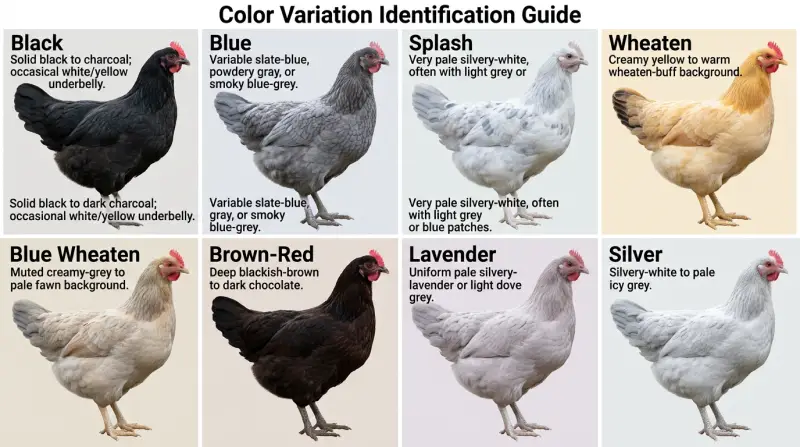
Identification Ameraucana Chick Color Chart
- True Ameraucana chicks display slate-blue or dark legs, pea combs, and well-developed muffs and beards from an early age.
- Chipping and striping patterns on chipmunk-backed varieties (like Wheaten and Brown-Red) provide the primary visual map for early identification.
- Lavender Ameraucana chicks hatch in a uniform pale silvery-gray, lacking the bold dorsal stripes seen in wild-type varieties.
- Blue, Black, and Splash varieties often interbreed or hatch together within a single blue pen, requiring careful observation of down shade and leg tint.
- Easter Eggers are frequently mislabeled as Ameraucanas; yellow skin, willow legs, or single combs are immediate disqualifiers for pure Ameraucanas.
The Genetic Basis of Ameraucana Chick Down Patterns
Avian color genetics dictate that the down feathers of a day-old chick rarely match its adult plumage. Instead, down patterns serve as evolutionary camouflage or a visible manifestation of complex underlying pigment loci. In Ameraucanas, these patterns are strictly governed by standard breeding requirements established to preserve specific plumage types. The wild-type pattern, characterized by dark head spots, distinct back stripes, and lighter underparts, forms the blueprint for varieties like the Wheaten, Blue Wheaten, and Brown-Red.
When evaluating a chick, one must examine three primary color components: eumelanin (black/brown pigment), phaeomelanin (red/yellow pigment), and the absence or presence of dilution genes. For example, the lavender gene ($lav$) is an autosomal recessive mutation that dilutes black down to a soft, even slate-gray and red down to a pale straw color. Recognizing how these genetic expressions manifest in down feathers prevents common misidentifications during the critical brooder phase.
Recognized Ameraucana Varieties and Their Chick Signatures
The American Poultry Association recognizes eight distinct Ameraucana standard varieties: Black, Blue, Blue Wheaten, Brown-Red, Buff, Lavender, Silver, and Wheaten. Splash is also widely bred and accepted by specialty clubs as a natural derivative of the blue gene. Each variety presents unique visual markers in the hatchling stage.
| Variety | Primary Down Color / Pattern | Head & Back Markings | Leg Color (Day-Old to 2 Weeks) | Key Distinguishing Feature |
|---|---|---|---|---|
| Black | Solid black to dark charcoal; occasional white/yellow underbelly. | None; uniform dark coloration. | Dark slate to near black. | Dark beak and complete lack of dorsal striping. |
| Blue | Variable slate-blue, powdery gray, or smoky blue-grey. | Faint or absent darker blue dorsal shading. | Slate-blue. | Lighter grey down compared to solid black chicks; beak shows dark shading. |
| Splash | Very pale silvery-white, often with light grey or blue patches. | Scattered pale grey smudges. | Light slate to willow-tinted slate. | Extremely light overall down; looks almost white with subtle smoky tones. |
| Wheaten | Creamy yellow to warm wheaten-buff background. | Distinct dark brown head spot and a distinct single or broad brown back stripe (“chipmunk” pattern). | Medium slate-blue. | Warm golden tones with sharp chipmunk striping down the spine. |
| Blue Wheaten | Muted creamy-grey to pale fawn background. | Soft greyish-brown head spot and muted dorsal stripes. | Slate-blue. | Noticeably cooler, greyer undertones compared to standard Wheaten chicks. |
| Brown-Red | Deep blackish-brown to dark chocolate. | Faint or darker chocolate dorsal lines; sharp contrast against lighter throat/chest. | Very dark slate to black. | Darker and sharper contrast than Black chicks, with warm throat fuzz. |
| Lavender | Uniform pale silvery-lavender or light dove grey. | None; completely solid pale grey. | Medium slate-grey. | Complete absence of black pigment or dorsal stripes; uniform pastel grey. |
| Silver | Silvery-white to pale icy grey. | Clear, dark charcoal-black dorsal striping on a silvery background. | Dark slate. | Striking high-contrast black-and-silver chipmunk pattern. |
This reference matrix highlights how breeders categorize neonates before feathering begins. While solid-colored varieties like Black and Lavender are easily told apart by shade density, the patterned varieties (Wheaten, Silver, Brown-Red) rely heavily on head spots and dorsal striping intensity.
Detailed Breakdown of Wheaten and Blue Wheaten Chick Identification
Wheaten and Blue Wheaten Ameraucanas are among the most popular varieties due to their striking adult appearance and excellent egg production. However, identifying them as chicks requires a keen eye because they share the classic “chipmunk” pattern common in many egg-laying breeds.
Standard Wheaten chicks hatch out in shades of warm cream and golden tan. They feature a distinct dark brown or reddish-brown spot on top of the head and a clear, unbroken brown stripe running down the center of the back. As they feather out over the first four weeks, the baby down is pushed out by rich buff, wheaten, and golden-brown juvenile feathers in pullets, and darker, striking black-breasted red plumage in cockerels.
Blue Wheaten chicks mirror this exact chipmunk architecture, but the pigment palette is shifted by the blue dilution gene ($Bl$). Instead of warm golden creams and rich browns, Blue Wheaten neonates display cooler, muted tones: pale greyish-cream backgrounds paired with soft slate-grey head spots and dorsal stripes. Distinguishing between a standard Wheaten and a Blue Wheaten at hatch requires placing them side by side under natural light to compare the warmth of the yellow-gold down against the cooler, smokier grey tones.
Navigating the Blue, Black, and Splash Complex
Breeding blue-feathered poultry involves managing a heterozygous genetic combination ($Blbl$). When two Blue Ameraucanas mate, the resulting offspring statistically yield 50% Blue, 25% Black, and 25% Splash chicks. Consequently, hatchery boxes containing blue-variety orders frequently include a mix of all three shades.
Identifying these three cohorts at the chick stage is a valuable skill:
- Black Chicks: Hatch with deep, rich black down. Their beaks and legs are exceptionally dark slate. Any white on the underbelly is generally discouraged in strict breeding circles, though minor down leakage can occur.
- Blue Chicks: Hatch in varying shades of slate-blue, ranging from pale powdery grey to deep charcoal-blue. They often exhibit a smokey haze across the back. Their leg color is clean slate-blue.
- Splash Chicks: Hatch with very pale, almost white down, frequently marked with faint grey or blue smudges, particularly around the head and rump. Their legs are lighter slate, sometimes showing a slight willow or pinkish cast that darkens with age.
The Distinctive Lavender and Silver Markers
Lavender is a single-locus recessive trait that affects all black pigment in the bird. Because lavender chicks lack black melanin expression, they completely bypass the chipmunk striping seen in wild-type breeds or the dark solid down of black chicks.
A true Lavender Ameraucana chick hatches with a remarkably uniform, soft, silvery-lavender down. There are no head spots, no back stripes, and no shading variations. If a chick labeled as a Lavender Ameraucana exhibits dark dorsal stripes, it is either an incorrect cross, an Easter Egger, or a different variety entirely. Leg color in lavender chicks starts as a medium slate-grey and deepens slightly as the bird matures.
Silver Ameraucanas, by contrast, present a dramatic high-contrast appearance. Their down is bright silvery-white, accented by sharp, well-defined jet-black dorsal stripes. This stark contrast makes Silver and Silver-derived chicks some of the easiest to spot in a mixed brooder, provided they possess the correct pea combs and heavy facial muffing.
Physical Markers Beyond Color: Confirming True Ameraucanas
Color charts and down patterns provide the first line of identification, but structural anatomy must corroborate color findings to ensure purebred status. Mislabeling is widespread in the poultry industry, with hatcheries frequently selling generic Easter Eggers under the Ameraucana trade name.
Comb Morphology
True Ameraucanas must possess a distinct pea comb. A pea comb is low-profile, featuring three distinct linear rows of small bumps or ridges, with the center row slightly higher than the outer rows. Any chick exhibiting a single, tall, serrated blade comb or a rose comb is not a pure Ameraucana.
Facial Furnishings
Muffs and beards are genetic signatures of the breed. Day-old Ameraucana chicks exhibit noticeable fullness around the cheeks and under the beak, caused by tufted down development. The side whiskers and beard should be prominent even at 24 to 48 hours post-hatch.
Leg and Skin Color
Ameraucanas possess white skin underneath their feathers and slate-blue or dark legs. Any chick showing yellow skin, yellow shanks, white shanks, or pale pink legs without slate undertones is an Easter Egger or an admixture.
Common Identification Mistakes and Pitfalls
Even experienced chicken keepers can misidentify Ameraucana chicks if they rely solely on superficial traits or fail to account for developmental changes.
The Easter Egger Imposter Trap: The most common error is assuming any chick with a chipmunk back and muffs is an Ameraucana. Easter Eggers display extreme phenotypic variation, hatching in every conceivable color combination with various comb types and leg colors (including green, yellow, and white). Only birds conforming strictly to the APA standard varieties with slate legs and pea combs qualify.
Premature Down Judging: Chick down is notoriously deceptive. A chick that hatches with a muddy greyish-brown down can feather out into a striking Blue Wheaten or Brown-Red adult, while minor variations in shade density during the first week often balance out once juvenile feathering replaces the chick fuzz.
Misinterpreting Leg Color Evolution: Day-old chicks often have lighter leg pigmentation than mature birds. A slate-blue leg on a neonate can appear somewhat grey or dull; however, if the legs display bright yellow or pinkish tones by week two, pigment mutation or crossbreeding has occurred.
Frequently Asked Questions
True Ameraucana chicks belong to standardized color varieties and possess slate-blue legs, pea combs, and distinct muffs and beards. Easter Eggers show immense variation in chick down, frequently have single combs instead of pea combs, and may exhibit yellow skin, yellow shanks, or green/willow leg coloration.
Yes. Chick down serves only as an initial pigment placeholder. As the chick drops its down and develops juvenile and adult plumage between weeks 3 and 12, the colors and patterns transform significantly, though the underlying genetic variety remains constant.
In certain varieties like Wheaten and Blue Wheaten, a degree of sex-linking or shade dimorphism can sometimes be observed by experienced breeders—such as darker head spots or deeper rust tones in cockerels versus lighter, cleaner wheaten tones in pullets. However, color-based sexing is not 100% reliable in Ameraucanas, and vent sexing or waiting for feather/comb development is recommended for absolute accuracy.
The blue gene ($Bl$) is a dilution factor that does not breed true. When breeding Blue to Blue, genetics dictate that you will hatch roughly 50% Blue chicks, 25% Black chicks, and 25% Splash chicks. Therefore, variation within a blue breeding pen is completely normal and expected.
Lavender Ameraucana chicks should feature medium slate-grey legs. Because lavender is a recessive dilution gene affecting black pigment, the leg color is softer and lighter than that of a solid Black Ameraucana chick, but it must never show yellow, white, or flesh-colored tones.
Accurate identification of Ameraucana chicks requires patience, observation, and a solid grasp of both genetic color charts and structural breed standards. By examining down patterns, head markings, leg pigmentation, and comb development during the first weeks of life, poultry keepers can confidently verify their flock and appreciate the rich diversity of this remarkable blue-egg laying breed.