
Numismatics rests entirely on the details. Two coins bearing the exact same date and denomination can carry vastly different valuations solely because one was struck in Philadelphia while the other emerged from San Francisco, Denver, Carson City, or West Point. Understanding these nuances requires more than a casual glance; it demands a structured, methodical approach to reading the microscopic markers left behind by industrial coin production. Across centuries of coinage, mint facilities have utilized distinct lettering styles, positioning quirks, and unique design accents that serve as definitive fingerprints for attribution.
(Reference: Print Materials – MINT: Sources of Economic Information – Research Guides at Library of Congress)This guide serves as an authoritative master reference for numismatic mint identification. It explores the historical evolution of mint marks, analyzes the mechanics of modern and historic minting facilities, provides structured classification breakdowns, details practical authentication workflows, and tackles the common pitfalls that trip up both novice collectors and seasoned specialists.
Explore our detailed breakdown on Types Of Honey Bees (Complete Field Identification).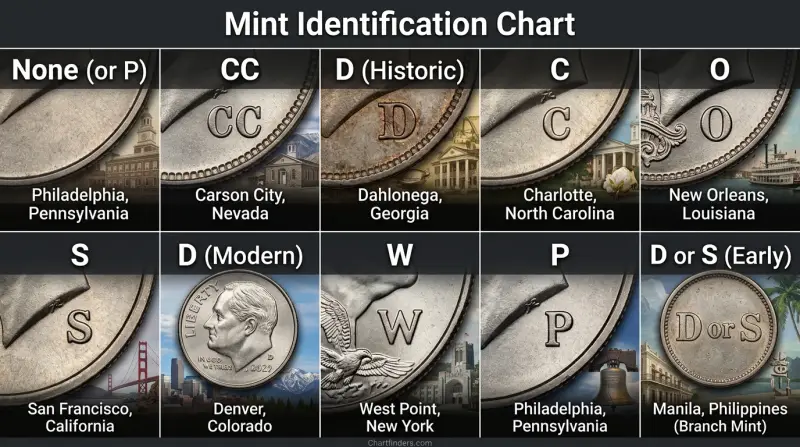
Mint Identification Chart
- Mint marks indicate the specific facility where a coin was manufactured, directly influencing its rarity, collector demand, and market value.
- Historic United States mints include branch facilities such as Carson City (CC), Dahlonega (D), Charlotte (C), New Orleans (O), San Francisco (S), Denver (D), and West Point (W), alongside Philadelphia, which historically used no mint mark for many series.
- Modern US commemorative and circulating programs frequently incorporate unique privy marks or experimental mint designations that require specialized reference charts.
- Accurate identification requires proper magnification (5x to 10x loupes), correct lighting angles, and an understanding of punch positions, repunched mint marks (RPMs), and over-mint marks (OMMs).
- Distinguishing between genuine mint marks and alterations or counterfeits demands close examination of serif shapes, font proportions, and surrounding field characteristics.
A comprehensive mint identification chart organizes coinage by denomination, series, year span, and mint mark location. Because minting technology, punch application methods, and facility operations shifted dramatically over the centuries, a singular chart cannot capture every nuance without contextual breakdown. Below is a foundational master reference table summarizing key United States mint marks, their operational periods, primary historical facility associations, and traditional placement zones.
| Mint Mark | Facility Location | Active Operating Years | Primary Coin Series Associated | Typical Location on Coin |
|---|---|---|---|---|
| None (or P) | Philadelphia, Pennsylvania | 1793–Present | All denominations (historically no mark; ‘P’ used on modern coinage and war nickels) | Reverse (historic) or Obverse (modern, near date) |
| CC | Carson City, Nevada | 1870–1893 | Morgan dollars, Seated Liberty coinage, Liberty Head gold series | Reverse, typically below wreath or denomination |
| D (Historic) | Dahlonega, Georgia | 1838–1861 | Gold dollar, quarter eagle ($2.50), half eagle ($5) | Reverse, within wreath or below denomination |
| C | Charlotte, North Carolina | 1838–1861 | Gold dollar, quarter eagle, half eagle | Reverse, near wreath or base |
| O | New Orleans, Louisiana | 1838–1909 (with interruptions) | Seated Liberty series, Morgan dollars, half dollars, dimes | Reverse, below eagle, wreath, or denomination |
| S | San Francisco, California | 1854–Present | Gold double eagles, Morgan dollars, modern proofs, commemorative issues | Reverse (historic) or Obverse/Reverse (modern) |
| D (Modern) | Denver, Colorado | 1906–Present | Lincoln cents, Roosevelt dimes, Washington quarters, modern circulating/bullion | Reverse (historic) or Obverse (near date on modern issues) |
| W | West Point, New York | 1973–Present (mint mark since 1983) | American Eagle bullion, commemorative issues, circulating quarters (2019-2020, 2026) | Obverse (near date) or Reverse (commemoratives/bullion) |
| P | Philadelphia, Pennsylvania | 1942–1945, 1980–Present | War nickels (1942-45), modern circulating coinage, bullion | Reverse (above dome on war nickels) or Obverse (near date on modern) |
| D or S (Early) | Manila, Philippines (Branch Mint) | 1920–1922, 1925–1941 | US-Philippine coinage (Pesos, Centavos) | Reverse, near bottom rim or denomination |
When analyzing this reference data, collectors must recognize that mint mark positioning is rarely uniform across all denominations within a single era. For instance, while Morgan silver dollars place the ‘CC’, ‘S’, ‘O’, or ‘D’ mint mark clearly on the reverse below the bow of the laurel wreath, twentieth-century circulating coinage shifted toward obverse placement near the date to improve striking consistency and visibility.
Historical Evolution of Mint Marks in the United States
The practice of marking coins with facility identifiers dates back to antiquity, but in the United States, it evolved alongside the expansion of the federal mint system. Established by the Coinage Act of 1792, the Philadelphia Mint was the sole producer of United States coinage for decades. Because all coins originated from a single location, mint marks were unnecessary.
As westward expansion and the discovery of gold necessitated regional production facilities, the federal government authorized branch mints in the late 1830s. Charlotte and Dahlonega were established specifically to process southern gold ores, while New Orleans served as a commercial shipping and bullion hub. These branch facilities required a reliable method of quality control and accountability, leading to the standardized application of letter stamps directly onto the working dies.
Hand-Punched Dies vs. Modern Integrated Mint Marks
One of the most critical concepts for any mint identification chart user is understanding how mint marks were applied historically versus how they are handled today.
- The Hand-Punch Era (Pre-1990s): For the majority of US minting history, working dies were manufactured at the Philadelphia central facility and shipped to branch mints. Each branch mint technician manually punched the appropriate letter (e.g., ‘S’ or ‘D’) into the blank die using a steel punch and a hammer. Because this process was entirely manual, human error resulted in wide variations in mint mark angle, depth, horizontal displacement, and vertical alignment. This era gave rise to major collectible varieties such as Repunched Mint Marks (RPMs) and High/Low mint mark positions.
- The Integrated Hub Era (Post-1990s): With advancements in computer-aided design (CAD), laser engraving, and master hub production, mint marks are now sculpted directly into the master hubs or working dies at the design stage. Consequently, modern circulating coins exhibit virtually zero variation in mint mark placement, eliminating traditional RPM varieties while setting a strict baseline for authenticity.
Branch Mint Specifics and Diagnostic Markers
Different mint facilities utilized distinct punch tools, leading to unique visual signatures that can help identify worn or altered coins.
Carson City (CC) Varieties
The Carson City mint mark underwent several distinct style changes. Early CC marks (1870–1873) tend to be smaller, thicker, and closely spaced, while later nineteenth-century issues feature taller, more widely separated letters. On Morgan dollars, the ‘CC’ mark is a primary driver of numismatic value, making authentication of the punch style .
New Orleans (O) Varieties
New Orleans mint marks are frequently described as “blobby” or misshapen due to heavy die wear, grease-filled dies, and over-polished working surfaces. An O-mint mark on a Morgan dollar or Seated Liberty half dollar will often appear tilted or slightly filled in the loops.
Dahlonega (D) and Charlotte (C) Gold
Because these southern branch facilities struck exclusively gold coinage (dollars, $2.50 quarter eagles, and $5 half eagles) prior to closing at the outbreak of the Civil War, their mint marks are exceptionally scarce. The ‘D’ used for Dahlonega is distinctly smaller and thicker than the modern Denver ‘D’, a critical distinction when examining fractional gold pieces.
Advanced Identification: RPMs, OMMs, and Privy Marks
Beyond standard single-letter identification, advanced numismatists utilize specialized terminology to categorize die anomalies and modern special-edition markers.
- Repunched Mint Mark (RPM): Occurs when the mint mark punch struck the working die multiple times before sinking was complete, resulting in overlapping, doubled, or tripled letters beneath the primary mint mark. Collectors classify these by direction (e.g., North, South, East, West, or Tilted).
- Over-Mint Mark (OMM): A rare occurrence where a die intended for one branch mint was repurposed for another by punching a new letter directly over an existing, partially erased one (most famously seen in 20th-century mercury dimes and early gold series).
- Privy Marks: Small symbols, geometric shapes, or commemorative initials stamped onto coins alongside or instead of traditional mint marks. Modern programs, such as the 2026 semiquincentennial quarter series and special collector bullion releases, frequently employ unique privy marks to honor historical coin designs or special anniversaries.
Practical Step-by-Step Mint Identification Methodology
Properly identifying a coin’s mint origin requires a disciplined physical workflow to prevent misattribution and surface damage.
- Secure Proper Illumination and Magnification: Position the coin under balanced, angled LED lighting to reveal relief shadows. Use a 5x to 10x numismatic loupe. Avoid direct, flat overhead lighting, which washes out the shallow relief of stamped mint marks.
- Locate the Designated Zone: Consult a modern or historic mint chart to identify where the specific series places its mint mark. Check both obverse and reverse fields, borders, and interior wreath spaces.
- Examine Font Characteristics: Compare the serifs, loops, and interior spacing of the letter against verified authentic exemplars. Check for casting seams, bubbles, or soft letter edges that suggest a counterfeit.
- Cross-Reference with Date and Variety Guides: Match the observed mint mark position and die markers (such as die cracks, clashes, or doubling) with standard numismatic references to confirm complete attribution.
Common Mistakes and Identification Pitfalls
Even experienced collectors occasionally fall victim to visual illusions and fraudulent alterations. Recognizing common pitfalls saves time and protects capital.
- Assuming Philadelphia Never Used a Mark: While historic Philadelphia issues lacked a mint mark (except for 1942–1945 War Nickels), modern Philadelphia issues utilize a prominent ‘P’ on circulating and commemorative coinage. Failing to check for a modern ‘P’ leads to misattributed mintages.
- Confusing Die Chips with Mint Marks: Raised metallic flaws caused by broken die steel can mimic small letters or dots near the date or design elements. Always verify that a purported mint mark exhibits proper typographic proportions rather than irregular blob shapes.
- Altered Mint Marks: Unscrupulous individuals have historically carved, soldered, or glued genuine mint marks onto common Philadelphia-issue coins (such as converting a common 1909 Philadelphia Lincoln cent into a rare 1909-S or 1909-S VDB). High-magnification examination of the surrounding metal flow lines is essential to detect tooling or added metal.
Frequently Asked Questions
Coins produced at the Philadelphia Mint throughout most of the 19th and 20th centuries traditionally bore no mint mark as the primary facility identifier. Additionally, certain modern circulating issues or experimental trial pieces may lack mint marks due to legislative specifications or production changes.
The Dahlonega mint (‘D’) operated exclusively between 1838 and 1861 and struck only gold coins. The Denver mint (‘D’) began operations in 1906. , the font style of the Dahlonega mint mark is noticeably smaller, chunkier, and less refined than the standard modern Denver block ‘D’.
An RPM occurs when the mint technician struck the die punch more than once, creating a doubled or shadowed effect. Depending on the prominence of the doubling and the specific coin series, verified RPMs can significantly increase a coin’s collector value and demand.
No. While nineteenth-century coins predominantly placed mint marks on the reverse (such as on the ribbon of Morgan dollars or inside the wreath of Seated Liberty coins), the US Mint transitioned most circulating coin mint marks to the obverse (front) near the date starting in the late twentieth century.
Authentication requires high-magnification (10x+) inspection of the metal surrounding the mint mark. Look for tool marks, disturbed metal flow lines, discoloration from solder, or inconsistencies in the letter’s font and height compared to certified authentic specimens.
Mastering mint identification transforms coin collecting from a passive hobby into an analytical science. By combining structured reference charts, rigorous magnification habits, and an understanding of historic minting operations, collectors can confidently attribute specimens, uncover hidden varieties, and safeguard their collections against counterfeits.