
Quick Answer: Moth caterpillar identification relies on systematic evaluation of morphological traits—including body hair (setae), proleg patterns, head capsule markings, coloration, and feeding behavior. Unlike butterfly caterpillars, which often feature smooth bodies and chrysalis pupation, many moth caterpillars spin silken cocoons, burrow underground, or possess stinging urticating hairs, making accurate identification essential for both garden management and personal safety.
(Reference: The NHBS Guide to UK Caterpillar Identification)Identifying moth caterpillars requires a careful blend of entomological knowledge and keen observation. While butterflies often steal the spotlight with their vibrant adult forms and familiar chrysalises, the larval stage of the order Lepidoptera is overwhelmingly dominated by moths. North America alone hosts thousands of distinct moth species, each adapted to specific host plants, microclimates, and seasonal cycles. Field researchers, gardeners, and nature enthusiasts frequently encounter these larvae as they forage, molt, or seek pupation sites, particularly during peak seasonal windows such as the early-season emergence of the Lettered Sphinx or the late-summer surge of woolly bears.
Explore our detailed breakdown on Types Of Elephants Identification Chart.However, distinguishing among these diverse caterpillars can be notoriously tricky. Many species exhibit color polymorphisms, meaning an individual caterpillar can change its hue across different instars (growth stages), while others mimic twigs, bird droppings, or toxic vegetation to evade predation. Relying solely on color or a single snapshot often leads to misidentification. A reliable identification chart breaks down these complex biological organisms into observable structural features, structural groupings, and behavioral cues. This guide provides a comprehensive framework to help you navigate North American moth caterpillar families, decode their unique physical attributes, and safely interpret what you find in the field.
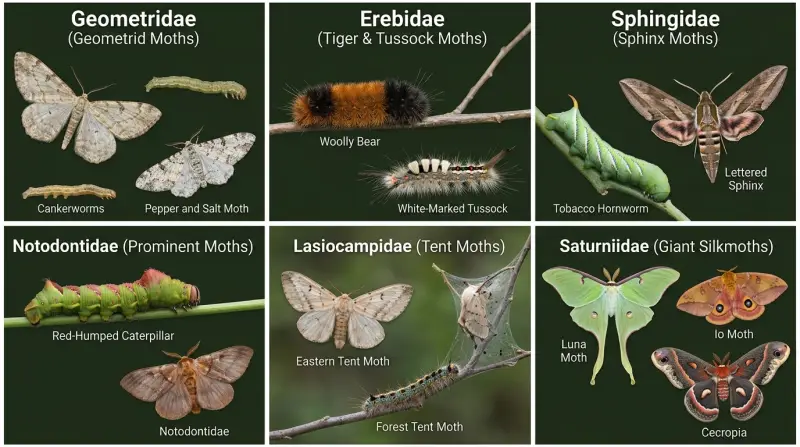
Understanding the Moth Caterpillar Identification Chart Framework
- Moth caterpillars possess distinct anatomical markers, such as specific proleg counts and head capsule patterns, separating them from sawfly larvae and other look-alikes.
- Body modifications—including smooth cylindrical forms, hairy tufts, fleshy tubercles, and caudal horns—provide the foundation for family-level identification.
- Stinging caterpillars (like the Puss Caterpillar or Io Moth) feature specialized hollow setae connected to venom glands that demand careful handling.
- Seasonal timing and host plant specificity narrow down candidates significantly when navigating broad regional species lists.
- Using a structured morphological chart prevents common misidentifications caused by color changes between caterpillar instars.
Effective caterpillar identification begins with a structured approach. An identification chart is not merely a picture book; it is a diagnostic tool designed to narrow down candidates by systematically eliminating unlikely families. When observing a caterpillar in the field, you must look past its general color and focus on hard anatomical markers: the number and placement of prolegs, the presence of structural modifications on the posterior segments, the texture of the integument (skin), and the presence or absence of urticating hairs.
, understanding the biological differences between moth caterpillars and other insect larvae prevents wasted effort. For instance, sawfly larvae (order Hymenoptera) look remarkably like caterpillars but can be distinguished by having six or more pairs of abdominal prolegs without tiny gripping hooks (crochets), whereas true Lepidoptera caterpillars possess five or fewer pairs of prolegs equipped with crochets. By establishing these baseline rules, field observers can immediately isolate moth larvae and apply targeted identification criteria.
Anatomical Foundations of Moth Larvae
Every moth caterpillar shares a standardized insect body plan divided into three distinct functional regions: the head, thorax, and abdomen.
- The Head Capsule: Heavily sclerotized (hardened), containing mouthparts adapted for chewing foliage. The shape, color markings (such as inverted “V” shapes on tent caterpillars), and presence of secondary ocelli (simple eyes) are vital diagnostic clues.
- Thoracic Segments: Three segments immediately behind the head, each bearing a pair of true, jointed legs. These are retained when the insect transforms into an adult moth.
- Abdominal Segments: Ten distinct segments following the thorax. Segments 3 through 6 and segment 10 typically bear fleshy, unjointed prolegs equipped with tiny hooks called crochets that allow the caterpillar to grip surfaces securely.
Key Morphological Groups
To use an identification chart efficiently, caterpillars are typically sorted into broad morphological groups based on their overall physical build. Recognizing these groups allows you to jump straight to the correct family rather than scanning every known species:
- Loopers and Measuring Worms (Geometridae): Characterized by the absence of prolegs on abdominal segments 3 and 4, forcing them to loop their bodies as they crawl.
- Tussocks and Tiger Moths (Erebidae): Frequently covered in dense tufts of hair, verrucae (wart-like growths), or long pencils of setae designed to deter predators.
- Sphinx / Hornworms (Sphingidae): Large, robust caterpillars featuring a prominent posterior “horn” on the eighth abdominal segment and smooth, granulated skin.
- Tent and Leafroller Moths (Lasiocampidae, Tortricidae): Often social web-spinners or leaf-tiers that feed inside protective silken shelters on deciduous trees.
- Prominents (Notodontidae): Known for bizarre body shapes, swollen thoracic segments, or the ability to raise their tail and head simultaneously when threatened.
| Moth Family | Common Examples | Key Identification Features | Typical Host Plants / Habitats |
|---|---|---|---|
| Geometridae (Geometrid Moths) | Cankerworms, Pepper and Salt Moth | Reduced prolegs (only 2 pairs on abdomen); loops body when walking; twig mimics. | Deciduous trees, shrubs, herbaceous garden plants. |
| Erebidae (Tiger & Tussock Moths) | Woolly Bear, White-Marked Tussock | Dense setae (hairs), distinct tufts or pencils, bright warning coloration (aposematic). | Broadleaf trees, grasses, low-growing herbaceous weeds. |
| Sphingidae (Sphinx Moths) | Tobacco Hornworm, Lettered Sphinx | Large size, smooth or granulated skin, distinct posterior caudal horn on segment 8. | Solanaceous crops, woody vines, forest trees. |
| Notodontidae (Prominent Moths) | Red-Humped Caterpillar, Datana | Swollen segments, lack of dense hair, defensive postures, often feed in groups. | Fruit trees, oaks, maples, birch. |
| Lasiocampidae (Tent Moths) | Eastern Tent Moth, Forest Tent Moth | Hairy bodies with colorful lateral stripes; construct communal silken tents. | Rosaceous fruit trees (apple, cherry), oaks, aspens. |
| Saturniidae (Giant Silkmoths) | Luna Moth, Io Moth, Cecropia | Large, bulky bodies, fleshy tubercles or spines (sometimes venomous), colors. | Hardwood forests, shade trees, fruit orchards. |
The table above serves as a primary reference grid. When evaluating an unknown caterpillar, match its primary locomotion style and bodily appendages against these family traits to narrow your search parameters instantly.
Decoding Physical Markers: Setae, Spines, and Horns
The external texture of a moth caterpillar is its primary defense mechanism, and consequently, its most reliable identification marker. While some larvae rely on camouflage (cryptpsis), many advertise their presence with striking modifications.
Hair Types and Defense Functions
Not all “hairy” caterpillars are created equal. Entomologists categorize caterpillar hairs into distinct structural types:
- Standard Setae: Fine, flexible hairs that provide tactile sensation or minor thermal insulation. Most tiger moth caterpillars fall into this category.
- Verrucae and Tubercles: Raised bumps or fleshy projections from which clusters of setae radiate. These are common in the Erebidae and Saturniidae families.
- Urticating Hairs: Hollow, venom-injecting spines or hairs connected to sub-dermal poison glands. When touched, the tips break off, releasing a chemical irritant that causes immediate burning, swelling, or blistering in humans. Classic examples include the Saddleback Caterpillar and the Puss Caterpillar.
Appendages and Posterior Markers
Beyond hair, many moth larvae feature specialized physical appendages:
- Caudal Horns: Found almost exclusively in the Sphingidae (sphinx moth) family, these stiff, horn-like projections sit on the dorsal surface of the eighth abdominal segment. Despite their intimidating appearance, they are entirely harmless and cannot sting.
- Anal Claspers: The terminal prolegs on the tenth segment. In some species, these are modified into whip-like filaments or defensive flagella that the caterpillar can lash about when disturbed.
- Anal Forks: Specialized structures used by certain families to fling fecal pellets away from their feeding shelters to avoid detection by parasitic wasps.
Regional Distribution and Seasonal Emergence Patterns
Geographical location and seasonal timing are vital filters when using an identification chart. A caterpillar common in the pine forests of the southeastern United States will rarely appear in an alpine meadow in the Pacific Northwest.
Regional Hotspots in North America
Certain states and provinces boast exceptionally diverse Lepidoptera populations due to overlapping climate zones and rich flora:
- Virginia & the Mid-Atlantic: High deciduous forest density supports massive populations of Lasiocampidae (tent caterpillars) and Saturniidae (giant silkmoths) during the spring and summer transition.
- Florida & the Deep South: Subtropical climates allow for extended breeding seasons, yielding unique tropical strays and high numbers of stinging slug caterpillars (Limacodidae).
- South Carolina & the Southeast: Dense pine flatwoods and mixed hardwood forests host specialized defoliators, including various dagger moths (Acronicta species) and bagworm moths (Psychidae).
Seasonal Chronology
Caterpillar appearance is tightly coupled with host plant phenology (bud burst, leaf expansion, and senescence). Spring emergence typically brings defoliators that feed on tender new foliage, such as the Eastern Tent Moth (Malacosoma americanum). Mid-summer sees a surge in sphinx moths and large silk moths as temperatures peak. By late summer and early autumn, woolly bears (Pyrrharctia isabella) and other generalist tiger moths wander extensively across lawns and trails in search of overwintering sites, making autumn the peak season for casual caterpillar sightings.
Step-by-Step Field Identification Protocol
When you encounter an unfamiliar caterpillar in the wild, working through a structured mental checklist ensures an accurate classification without risking physical harm.
- Assess Safety First: Look for bright warning colors (red, yellow, white contrast), bristly tufts, or fleshy branching spines. Do not touch any caterpillar until you have confirmed it is a non-venomous species.
- Observe Locomotion: Watch how the caterpillar moves. Does it arch its back into a loop (Geometridae)? Does it crawl with a smooth, continuous wave of its prolegs?
- Count the Prolegs: Gently examine the underside of the abdomen. Note whether prolegs are present on segments 3 and 4, or if they are restricted to the rear segments.
- Identify Host Plant Associations: What plant is the caterpillar eating or resting upon? Many species are monophagous (restricted to a single plant genus) or oligophagous (restricted to a specific plant family). Knowing the host plant instantly eliminates 90% of potential candidates.
- Examine Special Markings: Check for eye-spots on the thoracic segments, distinctive dorsal stripes, caudal horns, or hair pencils. Match these details against regional photographic guides or verified databases.
Common Identification Mistakes and Pitfalls
Even experienced field naturalists occasionally misidentify moth larvae due to biological variables that complicate standard identification charts.
The Instar Coloration Trap
A frequent error is assuming a caterpillar retains the same color pattern throughout its life. Lepidoptera larvae undergo multiple molts as they growth, shedding their exoskeleton several times. A first-instar caterpillar often looks entirely different from a final-instar (mature) caterpillar of the same species. For example, some swallowtail and sphinx moth larvae shift from bird-dropping mimicry in early stages to bright green or brown leaf-camouflage in later stages.
Confusing Moth and Butterfly Larvae
While both belong to the order Lepidoptera, distinguishing between butterfly and moth caterpillars can be challenging. Butterfly caterpillars (such as Nymphalidae and Papilionidae) rarely spin silken cocoons—instead pupating into naked chrysalises—and tend to have smoother bodies or simple fleshy tubercles rather than dense urticating hairs or social tent-building behaviors. However, exceptions exist in both groups, making proleg structure and pupation method the most reliable separator.
Overlooking Parasitic Interference
Sometimes a caterpillar’s appearance is radically altered by nature itself. Parasitic braconid wasps frequently lay eggs inside moth caterpillars. When the wasp larvae emerge, they spin small, white, silken cocoons all over the outside of the host’s body. An observer might mistake the parasitized caterpillar for an exotic hairy species when it is actually a common host carrying wasp pupae.
Frequently Asked Questions
Venomous caterpillars in North America typically feature specialized urticating hairs, sharp branching spines, or vibrant aposematic (warning) coloration. If a caterpillar looks fuzzy, bristly, spiny, or brightly colored with contrasting red, yellow, or black patterns, treat it as potentially venomous and avoid direct skin contact. Smooth green or brown caterpillars with caudal horns (like tomato hornworms) are entirely non-venomous.
Discrepancies usually stem from developmental changes (instars) or regional variations. A caterpillar photographed in a field guide may be in its final growth stage, whereas the specimen in your garden is only halfway through its development. Additionally, color variations within the same species are common due to genetic diversity and environmental temperature cues.
No. While many moth families spin silk cocoons incorporating shed hairs, leaves, or debris (such as Saturniidae and Lasiocampidae), others do not. Many cutworms and sphinx moths burrow directly into the soil and pupate underground within an earthen cell without any silken cocoon structure.
Hornworms belong to the family Sphingidae (sphinx moths) and are easily distinguished by their large size, smooth or finely granulated skin, and the distinct stiff horn protruding from their posterior end. Most other common garden caterpillars lack this horn and belong to families like Noctuidae (cutworms and armyworms) or Erebidae.
If the host plant is unknown, rely entirely on structural morphology: check proleg counts, locomotion style (looping vs. crawling), hair/spine distribution, and head capsule markings. Input these physical traits into a dichotomous key or a verified regional insect identification database to narrow down the possibilities.
Conclusion
Mastering moth caterpillar identification transforms a casual walk in the garden or forest into an engaging exercise in ecological literacy. By moving beyond unreliable color cues and focusing on structural foundations—such as proleg counts, setae distribution, head capsule patterns, and seasonal timing—observers can reliably navigate the rich diversity of North American Lepidoptera. Whether you are managing garden pests, protecting beneficial pollinators, or simply documenting local biodiversity, a systematic approach ensures accurate classification every time.